At 7:40 on a Saturday morning, a rifle shot cracked across the corner of our pasture.
I knew before I got to the window.
Domino was lying beside the fence line.
He was on our side. He had never crossed onto anyone’s land.
Our daughter Kinley had raised him from a newborn bottle calf. For eight weeks straight that autumn she’d been out of bed at five every morning to feed him before the school bus came. She talked to him. She brushed him. She’d named him for the white patch on his forehead that looked like a domino.
We’d always known what he was for. Farm kids know. He was going to the locker in two weeks, and he was going to feed our family through the winter. Kinley understood that. She’d made her peace with it.
She had not made her peace with this.
Across the fence, my brother-in-law Vern stood at the edge of his cornrows with a rifle in his hands.
“That steer was in my corn again,” he said.
Again. Domino had never once been in his corn.
I walked the fence right there in front of him. All four wires were tight. Every staple was still in the post, exactly where my husband Dale had hammered them in last spring.
“Then show me where he crossed, Vern.”
He didn’t answer. He turned around and walked back toward his house.
My hand was on my phone. I could have called the sheriff right then.
But Vern is Dale’s brother. Our fences touch. We’ll probably be looking at each other across that wire for another thirty years. If I called the sheriff, it would never be over. Not for us, not for Kinley, not for anyone on our road.
So I knelt down beside Domino and did what we were raised to do. I used my belt knife and bled him. On a farm you don’t waste an animal. Not ever. Not even this one.
Then I called Arnold Fogle, who runs the meat locker down the highway.
He was there within the hour. Before he did anything else, he walked over to the fence, took hold of the top wire, and plucked it like a guitar string. It hummed.
“Ain’t a loose spot on this whole line,” he said quietly.
Kinley saw his truck from the pasture and came running. I got to her first and pulled her in against me. She held it together all the way to the porch. Then she didn’t.
Dale was two hundred miles away, hauling corn for the co-op. He called Vern twice. Vern didn’t pick up either time.
Dale got home after dark and walked the fence himself with a flashlight. Every foot of it.
When he came back in, he said, “There’s no gap, Jill. Not one. He’s my brother. But Domino was yours. Whatever you decide, I’m with you.”
Domino came back from the locker as six hundred and forty pounds of dressed beef. About eighteen hundred dollars’ worth. Enough for our family for the winter and then some.
We kept what we needed.
The rest we split into six boxes. Ground beef, steaks, roasts in each one, wrapped in white butcher paper.
At the locker, Kinley sat on the tailgate of our pickup with a black marker and wrote Domino’s name on the bottom of every box. Six times. Slowly. In her best handwriting.
“I don’t want anybody to forget who he was,” she said.
I’ve been the mail carrier on our road for years. Five days a week. I know every family and nearly every porch.
That Saturday, I loaded the six boxes into the back of the pickup. Our own share went in behind them. And Kinley and I drove the route.
At every house I left a box and a handwritten note. Beef from Kinley’s steer, Domino. Please enjoy.
Marge Hansen came to her door and just raised her hand. She didn’t say a word. She didn’t need to.
Pete Larson met us by his machine shed.
“Seems like your steer went to the locker a couple weeks early,” he said.
“He did.”
Pete held the box against his chest. He didn’t ask where Domino had been standing when it happened. He didn’t have to. Everyone on our road had heard that shot.
Five houses. Then the last driveway.
Kinley stayed in the passenger seat.
“Make sure he sees Domino’s name, Mom,” she said.
Vern’s mailbox stands at the end of his lane. I’ve put mail in it for eleven years.
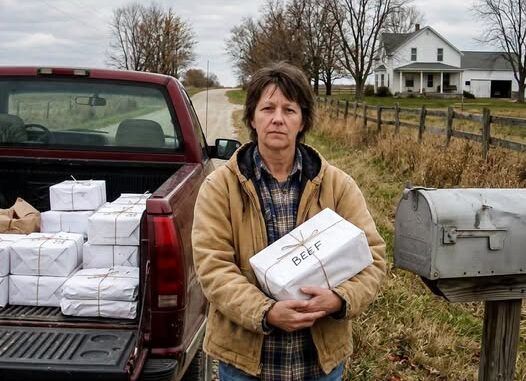
I pulled my dark red pickup up beside it and dropped the tailgate. Gray October clouds hung low. The ditch grass had gone brown. Our own farmhouse sat small and white in the distance across the fields.
I lifted Vern’s box and held it against my barn coat. I meant to walk it up to his porch, the same as everyone else’s.
Before I took a step, his front door opened.
Vern came down the lane slowly. He must have watched us stop at every house on the road.
He stopped about six feet away and looked at the box.
“What’s that?”
“Your share of the beef,” I said. “I was going to leave it on your porch.”
He reached out and took it from me. He turned it over in his hands.
And he saw the name Kinley had written on the bottom.
He read it for a long time. Longer than it takes to read one word.
Then he looked up at me. His eyes were wet.
“I knew it was hers,” he said. “I knew when I pulled the trigger.”
I didn’t say anything. I wanted to hear the rest.
“He never crossed,” Vern said. “He was standing by the fence. Just standing there, looking at me. Like he always did.”
He told me then. Standing at the end of his lane with a box of beef in his arms.
His wife, Carol, had left him in August. Packed up and moved to her sister’s in town. He hadn’t told anyone. Not even Dale.
He’d been sitting up at night. Not sleeping. Some nights drinking more than he should.
And that morning, he’d gone out at dawn and stood at the edge of his corn and looked across the fence at our place. Dale’s place. The bigger half of their father’s farm. The half with the good barn. The half with a wife in the kitchen and a kid in the pasture feeding a calf at five in the morning.
“I looked at that steer and I thought, Dale got everything,” he said. “Dad gave him the good ground. He got Jill. He got Kinley. And I got a cornfield and an empty house.”
He swallowed.
“So I took something. That’s all it was. I just wanted to take something.”
He held the box out to me.
“I can’t eat this, Jill.”
“Yes, you can,” I said. “You’re going to eat every package. That’s the point. You don’t waste an animal, Vern. Dad Miller taught you that too.”
He stood there with it for a long moment.
Then he looked past me, at the passenger window of the pickup, where Kinley was sitting very straight with her hands in her lap, watching him.
Vern walked over to the truck. He took off his cap. He waited until she rolled the window down.
“Kinley,” he said. “Domino didn’t do anything wrong. I did. I’m sorry. I’m so sorry, honey.”
She looked at him for a long time. She’s eleven, and she has her father’s way of looking at a person until they tell the truth.
“You have to tell Dad,” she said.
“I will.”
He did. That same night, Vern came up our lane on foot and knocked on our kitchen door. He and Dale sat on the porch until almost midnight. I heard Dale’s voice get loud once. Then I heard it go quiet. Then I heard two grown men crying, which I’ve only heard once before, at their father’s funeral.
Vern tried to give us eighteen hundred dollars the next week. Dale wouldn’t take it. They argued about it in the machine shed for twenty minutes and finally agreed it would go into Kinley’s 4-H account.
Pete Larson started inviting Vern to the Thursday coffee at the co-op. I suspect Marge Hansen had something to do with that. Nobody on our road said a word about the shot. They didn’t have to. They’d all eaten the beef.
In April, Vern’s pickup pulled into our yard with a trailer behind it.
In the trailer was a black heifer calf, four days old, from the spring sale. Vern had paid for her himself. He’d already bought the milk replacer and the bottles.
“She’s not for the locker,” he told Kinley. “She’s for keeping. If you want her.”
Kinley named her Dot.
Vern stops by most mornings now on his way to his field. He leans on the fence, the same fence, and watches Kinley feed her before the school bus comes.
Last week I saw him hand her a new brush over the top wire.
All four wires are still tight. Nobody has ever needed to cross them.
Leave a Reply