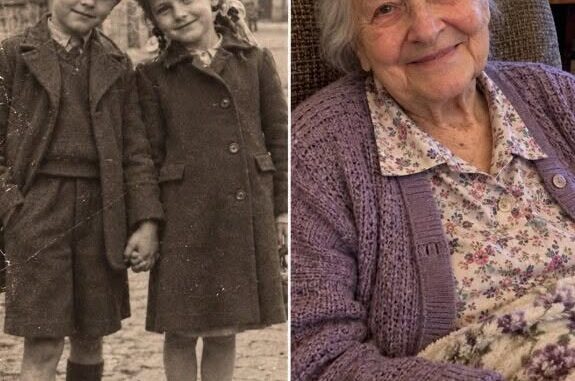
Some childhood memories remain with us long after the places and people connected to them have changed.
For me, one of those memories began on a quiet street in Warsaw, Poland, with a boy who lived next door.
His name was Stanislaw.
We were young, and our friendship was filled with ordinary childhood adventures. We walked to school together, played outside, and spent afternoons imagining what our lives might look like when we grew older.
One day, he made a promise that seemed amusing at the time.
He told me that we would get married someday.
I laughed and told him not to forget.
Neither of us could have imagined how dramatically our lives would change.
In 1939, my family left Poland as Europe entered a period of devastating conflict. I never saw Stanislaw again.
For decades, I assumed our childhood promise would remain nothing more than a memory.
Then, many years later, my granddaughter arrived home carrying a small package.
An elderly stranger had asked her to deliver it to me.
And he had included a message that brought my childhood rushing back.
Growing Up in Warsaw
My name is Zofia, although most people in America know me as Zoe.
I was born in Warsaw, where I spent my early childhood surrounded by familiar streets, neighborhood friends, and family traditions.
Our community was the center of my world.
I knew the houses along our street, the places where children gathered to play, and the neighbors who greeted one another each morning.
Life seemed predictable in the way childhood often does.
I went to school, helped my parents with small tasks, and spent time with friends.
Among those friends, Stanislaw was particularly important to me.
His family lived next door, which meant we saw each other almost every day.
We became close friends without ever thinking much about how our friendship began.
He was simply part of my everyday life.
The Boy Who Always Made Me Laugh
Stanislaw had a cheerful personality.
He enjoyed telling jokes and coming up with imaginative plans.
Sometimes he teased me, and I pretended to be annoyed.
But I usually ended up laughing.
We shared schoolbooks, walked through the neighborhood, and spent warm afternoons outdoors.
Like many children, we talked about what we wanted to do when we grew up.
Our plans changed constantly.
One week, we imagined traveling to distant places.
Another week, we discussed the kinds of homes we might have someday.
At that age, the future seemed far away.
We didn’t understand how quickly circumstances could change.
All we knew was that we enjoyed spending time together.
A Promise Made Between Two Children
I remember one particular afternoon more clearly than many others.
Stanislaw and I were spending time outside when he suddenly announced that he had made an important decision.
“When we’re older, I’m going to marry you,” he said.
I laughed.
He sounded completely certain.
I asked why he thought that would happen.
He simply replied that he had already decided.
I shook my head, amused by his confidence.
“All right,” I told him. “But you have to remember your promise.”
He smiled and agreed.
It was a lighthearted conversation between two children.
Neither of us treated it as a serious commitment.
We were too young to understand marriage or the many decisions that shape adult relationships.
But the exchange stayed in my memory.
Years later, I would remember his words with surprising clarity.
The Year Our Lives Changed
In 1939, the world around us began changing in ways I could barely understand.
Europe was entering a period of war and uncertainty.
Adults spoke more seriously.
My parents became increasingly concerned about our family’s safety.
I noticed their worried expressions and the conversations that stopped whenever I entered a room.
As a child, I didn’t understand every detail of what was happening.
I only knew that something important had changed.
Then my parents told me we would be leaving Poland.
We were going to America.
The decision was difficult, but they believed leaving would give our family a better chance of finding safety and stability.
Everything happened quickly from my perspective.
There were belongings to organize and travel arrangements to make.
I struggled to understand what leaving would mean.
I had never imagined living anywhere other than Warsaw.
Leaving Without a Proper Goodbye
One of the hardest parts of leaving was realizing that I might not see my friends again.
I wanted to say goodbye to Stanislaw.
I wanted to explain where we were going and ask whether we could stay in contact.
But our departure did not unfold the way I had imagined.
There was no final afternoon together.
No opportunity to sit outside and talk about our plans.
Our family left, and the familiar neighborhood became part of my past.
I remember looking back on the life we were leaving.
At the time, I assumed I would eventually learn what had happened to everyone.
I thought perhaps letters would arrive or that our families might find a way to reconnect.
But the years that followed were complicated.
The war changed countless lives.
Communication became difficult, and many families were separated.
I never received another message from Stanislaw.
Beginning Again in Chicago
Our journey eventually brought us to Chicago.
For my parents, arriving in America meant starting over.
They had to find work, establish a home, and learn how to navigate a different society.
Everything felt unfamiliar at first.
The streets looked different.
The language was different.
Even everyday routines required adjustment.
I began attending school and gradually made new friends.
My parents worked hard to help our family settle into our new surroundings.
I understood that we were fortunate to have reached a safer place.
But I also missed the home we had left behind.
I missed the familiar neighborhood.
I missed the people I had known since childhood.
And sometimes, I thought about Stanislaw.
From Zofia to Zoe
One of the smaller changes in my new life involved my name.
In Poland, everyone had called me Zofia.
It was the name my parents had chosen and the name I had heard throughout my childhood.
In America, people sometimes struggled to pronounce it.
Some began calling me Zoe.
At first, I found the change strange.
It felt as though a small part of my old life was being replaced.
But over time, I became comfortable with the shorter name.
Eventually, Zoe became the name most people used.
I never stopped thinking of myself as Zofia, though.
That name remained connected to my childhood, my family, and the country where I was born.
It also belonged to the girl Stanislaw had known.
I didn’t realize how important that detail would become many decades later.
Building a Life of My Own
As the years passed, Chicago gradually became home.
I finished school, made friendships, and developed interests that had little to do with my childhood in Warsaw.
I eventually met someone I loved.
We married and began building a family.
Our lives included ordinary responsibilities and memorable celebrations.
We raised children, worked through challenges, and created traditions of our own.
There were joyful years and difficult periods.
Like most families, we experienced changes that required patience and understanding.
Over time, our children grew older and began creating their own lives.
Eventually, I became a grandmother.
That new chapter brought me a great deal of happiness.
I enjoyed spending time with my grandchildren and hearing about their experiences.
Sometimes, their questions encouraged me to remember my own childhood.
Sharing Stories About Poland
My grandchildren knew that I had been born in Poland.
They were curious about what life had been like before I came to America.
I told them about Warsaw.
I described the neighborhood where I grew up, the school I attended, and the family traditions I remembered.
Some details were still vivid.
Others had become less clear with time.
I could remember certain streets and buildings, but not every name or address.
I enjoyed sharing what I knew.
Those conversations helped my grandchildren understand a part of our family’s history that existed long before they were born.
Occasionally, I mentioned childhood friends.
But I rarely spoke about Stanislaw.
He belonged to a chapter of my life that felt very distant.
I didn’t know what had happened to him.
I didn’t even know whether he had survived the war.
After so many years, I assumed we would never meet again.
A Memory That Never Completely Disappeared
Although I rarely discussed Stanislaw, I never entirely forgot him.
Sometimes a familiar song or an old photograph reminded me of Poland.
At other times, a childhood memory returned unexpectedly.
I would remember walking to school or laughing with neighborhood friends.
And occasionally, I remembered the boy next door.
I wondered what his life had been like.
Had he remained in Poland?
Had his family moved elsewhere?
Had he married and raised children?
There was no way for me to know.
As the decades passed, I stopped expecting answers.
I accepted that some people remain part of our memories even when we never learn what became of them.
I had built a full life in America.
I was grateful for my family and the experiences we had shared.
But the memories of Warsaw remained meaningful.
An Ordinary Evening Takes an Unexpected Turn
One evening, my granddaughter returned home carrying a small package.
I was occupied with an ordinary household task when she approached me.
“Grandma, something unusual happened at work today,” she said.
I looked up.
She placed the package on the table.
It was carefully wrapped and small enough to hold in one hand.
I asked where it had come from.
She explained that an elderly man had approached her at work.
He had asked her to deliver the package to her grandmother.
At first, I assumed there had been some misunderstanding.
Perhaps it was intended for someone else.
But my granddaughter seemed certain that the man had been looking for me.
I asked whether he had introduced himself.
She shook her head.
He hadn’t given her much information.
The Stranger Knew My Original Name
My granddaughter explained that the man had asked her a very specific question.
He wanted to know whether her grandmother was named Zofia.
I looked at her in surprise.
Zofia.
It had been many years since someone outside my family had used my Polish name.
Most people in Chicago knew me as Zoe.
Even acquaintances I had known for decades were unfamiliar with the name I had used as a child.
I asked my granddaughter to repeat what the stranger had said.
She confirmed that he had specifically asked about Zofia.
I began wondering who he could be.
Perhaps he was someone who had known my parents.
Maybe he had a connection to our family in Poland.
Or perhaps he had learned my original name through an old record or mutual acquaintance.
There were several possibilities.
But none explained why he had sent a package.
A Message From Long Ago
I asked my granddaughter whether the man had said anything else.
She paused.
Then she remembered that he had asked her to deliver a message along with the package.
I waited for her to continue.
“He said you should remember your promise,” she told me.
For a moment, I couldn’t respond.
Those words were unexpectedly familiar.
A promise.
I thought about my childhood in Warsaw.
Then I remembered Stanislaw.
I could almost hear his cheerful voice telling me that he intended to marry me someday.
And I remembered how I had laughed and told him not to forget.
The conversation had happened decades earlier.
It was a small moment from a childhood interrupted by war and relocation.
Yet someone had apparently remembered it.
Could It Really Be Connected to Stanislaw?
I looked at the package again.
My granddaughter noticed that I had become unusually quiet.
She asked whether I recognized the message.
I told her about the boy who had lived next door in Warsaw.
I explained that we had been close friends and that he had once jokingly promised to marry me when we grew older.
She listened with interest.
It was a story I had rarely shared.
I explained that my family had left Poland in 1939 and that I had never heard from Stanislaw again.
My granddaughter looked toward the package.
“Do you think the man knew him?” she asked.
I couldn’t answer.
The message suggested a connection, but I had no way to confirm it.
Perhaps the stranger was Stanislaw himself.
Perhaps he was a relative carrying a message.
Or perhaps there was another explanation.
I didn’t want to make assumptions.
But I was eager to discover what the package contained.
Opening the Carefully Wrapped Parcel
I brought the package closer and began removing the wrapping.
My granddaughter sat beside me.
The room had become quiet.
I tried to open the parcel carefully, not wanting to damage anything inside.
As I worked, memories from Warsaw continued returning.
I thought about the familiar houses and the children who played along our street.
I remembered how quickly my family’s departure had changed everything.
For most of my life, those memories had remained separate from the world I knew in America.
Now, for the first time in decades, someone seemed to be connecting the two.
I removed the final layer of wrapping.
Inside was an object that immediately caught my attention.
I stared at it.
Something about it was familiar.
A Discovery That Brought Back Memories
My granddaughter leaned forward.
“Grandma, what is it?” she asked.
I continued looking at the object.
I recognized its significance, although I needed a moment to collect my thoughts.
The memories it brought back were unexpectedly vivid.
I remembered my childhood neighborhood.
I remembered Stanislaw.
And I remembered the promise we had made before my family left Poland.
My granddaughter waited for an explanation.
But I wasn’t ready to speak.
I was still trying to understand how something connected to my childhood had found its way into my home after so many years.
The package had raised more questions than it answered.
Who had sent it?
How had the stranger found my granddaughter?
And what did he know about Stanislaw?
The Questions That Remained
I examined the contents again, hoping to find something that would explain the stranger’s identity.
The object seemed meaningful, but I still didn’t know the full story behind its delivery.
My granddaughter told me everything she could remember about the encounter.
The man had been elderly.
He had asked about my original name.
He had been determined to make sure the package reached me.
But he hadn’t explained his connection to our family.
I wished she had been able to ask him more questions.
Still, I understood that she hadn’t known the importance of his message at the time.
To her, it had simply been an unusual interaction at work.
To me, it was a possible connection to someone I had wondered about for most of my life.
Remembering the People We Leave Behind
As I sat with the package, I thought about how much life had changed since 1939.
I had left Poland as a child.
I had learned a new language, built a family, and spent decades in America.
The world I remembered from Warsaw had changed in ways I could scarcely imagine.
Some of the people I had known were no longer alive.
Others may have moved to different countries.
Many family stories had become difficult to trace.
But the memory of my childhood friendship had survived.
I realized that people can remain important to us even when we lose contact.
Not every meaningful relationship continues throughout life.
Some friendships belong to a particular time and place.
That doesn’t make them any less real.
Stanislaw had been part of my childhood, and I had never completely forgotten him.
A Conversation Between Generations
My granddaughter asked me to tell her more about Warsaw.
I began describing the neighborhood where Stanislaw and I had grown up.
I told her about walking to school together and spending afternoons outside.
I explained how different life had been before our family moved.
She asked questions I hadn’t expected.
What had our street looked like?
What games did we play?
What did I remember about Stanislaw’s family?
As I answered, I realized how many details I still carried with me.
Some memories were incomplete.
Others felt remarkably clear.
The conversation gave my granddaughter a new understanding of my childhood.
She had always known me as her grandmother.
Now she was hearing about the little girl I had once been.
Why Family Stories Matter
That evening reminded me how important it can be to share personal histories.
Younger generations often know their grandparents through family routines and familiar traditions.
They may not realize how different their lives were decades earlier.
Stories about childhood, migration, friendships, and historical events can help bridge that gap.
They allow family members to understand experiences that shaped earlier generations.
Not every story needs to involve a major historical event.
Sometimes an ordinary memory can be just as meaningful.
A childhood friendship.
A favorite place.
A family tradition.
Or a simple promise made many years ago.
These details help preserve the human side of family history.
Looking Back Without Forgetting the Present
The package reminded me of my childhood, but it also made me appreciate the life I had built.
I had experienced many meaningful relationships after leaving Poland.
I had married, raised children, and watched my family grow.
Those experiences were not diminished by remembering Stanislaw.
The past and present could exist together.
I could feel grateful for my life in America while still caring about the people I had known in Warsaw.
I could remember a childhood promise without treating it as an obligation that had to be fulfilled.
After all, Stanislaw and I had been children.
We couldn’t have understood the complicated paths our lives would take.
What mattered now was the possibility of learning what had happened to an old friend.
An Unexpected Connection Across Decades
I still didn’t know whether the elderly stranger was Stanislaw.
I didn’t know whether he had delivered the package himself or whether someone else had asked him to find me.
But the message was too specific to ignore.
He knew my original name.
He knew about a promise from my childhood.
And he had found a way to reach me through my granddaughter.
Someone had made an effort to reconnect the present with the past.
That alone was remarkable.
I thought about the years that had passed since I last walked through my old neighborhood.
So much had changed.
Yet a memory shared by two children had somehow returned to my life.
The Meaning of a Childhood Promise
When Stanislaw and I made our promise, we had no idea what adulthood would involve.
We were simply two friends imagining a future together.
Our words reflected the innocence of childhood.
They weren’t a plan or a commitment that could reasonably survive every change in our lives.
But they represented affection and friendship.
That was what made the message meaningful to me.
Someone remembered a moment that I had assumed belonged only to the past.
Whether the stranger was Stanislaw or someone connected to him, the message suggested that our friendship had not been entirely forgotten.
For me, that possibility was enough to bring back memories I hadn’t revisited in years.
Final Thoughts: When the Past Reappears Unexpectedly
My childhood in Warsaw ended when my family left Poland in 1939.
I went on to build a life in Chicago, where I became a wife, mother, and grandmother.
For decades, I had no information about Stanislaw, the boy who lived next door and once promised to marry me.
Then my granddaughter arrived home with a package from an elderly stranger.
The man knew my Polish name.
He also knew about a childhood promise I had rarely discussed.
Although I recognized the significance of the object inside the parcel, I still didn’t know who had sent it or how he had found my family.
The experience reminded me that childhood memories can remain meaningful throughout a lifetime.
Sometimes, the most unexpected discoveries don’t immediately provide answers. Instead, they encourage us to remember the people, places, and experiences that helped shape who we became.
As I sat beside my granddaughter, I realized that I had one important question left.
Had Stanislaw truly found a way to reach me after all those years?
Or was someone else carrying a message from a childhood we had both left behind?
Leave a Reply