A week after losing our mother, my brother and I returned to her apartment to begin sorting through her belongings.
We expected an emotional afternoon filled with old photographs, familiar furniture, and memories of the home where she had spent the previous fifteen years.
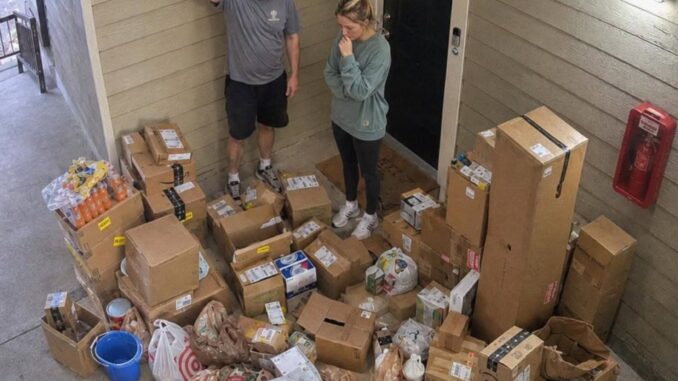
What we didn’t expect was to find 28 packages waiting outside her door.
At first, we couldn’t understand why so many deliveries had arrived.
Our mother had always been careful with money. She rarely bought anything unnecessary and preferred repairing or reusing things rather than replacing them.
But when we opened the first package, we discovered something that changed our understanding of those deliveries.
Inside was a blue ceramic mixing bowl and a handwritten birthday card addressed to me.
As my brother and I began looking through the other packages, we realized that our mother had been preparing something meaningful for both of us.
Returning to Mom’s Apartment
My name is Claire, and my younger brother is Ben.
Our mother had passed away just seven days earlier.
Although her health had been declining, neither of us had felt prepared to lose her.
During her final days in the hospital, she had continued asking about our lives.
She reminded me to eat proper meals instead of relying on sandwiches.
She asked Ben whether he was getting enough sleep.
Even when she was unwell, she remained concerned about the everyday details of our lives.
Before her passing, she had also given us practical instructions about her apartment.
She told us where to find the spare keys and reminded us to keep the dishes that had belonged to our grandmother.
At the time, I promised we would take care of everything.
But standing outside her building a week later, I realized how difficult that promise would be to fulfill.
An Unexpected Sight Outside Her Door
Ben parked the car, and we sat quietly for a moment.
Neither of us was eager to go inside.
Eventually, he picked up the empty boxes we had brought for organizing Mom’s belongings.
We walked upstairs together.
When we reached her floor, we stopped.
Packages were stacked along the wall near her apartment.
There were cardboard boxes of different sizes, shopping bags, and smaller parcels.
For a moment, we simply stared at them.
“Did Mom order all of this?” Ben asked.
I couldn’t imagine why she would have.
She had always been practical with her spending.
She wore sweaters she had knitted years earlier and kept furniture that had been in our family since childhood.
Her favorite dishes were old, and she rarely replaced anything that still worked.
Seeing so many deliveries addressed to her was completely unexpected.
The First Package
Ben suggested that perhaps friends or neighbors had sent gifts after hearing about Mom’s passing.
I checked the labels.
Most of the packages had come directly from stores.
Nearly all were addressed to our mother.
I picked up one of the boxes and examined it.
It was medium-sized and carefully sealed.
Curiosity got the better of me.
I opened it.
Inside was a beautiful blue ceramic mixing bowl, protected by layers of wrapping paper.
Beneath the bowl was a birthday card.
My birthday was only three weeks away.
I immediately recognized Mom’s handwriting.
The envelope had a note asking me to open it on my birthday.
But it wasn’t sealed.
I carefully removed the card.
A Birthday Gift Prepared in Advance
The message was short but deeply personal.
Mom wrote that she hoped she would still be there to make my birthday pancakes.
If she wasn’t, she wanted me to have the bowl.
She reminded me of the blue mixing bowl we had used together when I was little.
It had been one of my favorite things in her kitchen.
Years earlier, she had accidentally broken it.
She had never found a suitable replacement.
But now, she had finally discovered another one.
I looked down at the bowl in my hands.
Suddenly, it wasn’t just a kitchen item.
It represented countless childhood mornings spent helping Mom prepare breakfast.
Ben came closer and read the card.
He looked at me quietly.
We both understood that Mom had purchased the gift knowing she might not be there to give it to me herself.
Realizing Mom Had Been Planning Ahead
We sat on the hallway floor for several minutes.
I held the bowl while Ben looked at the remaining packages.
During her final hospital stay, Mom had rarely spoken about the possibility that she might not recover.
Instead, she discussed ordinary things.
She asked about our jobs, our homes, and the small problems we were dealing with.
She wanted to know whether Ben had repaired his kitchen faucet.
She asked whether I was eating enough.
I had assumed she was trying to remain optimistic.
Now I wondered whether she had been preparing privately for an uncertain future.
The packages suggested that she had been thinking about important family occasions she might miss.
Ben asked whether we should open another one.
I hesitated.
Some of the gifts might have been intended for specific dates.
We decided to carry everything inside before making any decisions.
The Apartment Still Felt Like Home
When we opened Mom’s apartment, everything looked familiar.
Her reading glasses were beside the couch.
A partially finished sweater rested in her knitting basket.
Her favorite coffee mug stood on the kitchen counter.
The rooms still carried the faint scent of the lavender soap she liked.
Seeing those ordinary details was difficult.
They reminded us of the routines that had filled her days.
Ben quietly carried the packages into the living room.
We counted them.
There were 28 in total.
Some had arrived while Mom was in the hospital.
Others appeared to have been ordered several weeks earlier.
A few delivery notices indicated that the parcels had been held before being brought to her apartment.
It became clear that Mom had planned these purchases over time.
A List Hidden in the Kitchen Drawer
We found our first explanation in the kitchen.
Beside the spare keys was a folded sheet of paper.
At the top, Mom had written:
“Packages for Claire and Ben.”
Underneath were dates, store names, and short descriptions.
She had listed my birthday gift as the blue bowl.
For Ben’s birthday, she had written down woodworking tools.
There were also packages intended for Christmas and other occasions.
Near the bottom was one instruction that caught our attention.
One particular package was meant to be opened by both of us together, after the others had been sorted.
Ben studied the list.
He seemed especially surprised by the mention of woodworking tools.
Remembering Ben’s Old Passion
When Ben was younger, he loved working with wood.
He could take discarded boards and turn them into shelves, tables, and small pieces of furniture.
For years, he had dreamed of having his own workshop.
He was patient and creative.
He enjoyed making things with his hands.
But life had become more demanding.
After losing one job, he had accepted another that required long hours.
The work provided financial stability, but it left him exhausted.
Gradually, his woodworking projects became less frequent.
Eventually, his tools were stored away.
Mom had often asked whether he was building anything new.
Ben usually told her he was too busy.
Now, seeing the woodworking tools on her list, I wondered whether she had wanted to encourage him to return to something he loved.
A Gift That Meant More Than Money
Ben looked uncomfortable.
He said Mom shouldn’t have spent money buying things for him.
That reaction didn’t surprise me.
During her illness, he had helped pay for groceries and other household expenses whenever he could.
Even when his own finances were tight, he tried to make sure she had what she needed.
He rarely spent money on himself.
I reminded him that Mom had chosen the gifts because she wanted to.
The woodworking tools weren’t simply another purchase.
They represented something she remembered about him.
Something he had gradually stopped making time for.
Ben didn’t say much.
But I could tell the gift had affected him.
Sorting Through the Remaining Packages
We began organizing the parcels according to Mom’s instructions.
Some were easy to identify.
There were baking pans, a warm scarf, and holiday decorations.
Other items were less obvious.
One package contained fabric, thread, and sewing patterns.
Another held watercolor paints.
We also found a small wooden birdhouse kit.
Ben smiled and wondered aloud whether Mom had suddenly decided we needed a dozen new hobbies.
I laughed.
Then I picked up the fabric.
It had a delicate yellow floral pattern.
I recognized it immediately.
The Fabric That Reminded Me of Childhood
When I was younger, I loved sewing.
I used leftover fabric to make simple dresses, skirts, and other clothing.
My earliest projects were far from perfect.
Some seams were uneven.
A few sleeves didn’t match.
But Mom always encouraged me.
She kept many of the things I made, even when I thought they weren’t good enough.
When I was sixteen, I had sewn her an apron using fabric with small yellow flowers.
The pocket had been crooked.
Mom wore it anyway.
She used to joke that the uneven pocket made the apron special.
The fabric in the package looked remarkably similar.
I showed it to Ben.
He immediately remembered the apron.
For the first time that afternoon, we laughed together.
Then I began crying again.
Mom had remembered a part of my life I had almost forgotten.
The Dream I Had Put Aside
As a teenager, I had hoped to study fashion design.
I enjoyed sketching clothing and experimenting with different fabrics.
But after college, I accepted an office job that offered a steady income.
I told myself I could return to design later.
There would always be time.
Then Mom became ill.
My evenings were increasingly filled with appointments, errands, and helping her with everyday tasks.
I didn’t regret being there for her.
But gradually, I stopped sewing.
My sewing machine went into storage.
My sketchbooks remained unopened.
I kept postponing the things I wanted to do.
Holding the yellow fabric, I realized how long it had been since I had made something simply because I enjoyed it.
A Notebook on Mom’s Bedside Table
Later that afternoon, Ben found a small notebook in Mom’s bedroom.
At first, it appeared to contain ordinary shopping lists.
There were store names, delivery dates, and reminders.
But between those entries were personal observations.
Mom had written that Ben seemed tired even when he insisted he was fine.
She had noticed that I no longer talked about sewing.
Another note said that we spent so much time asking what she needed that she wished we would talk about what we needed ourselves.
I read those words several times.
They were so characteristic of Mom.
Even while dealing with her own health problems, she had been paying attention to us.
She Had Noticed More Than We Realized
We continued reading the notebook.
Mom had written reminders to ask Ben about his workshop.
She had also made a note to find my old fashion sketches.
There were references to our birthdays, favorite foods, and conversations we’d had during hospital visits.
I remembered one afternoon when she asked whether I was still drawing clothing designs.
I had told her I was too busy.
She had asked why I didn’t make time for it.
I gave the same answer I always gave.
Life was complicated.
There were too many responsibilities.
At the time, I thought she was simply being nostalgic.
Now I understood that she was concerned about how much of our personal lives we had placed on hold.
A Conversation My Brother and I Had Avoided
Ben turned another page.
His expression changed.
He handed me the notebook.
Mom had written that both of us were postponing important parts of our lives.
She didn’t want that to continue indefinitely.
We sat quietly for a moment.
Then Ben admitted something I hadn’t known.
He had turned down a better job the previous spring.
The position was in another city.
He hadn’t accepted it because he didn’t want to move away while Mom was ill.
I was surprised.
He had never mentioned the opportunity.
Then he pointed out that I had also stopped applying to design programs.
I asked how he knew.
He explained that Mom had told him I was considering returning to school.
We looked at each other.
Neither of us had realized how much the other had sacrificed.
Learning to Speak More Openly
For months, Ben and I had been asking each other whether everything was okay.
We usually gave the same answer.
We were fine.
We didn’t want to add to each other’s worries.
But the truth was more complicated.
We were tired.
We were worried about Mom.
And we had quietly put some of our personal goals aside.
I remembered something she had told me during one hospital visit.
She said that Ben and I didn’t always have to protect each other from difficult feelings.
At the time, I hadn’t thought much about it.
Now her words made sense.
She had wanted us to be more open with each other.
Not because she thought we were doing anything wrong, but because she knew we both needed support.
A Letter Inside Her Recipe Book
That evening, we found another message.
It was tucked inside Mom’s old recipe book, near the page containing her birthday pancake recipe.
The envelope was addressed to both of us.
She had asked us to read it together.
Ben sat beside me at the kitchen table.
I opened the envelope carefully.
The letter began with a familiar touch of humor.
Mom hoped we were sitting together and hadn’t argued over who would keep Grandma’s dishes.
Ben smiled.
Then I continued reading.
She explained that she had been planning the packages for some time.
At first, she wanted to make sure we had gifts for birthdays and holidays she might not be able to celebrate with us.
But as she thought about it, her intentions had changed.
She wanted the gifts to remind us of the people we had been before life became so busy.
Mom’s Message to Both of Us
The letter brought back memories of our childhood.
Mom described the first dress I had sewn.
She remembered how proud I was, even though one sleeve was longer than the other.
She also recalled the small wooden shelf Ben had made for her when he was fourteen.
He had insisted it was perfectly level.
It wasn’t.
But she kept it because he had made it.
Those details made us smile.
Then the letter became more serious.
Mom acknowledged how much we had done to support her during her illness.
She knew we had changed plans and set aside opportunities because we wanted to be close to her.
She was grateful.
But she didn’t want us to spend the rest of our lives postponing things that mattered to us.
Permission to Keep Living
Mom’s message wasn’t about forgetting her.
It was about allowing ourselves to continue building meaningful lives.
She told us that we didn’t need to keep every possession in the apartment.
We didn’t have to feel guilty about laughing or celebrating.
And we didn’t have to pretend everything was fine when it wasn’t.
She wanted us to look after ourselves and each other.
She reminded us that we would always be her children, regardless of where life took us.
By the time I reached the end of the letter, I was crying.
Ben took my hand.
We sat quietly together.
Neither of us had expected to find such a thoughtful message among her belongings.
What the Letter Changed
Ben admitted that he had been afraid moving away would mean abandoning Mom.
Even when she encouraged him to apply for new opportunities, he had felt guilty considering them.
I understood.
I had experienced similar feelings about returning to design.
We had both believed that putting our goals aside was part of being responsible children.
But Mom’s letter helped us see that she had never wanted us to abandon our interests permanently.
We didn’t suddenly know what to do next.
Ben wasn’t ready to make an immediate career decision.
I wasn’t sure whether returning to school was practical.
But for the first time, we talked about those possibilities without feeling that we were doing something wrong.
The Final Package
Before leaving the apartment, we returned to Mom’s list.
One instruction remained.
There was a package marked for both of us to open together.
We searched through the remaining boxes until we found a large parcel with both our names.
Inside were pancake ingredients, two matching aprons, and a framed photograph.
The picture showed Ben and me as children standing beside Mom in her kitchen.
I had flour on my nose.
Ben was holding a wooden spoon as though it were a sword.
Mom was laughing.
Beneath the photograph was another handwritten note.
She asked whether we remembered Saturday mornings when we used to make pancakes together.
She hoped we would continue the tradition.
And she jokingly reminded us that if the first batch burned, Ben was probably responsible.
A Memory From Our Childhood
Ben laughed when he read the note.
When he was nine, he had tried making breakfast before Mom woke up.
He wanted to surprise her.
Unfortunately, he burned the pancakes and set off the smoke alarm.
Mom teased him about it for years.
The memory made us both smile.
I picked up the matching aprons.
Then I looked toward the kitchen.
“Should we make pancakes?” I asked.
Ben seemed surprised.
“Now?”
I nodded.
There was no reason to wait.
We had the ingredients, Mom’s old recipe, and the kitchen where we had spent so many childhood mornings.
He agreed.
Making Pancakes in Mom’s Kitchen
We found Mom’s frying pan in the cupboard.
Ben measured the flour while I mixed the batter.
Almost immediately, we began disagreeing about how much milk to add.
He thought the pan needed to be hotter.
I told him he still hadn’t learned how to cook pancakes properly.
The first one burned.
We laughed so much that I had to sit down.
For a few minutes, the kitchen felt familiar again.
Then I looked toward Mom’s empty chair.
The sadness returned.
Ben noticed.
He quietly admitted that he missed her.
I told him I did too.
We didn’t try to hide how we felt.
We simply continued making breakfast together.
Finding Comfort in Familiar Traditions
We placed the framed photograph beside the stove.
As we cooked, we remembered the Saturday mornings of our childhood.
Mom had always been patient with us, even when we made a mess.
She let us help with the batter.
She laughed when we argued about whose turn it was to stir.
And she somehow managed to make ordinary breakfasts feel special.
Sitting at her kitchen table, I realized that we could still enjoy those memories.
Missing her didn’t mean we had to avoid everything that reminded us of her.
We could feel sad and grateful at the same time.
For the first time since the funeral, talking about Mom felt a little easier.
Opening the Gifts on Their Intended Dates
Over the following weeks, Ben and I followed Mom’s instructions.
We opened the remaining packages on the dates she had written.
When my birthday arrived, I used the blue ceramic bowl to make pancakes.
Ben came over, and we spent the morning looking through family photographs.
The bowl reminded me of childhood breakfasts with Mom.
But it also became part of a new memory with my brother.
That was what made the gift meaningful.
It wasn’t only about remembering what we had lost.
It was also about continuing a tradition in our own way.
Returning to the Things We Loved
After my birthday, I took my sewing machine out of storage.
At first, I didn’t attempt anything ambitious.
I repaired a torn shirt.
Then I began sketching clothing designs again.
Gradually, I started making time for a hobby I had missed.
Ben did something similar.
He cleaned his workshop and organized the tools he hadn’t used in years.
Then he began restoring an old chair.
Neither of us made dramatic changes overnight.
We still had jobs and responsibilities.
There were days when grief made ordinary tasks difficult.
But we stopped treating our personal interests as things that had to wait indefinitely.
Taking Small Steps Forward
Ben eventually began considering new career opportunities.
He wasn’t sure whether he wanted to move to another city.
But he was willing to explore the possibility.
I continued sewing and thinking about what role design might play in my future.
We also became more open with each other.
When one of us was having a difficult day, we said so.
We didn’t always have solutions.
Sometimes, we simply listened.
That was enough.
We had spent so much time trying to protect one another from worry that we had forgotten how helpful an honest conversation could be.
Mom had recognized that long before we did.
A Phone Call That Made Me Smile
One evening, I was working on a dress when Ben called.
He told me he was thinking about applying for another job.
It might involve moving.
He wasn’t certain yet.
I encouraged him to explore the opportunity.
Then he asked what I was working on.
I looked at the yellow floral fabric spread across my table.
I told him I was making something Mom would have loved.
He paused.
Then he asked whether the pocket would be crooked.
I laughed.
It was exactly the kind of joke Mom would have made.
For a moment, I could almost imagine her sitting nearby, smiling at our conversation.
What the 28 Packages Really Meant
When we first discovered the packages, I thought Mom had simply prepared gifts for occasions she might miss.
That was part of the reason.
But as we opened them, we began to understand a deeper message.
She had remembered our interests.
She had noticed when we stopped making time for ourselves.
And she had wanted to encourage us to continue pursuing the things that brought us happiness.
The gifts weren’t extravagant.
They were personal.
A mixing bowl.
Woodworking tools.
Fabric.
A photograph.
Pancake ingredients.
Each item reflected something she knew about us.
Together, they reminded us that her love had always been expressed through attention to the small details of our lives.
The Importance of Family Memories
Losing a parent can change the way familiar places and objects feel.
An ordinary coffee mug can become a reminder of someone who used it every morning.
A handwritten recipe can bring back memories of family celebrations.
A favorite photograph can encourage conversations that might otherwise never happen.
For Ben and me, the packages became a way to remember Mom through the things she valued.
They also helped us talk more openly about our grief.
We didn’t stop missing her.
But we found comfort in sharing stories, continuing traditions, and supporting each other.
Over time, those small moments became an important part of how we adjusted to life without her.
Final Thoughts
A week after our mother’s passing, my brother and I discovered 28 packages outside her apartment.
At first, we were confused.
We couldn’t understand why she had ordered so many things.
But the gifts, notebook, and handwritten letter revealed how carefully she had been thinking about us.
She knew we had put parts of our lives on hold while helping her through her illness.
She appreciated everything we had done.
And she wanted us to remember that we still had futures worth exploring.
The packages didn’t take away our sadness.
They didn’t answer every question about what came next.
But they encouraged us to reconnect with our interests, speak honestly with each other, and continue the family traditions we loved.
Mom hadn’t wanted us to spend our lives holding on to every object she left behind. She wanted us to keep making things, sharing memories, and finding reasons to enjoy life together.
And in that way, her final gifts became more than reminders of the past.
They helped us begin imagining the future.
Leave a Reply