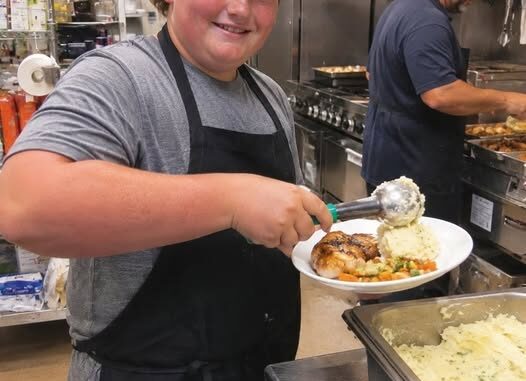
The Unexpected Visitor at the Community Dinner
The man in the dark coat entered the community center just as the final guests were finishing their meals.
He paused near the doorway, looking carefully around the crowded dining hall.
Volunteers were clearing plates. Families were talking quietly at long tables. Children were enjoying the last slices of chocolate cake.
Near the back of the room, my 12-year-old son, Noah, sat beside me with his green backpack resting against his knees.
He had spent the afternoon helping organize a special community meal.
Three hundred people had been served.
It was an extraordinary achievement for a boy who had spent much of the previous year receiving treatment for leukemia.
But instead of celebrating, Noah seemed unusually nervous.
He kept looking toward the entrance.
When he noticed the stranger, he sat up straight and pulled his backpack onto his lap.
The man approached our table.
“Are you Clarice?” he asked.
I stood.
“Yes. Can I help you?”
“My name is Daniel.”
I recognized the name immediately.
Two weeks earlier, I had overheard Noah speaking to someone named Daniel on the phone.
He had said something that had worried me ever since.
“Please don’t tell my mom yet. I want to explain it myself.”
Now that same person was standing in front of us.
Daniel glanced at Noah, then turned back to me.
“Your son has been keeping something from you,” he said gently.
I looked at Noah.
He lowered his eyes.
And I realized that the community dinner had a meaning I hadn’t fully understood.
The Year Our Family Changed
Four years earlier, my husband, Mark, had passed away following a road accident.
He had been returning home from work.
Noah was eight at the time.
We lived in a modest apartment in Ohio, and Mark’s income covered a significant portion of our household expenses.
After his death, I struggled to keep everything running.
I worked additional shifts, sold belongings we no longer needed, and tried to provide Noah with as much stability as possible.
Eventually, I found a full-time position as a receptionist at a dental office.
The steady income helped us move into a slightly larger apartment.
Life gradually became more manageable.
Then, eleven months before the community dinner, Noah began experiencing unusual tiredness, unexplained bruising, and persistent illness.
Medical tests led to a diagnosis of leukemia.
He was eleven when treatment began.
He turned twelve while receiving care at the hospital.
Our days became filled with appointments, medications, blood tests, and conversations with his medical team.
Some days were difficult.
Others were surprisingly ordinary.
Noah still made jokes, requested his favorite foods, and found ways to make me laugh.
Even during treatment, he remained curious about the world beyond his hospital room.
The Ocean He Had Always Wanted to See
Beside Noah’s hospital bed hung a drawing of the ocean.
He had made it with colored markers.
The picture showed large blue waves, a bright yellow sun, and a bird flying over the water.
Noah had never visited the beach.
Mark had always hoped to take us to Myrtle Beach one summer.
We had even looked at hotels together.
But the trip never happened.
Sometimes, when Noah couldn’t sleep, he studied the drawing.
“Mom, are ocean waves really loud?”
“I think so,” I answered.
“Louder than the hospital?”
I smiled.
“Probably.”
He looked thoughtful.
“I want to hear them someday.”
I promised we would do our best to make that happen when his health allowed it.
So when a volunteer from a children’s wish-granting charity visited his hospital room, I assumed I knew exactly what Noah would request.
I was wrong.
A Wish Nobody Expected
The volunteer’s name was Beth.
She explained that the organization helped children facing serious medical conditions experience something personally meaningful.
Depending on what was possible, a wish might involve travel, meeting someone special, or enjoying a memorable activity.
Noah listened carefully.
Then he asked, “Could I use my wish to buy dinner for people?”
Beth smiled.
“What kind of dinner?”
“For people who don’t always have enough to eat.”
He explained that he didn’t want to distribute only small snacks.
He imagined a proper meal with tables, chairs, warm food, and dessert.
“Everyone should be able to sit down and enjoy it,” he said.
I looked at him.
“Noah, you could choose something just for yourself. What about the ocean?”
He glanced at the nurses outside his room.
“People have been helping me every day,” he replied. “I want to help someone else.”
Beth asked how many guests he hoped to serve.
“As many as possible.”
That simple answer became the beginning of a remarkable community project.
Planning a Meal for 300 People
Beth contacted the Harbor Street Community Center, an organization that provided meals and food assistance to local residents.
The center had a large dining hall and an experienced volunteer team.
Its coordinator, Rosa, visited Noah in the hospital.
She explained that, with sufficient donations and volunteers, the center could prepare and serve meals to approximately 300 people across several sittings.
Noah was delighted.
“Then we need really good food,” he said.
He wrote a menu on the back of a hospital meal sheet.
Roast chicken.
Baked macaroni and cheese.
Green beans.
Fresh bread with butter.
And plenty of chocolate cake.
Rosa reviewed the list with the kitchen team.
They discussed ingredients, food allergies, preparation schedules, and the number of volunteers needed.
Local businesses offered to contribute.
A grocery store donated chicken.
A bakery agreed to prepare desserts.
A nearby church provided extra chairs.
Community members volunteered to help with cooking, serving, and cleanup.
For the first time in months, many of Noah’s conversations were about something other than his medical appointments.
He wanted to know how the tables would be arranged and whether guests could choose between lemonade and iced tea.
He even selected the napkin color.
Yellow.
“White napkins remind me of the hospital,” he explained.
Everyone agreed that yellow would be perfect.
The Green Backpack Noah Wouldn’t Let Go
As the dinner preparations continued, I noticed something unusual.
Noah had become very protective of his old school backpack.
It was green, with a broken zipper pull he had repaired using a paperclip.
He kept it beside his hospital bed and carried it to every planning meeting.
Inside was a small wooden keepsake box with a brass latch.
Whenever I approached, he quietly closed the backpack.
One evening, I asked what he was keeping inside.
“Something important,” he said.
“Can I see it?”
“Not yet.”
I assumed it was a small surprise connected to the dinner.
Perhaps a thank-you gift for the volunteers.
But during one planning visit, I saw Noah showing the box to Rosa.
She listened carefully, wrote something on her clipboard, and smiled.
When I returned, both of them changed the subject.
“Just planning something,” Noah told me.
I decided not to press him.
He had so little control over his daily routine during treatment.
If planning a surprise made him happy, I wanted him to enjoy it.
I didn’t know that the box contained a reminder of one of the most difficult afternoons of our lives.
A Winter Afternoon I Never Forgot
After Mark passed away, money became extremely tight.
I was doing everything I could to pay our bills, but some weeks there was very little left for groceries.
One cold January afternoon, I took eight-year-old Noah to a neighborhood park.
He wanted to play on the swings.
I packed a peanut butter and jelly sandwich for him.
There wasn’t enough food at home for both of us to have lunch.
When Noah asked why I wasn’t eating, I told him I had already eaten before we left.
He accepted the sandwich and sat beside me on a bench.
At least, I thought he believed me.
A few minutes later, a man wearing a worn brown jacket sat at the other end of the bench.
He carried a paper bag.
Inside was a turkey-and-cheese sandwich wrapped in a napkin.
The man noticed Noah eating.
Then he glanced at my empty hands.
Without making a fuss, he divided his sandwich in half.
He placed one portion beside me.
“Would you like some?” he asked.
I politely declined.
He smiled.
“There’s enough.”
His name was Michael.
He told me he volunteered at Harbor Street, a community outreach center on the east side of town.
I eventually accepted the sandwich.
It was a simple lunch.
Turkey, cheese, and wheat bread.
No mustard.
But I remembered that moment for years.
Michael had offered kindness without expecting anything in return.
The Stranger I Tried to Thank
The following morning, I bought ingredients for two sandwiches.
I prepared one for Noah and another for Michael.
I wanted to return his kindness.
We went back to the park and waited near the same bench.
Michael didn’t appear.
I returned again another afternoon.
Still nothing.
Eventually, I stopped looking for him.
But I never forgot what he had done.
Whenever I packed Noah’s lunch for school, I remembered the stranger who had shared his meal with me.
I hoped that someday I would have the opportunity to help someone else in a similar way.
What I didn’t realize was that Noah remembered the afternoon just as clearly.
He had noticed much more than I knew.
The Secret Phone Call
A few weeks before the community dinner, Noah was resting at home between medical appointments.
I found him sitting on his bed, looking at an old folded napkin inside a clear plastic sleeve.
When he noticed me, he quickly returned it to his wooden box.
“What’s that?” I asked.
“Something I’ve kept for a long time.”
Before I could ask another question, his phone rang.
“Hi, Daniel,” he answered.
I stepped into the kitchen to give him privacy.
But our apartment was small, and I overheard part of the conversation.
“Please don’t tell my mom yet,” Noah said. “I want to do it myself.”
I became concerned.
Later, I asked who Daniel was.
“He’s connected to the community center,” Noah explained.
“Have you met him?”
“We’ve talked with Rosa helping.”
“Why didn’t you tell me?”
Noah hesitated.
“It’s part of the surprise.”
I didn’t want to discourage him, but I also wanted to make sure he was communicating with a trusted adult.
The next day, I confirmed with Rosa that Daniel was someone she knew and that their conversations had been arranged through the center.
She reassured me that Noah was safe.
I still didn’t know what they were planning.
But I felt more comfortable allowing the surprise to continue.
Making Sure the Dinner Was Safe for Noah
Before the event, Noah’s medical team reviewed the plans.
Because leukemia treatment can affect the immune system, his doctors emphasized the importance of precautions tailored to his health.
They discussed ways to limit exposure, avoid unnecessary crowding, and ensure he could rest when needed.
Noah would have a designated table away from the busy serving area.
He wouldn’t handle hot food or assist with kitchen preparation.
The adults would monitor his energy and follow the medical team’s instructions.
He was particularly interested in one question.
“Can I still hand out napkins?”
His nurse, Tasha, smiled.
“With the precautions we’ve discussed, you can help from your own table.”
Noah was delighted.
He announced that he would be the event’s official napkin manager.
Rosa even made him a sign.
OFFICIAL NAPKIN MANAGER
It became his favorite part of the plan.
The Day of the Community Dinner
On the morning of the event, Noah woke up early.
He wore his favorite blue sweatshirt.
It was a little loose after months of treatment, but he insisted it was the perfect outfit.
He checked his backpack several times.
“Water bottle?” I asked.
“Yes.”
“Everything else you need?”
“Yes, Mom.”
“Your secret project?”
He grinned.
“Definitely.”
We arrived at Harbor Street before the first guests.
Volunteers were arranging tables.
Yellow decorations hung around the dining hall.
Small vases of daisies stood near the center of each table.
The kitchen smelled of roasted chicken and warm bread.
Noah stopped just inside the entrance.
He looked around in amazement.
“All this is really happening?”
Rosa nodded.
“It certainly is.”
He smiled.
Then he corrected her when she said the dinner was for him.
“It’s for everyone coming today.”
Three Hundred Meals and Hundreds of Small Moments
The first guests began arriving shortly before noon.
Some came alone.
Others arrived with friends or family members.
There were older adults, parents with children, and people who simply appreciated having a welcoming place to enjoy a meal.
The volunteers greeted everyone respectfully.
Guests were offered food and drinks, with accommodations made where possible for dietary needs.
Noah sat at his designated table with a neat stack of yellow napkins.
He greeted people as they passed.
Some stopped to chat.
Others smiled and continued toward their seats.
One man thanked Noah for helping organize the dinner.
Noah pointed toward the kitchen.
“Everyone did the work,” he said. “I just picked the cake.”
The man laughed.
“Then you made an excellent choice.”
Throughout the afternoon, Noah took the breaks recommended by his medical team.
He drank water, rested, and enjoyed a small piece of chocolate cake.
I stayed nearby.
I was proud of what he had helped create.
But I also noticed that he kept looking toward the entrance.
He was waiting for someone.
The Final Guest Count
By late afternoon, the last group had finished eating.
Rosa approached our table carrying her clipboard.
She was smiling.
“Noah, I have some news.”
He looked up.
“What?”
“We reached our goal.”
She turned the clipboard around.
The volunteers had recorded 300 meals served.
Noah stared at the number.
“Exactly three hundred?”
“Exactly.”
He leaned back in his chair.
For a moment, he didn’t say anything.
Then he turned to me.
“Did we do a good job, Mom?”
I hugged him.
“You helped make something wonderful happen.”
He rested his head on my shoulder.
I thought the day’s biggest surprise had already happened.
Then the man in the dark coat entered the dining hall.
The Man Named Daniel
Daniel approached us carefully.
He introduced himself and asked whether he could sit down.
I agreed.
He looked at Noah with a warm expression.
“Your son has been helping us put together something very special,” he said.
I looked at Noah.
“What have you been planning?”
Noah reached for his backpack.
His hands were trembling slightly.
Daniel spoke gently.
“Clarice, do you remember a man who shared his sandwich with you in a park several years ago?”
I stared at him.
For a moment, I couldn’t answer.
Then the memory returned.
The cold afternoon.
The park bench.
The sandwich wrapped in a paper napkin.
“Michael?” I whispered.
Daniel nodded.
“He was my older brother.”
I looked at Noah.
He was already opening the small wooden box.
The Napkin Noah Had Saved for Four Years
Inside the box was a folded paper napkin.
Its edges had yellowed with age.
Noah had protected it inside a clear plastic sleeve.
He held it out to me.
“Mom, remember that day at the park?”
“Of course.”
He looked down.
“I knew you hadn’t eaten.”
I felt tears forming.
“What?”
“I knew you were hungry. You told me you’d already had lunch, but I knew.”
I stared at him.
He had been only eight.
I thought I had protected him from understanding how difficult our circumstances had become.
But he had noticed.
“When Michael gave you the sandwich,” Noah continued, “I saw how happy you were.”
He looked at the napkin.
“Afterward, I picked this up from the bench. I wanted to remember him.”
I carefully took the plastic sleeve.
“You kept it all these years?”
He nodded.
“That’s why I wanted the dinner.”
A Small Act That Inspired a Bigger One
Noah explained that he had remembered Michael’s kindness throughout his hospital treatment.
Doctors and nurses helped him every day.
Volunteers brought activities.
Family members offered encouragement.
He appreciated everything people did for him.
But when Beth asked him to choose a special wish, he remembered the afternoon at the park.
He remembered a stranger sharing what he had.
And he wanted to offer that same kindness to others.
“I thought if one sandwich helped us,” Noah said, “maybe a lot of dinners could help a lot of people.”
I pulled him into my arms.
For years, I had believed he had forgotten that difficult winter.
Instead, he had carried one small memory with him.
And he had turned it into something meaningful.
Michael’s Story
Daniel waited until Noah and I had finished talking.
Then he told us about his brother.
Michael had worked in restaurant kitchens for many years.
He enjoyed cooking and regularly volunteered at Harbor Street.
Later, a combination of employment difficulties, health problems, and rising living costs left him without stable housing for a period.
He stayed in temporary accommodation while trying to rebuild his life.
Even then, he continued helping at the community center whenever he could.
Eventually, a housing assistance program helped him move into a small apartment.
Daniel smiled as he described how proud Michael had been of having his own front-door key.
“He sent me a photograph of it,” Daniel said.
Michael continued volunteering.
He prepared sandwiches for people visiting the outreach center and nearby park.
His favorite was turkey and cheese on wheat bread.
No mustard.
I smiled through my tears.
“That was exactly what he gave me.”
Daniel nodded.
“That’s how Rosa recognized the story when Noah told her.”
The News About Michael
Then Daniel shared something more difficult.
Michael had passed away the previous year following a heart-related illness.
I lowered my eyes.
“I’m sorry.”
Daniel thanked me.
He explained that he had learned many stories about his brother’s generosity after his passing.
People had approached him to describe meals Michael had prepared, conversations he had shared, and small ways he had helped them.
But Daniel had never heard about the afternoon at the park.
Not until Noah contacted Rosa.
“When she told me about the napkin,” he said, “I wanted to meet you both.”
He looked around the dining hall.
“I think Michael would have appreciated what happened here today.”
Noah nodded.
“He liked feeding people.”
“He really did.”
The Lunch I Had Tried to Give Back
I told Daniel something I had never shared with Noah.
After Michael gave me half his sandwich, I returned to the park hoping to thank him.
I had prepared a turkey-and-cheese sandwich for him.
I waited by the bench.
When he didn’t appear, I tried again.
But I never saw him.
Noah looked surprised.
“You went back?”
“Yes.”
“I thought you wanted to forget that day.”
I shook my head.
“I never forgot it.”
I explained that I had avoided discussing our financial struggles because I wanted Noah to remember his childhood with warmth rather than worry.
He took my hand.
“I remember the good part,” he said.
I smiled.
“So do I.”
Michael’s Recipe Card
Daniel reached into his coat pocket.
He removed an old index card.
It had been kept in Michael’s former work area at Harbor Street.
The card contained his handwritten sandwich recipe.
Wheat bread.
Turkey.
Cheese.
Lettuce when available.
Tomato in season.
Wrap each sandwich in a napkin.
Offer it with kindness.
Noah studied the card carefully.
Then he asked a question that made us all laugh.
“Did he put mustard on them?”
Daniel shook his head.
“Never. He couldn’t stand mustard.”
Noah grinned.
“Then he had good taste.”
Daniel offered him the recipe card as a keepsake.
Noah placed it carefully beside the old napkin in his wooden box.
The two pieces of paper represented different moments in the same story.
One remembered a kindness received.
The other showed how Michael had continued sharing that kindness with others.
A Tribute at the Community Center
Before we left, Rosa approached us with a small brass plaque.
Daniel had helped arrange it in memory of his brother.
It would be placed near the kitchen area where Michael had volunteered.
The plaque read:
MICHAEL’S KITCHEN
There’s enough.
Noah read the words aloud.
Then he looked at me.
“That’s what he said on the bench.”
I nodded.
“Yes, it is.”
Rosa explained that the center hoped the plaque would remind future volunteers of Michael’s generosity and dedication.
Daniel helped the team finish cleaning up.
He removed his coat, rolled up his sleeves, and carried folding chairs with the other volunteers.
By the time we left, the dining hall was nearly empty.
Noah was exhausted but happy.
As we walked toward the car, he held his wooden box close to his chest.
A New Saturday Tradition
A few weeks later, Noah had another medical appointment.
His doctors reviewed his progress and explained the next stages of treatment.
Some of his results were encouraging, although he still needed ongoing care.
That afternoon, Noah asked if we could make sandwiches using Michael’s recipe.
We bought wheat bread, turkey, provolone cheese, and lettuce.
No mustard.
Noah supervised from the kitchen table.
After lunch, he asked whether we could prepare sandwiches for Harbor Street.
I contacted Rosa to ask what donations the center could accept.
She explained its food safety requirements and the types of food that would be useful.
We agreed to prepare sandwiches according to the center’s guidelines.
The first Saturday, we made six.
The following week, we made ten.
Soon, Daniel joined us with groceries.
Beth from the children’s charity offered to help.
Tasha, Noah’s nurse, volunteered on a day off.
A few of Noah’s school friends joined with their parents’ permission.
Our little kitchen became a place where people gathered to prepare food for others.
Noah remained the official napkin manager.
He insisted on yellow napkins.
The Kindness Continues
Over time, our Saturday sandwich project grew.
Volunteers helped prepare and deliver food through Harbor Street’s established distribution program.
Noah’s medical team continued advising us about activities that were appropriate for him.
On days when he needed extra rest or had to avoid crowded places, he stayed home.
He still helped with planning whenever he felt well enough.
One Saturday, our group prepared 112 sandwiches.
Daniel brought the bread.
Tasha helped organize the ingredients.
Beth coordinated the packaging.
Noah counted the napkins.
I watched everyone working around our small kitchen table and thought about Michael.
He had shared half a sandwich with a stranger.
He couldn’t have known that, years later, his kindness would inspire a child to organize hundreds of meals.
But that was exactly what had happened.
Encouraging News From the Hospital
In September, Noah’s doctor shared news we had been hoping to hear.
His leukemia had entered remission.
The doctor carefully explained what that meant for his particular condition.
Noah would still need follow-up appointments, monitoring, and any treatment recommended by his medical team.
Remission was an important milestone, not a reason to stop medical care.
But it was encouraging news.
When we reached the car after the appointment, I became emotional.
Noah looked at me.
“Mom, you’re supposed to be happy.”
“I am happy.”
He considered my expression.
“You have a funny way of showing it.”
I laughed.
Some things about Noah hadn’t changed at all.
He still loved making jokes.
He still wanted extra cheese on his pizza.
And he still believed that small acts of kindness mattered.
The Trip to the Ocean
Later that year, Beth contacted us with another surprise.
The charity had arranged for Noah to experience the beach trip he had originally hoped for.
His medical team reviewed the travel plans, and once they agreed it was appropriate, we prepared for the journey.
We went to Myrtle Beach.
The hotel was near the same stretch of coastline Mark had once wanted us to visit.
On our first morning, Noah walked toward the water.
He stood at the shoreline and listened.
The waves rolled across the sand.
The breeze moved through his sweatshirt.
He watched the water for a long time.
Then he turned toward me.
“Mom?”
“Yes?”
“You were right.”
“About what?”
“The ocean.”
I smiled.
“What about it?”
“It’s louder than the hospital.”
I laughed and stood beside him.
For a moment, I thought about Mark and how much he would have loved seeing Noah there.
Then I looked at my son.
He was smiling.
And I was grateful we had finally made the trip.
The Wooden Box on Noah’s Shelf
When we returned home, Noah placed his keepsake box on the shelf above his bed.
Inside were two objects.
The old napkin Michael had used to wrap half a sandwich.
And the handwritten recipe card Daniel had given him.
Neither item had much financial value.
But to Noah, they represented something important.
The napkin reminded him of a time when someone had helped our family.
The recipe card reminded him that kindness could become a habit.
Sometimes he opened the box and looked at both.
Other times, he simply left it beside his drawing of the ocean.
The drawing had been with him through months of treatment.
Now it reminded him of a promise we had finally been able to keep.
What One Shared Sandwich Taught Our Family
For years, I thought about that winter afternoon as a memory of financial hardship.
I remembered worrying about bills.
I remembered having very little food.
I remembered trying to make sure Noah never felt responsible for our difficulties.
But Noah remembered something different.
He remembered a stranger noticing that someone needed help.
He remembered Michael sharing his lunch without making us feel uncomfortable.
He remembered the simple words:
There’s enough.
When Noah had the opportunity to choose a special experience, he thought about that moment.
He didn’t ask for something expensive.
He asked whether he could help provide a welcoming meal for others.
The community responded.
Volunteers contributed their time.
Local businesses donated supplies.
Three hundred guests enjoyed dinner.
And afterward, a new food preparation project continued through the outreach center.
None of it would have happened without the people who worked together to make Noah’s wish possible.
Why Community Support Matters
Food assistance programs can offer more than meals.
They can provide a welcoming place where people feel acknowledged and supported.
For families experiencing financial difficulty, access to community resources may help reduce immediate pressure while they work toward greater stability.
Organizations such as food pantries, community kitchens, and outreach centers often depend on donations and volunteers.
People interested in helping can contact established local organizations to learn what support is needed.
Some centers accept food donations prepared under specific safety guidelines.
Others prefer packaged groceries, financial contributions, or volunteer assistance.
As our family learned, asking an organization what it needs is often the most useful place to begin.
A small contribution, when coordinated with others, can become part of a much larger effort.
A Memory That Became a Tradition
Our family still prepares sandwiches for Harbor Street.
Not every Saturday looks the same.
Sometimes only a few volunteers are available.
Sometimes Noah needs to rest.
Sometimes the center requests different supplies.
We adjust our plans accordingly.
The important part is continuing to help in ways that are safe, practical, and genuinely useful.
Daniel remains part of our lives.
He visits regularly, and we often talk about Michael.
Through his stories, I have learned more about the man who helped us at the park.
Michael was a cook.
A volunteer.
A brother.
A person who experienced difficult circumstances but continued offering kindness when he could.
I wish I had been able to thank him properly.
But I take comfort in knowing that his generosity has not been forgotten.
Final Thoughts
When Noah asked to use his special wish to serve 300 meals, I thought he was simply trying to help people who needed food.
I didn’t know that his decision came from a memory he had carried for four years.
I didn’t know he had kept an old paper napkin in a wooden box.
And I didn’t know that the man who had once shared his lunch with us had a brother who would eventually help us understand the full story.
Michael’s gesture was small.
He offered half of his sandwich to someone sitting beside him on a park bench.
But to our family, that moment meant much more.
It showed Noah what kindness could look like in everyday life.
Years later, he found a way to share that lesson with others.
Sometimes, one thoughtful action inspires another—and together, those actions can make a meaningful difference in a community.
Michael gave us half a sandwich.
Noah helped organize 300 meals.
And a group of neighbors and volunteers turned that inspiration into an ongoing tradition.
That’s the part of the story I hope people remember.
Not how little we had that winter.
But how much good can begin when someone notices another person and chooses to help.
Leave a Reply