Sometimes, the smallest acts of kindness can inspire an entire neighborhood.
For six-year-old Oliver, helping others came naturally. He was the kind of child who noticed when someone needed assistance, whether it was a classmate sitting alone at school or a neighbor carrying groceries.
But one afternoon, his compassion led to something neither of us could have expected.
It began with an elderly neighbor named Mrs. Adele.
A Special Friendship Across the Street
Mrs. Adele was 81 years old and lived alone in a small yellow house with white shutters.
She had lived in the neighborhood for decades and knew many of the families who had come and gone over the years.
Oliver had developed a particularly close friendship with her.
Whenever he saw her outside, he would wave enthusiastically and ask if he could stop by to say hello.
Sometimes they talked about the birds visiting her garden.
Other times, she shared stories about the neighborhood when she was younger.
She occasionally offered him a butterscotch candy, which he considered a wonderful treat.
To Oliver, Mrs. Adele wasn’t simply a neighbor.
She was a friend.
That’s why he noticed when something about her home seemed different.
The House With No Lights
One evening, Oliver stood near our living room window and looked across the street.
“Mom, why are Mrs. Adele’s lights off?”
I glanced outside.
Her porch was dark, and I couldn’t see any lights through the windows.
“Maybe she’s resting,” I suggested.
Oliver shook his head.
“She usually has her little lamp on.”
I didn’t think much about it at first.
But the following evening, the house was still dark.
By the third day, Oliver had become concerned.
He asked whether we could check on her.
I agreed.
Before we could leave, however, he disappeared into his bedroom.
A few minutes later, he returned carrying his favorite piggy bank.
It was a small blue ceramic elephant.
He placed it carefully on the kitchen table.
“Mom, I want to give this to Mrs. Adele.”
The Savings He Had Been Keeping for a Toy
Oliver had been saving money for more than a year.
He collected coins from birthdays, small gifts from relatives, and money he received for completing age-appropriate chores.
His goal was to buy a remote-control airplane he had seen at a toy store.
He talked about that airplane constantly.
He imagined flying it in the backyard and showing it to his friends.
So when he offered to give away his savings, I was surprised.
“Sweetheart, you’ve been saving that money for something special,” I reminded him.
“I know.”
“Why do you want to give it away?”
He pointed toward the window.
“Mrs. Adele might need help with her lights.”
I sat beside him.
“We don’t know why her house is dark yet. Let’s check on her first.”
Oliver nodded.
Then he said something that stayed with me.
“If she needs help, she can have my airplane money. I can save again.”
At six years old, Oliver didn’t understand household bills or the challenges some older adults face while living on a fixed income.
He simply understood that someone he cared about might need assistance.
And he wanted to do something.
Visiting Mrs. Adele
We walked across the street together.
When Mrs. Adele opened her door, she smiled at Oliver.
“Well, hello there!”
“Hi, Mrs. Adele!”
She invited us inside.
The house was noticeably cooler than usual, and the lights were off.
I gently asked whether everything was all right.
Mrs. Adele hesitated before explaining that she was having difficulty with her electricity account.
She had been trying to resolve the issue but wasn’t sure where to begin.
I asked whether she would like help contacting her utility provider or finding a local assistance program.
She seemed relieved.
Then Oliver stepped forward.
He held out his blue elephant piggy bank.
“I brought you something.”
Mrs. Adele looked surprised.
“What is it, sweetheart?”
“My savings.”
She glanced at me.
I explained that Oliver had noticed the dark house and wanted to help.
Mrs. Adele’s expression softened.
“Oh, Oliver. That’s incredibly thoughtful.”
He held the piggy bank a little higher.
“You can use it if you need to.”
She gently placed her hand over his.
“Thank you, dear. But you don’t have to give me everything you’ve saved.”
Oliver considered her words.
“I just want you to have your lights back.”
Mrs. Adele smiled warmly and hugged him.
I explained that we could work together to find the most appropriate way to help.
For the moment, Oliver’s offer meant more to her than the amount inside his piggy bank.
A Conversation That Changed Everything
While Oliver sat nearby, Mrs. Adele and I discussed possible solutions.
We agreed to contact the electricity provider and ask about payment arrangements and assistance options.
I also offered to help her reach a local community organization that supported older residents.
Mrs. Adele thanked us.
Before we left, she leaned toward Oliver and whispered something.
He smiled.
On the walk home, I asked what she had said.
“She told me I made her feel less alone.”
I looked down at him.
“That’s a very special thing to hear.”
Oliver nodded.
Then he asked whether we could visit her more often.
“Of course,” I replied.
I thought the evening had ended with a simple lesson about kindness.
But the following morning brought an unexpected surprise.
An Unusual Scene Outside Our Home
I woke up early after hearing voices outside.
At first, I assumed a delivery vehicle had stopped nearby.
Then I heard people talking and laughing.
I went downstairs and opened the front door.
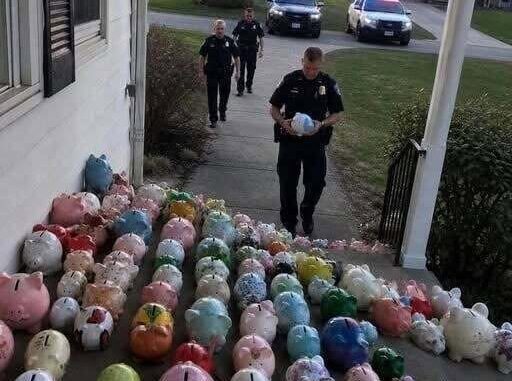
Our yard was filled with colorful savings containers.
There were ceramic piggy banks along the walkway.
Small jars stood near the porch steps.
Several handmade containers decorated with stickers sat beside the flower beds.
I couldn’t understand what was happening.
Oliver appeared behind me.
“Mom, why are there so many piggy banks?”
“I have no idea.”
Then I noticed two police vehicles parked nearby.
A couple of officers were speaking with neighbors at the end of the driveway.
One of them approached our porch.
“Good morning. Are you Oliver’s mother?”
“Yes.”
He smiled.
“We’ve been helping coordinate a neighborhood gathering, and I believe your son is the reason everyone’s here.”
I looked around in confusion.
“What kind of gathering?”
The officer gestured toward the donations.
“Your neighbors wanted to do something special.”
How the Neighborhood Heard About Oliver
The officer explained that Mrs. Adele had shared the story of Oliver’s visit with someone she trusted.
She had described how a six-year-old boy offered his savings because he was concerned about her electricity.
The story quickly reached several neighbors.
One person suggested organizing a small collection to help Mrs. Adele with her immediate needs.
Another offered to contact local community services.
Soon, more residents wanted to participate.
Some brought small donations.
Others offered groceries, transportation, or help with household tasks.
A few children decided to bring their own piggy banks as a symbolic gesture inspired by Oliver.
The officers had stopped by after being asked to assist with the busy neighborhood gathering and help keep the street clear.
There was no emergency.
Everyone simply wanted to make sure the event remained organized.
Oliver looked around in amazement.
“All these people came because of Mrs. Adele?”
The officer nodded.
“And because you reminded everyone how important it is to look after our neighbors.”
The Piggy Bank With a Special Message
Among the colorful containers was a small ceramic house.
It had a narrow opening in the roof and a handwritten note attached underneath.
One of the neighbors brought it over.
“We thought Oliver might like to read this,” she said.
I carefully removed the note.
It contained a simple message:
“You don’t need to have a lot to make a difference in someone’s life.”
I read it aloud.
Oliver smiled.
“That’s nice.”
The neighbor explained that several residents had contributed to the collection.
They planned to count the donations with Mrs. Adele’s permission and make sure any money was used appropriately.
The community also wanted to respect her privacy.
Rather than discussing her personal financial situation publicly, they focused on offering practical support.
I appreciated that approach.
Mrs. Adele deserved assistance without feeling uncomfortable or singled out.
More Than Financial Assistance
By the afternoon, neighbors had begun organizing different ways to help.
One resident offered to accompany Mrs. Adele when she contacted her electricity provider.
Another helped her find information about utility assistance programs.
A nearby family offered to include her in their weekly grocery trips.
Someone else volunteered to drive her to appointments when needed.
The goal wasn’t simply to collect money.
It was to make sure Mrs. Adele knew she had people nearby who cared about her well-being.
Over the next few days, the electricity issue was resolved with help from the appropriate provider and community support.
Mrs. Adele was grateful.
But what seemed to mean the most to her was discovering how many neighbors were willing to stay in touch.
Oliver’s Reaction to the Surprise
Throughout the day, Oliver remained unusually quiet.
He watched people talking in our yard.
He listened as neighbors shared ideas.
And he kept looking at the colorful piggy banks.
Finally, he turned to me.
“Mom, did I do something good?”
I crouched beside him.
“You did something thoughtful. You noticed that someone might need help, and you cared enough to ask.”
He smiled.
“Can I still save for my airplane?”
I laughed.
“Absolutely.”
I explained that he didn’t need to give away all his savings to be generous.
Helping others could mean offering time, sharing something appropriate, or simply checking on someone.
Oliver seemed pleased.
He returned his blue elephant piggy bank to his bedroom and began saving again.
But he had a new idea.
“Maybe I can have two piggy banks,” he suggested.
“One for my airplane and one for helping people.”
I thought that was a wonderful plan.
A New Tradition in the Neighborhood
The experience inspired several neighbors to stay more connected.
A few families began checking in on older residents who lived alone.
Others created a small contact list so neighbors could offer help when needed.
Some organized occasional grocery collections for local assistance programs.
Children became involved too.
They made greeting cards for elderly neighbors and helped their parents deliver approved donations to community organizations.
Nothing was particularly complicated.
There were no large fundraising campaigns or elaborate events.
People simply became more attentive to those living around them.
Mrs. Adele started receiving more visitors.
Sometimes neighbors stopped by for a short conversation.
Other times, they helped with small errands.
And Oliver continued visiting whenever we had time.
Their friendship remained as strong as ever.
What My Son Taught Me About Kindness
As adults, we sometimes assume that helping others requires significant resources.
We think about how much money we can contribute or whether we have enough time to volunteer.
But Oliver approached the situation differently.
He noticed something unusual.
He became concerned.
And he asked what he could do.
His first idea was to offer his savings.
Although we found a more practical way to help, his willingness to share encouraged others to take action.
It reminded me that generosity isn’t measured only by the amount someone gives.
A thoughtful conversation can make a difference.
So can helping a neighbor carry groceries, offering transportation, or connecting someone with a useful local resource.
Small gestures often matter because they show people they haven’t been forgotten.
Helping Older Neighbors Respectfully
Oliver’s experience also taught our family an important lesson about supporting older adults.
Not everyone who lives alone needs financial assistance.
And a dark house doesn’t necessarily mean someone is experiencing hardship.
That’s why it’s important to ask rather than assume.
When offering help, respecting privacy and personal choices matters.
Sometimes the most useful support is helping someone find reliable information about available services.
Community organizations, utility assistance programs, and local social services may offer resources to people facing temporary financial difficulties.
For families who want to contribute, working through established organizations can help ensure donations are handled responsibly.
And for children, learning about generosity can begin with simple, age-appropriate activities that don’t require giving away personal savings.
A Small Gesture With a Lasting Impact
Several weeks after the neighborhood gathering, I watched Oliver sitting on Mrs. Adele’s front steps.
They were talking about the birds visiting her garden.
She pointed toward a small robin perched on the fence.
Oliver listened carefully.
Then he asked whether the bird would return the next day.
Mrs. Adele smiled.
“We’ll have to wait and see.”
I stood across the street for a moment, watching them.
The scene looked almost exactly as it had before the electricity problem.
A little boy talking with his elderly neighbor.
Two friends enjoying an ordinary afternoon.
But something had changed.
Mrs. Adele now had more people checking in on her.
Our neighbors knew one another better.
And Oliver had learned that caring for someone could inspire others to help too.
Final Thoughts
When my six-year-old son offered his savings to help Mrs. Adele, I thought it would be a private moment between our family and a neighbor.
I never expected to open my front door the following morning and find colorful piggy banks scattered across our yard.
I certainly didn’t expect the story to bring so many people together.
But the experience reminded me of something important.
Kindness doesn’t have to begin with a grand gesture. Sometimes it starts with simply noticing that someone might need a friend.
Oliver didn’t understand the details of Mrs. Adele’s electricity account.
He didn’t know how the neighborhood would respond.
He only knew that someone he cared about might be having a difficult time.
And he wanted to help.
His small act of compassion encouraged an entire community to become more connected.
Today, Oliver is still saving for his remote-control airplane.
But beside his blue elephant piggy bank sits another little container.
He calls it his helping fund.
Whenever he adds a coin, he smiles and tells me:
“Maybe this can help someone someday.”
And every time he says it, I’m reminded that some of life’s most valuable lessons come from the people we least expect to teach us.
Leave a Reply