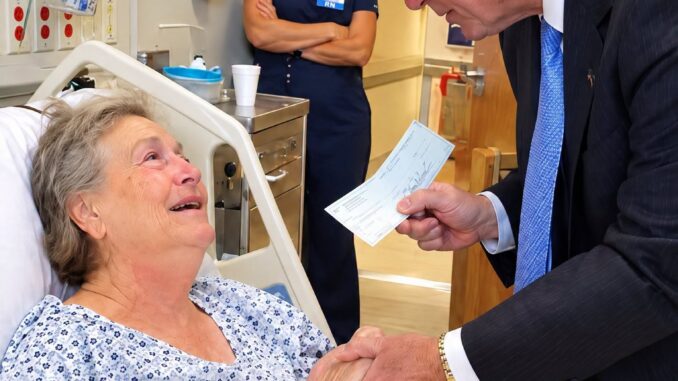
Chapter 1: The Empty Chairs
When I woke up after heart surgery, the first thing I noticed was the soft sound of the medical equipment beside my bed.
The second was the gray Seattle sky beyond the hospital window.
Then I looked toward the three chairs arranged along the wall.
They were empty.
I had imagined opening my eyes and seeing my children waiting nearby. Before the operation, all three had promised to be there.
My oldest son, David, said he would take the day off work.
My daughter, Sarah, promised to bring my favorite yellow roses.
My youngest son, Michael, assured me he would arrive as soon as his morning appointments were finished.
I was sixty-four years old, and the surgery had been a major event in my life.
Although the medical team had explained the procedure carefully, I had still been nervous.
Knowing my children would be nearby had helped me feel less afraid.
Now, as I looked around the quiet room, I wondered where they had gone.
A nurse entered a few moments later.
Her name tag read Kayla.
“Good afternoon, Mrs. Davis,” she said warmly. “How are you feeling?”
“Tired,” I admitted. “Could I have some water?”
She helped me take a few small sips.
Then I asked the question that had been on my mind.
“Have you seen my children?”
Kayla paused.
“They were here while you were in surgery,” she explained. “They waited in the family lounge.”
I felt relieved.
“Are they coming back?”
She told me they had left about an hour earlier.
Apparently, they believed I would be resting for the remainder of the afternoon and had decided not to stay.
Parking costs had also been mentioned.
I tried not to take it personally.
They had busy lives, jobs, and responsibilities.
Still, I felt disappointed.
I had spent so many years being there for them that I had hoped they would stay a little longer when I needed support.
I turned toward the window.
Kayla adjusted my blanket and encouraged me to rest.
Then someone appeared at the doorway.
He was a tall man with gray hair, wire-rimmed glasses, and a leather briefcase.
“Excuse me,” he said politely. “Are you Adrienne Davis?”
“Yes.”
He smiled.
“You probably don’t remember me. But many years ago, you helped me when I was a little boy.”
I looked at him, puzzled.
Then he added something I never expected.
“You used to buy my lunch.”
Chapter 2: A Boy From Franklin Elementary
The man introduced himself as Malcolm Chen.
He explained that when he was a child, he had been known as Malcolm Peterson.
That name brought back a memory from long ago.
When I was sixteen, I worked part-time as a teaching assistant at Franklin Elementary School in South Seattle.
My family didn’t have much money.
I was grateful for the small amount I earned, and I tried to save whenever possible.
During lunch breaks, I often helped supervise the cafeteria.
That’s where I noticed a quiet boy who usually sat near the end of a table.
His clothes were often worn, and he rarely had a proper lunch.
I didn’t know much about his circumstances.
But I could tell that mealtimes were difficult for him.
One afternoon, I used part of my earnings to purchase a few cafeteria meal tickets.
I gave one to him discreetly.
“The cafeteria has some extra meals today,” I said. “You should get something before they go to waste.”
He looked uncertain.
I smiled and encouraged him to take it.
The next day, I brought another ticket.
I continued helping whenever I could.
It wasn’t a grand gesture.
I simply didn’t want him to spend his lunch breaks hungry or embarrassed.
Now, decades later, that little boy was standing beside my hospital bed.
Malcolm opened his briefcase.
He removed a small yellow piece of cardboard.
It was an old cafeteria ticket.
“You gave me two on the last day of school,” he explained. “I used one and saved the other.”
I held the faded ticket carefully.
I couldn’t believe he had kept it all these years.
Chapter 3: The Life Malcolm Built
Malcolm pulled a chair closer.
He told me that his childhood had been difficult.
His family circumstances changed several times, and he eventually spent a period in foster care.
Later, a couple named Robert and Grace Chen welcomed him into their home and adopted him.
They encouraged him to pursue his education.
He worked hard in school and eventually attended the University of Washington.
From there, he continued his studies in medicine and healthcare administration.
Over the years, he built a successful career.
Today, he helped lead a healthcare organization operating several hospitals across the Pacific Northwest.
I listened in amazement.
The quiet child I remembered had become a respected professional.
But Malcolm said his greatest achievement wasn’t his career.
It was a program he had created to help children who needed meals while visiting hospitals.
Some were young patients.
Others were siblings waiting with relatives.
The program offered food without making families complete unnecessary paperwork or explain their circumstances in front of others.
“Last year, we helped thousands of children,” he told me.
I looked down at the yellow ticket.
“All because of this?”
He smiled.
“That ticket reminded me that somebody noticed when I needed help.”
I felt deeply moved.
I had never imagined that something so ordinary could remain important to someone for so many years.
For the first time since waking up, I felt less alone.
Chapter 4: A Difficult Conversation About My Family
After we spoke about his childhood, Malcolm asked how I had been doing.
I told him about my years working in the Seattle public school system.
I explained that my husband, Frank, had passed away years earlier.
After losing him, I had raised our three children while continuing to work.
Life had been busy.
There were school activities, household expenses, and countless responsibilities.
But I had always tried to make sure my children had what they needed.
Now they were adults with lives of their own.
Malcolm asked whether I had support during my recovery.
I mentioned that my children had been at the hospital earlier but had gone home.
He listened.
Then he asked whether I had someone who could help me after discharge.
I thought about my longtime friend Joyce Whitaker.
Joyce lived nearby and had offered to assist.
I told Malcolm that I would contact her.
He nodded.
Then his expression became serious.
“Adrienne, there’s something else I wanted to discuss with you.”
I looked at him.
He explained that he had spent years trying to find me so he could thank me.
During that search, he had come across information suggesting that I might be dealing with complicated family financial matters.
I felt uncomfortable.
My finances were personal.
Malcolm acknowledged that and apologized for raising the subject unexpectedly.
He said he didn’t want to interfere.
But he believed I should know about some concerns that had come to his attention.
Chapter 5: Years of Financial Support
Over the years, I had helped my children financially whenever I could.
David, my oldest son, had started an accounting business.
When the business experienced difficulties, he asked whether I could lend him money.
I eventually provided $60,000 from my savings.
He promised to repay it when the business improved.
But the repayments never began.
Sarah had struggled with credit card debt.
I had helped her with several monthly payments because I didn’t want her to fall further behind.
Michael had asked me to co-sign a vehicle loan.
I agreed, believing he would manage the payments responsibly.
Later, he missed several installments.
I found myself worrying about obligations that weren’t originally mine.
I had never thought of these decisions as extraordinary.
They were my children.
I loved them.
And I wanted to help.
But as Malcolm listened, he gently asked whether I had enough money left to support my own retirement.
I hesitated.
The truth was that I had become increasingly careful with my spending.
I lived on a modest retirement income and Social Security benefits.
I could manage my daily expenses, but unexpected costs had become stressful.
For the first time, I wondered whether I had been helping my children at the expense of my own security.
Chapter 6: Questions About My Future
Malcolm explained that some information he had encountered suggested my children were discussing my future living arrangements.
He was careful to say that he didn’t know their full intentions.
He had heard that David was consulting an attorney about legal options for assisting an older parent.
Sarah had been exploring assisted-living communities.
Michael had asked questions about managing a parent’s financial affairs.
I was surprised.
Nobody had discussed those plans with me.
I lived independently.
I managed my household.
I paid my bills.
And although I was recovering from surgery, I had no reason to believe I needed someone else to make all my decisions.
I told Malcolm that I wanted to understand what was happening.
He encouraged me to speak with a qualified attorney.
I agreed.
I didn’t want to accuse my children of anything without hearing their explanation.
But I also didn’t want important decisions about my future made without my participation.
Chapter 7: Seeking Independent Legal Advice
That evening, I spoke with an attorney named Gloria Nakamura.
She had extensive experience with estate planning, elder law, and protecting the independence of older adults.
I explained my concerns.
Gloria listened carefully.
She told me that adult children sometimes explore legal arrangements because they genuinely worry about a parent’s well-being.
But she also explained that financial stress and family disagreements can complicate those decisions.
She emphasized that I should understand any document before signing it.
We reviewed my existing legal arrangements.
David had previously been named as my healthcare representative under a power of attorney.
At the time, I had trusted him to make decisions if I ever became unable to do so.
Now I wanted to reconsider that choice.
Gloria explained the steps involved in reviewing or changing those documents under the applicable rules.
I decided to name Joyce, my longtime friend, as my preferred healthcare representative.
I also asked Gloria to help me review my financial power of attorney and other estate-planning documents.
I wanted everything to reflect my current wishes.
Chapter 8: A Question of Independence
During our conversation, Gloria explained that guardianship and similar court arrangements are serious legal matters.
The requirements vary by jurisdiction and circumstance.
In Washington, courts generally consider evidence about a person’s ability to make decisions and whether less restrictive alternatives may be appropriate.
Gloria encouraged me not to panic.
She said that recovering from surgery did not, by itself, establish that I was unable to manage my affairs.
Still, I wanted to be prepared.
I agreed to an independent assessment by a qualified medical professional when my treating team considered it appropriate.
I wanted an objective evaluation of my memory, reasoning, and decision-making ability.
I also asked Gloria to help me understand whether any court filings had been made.
After checking through the appropriate channels, she confirmed that a petition concerning my affairs had recently been submitted.
A hearing was scheduled for Thursday.
I felt deeply unsettled.
I hadn’t expected to spend my recovery discussing legal documents.
But I was grateful to have professional guidance.
Chapter 9: My Children Return
The following morning, my children arrived at the hospital.
Sarah entered first, carrying yellow roses.
Michael followed with a cheerful balloon.
David came last, holding a large envelope.
“Mom, you’re looking better,” Sarah said.
She kissed my cheek and arranged the flowers beside the bed.
I thanked her.
Michael asked how I was feeling.
I told him I was tired but improving.
Then I asked why they had left the previous afternoon.
Sarah explained that they believed I would be sleeping.
Michael admitted that the parking charges had been frustrating.
I told them I understood that waiting at a hospital could be tiring.
But I also explained how disappointed I had felt when I woke up alone.
For a moment, nobody spoke.
Then David changed the subject.
He said there were some documents we should discuss while I was in the hospital.
Chapter 10: The Paperwork David Brought
David opened his envelope.
He explained that he wanted to make managing household matters easier while I recovered.
He handed me a document and suggested I sign it.
I asked to read it first.
He seemed impatient.
“Mom, it’s mostly legal language. We can explain it.”
“I’d still like to understand it myself,” I replied.
I put on my reading glasses.
The document wasn’t simply an insurance form.
It was a financial power of attorney.
It would give David broad authority to act on my behalf in several financial matters.
Some provisions concerned property transactions.
I looked up.
“David, why do you need this much authority?”
He said he wanted to protect me from unnecessary stress.
I told him I appreciated practical help.
But I wasn’t comfortable signing a document that could significantly affect my finances without independent advice.
He suggested I was overcomplicating the situation.
I calmly placed the document on the bedside table.
“I’m not signing anything today.”
Chapter 11: The Conversation We Had Avoided
David looked frustrated.
Sarah glanced at Michael.
I asked them directly whether they had been discussing my future living arrangements.
There was a long silence.
Finally, Sarah admitted that David had raised concerns about my ability to manage money.
He had pointed to the financial assistance I had given all three children.
He believed my savings were declining too quickly.
I looked at David.
“My savings have declined because I’ve been helping you.”
He didn’t answer.
I reminded him about the $60,000 loan.
I mentioned Sarah’s credit card payments and Michael’s vehicle loan.
I wasn’t trying to embarrass them.
I wanted us to acknowledge the facts.
I had made those decisions willingly.
But the financial strain did not automatically mean I lacked the ability to understand my affairs.
It meant I needed to establish better boundaries.
Chapter 12: Sarah Explains Her Concerns
Sarah began to cry.
She said she had been worried about my recovery and future healthcare needs.
She had visited several assisted-living communities to learn what services were available.
She also admitted that she had hoped selling my house might eventually provide money for my care.
I asked whether she had intended to discuss that possibility with me.
She lowered her eyes.
“Eventually,” she said.
I felt hurt.
My little green house in Ballard was more than an asset.
It was where I had raised my children.
It held memories of Frank, family celebrations, and ordinary evenings together.
I didn’t object to discussing future care.
I knew that planning could be responsible.
But I wanted to be part of those conversations.
I told Sarah that my wishes mattered.
She nodded.
“I know, Mom. I’m sorry.”
Chapter 13: Michael’s Admission
Michael had been quiet throughout the conversation.
Eventually, he spoke.
He said he had followed David’s suggestions because he was worried about his own financial situation.
The vehicle loan had become difficult to manage.
He feared that if I stopped helping, he would face serious consequences.
I listened.
Then I told him something I should have said years earlier.
“I love you, Michael. But I can’t keep solving every financial problem for you.”
He nodded slowly.
I explained that I needed to protect my retirement savings and prepare for my own healthcare expenses.
That didn’t mean I would stop caring about my children.
It meant our relationship needed to change.
I wanted them to become more independent.
And I needed to remain independent too.
Chapter 14: Support From People I Trusted
Later that morning, Gloria returned to the hospital.
Joyce came with her.
Malcolm also stopped by briefly to ask how I was recovering.
I introduced everyone to my children.
Gloria explained that she was helping me review my legal arrangements.
She made it clear that I wanted independent advice before making decisions about my property or finances.
I also explained that I had requested an objective assessment of my decision-making ability.
The assessment was completed by Dr. Elena Ruiz, a qualified specialist.
She found that I could understand relevant information, discuss my options, and communicate informed decisions at the time of the evaluation.
The findings were provided to my attorney for the legal proceedings.
I felt relieved.
Not because I needed to prove my worth to my children.
But because I wanted decisions about my future to be based on accurate information.
Chapter 15: The Court Hearing
Thursday morning arrived.
Because I was still recovering, arrangements were made for me to participate in the hearing remotely.
Joyce sat beside me.
Gloria represented my interests.
The court reviewed the petition and the available information.
The independent assessment was considered alongside other relevant documents.
The court also heard about my current wishes and the legal arrangements I had reviewed with Gloria.
David attended with his attorney.
Sarah and Michael had decided not to support the petition.
After consulting his lawyer, David chose to withdraw his request.
The court dismissed the matter.
I knew that legal outcomes depend on the facts and procedures of each case.
But in my situation, I was grateful that the matter had been resolved without further proceedings.
When the hearing ended, I leaned back against my pillows.
For the first time since surgery, I felt able to focus fully on my recovery.
Chapter 16: A Different Conversation With David
A few days later, David called.
His voice was quieter than usual.
He said he had been thinking about what happened.
He acknowledged that he should have discussed his concerns with me openly rather than making plans without my agreement.
I listened.
Then I told him how much the experience had hurt.
I had always tried to support him.
I never expected that support to become a reason for questioning my independence.
David apologized.
He also agreed to put a repayment plan in writing for the money he had borrowed.
With appropriate advice, we documented the arrangement.
It didn’t resolve every difficulty between us.
But it was a practical step toward rebuilding trust.
Chapter 17: Returning to My Little Green House
I was discharged from the hospital the following Monday.
Joyce drove me home.
When we turned onto my street in Ballard, I saw my little green house waiting beneath the cloudy Seattle sky.
The sight brought tears to my eyes.
I had spent years creating a home where my family could gather.
Now I was grateful simply to return to it.
A home health professional named Leticia was waiting to discuss my recovery support.
Malcolm had offered to help cover additional services for several weeks, subject to my agreement and the care plan recommended by my medical team.
At first, I hesitated.
I wasn’t accustomed to accepting such generous assistance.
But Malcolm reminded me that people sometimes need help, regardless of how independent they usually are.
I accepted with gratitude.
The extra support made my recovery more comfortable.
Chapter 18: Malcolm’s New Idea
Malcolm visited later that week.
He brought groceries and a bouquet of yellow roses.
We sat on my porch and talked about the years that had passed since Franklin Elementary.
Then he told me about a new opportunity.
His healthcare organization was expanding its children’s meal assistance program.
He wanted someone with experience in education and community support to help coordinate it.
He thought I might be interested.
I laughed.
“Malcolm, I just had heart surgery.”
He smiled.
“There’s no rush. Your recovery comes first.”
He explained that the position could be part-time and largely remote once I was medically ready to work.
I promised to think about it.
Over the following weeks, the idea stayed with me.
I had spent my career helping children.
The possibility of continuing that work in a new way felt meaningful.
After discussing it with my medical team and considering the responsibilities, I accepted.
Chapter 19: The Children’s Table
We called the program The Children’s Table.
Its purpose was simple.
Children visiting participating hospitals could receive meals when their families needed assistance.
We wanted the process to be welcoming and discreet.
No child should feel embarrassed about needing food.
I worked with staff members to improve communication, coordinate volunteers, and make the program easier for families to access.
The work gave me a renewed sense of purpose.
I wasn’t trying to prove that I could still contribute.
I simply enjoyed being useful.
During the first year, the program expanded significantly.
Across participating locations, it helped provide more than fifty thousand meals to children.
I was proud of what the team accomplished.
But I was especially touched by one small detail.
On the back of each meal ticket, we printed a familiar sentence:
The cafeteria made extras today.
It was a gentle reminder of the way I had helped Malcolm all those years earlier.
Chapter 20: A Change at the Hospital
About a month after returning home, I visited the hospital for a follow-up appointment.
Joyce drove me.
As we entered the parking garage, I noticed a new sign near the payment machines.
The hospital had introduced a parking assistance policy for families visiting admitted patients.
Under the new program, eligible visitors could receive parking support so that costs were less likely to prevent them from spending time with loved ones.
I read the notice carefully.
It reminded me of the afternoon I had awakened to find three empty chairs.
Later, Malcolm explained that his organization had been reviewing visitor access and transportation barriers.
My experience had contributed to those discussions.
I was glad.
Hospitals can be stressful places.
Families shouldn’t have to worry unnecessarily about practical obstacles when someone they love is receiving care.
The policy wouldn’t solve every problem.
But it could make difficult days a little easier.
Chapter 21: Learning to Set Financial Boundaries
As my health improved, I spent time reviewing my finances.
Gloria helped me understand my legal documents.
I also worked with a financial professional to create a more realistic retirement budget.
I listed my income, regular expenses, and future healthcare needs.
Then I reviewed the financial assistance I had provided to my children.
For years, I had treated their emergencies as my responsibility.
If one needed money, I tried to find it.
If another struggled with bills, I offered help.
But I hadn’t always considered how those decisions affected my long-term security.
I decided to make some changes.
I would no longer co-sign loans without careful consideration.
I would not agree to major financial transfers under pressure.
And I would keep clear records of any money I chose to lend.
I still loved my children.
But I was learning that love and financial boundaries could exist together.
Chapter 22: David Begins Again
David continued making payments toward his loan.
His business difficulties eventually led him to make significant changes.
He sold the accounting business and accepted a position with another company.
It wasn’t the future he had originally planned.
But he told me the stability was helping him regain confidence.
One afternoon, he visited my house.
We sat at the kitchen table with coffee.
He apologized again for the way he had handled the legal situation.
I told him I appreciated hearing that.
We didn’t resolve every disagreement.
There were still painful memories.
But we talked more openly than we had in years.
Before leaving, he asked whether he could visit the following weekend.
I said yes.
I wanted a relationship with my son.
I simply needed it to be built on mutual respect.
Chapter 23: Sarah Makes Changes
Sarah began visiting on Sundays.
Sometimes we had lunch.
Other times, she helped me in the garden.
She also started working with a financial counselor to address her debt.
I was proud that she was taking responsibility for her situation.
One afternoon, while we were planting flowers, she told me about a woman she had seen during a visit to an assisted-living community.
The woman had been sitting alone, waiting for a family member.
Sarah said the memory had stayed with her.
She had begun thinking more carefully about what older adults might experience when major decisions are made without their involvement.
“I should have asked what you wanted,” she told me.
I nodded.
“That’s all I ever wanted, Sarah. To be included.”
She hugged me.
It was a simple conversation.
But it meant a great deal.
Chapter 24: Michael Finds His Own Way
Michael faced difficulties with his vehicle loan.
Eventually, he had to give up the truck.
He was disappointed.
But he also recognized that he needed to make more sustainable financial choices.
He found a less expensive car and began working toward completing a degree he had left unfinished.
He called me every Wednesday.
Sometimes we talked about school.
Sometimes we discussed the weather or his plans for the weekend.
The calls were often brief.
But I appreciated them.
Our relationship was becoming less focused on financial emergencies.
We were learning how to enjoy ordinary conversations again.
That felt like progress.
Chapter 25: A Year Later
Almost a year passed after my surgery.
My recovery had gone well, and I was grateful to be living independently in my little green house.
The cherry tree in the backyard bloomed beautifully in spring.
I spent mornings reading on the porch and afternoons working on the meal program.
Some days were busy.
Others were quiet.
I enjoyed both.
My relationship with my children was still evolving.
Trust takes time to rebuild.
There were moments when old disagreements resurfaced.
But we had become more willing to discuss difficult subjects without avoiding them.
I had also learned to ask for help when I needed it.
Joyce remained a close friend.
Malcolm continued supporting the meal program.
And I felt fortunate to have people in my life who respected my independence.
Chapter 26: Another Child in the Cafeteria
One afternoon, I visited a hospital to meet with staff members about The Children’s Table.
Afterward, I stopped in the cafeteria for tea.
Near the window, I noticed a young girl sitting quietly.
She appeared to be about eight years old.
She wore a hospital visitor sticker and held a small juice box.
I saw her looking toward the food counter.
Something about the moment reminded me of Franklin Elementary.
I approached a cafeteria staff member and asked whether the girl might be eligible for a meal through our program.
The staff member checked and confirmed that assistance was available.
With the appropriate caregiver’s permission, we offered her a meal ticket.
The girl looked surprised.
“Really?”
“Of course,” I said.
She smiled and walked toward the counter with her caregiver.
I watched for a moment.
Then I returned to my tea.
It was a small interaction.
But it reminded me why the program mattered.
Chapter 27: The Yellow Ticket
Inside my purse was the old cafeteria ticket Malcolm had shown me in the hospital.
He had given it back to me on my sixty-fifth birthday.
For decades, he had kept it as a reminder of a difficult childhood and the kindness someone had shown him.
Now he wanted me to have it.
I took it out and studied the faded lettering.
I remembered being sixteen.
I remembered the school cafeteria, the crowded tables, and the quiet little boy who rarely had lunch.
At the time, I hadn’t imagined that I was doing anything extraordinary.
I simply noticed someone who needed help.
Years later, that same child had grown into a man who created opportunities to help thousands of others.
And when I was recovering from surgery, he had returned to thank me.
The thought filled me with gratitude.
Chapter 28: What the Empty Chairs Taught Me
I still remember waking up in the hospital and seeing those three empty chairs.
At the time, I felt forgotten.
I had expected my children to be there.
Their absence hurt.
But that difficult afternoon also became the beginning of important changes.
I learned to speak more openly about my needs.
I learned to protect my financial independence.
I learned that accepting assistance doesn’t make someone weak.
And I learned that relationships become healthier when people respect one another’s choices.
My children and I still had work to do.
But we were making progress.
We were learning to communicate more honestly.
And I was discovering that my life could hold new opportunities even after retirement.
Final Thoughts: The Lasting Value of Kindness
When I bought those cafeteria tickets as a teenager, I never expected anything in return.
I didn’t know whether Malcolm would remember me.
I didn’t know what his future would look like.
I only knew that he needed a meal.
Many years later, he reminded me that small acts of compassion can have lasting meaning.
His generosity helped me during recovery.
His meal program gave me a new purpose.
And his commitment to helping families created opportunities for others to receive support.
But the greatest lesson wasn’t that kindness would eventually be rewarded.
It was that kindness matters even when nobody notices.
A thoughtful action may seem small in the moment, but its influence can continue long after we have forgotten it.
That evening, I placed the yellow ticket back in my purse and drove home.
The porch light was glowing outside my little green house.
Inside, everything was quiet and familiar.
I made a cup of tea, sat by the window, and watched the last light fade from the Seattle sky.
I thought about the people who had helped me, the relationships I was rebuilding, and the children who would receive meals through our program.
Then I smiled.
For the first time in a long while, I felt truly at peace.
Leave a Reply