A Disappointing Visit to the Sawmill
My eighty-year-old father sat beside me in the logging truck, staring at a check for $600.
We had just left Lindholm Lumber Company, the sawmill operated by my cousin Lyle.
The check was supposed to cover twenty-two black cherry logs that Dad had spent weeks preparing.
On the memo line, Lyle had written one word: Pallet.
I knew why Dad was disappointed.
Those trees had grown on our family’s hillside for decades. Some had been there since before he was born.
Harvesting them had taken time, effort, and careful planning.
Yet Lyle had classified every log as low-grade timber.
I had worked in the logging industry for twenty-six years, and the evaluation didn’t match what I believed the logs were worth.
Rather than argue, I decided we should find someone willing to examine them more closely.
The Trees Behind Our Family Farm
My grandfather Nils had immigrated from Sweden and eventually purchased the land where my parents still lived.
He believed that caring for a farm meant thinking beyond your own lifetime.
He planted trees, maintained the fields, and taught his children to respect the land.
One of the black cherry trees on the hillside had been planted around the time my father was born.
Dad often spoke about that tree.
As a boy, he played beneath its branches.
Years later, he watched his own children explore the same hillside.
Eventually, his grandchildren came to know it too.
When Dad turned eighty, he decided it was time to harvest several mature trees.
My mother needed dental treatment that their insurance wouldn’t fully cover.
Dad also hoped to save a little money for his grandchildren.
He saw the timber as an opportunity to provide for his family.
The First Offer
A few months before the harvest, Lyle visited the farm.
His father, Walt, had established Lindholm Lumber Company in 1961.
For decades, Walt had been known for treating local timber suppliers fairly.
After his death, Lyle inherited the operation.
During his visit, Lyle walked the hillside with Dad and examined the cherry trees.
He offered $4,000 for the standing timber.
Dad thanked him but declined.
He wanted to harvest the trees himself.
My son Mason and I agreed to help with the work.
Throughout October, we spent weekends preparing the logs.
Dad handled tasks he was comfortable with, while Mason and I helped with the heavier equipment.
By the end of the month, twenty-two logs were ready to be delivered.
An Unexpected Evaluation
When we arrived at Lyle’s sawmill, I expected him to inspect the timber carefully.
Instead, he moved along the grading deck and marked each log with the letter P.
Every log received the same classification.
Lyle explained that he considered the timber suitable mainly for pallet production.
He estimated approximately 4,300 board feet and offered fourteen cents per board foot.
That came to about $600.
I was surprised.
The logs appeared to contain far better material than the grading suggested.
I asked whether he would reconsider.
Lyle insisted that the offer reflected what he was willing to pay.
I told him we weren’t ready to accept it.
Mason helped reload the trailer.
Dad folded the check and placed it in his coat pocket.
We drove home with all twenty-two logs.
Searching for Another Opinion
When we returned to the farm, Mom made coffee.
We sat around the kitchen table and discussed what had happened.
Dad was disappointed, but he didn’t want to argue with Lyle.
He simply wanted to understand whether the timber was worth more.
I remembered a sawmill near Smicksburg, Pennsylvania.
It belonged to an Amish craftsman named Levi Yoder.
I had delivered timber to Levi before and remembered how carefully he evaluated hardwood.
I called him that afternoon.
After hearing about the trees, he asked several questions about their dimensions and condition.
Then he invited us to bring the logs to his mill.
“Come Saturday morning,” he said. “And bring your father.”
Dad immediately agreed.
The Journey to Levi’s Mill
We left early Saturday.
Dad rode with me in the logging truck, while Mason followed in his pickup.
Mom packed sandwiches, coffee, and a homemade pie.
As we traveled through the Pennsylvania countryside, Dad began telling stories about his childhood.
He spoke about his father planting trees and teaching him to care for the land.
He explained that Nils believed planting a tree was a gift to future generations.
The largest log on our trailer had come from the tree planted around the time Dad was born.
That made the trip especially meaningful.
When we arrived, Levi greeted us warmly.
His sawmill was simple but well organized.
A diesel engine powered the machinery, and his family worked together to process timber.
Levi began inspecting the logs.
A Careful Examination
Levi studied the ends of the logs, examined their bark, and checked their shape and condition.
He spent extra time looking at the largest cherry log.
Then he explained that the appearance of a log can provide clues about its quality, but sawing it reveals more about the wood inside.
Mason helped unload the trailer.
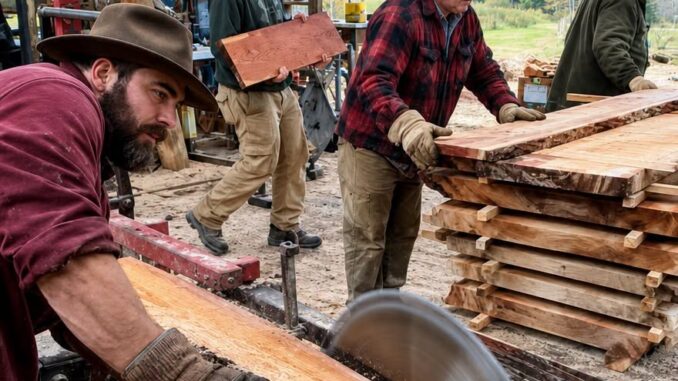
Levi prepared the first log for cutting.
As the saw began working, the outer sections were removed.
Then a smooth cherry board emerged.
Its color was a rich reddish brown.
The grain was attractive and consistent.
Dad stepped closer and gently placed his hand on the wood.
For a moment, he said nothing.
I knew he was remembering the tree as it had stood on our hillside.
It had been part of his life for decades.
Now it was becoming something new.
The Quality of the Lumber
Throughout the morning, Levi and his team processed the logs.
They separated the finished boards according to quality.
Some contained knots and other natural imperfections.
Others had large, clear sections suitable for furniture and cabinetry.
Levi explained that much of the best lumber met the characteristics of FAS, or Firsts and Seconds, a premium hardwood grade.
Other pieces were classified as Number One Common.
Both grades could be useful, but they served different purposes and commanded different prices.
Dad appreciated the explanation.
He wasn’t simply being told what the timber was worth.
He could see how the boards were being evaluated.
By early afternoon, Levi had finished measuring the lumber.
A Very Different Valuation
Levi explained that the logs had produced approximately 4,600 board feet of finished lumber.
His measurements showed that about 3,100 board feet were premium-quality cherry.
Another 1,500 board feet were Number One Common.
He offered $2.80 per board foot for the premium material and $1.40 for the common lumber.
The calculated total was $10,780.
Dad looked at him in surprise.
The difference from Lyle’s offer was substantial.
Levi explained that raw logs and processed lumber are not directly comparable products.
Harvesting, transportation, sawing, grading, drying, and market conditions all influence the final value.
Still, the evaluation demonstrated that the timber contained a significant amount of high-quality cherry.
Dad finally had the information he had been looking for.
A Special Request
Before completing the sale, Levi suggested that Dad keep seven particularly beautiful boards.
They had come from the largest cherry tree.
Levi knew how much that tree meant to our family.
He offered to dry those boards in his kiln so Dad could use them for a future project.
Dad liked the idea.
They agreed that Levi would purchase the remaining lumber for $9,400.
Dad accepted the arrangement.
He thanked Levi for taking the time to explain the grading process.
As we prepared to leave, Dad asked why the first evaluation had been so different.
Levi didn’t speculate about Lyle’s intentions.
He simply explained that careful examination was essential when determining timber quality.
Dad nodded.
That answer was enough for the moment.
Plans for the Money
During the drive home, Dad seemed more relaxed.
He began discussing how he would use the money.
First, he wanted to pay for Mom’s dental treatment.
Then he hoped to give his grandchildren Christmas gifts.
He also planned to put something aside for Mason’s education.
I was surprised when Dad mentioned that Mason was interested in studying forestry at Penn State DuBois.
Apparently, they had been discussing it for months.
Dad smiled.
He hoped Mason would learn about responsible forest management and the value of different types of timber.
He wanted his grandson to understand both the practical and environmental sides of the industry.
I looked at Dad and realized that the sale had given him more than financial relief.
It had given him something positive to plan for.
Lyle Returns to the Farm
Two weeks before Christmas, Lyle came to visit.
Snow was falling lightly when he arrived.
He stood near the barn for several minutes before approaching the house.
Dad invited him inside.
Lyle explained that he had heard about the sale at Levi’s sawmill.
Then he admitted that Lindholm Lumber Company had been experiencing serious financial difficulties.
He had borrowed money to purchase new equipment, and the business wasn’t generating enough income to cover its obligations.
The bank was considering taking possession of the mill.
Lyle said the pressure had affected his judgment.
He acknowledged that he had deliberately assigned lower grades to some timber in an effort to purchase it at reduced prices.
He also admitted that he had recognized the quality of Dad’s cherry trees during his earlier visit.
Dad listened quietly.
An Important Conversation About Trust
When Lyle finished speaking, Dad reached into his coat pocket.
He removed the original $600 check.
He had kept it all that time.
He placed it on the table.
Then he reminded Lyle of the reputation his father Walt had worked so hard to establish.
Walt had believed that a successful business depended on honest relationships.
Farmers needed to trust the people evaluating their timber.
And customers needed confidence in the products they purchased.
Dad told Lyle that financial pressure could make decisions difficult, but it didn’t remove the responsibility to treat people fairly.
Lyle apologized.
Dad accepted that he was trying to take responsibility.
But he also encouraged him to contact anyone else who might have received an unfair evaluation.
An apology was a beginning.
Making things right would require action.
Taking Responsibility
Over the following weeks, Lyle contacted eleven farmers and timber owners.
He explained that some of his previous evaluations had been unfair.
He apologized and began discussing ways to address the differences.
Not everyone responded positively.
Some were disappointed.
Others appreciated his willingness to acknowledge what had happened.
Lyle sold personal belongings, including his pickup truck and a hunting property, to help repay outstanding amounts.
He also arranged installment payments where possible.
Despite those efforts, the financial problems at the sawmill continued.
Eventually, the bank took possession of the business.
The equipment was sold.
The company Walt had established decades earlier closed.
It was a difficult chapter for our family.
But Lyle understood that he needed to begin again.
A New Beginning at the Sawmill
Several months later, Lyle visited Levi Yoder.
He explained his circumstances and asked whether there might be work available.
He wasn’t seeking a management role.
He was willing to start with basic tasks and learn from experienced workers.
Levi considered the request.
Then he offered him a position.
Lyle began helping move logs, stack boards, and maintain the work area.
He also received guidance in hardwood grading.
The job was different from running his own business.
But Lyle approached it seriously.
Over time, he developed a greater appreciation for careful evaluation and honest communication.
He later told me that returning to the fundamentals of the trade had helped him reconsider his priorities.
Seven Boards From a Special Tree
While Lyle was rebuilding his career, Dad had begun a project of his own.
In January, the seven cherry boards returned from Levi’s kiln.
Dad brought them into his workshop and arranged them on sawhorses.
He examined the grain and began making measurements.
He wouldn’t tell us what he was building.
Mason helped him on Saturdays.
Together, they measured, cut, shaped, and joined the wood.
Dad worked patiently.
He enjoyed using hand tools and paying attention to small details.
Sometimes I stopped by to watch.
But whenever I asked what he was making, he simply smiled.
“You’ll see.”
Several months later, he finally revealed the finished piece.
A Gift for Mom
Dad had built a beautiful piano bench.
It was made from the cherry tree his father had planted decades earlier.
The wood had a rich reddish-brown finish.
The seat opened to reveal a storage compartment for hymnbooks and sheet music.
Dad had designed it to accompany Mom’s old Baldwin piano.
Inside the lid, he had carefully burned an inscription:
Planted in 1945 by Nils for his son’s old age. Cut in 2025 by Arvid for his wife.
He also added a line inspired by a Swedish hymn that had been part of our family for generations.
On Easter Sunday, Dad and Mason carried the bench into the living room.
Mom walked toward it and gently touched the polished wood.
Then she read the inscription.
She immediately understood its meaning.
A Moment We Would Always Remember
Mom sat down at the piano.
She opened one of her hymnbooks and began playing a familiar melody.
Dad stood beside her.
He rested a hand on her shoulder.
The room was quiet except for the music.
I thought about my grandfather planting that cherry tree so many years earlier.
He had no way of knowing what it would eventually become.
Yet his decision had provided something meaningful for the family decades later.
The bench was beautiful.
But its importance wasn’t limited to craftsmanship.
It represented memories, care, and the connection between generations.
I knew it would remain in our family for years to come.
Planting for the Future
In May, Dad invited Mason and me to the farm early one Saturday morning.
When we arrived, he had a cardboard box waiting near the barn.
Inside were twenty-two young black cherry seedlings.
He had purchased them from a state nursery.
There was one seedling for every tree we had harvested.
Dad explained that he wanted to replant the hillside.
He knew the young trees would take decades to mature.
But that didn’t discourage him.
He remembered what his father had taught him.
Planting a tree was a way of caring for a future you might never see.
We gathered our tools and walked uphill.
The old stumps remained where the mature trees had once stood.
Sunlight now reached areas that had been shaded for years.
We began planting.
A Lesson for Mason
Mason dug the holes.
Dad positioned each seedling.
I helped install protective wire cages to reduce damage from deer.
We worked throughout the morning.
By the time we reached the final tree, the hillside was dotted with young cherry seedlings.
Dad chose a spot beside the stump of the largest tree.
It was the one his father had planted around the time he was born.
He called Mason over.
Then he handed him the last seedling.
Dad explained that he might not live long enough to see the tree reach maturity.
But Mason might.
And perhaps one day, Mason’s own children would enjoy its shade.
Mason carefully planted the tree.
Dad helped settle the soil around its roots.
Then he placed a hand on his grandson’s shoulder.
He reminded Mason to seek reliable advice, examine the evidence, and make decisions with integrity.
An Unexpected Visitor
After finishing the planting, the three of us sat on an old stone wall overlooking the hillside.
Below us stood twenty-two young cherry trees.
Each was protected by a small wire enclosure.
From the farmhouse, we could hear Mom playing the piano.
She was practicing the same Swedish hymn she had played on Easter Sunday.
Dad began humming along.
Then we heard a vehicle approaching on the gravel road.
It was Lyle.
He had driven from Levi’s sawmill on his day off.
He stepped out of his pickup carrying a cherry board wrapped in a blanket.
It was one of the first boards he had graded himself since beginning his new job.
He wanted to show Dad.
Lyle looked toward the hillside.
Dad raised his hand.
“Come on up, Lyle,” he called. “We saved you a seat.”
Lyle smiled and began walking toward us.
What the Trees Had Given Our Family
As I watched Lyle approach, I thought about everything that had happened since our first visit to his sawmill.
Dad had received a better return for his timber.
Mom had been able to receive the dental treatment she needed.
Mason had gained valuable experience and support for his education.
Lyle had begun rebuilding his career and taking responsibility for his earlier decisions.
And the cherry tree planted by my grandfather had become a beautiful piano bench.
But perhaps the most meaningful change was on the hillside.
Twenty-two new trees were growing where the old ones had stood.
They would take years to reach maturity.
Their shade might belong to another generation.
Yet Dad had planted them anyway.
Final Thoughts: The Value of What We Leave Behind
The experience taught our family several lessons.
An important financial decision often deserves careful research and, when appropriate, an independent second opinion.
Timber value depends on many factors, including species, quality, dimensions, processing, transportation, and market conditions.
The price of standing trees is not directly comparable to the value of finished lumber.
We also learned that financial difficulties don’t remove the importance of honesty.
Trust is built through consistent decisions and responsible behavior.
And family traditions can carry meaning far beyond their immediate practical value.
The true legacy of those cherry trees wasn’t simply the money they brought. It was the care, responsibility, and opportunities they passed from one generation to the next.
That afternoon, Lyle joined us on the stone wall.
Dad made room for him.
Below us, twenty-two young cherry trees moved gently in the spring breeze.
And from the farmhouse, Mom’s piano continued to play.
Leave a Reply