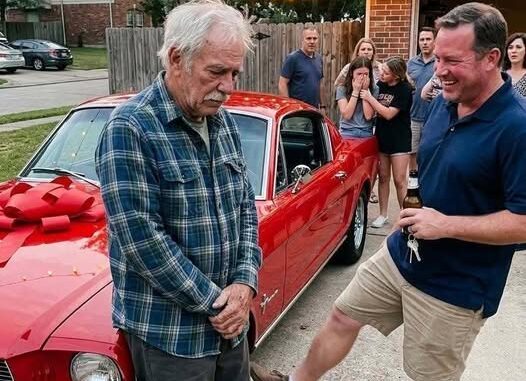
For 74-year-old Gus Kowalski, restoring an old car was about much more than repairing an engine or bringing faded paint back to life.
The 1966 Ford Mustang had belonged to his late wife, Dottie, and carried decades of family memories.
When Gus decided to restore it for their granddaughter, Lily, he knew the project would require time, patience, and considerable effort.
For two years, he dedicated himself to bringing the vehicle back to its former condition.
But shortly after he presented the finished Mustang to Lily, an unexpected disagreement involving his son-in-law, Brent, threatened to change everything.
What followed became a story about family memories, personal responsibility, and the importance of understanding legal ownership.
A Car That Held Decades of Memories
Gus had spent much of his life working as a mechanic.
Over the years, he’d repaired countless vehicles, from everyday family cars to older models requiring specialized attention.
He understood engines, electrical systems, and the careful work involved in restoring aging automobiles.
But one vehicle had always meant more to him than the others.
It was the 1966 Mustang that Dottie had purchased years earlier using money she’d saved herself.
The car represented an important chapter in their life together.
For Dottie, it had been a purchase she was proud of.
For Gus, it eventually became a reminder of their shared experiences and the years they’d spent building a family.
After Dottie’s passing, the Mustang remained in his possession.
Although its condition had deteriorated over time, Gus couldn’t imagine simply letting it go.
He wanted to preserve it.
More importantly, he wanted the car to remain connected to the family.
A Special Plan for His Granddaughter
As Lily grew older, Gus began thinking about what he could eventually pass down to her.
He wanted to give her something meaningful.
Rather than purchasing an expensive new gift, he decided to restore Dottie’s Mustang.
The project would allow him to combine his mechanical skills with his desire to preserve an important family memory.
He imagined the day Lily would receive the keys.
She wouldn’t simply be getting an old vehicle.
She would be receiving something her grandmother had chosen, owned, and cared about.
For Gus, that connection made the gift especially valuable.
He knew the restoration wouldn’t be easy.
The Mustang had aged, and returning it to good condition would require considerable attention.
Nevertheless, he committed himself to the project.
Two Years of Careful Restoration
Restoring a classic car is rarely a quick process.
Older vehicles can require extensive inspection, repairs, replacement parts, and careful planning.
Gus approached the Mustang with the patience he’d developed throughout his career.
He worked on it whenever his schedule and finances allowed.
Some tasks were straightforward.
Others required more time and attention.
He had to decide which repairs were most important, what could be completed immediately, and which improvements would need to wait.
The work continued over two years.
Gus invested much of his spare money into the restoration.
He also dedicated countless hours to the vehicle.
Although the project was demanding, he found satisfaction in seeing the Mustang gradually return to a condition he could be proud of.
Every completed repair brought him closer to the moment he’d imagined.
Why the Restoration Meant So Much
For someone unfamiliar with the family’s history, the Mustang might have looked like an ordinary classic car.
But Gus saw something different.
He remembered Dottie’s excitement when she’d first purchased it.
He remembered the years when the vehicle had been part of their lives.
Working on the car gave him a way to preserve those memories through something practical.
He couldn’t recreate the past.
But he could care for an object that had been meaningful to someone he loved.
The restoration also gave him a sense of purpose.
Instead of allowing the Mustang to continue deteriorating, he was preparing it for another generation.
He hoped Lily would eventually create her own memories with it.
That possibility made the effort worthwhile.
The Day Lily Received the Keys
After two years of work, the Mustang was finally ready.
Gus had completed the restoration he’d spent so long planning.
When he presented the car to Lily, her reaction was everything he’d hoped for.
She was deeply moved.
The gift surprised her, but its meaning became even more important when she considered its history.
This was the car her grandmother had once purchased with her own savings.
Her grandfather had then spent two years restoring it specifically for her.
Lily understood that the gift represented far more than its monetary value.
For Gus, seeing her reaction made the long hours and financial sacrifices feel worthwhile.
He’d achieved what he set out to do.
The Mustang was ready to begin another chapter within the family.
A Different Opinion About the Car
Not everyone viewed the restored Mustang in the same way.
Gus’s son-in-law, Brent, was less interested in its family history.
He focused on the vehicle’s potential resale value.
Where Gus saw memories and a carefully planned gift, Brent saw an opportunity to obtain money.
The difference in perspective eventually became a serious disagreement.
Brent dismissed the car’s sentimental importance and questioned why the family should keep it.
Gus, however, had no intention of selling the Mustang.
He’d restored it for Lily.
That had been his plan from the beginning.
He believed the decision about the car’s future belonged to him as its owner.
Unfortunately, Brent took steps that went beyond simply expressing an opinion.
An Unexpected Online Listing
Without Gus’s permission, Brent advertised the Mustang for sale online.
The listing presented the restored vehicle to potential buyers.
Gus had not authorized the advertisement.
He also hadn’t agreed to transfer ownership or accept an offer.
The situation became more complicated when Brent accepted a deposit from an interested buyer.
The buyer apparently believed the vehicle was legitimately available for purchase.
Gus was understandably concerned when he learned what had happened.
He’d spent two years restoring the car for Lily, only to discover that someone else was attempting to arrange its sale.
The disagreement was no longer simply about whether keeping the Mustang was a good idea.
It now involved questions about ownership and an unauthorized financial transaction.
Why the Vehicle Title Became Important
Gus knew he needed to establish the facts.
Fortunately, he had retained the Mustang’s ownership documentation.
The vehicle title identified him as the legal owner.
That record became central to resolving the disagreement.
In many jurisdictions, a vehicle title is an important document used to establish registered ownership and facilitate lawful transfers.
Specific rules vary by location, and a title alone may not resolve every possible ownership dispute.
In Gus’s situation, however, the document supported his position that Brent had no authority to sell the Mustang.
Gus presented the paperwork when the disagreement was addressed.
Rather than relying solely on arguments, he was able to point to a formal ownership record.
This helped clarify why the proposed sale could not proceed as Brent had intended.
Resolving the Attempted Sale
As the situation developed, law enforcement became involved.
The ownership documents were reviewed, and the attempted transaction was examined.
According to the account, the authorities confirmed that Gus was the rightful owner of the Mustang.
The interested buyer learned that Brent was not authorized to sell the vehicle.
Once the ownership issue became clear, the buyer withdrew from the proposed purchase.
Brent was required to return the deposit he’d accepted.
The sale did not go forward.
For Gus, the resolution was a relief.
The Mustang remained in his possession, allowing him to complete the gift he’d planned for Lily.
Although the financial issue had been addressed, the experience left the family with difficult questions about trust and respect.
When Family Members Value Things Differently
The disagreement revealed how differently people can interpret the value of the same possession.
To Brent, the Mustang represented a financial opportunity.
Classic cars can attract collectors and buyers willing to pay significant amounts, depending on their condition, history, and market demand.
But Gus had never restored the vehicle primarily to sell it.
Its value to him was personal.
It represented Dottie’s life, her independence, and the memories they’d shared.
Lily also understood the emotional importance of the car.
She appreciated knowing that her grandmother had once owned it and that her grandfather had worked so hard to preserve it.
The family disagreement illustrated why financial value and sentimental value are not always interchangeable.
An item can have a market price while also carrying memories that cannot be replaced.
The Importance of Respecting Ownership
The situation also highlighted a practical lesson about property rights.
Family relationships do not automatically give one person permission to sell something owned by another.
Even when relatives share a household or regularly use the same possessions, legal ownership and authorization remain important.
For vehicles, ownership records and transfer requirements help protect buyers and sellers.
Before purchasing a used vehicle, buyers should verify that the person arranging the sale has the authority to transfer it.
Depending on the jurisdiction, this may involve checking the title, identification details, vehicle identification number, and any outstanding financial interests.
In Gus’s case, retaining the original ownership documentation helped prevent the Mustang from being transferred without his agreement.
The incident demonstrated the value of keeping important records organized and accessible.
A Gift That Finally Reached Its Intended Owner
Once the attempted sale was stopped, Gus could return his attention to the reason he’d restored the Mustang.
He wanted Lily to have it.
The vehicle had been part of Dottie’s life, and Gus hoped it would become part of Lily’s future.
The disagreement with Brent had been stressful, but it didn’t change the meaning of the gift.
Lily still had the opportunity to appreciate her grandfather’s work and learn more about her grandmother through the car.
For Gus, that outcome mattered far more than the amount someone might have offered to purchase it.
He hadn’t spent two years rebuilding the Mustang to make a profit.
He’d done it to preserve a connection between generations.
Preserving Family History Through Meaningful Objects
Families often keep possessions that remind them of important people or experiences.
Sometimes these are photographs, letters, jewelry, or handmade items.
Other times, they are larger objects, such as furniture, musical instruments, or vehicles.
Their significance comes from the stories attached to them.
Dottie’s Mustang was one such possession.
Its history began with her decision to save money and purchase a car she wanted.
Years later, Gus chose to restore it.
Eventually, Lily became the person he wanted to receive it.
Each stage added another layer to the vehicle’s story.
By preserving the Mustang, Gus also preserved an opportunity for Lily to feel connected to her grandmother.
What the Experience Taught Gus
Gus had spent decades repairing engines and restoring worn vehicles.
He knew that mechanical problems could often be solved with the right tools, replacement parts, and enough patience.
Family disagreements were different.
They required communication, boundaries, and respect for one another’s decisions.
The situation with Brent reminded him that not everyone would understand why he’d invested so much effort in the Mustang.
But he didn’t need everyone to agree with his choice.
He needed his ownership to be respected.
He also wanted Lily to understand why the car mattered.
The attempted sale had created unnecessary tension, but it hadn’t erased the work he’d completed or the memories he hoped to preserve.
A Lasting Connection to Dottie
In the end, the Mustang remained with the family member Gus had intended to receive it.
The proposed sale was canceled, the buyer’s deposit was returned, and Lily could enjoy the restored vehicle.
For Gus, the outcome represented the completion of a promise he’d made through years of quiet effort.
The car had once been Dottie’s.
He had carefully restored it.
Now it could become part of Lily’s life.
The vehicle’s history would continue rather than end with an unauthorized sale.
Final Thoughts
Gus Kowalski’s experience illustrates how meaningful family possessions can become the center of unexpected disagreements.
His two-year restoration project was motivated by love for his late wife and a desire to give their granddaughter something lasting.
When Brent attempted to sell the Mustang without permission, ownership documentation became essential to resolving the situation.
The disagreement eventually ended with the vehicle remaining available for its intended recipient.
The most important part of the story wasn’t the Mustang’s potential selling price. It was the care, effort, and family history that made the car worth preserving.
For Gus and Lily, the restored Mustang represented a connection between generations and a reminder that some gifts are meaningful because of the stories they carry.
Leave a Reply