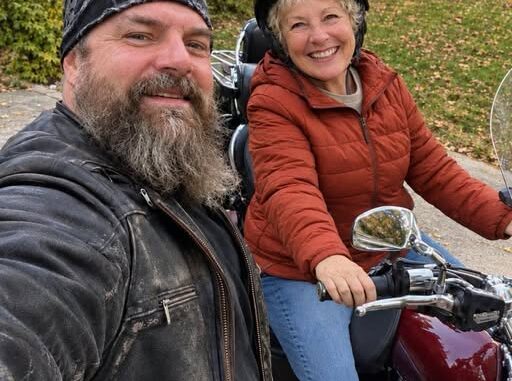
For months, I watched my elderly mother leave home every Saturday with a man named Connor.
He was a tall, broad-shouldered motorcyclist with a gray-streaked beard and a leather jacket. At first, I couldn’t understand why my quiet, reserved mother enjoyed spending time with someone who seemed so different from her.
But after losing my father, those weekly outings appeared to bring happiness back into her life.
She returned home smiling, began enjoying her old hobbies again, and seemed more optimistic than she had in months.
I assumed the rides were helping her cope with grief.
It wasn’t until after her funeral that I discovered they had served an entirely different purpose.
Meeting the Man Who Took My Mother on Weekly Rides
My name is Mia, and I was 47 when my mother, Frances, began spending her Saturdays with Connor.
My father, Richard, had passed away less than a year earlier.
He’d always been the outgoing member of our family, filling the house with music, conversation, and laughter.
Mom was different.
She preferred gardening, crossword puzzles, and quiet afternoons at home.
After Dad’s death, I began visiting her regularly.
I helped with groceries, cleaning, and household responsibilities, hoping to make her days easier.
One Saturday, while I was helping around the house, I heard a motorcycle pull into the driveway.
When I looked outside, I saw a large man standing beside it.
Mom appeared delighted.
“That’s Connor,” she explained.
I was surprised when she told me he had come to take her for a ride.
I questioned whether she knew him well enough and whether riding a motorcycle was a good idea.
But Mom gently reminded me that she was capable of making her own decisions.
She understood my concerns, yet she didn’t want fear to prevent her from enjoying life.
A few minutes later, she put on a helmet and left with Connor.
A Welcome Change in Her Routine
Three hours later, Mom returned looking happier than I’d seen her in months.
Her cheeks were rosy, her hair was flattened from the helmet, and she was smiling.
I couldn’t remember the last time she’d seemed so relaxed.
After that, Connor visited almost every Saturday.
Mom began baking again.
Sometimes she prepared cakes and carefully packed them into boxes before leaving.
Whenever I asked who the food was for, she offered only a playful answer.
She also started dressing up for the outings.
One afternoon, I noticed her applying lipstick.
When I asked whether there was someone special she wanted to impress, she became thoughtful.
She mentioned that she’d been considering an apology she should have made years earlier.
I asked what she meant.
But before she could explain, Connor arrived.
Mom kissed my cheek and left.
At the time, I didn’t understand how important that conversation would become.
When My Mother’s Health Began to Decline
Several months later, Mom developed serious health problems.
After medical appointments and examinations, we learned that she was experiencing heart failure.
Her energy decreased, and ordinary activities became more difficult.
Connor began arriving in his truck rather than on the motorcycle.
Although I was relieved that she was no longer riding, I remained concerned about the outings.
One afternoon, I asked her to stay home and rest.
She insisted that the visits were important.
When I asked why, she told me there was something she needed to resolve.
I wanted her to explain.
But she said the situation involved other people and wasn’t entirely hers to share.
I could see that she was troubled.
Eventually, I agreed to let her make her own decision.
Two months later, my mother passed away.
I still believed those Saturday trips had simply helped her enjoy the final months of her life.
Then Connor approached me after the funeral.
An Unexpected Conversation After the Funeral
Connor found me standing near the back of the room after the service.
He was wearing a dark suit instead of his usual motorcycle jacket.
He looked tired and emotional.
After expressing his condolences, he explained that he needed to tell me something about my mother’s weekly outings.
“They weren’t really scenic rides,” he said.
I asked where they’d been going.
He told me that every Saturday, he’d taken Mom to visit his mother.
Her name was Diane.
I didn’t recognize it.
Then Connor mentioned that Diane had known my uncle Mike.
That caught my attention.
Uncle Mike had been an important part of my childhood, but he’d died years earlier.
I asked Connor to explain the connection.
He suggested that Diane should tell me herself.
Although I was exhausted from the funeral, I wanted answers.
We arranged to meet that evening.
A Woman From My Mother’s Past
Connor returned with his mother, Diane, a silver-haired woman who appeared nervous about entering our family home.
As she looked at the photographs displayed around the room, she noticed a picture of Uncle Mike.
She quietly said his name.
I invited her to sit down and explain how she’d known my family.
Diane told me that she and Frances had been close friends during high school.
They’d shared many happy memories as teenagers.
But their friendship eventually became complicated.
Both women had known a young man named Sam.
Frances had feelings for him, but Sam developed a relationship with Diane.
They later married, and Connor was their son.
Although my mother eventually married Richard and built a family of her own, she apparently struggled to move past the disappointment.
I was surprised.
Mom had never mentioned Diane or this part of her youth.
But there was more to the story.
The Connection to Uncle Mike
Years after Diane married Sam, her marriage ended.
Eventually, she developed a relationship with my uncle Mike.
According to Diane, the two cared deeply about each other.
Connor remembered Mike spending time with him when he was a child.
Mike taught him baseball and became an important presence in his life.
Then, one day, the visits stopped.
Diane explained that Frances had strongly opposed the relationship.
She told Mike that continuing to see Diane would damage his relationship with the family.
Faced with that pressure, Mike ended the relationship.
I found the story difficult to accept.
My mother had always seemed protective of her brother.
The idea that she might have interfered in his personal life because of an old disagreement felt completely unfamiliar.
I questioned Diane’s account.
She didn’t argue.
Instead, she explained that Frances had spent her final months trying to make amends.
Why My Mother Had Kept Visiting
Connor told me that the weekly trips had taken Frances to Diane’s home.
At first, their conversations had been uncomfortable.
Years of distance and unresolved feelings couldn’t be repaired in a single afternoon.
But Mom continued returning.
She listened to Diane’s perspective and gradually acknowledged the pain her decisions had caused.
Diane explained that Frances hadn’t asked her to pretend the past had never happened.
She simply wanted to accept responsibility and apologize.
I struggled to understand why my mother had kept this secret from me.
Diane believed Frances had been ashamed.
She worried that I might see her differently if I learned about her mistakes.
I wasn’t ready to accept everything I’d heard.
Overwhelmed by grief and confusion, I asked Connor and Diane to leave.
After they were gone, I began searching through my mother’s belongings.
The Photographs That Helped Explain the Past
Upstairs, I found an old wooden box filled with photographs.
Some showed Mom and Diane as teenagers.
They were laughing together at school events, picnics, and gatherings with friends.
Other pictures included Sam.
In one photograph, my mother was looking toward him while he appeared focused on Diane.
Then I found a picture of Uncle Mike standing beside Diane.
Connor was there too, holding a baseball glove.
He looked about nine years old.
The photograph supported what Diane had told me about their connection.
I sat quietly, wondering why Mom had kept these memories hidden away.
The following morning, I opened her recipe box.
Inside was an envelope addressed to me.
It contained a letter written in my mother’s handwriting.
A Letter I Never Expected to Find
Mom’s letter explained the history of her friendship with Diane.
She acknowledged that she’d struggled with jealousy when Sam chose Diane.
Although she’d later built a happy marriage with my father, she hadn’t fully resolved those feelings.
When Diane began seeing Mike, Mom allowed her old resentment to influence how she treated them.
She admitted that she’d pressured her brother to end the relationship.
In the letter, she recognized that Mike and Diane should have been allowed to decide their own future.
She also explained that Dad had challenged her behavior at the time.
He believed she had no right to make personal decisions for her brother.
Mom wrote that she’d been unwilling to accept his advice because it meant acknowledging she was wrong.
One passage stayed with me.
She asked me not to remember her as a perfect person simply because I loved and missed her.
She wanted me to understand that she had made mistakes, hurt people, and eventually tried to take responsibility.
Reading those words changed how I understood the visits.
Mom hadn’t been hiding a new friendship.
She’d been trying to repair an old one.
Returning to Diane’s Home
After reading the letter, I contacted Connor and asked whether I could visit.
When I arrived, I placed Mom’s letter on the table.
I asked Diane whether Frances had told her everything.
She confirmed that they had discussed the past openly.
I wanted to know whether she’d forgiven my mother.
Diane explained that forgiveness hadn’t happened immediately.
Their first conversations were difficult.
Frances initially struggled to acknowledge the full impact of her actions.
But over time, she stopped defending her decisions and began listening.
Eventually, Diane chose to forgive her.
She explained that forgiveness didn’t erase what had happened.
It couldn’t restore the relationship she’d once shared with Mike or return the years they’d lost.
But it allowed her to move forward without continuing to carry the same resentment.
For the first time since the funeral, I began to understand what my mother had been trying to accomplish.
Learning to See My Mother Differently
I’d spent most of my life believing that Mom always knew the right thing to do.
She was dependable, caring, and devoted to our family.
Learning about her past didn’t erase those qualities.
But it reminded me that she was also human.
She’d experienced jealousy, made decisions she later regretted, and struggled to admit when she’d been wrong.
What mattered was that she eventually chose to confront those mistakes.
I realized I didn’t need to defend every decision she’d ever made in order to continue loving her.
I could appreciate the mother I’d known while acknowledging the harm she’d caused someone else.
That understanding helped me begin processing both the loss and the unexpected information I’d received.
Sharing the Truth With Our Family
A week later, I invited several relatives to help sort through Mom’s belongings.
Connor and Diane joined us.
During lunch, someone mentioned Uncle Mike.
A relative suggested that Frances had always protected him from relationships that might have caused problems.
I felt uncomfortable hearing that explanation.
Before learning the truth, I might have agreed.
But now I knew there was another side to the story.
I explained that Mom had written about her disagreement with Mike and Diane.
I shared enough of the letter to help everyone understand what had happened.
Some relatives believed the matter should remain private.
Others listened quietly.
I explained that Mom herself had chosen to acknowledge her mistakes.
Her final months had been spent trying to resolve something she’d avoided for decades.
Diane also spoke.
She acknowledged the pain Frances had caused but emphasized that the effort to apologize had meant something to her.
The conversation wasn’t easy.
But it allowed our family to understand Mom’s life with greater honesty.
The Meaning Behind Her Final Motorcycle Rides
Later that afternoon, Connor brought Mom’s motorcycle helmet inside.
I held it and smiled.
I’d never expected my mother to become someone who looked forward to weekend motorcycle trips.
Connor laughed when I mentioned it.
He told me she’d been nervous during her first ride but quickly became comfortable.
I asked where he’d taken her on their final Saturday together.
He said they’d visited Diane, as usual.
But afterward, Mom had asked him to take a longer route home.
She wanted to enjoy the scenery and spend a little more time outside.
According to Connor, she’d told him that she’d spent too many years avoiding difficult things.
Now, she wanted to appreciate the time she had.
His words helped me understand those final outings differently.
They weren’t simply a distraction from grief or illness.
They were an opportunity for Mom to make peace with her past.
A Different Way to Remember Her
Before leaving, Diane handed me an old photograph.
It showed her and Mom as teenagers, standing close together and smiling.
I asked whether that was how she preferred to remember Frances.
Diane explained that she didn’t want to remember only the happy moments or only the painful ones.
Both were part of their history.
Her answer stayed with me.
For weeks, I’d wondered whether discovering my mother’s mistakes meant I hadn’t truly known her.
Eventually, I realized that the person I’d loved was still the same.
She had been a devoted wife, a caring mother, and a woman who made decisions she later regretted.
She had also found the courage to apologize.
Those different parts of her life could exist together.
Final Thoughts
My mother’s Saturday outings had seemed like a simple way for her to find happiness after losing my father.
Only after her death did I understand their deeper meaning.
She’d been visiting someone from her past, acknowledging a painful mistake, and trying to rebuild a friendship that had ended decades earlier.
The experience changed how I remembered her.
I learned that loving someone doesn’t require believing they were perfect. Sometimes, understanding their mistakes allows us to appreciate their efforts to grow.
My mother couldn’t change what happened years earlier.
But she could take responsibility, offer an apology, and spend her remaining time making peace with the people she’d hurt.
In the end, those Saturday journeys weren’t about escaping the past.
They were about finally facing it—and finding a little peace along the way.
Leave a Reply