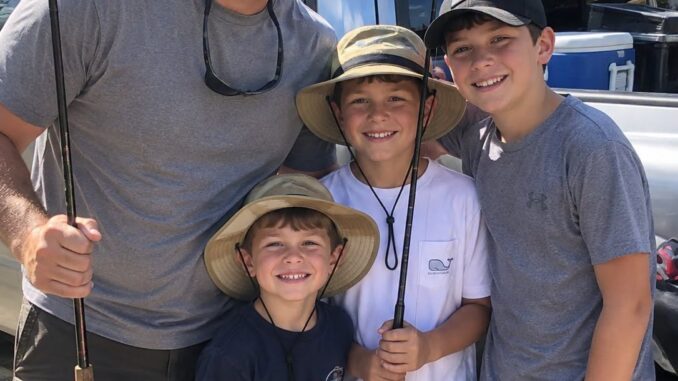
Everybody look at the camera for three seconds.”
My husband, Daniel, was checking the straps on the boat trailer for what seemed like the fourth time.
“Just three seconds,” I repeated.
Our youngest son laughed.
“Dad’s squeezing me!”
Daniel tightened his arm around the boy’s shoulders.
“Maybe that’ll help you stand still.”
The boys laughed, and I took the photograph.
I didn’t know it would become one of the most important pictures I’d ever taken.
At the time, I was thinking about ordinary things.
Had I packed enough snacks?
Did the boys have sunscreen?
Would they remember to call me when they arrived?
I had no reason to believe that weekend would change our family forever.
A Family Tradition
Daniel loved fishing.
For three years, he’d taken our three sons to the same lake for weekend trips.
He knew the boat launch, the shoreline, and the areas where the water could become difficult to navigate after heavy rain.
He was also remarkably careful.
Before every trip, he checked the weather forecast, inspected the equipment, and made sure everyone had the necessary safety gear.
“Life jackets?” he asked.
“Yes, Dad,” the boys answered together.
“Emergency whistles?”
“Packed.”
“Extra batteries?”
“Dad!”
I laughed.
Daniel took safety seriously, even when the boys teased him about it.
Before leaving, he kissed me goodbye.
“We’ll be back Sunday evening.”
“I know,” I said.
He smiled.
“Try not to miss us too much.”
I watched as the truck pulled out of the driveway.
Then I raised my phone and took another photograph.
It was such an ordinary moment.
I had no idea how often I would return to those pictures in the years ahead.
When Sunday Evening Came
By seven o’clock Sunday evening, dinner was ready.
But Daniel and the boys hadn’t returned.
I called his phone.
No answer.
I tried our oldest son’s number.
It rang without a response.
At first, I assumed they’d lost track of time.
Fishing trips sometimes ran longer than expected.
By eight o’clock, I was becoming concerned.
By nine, I knew something wasn’t right.
At 10:15 p.m., I contacted the authorities.
The following morning, Daniel’s truck was located near the marina.
The empty boat trailer was still attached.
His wallet and two jackets were inside the vehicle.
Later that day, search teams found the boat on the opposite shore.
It was badly damaged.
No one was aboard.
Weeks of Searching
The search continued for weeks.
Rescue teams examined the lake and surrounding shoreline.
Divers searched underwater areas.
Boats and helicopters assisted with the operation.
Volunteers helped wherever they could.
Our family waited for updates.
Every telephone call made my heart race.
Every unfamiliar vehicle approaching the house made me look toward the window.
But the search teams couldn’t locate Daniel or our three sons.
Eventually, investigators concluded that the most likely explanation was a boating accident involving difficult water conditions.
The family was informed that the missing passengers were presumed lost.
I understood what the investigators were telling me.
But understanding their conclusion wasn’t the same as finding peace with it.
The Question I Couldn’t Answer
Daniel had always been careful.
He checked the forecast repeatedly.
He inspected the life jackets.
He refused to take unnecessary risks on the water.
If something didn’t look right, he postponed the trip.
I knew those habits as well as I knew his voice.
So I struggled to understand how a man who took so many precautions could encounter such a serious accident.
I wasn’t suggesting the investigators had made a mistake.
I simply wished I knew more about the circumstances.
What had happened that afternoon?
Had the weather changed unexpectedly?
Had there been a mechanical problem?
Had Daniel tried to return to shore?
There were questions nobody could answer.
And those unanswered questions stayed with me.
Life With My Three Daughters
After the loss, I returned home to my three daughters.
Our family had once filled every room with noise.
The boys argued over television programs.
The girls borrowed one another’s clothes.
Someone was always searching for a missing shoe or asking what was for dinner.
Now the house felt different.
Four familiar voices were missing.
We continued with daily life because we had to.
The girls went to school.
I prepared meals.
We celebrated birthdays and holidays.
But grief remained part of our household.
Sometimes it was quiet.
Other times, a familiar song or an old photograph brought everything back.
We learned to live with memories that could make us smile and cry within the same moment.
Daniel’s Brother Tries to Help
Daniel’s younger brother, Dean, became a regular presence in our lives.
He repaired things around the house.
He helped with errands.
He attended school events when the girls wanted someone from their father’s family there.
I appreciated his support.
Dean had lost his brother and three nephews.
He was grieving too.
But whenever I asked about the fishing trip, he became uncomfortable.
“Andrea, the investigators did everything they could,” he’d say.
“I know. I just wish I understood what happened.”
He would look away.
Then he’d remind me that my daughters still needed me.
He wasn’t wrong.
But sometimes I felt as though he wanted me to stop asking questions.
I didn’t want to spend the rest of my life searching for an impossible answer.
I simply wanted to understand as much as I could.
Six Years Later
Six years passed.
Our daughters grew older.
One began college.
Another learned to drive.
Our youngest, Sophie, became increasingly thoughtful and independent.
The boys’ bedroom remained almost exactly as they’d left it.
Their books were still on the shelves.
Their clothes remained in the drawers.
Fishing equipment stood in one corner.
I told myself I was preserving their belongings for sentimental reasons.
But deep down, I knew I wasn’t ready to change the room.
Then one afternoon, Sophie appeared in the doorway holding a cardboard box.
“Mom, I think we should go through some of their things.”
I shook my head.
“Not today.”
She sat beside me.
“We don’t have to throw anything away. We can keep the important things and donate items that someone else could use.”
I looked toward the room.
For six years, I’d avoided making that decision.
Finally, I nodded.
“All right.”
Finding Daniel’s Old Phone
We began sorting through the boys’ belongings.
Sophie opened drawers and examined storage boxes.
I helped for a while.
Then I went downstairs to prepare dinner.
I needed a break from the memories.
About an hour later, Sophie came into the kitchen carrying an old black phone.
One corner of the screen was cracked.
“Mom, wasn’t this Dad’s?”
I recognized it immediately.
Daniel had misplaced the phone almost a year before the fishing trip.
We’d searched everywhere.
Eventually, he’d purchased a replacement.
Neither of us had expected to see the old phone again.
“Where did you find it?” I asked.
“In the electronics box.”
Sophie turned it over.
“Do you think it still works?”
I wasn’t sure.
She found a compatible charger and plugged it in.
Then we waited.
A Video From the Past
After some time, the phone powered on.
It connected to our home Wi-Fi.
Old photographs and account information began appearing.
Sophie was excited.
“There might be pictures we’ve never seen.”
I wanted to look.
But I also felt overwhelmed.
Seeing Daniel’s face unexpectedly after six years was difficult.
I told Sophie she could continue looking through the gallery while I went upstairs.
A few minutes later, I heard her calling.
“Mom?”
Something about her voice made me turn immediately.
She was standing in my bedroom doorway, holding the phone carefully.
“I found a video.”
“What kind of video?”
She swallowed.
“It’s from the day before the fishing trip.”
I stood.
Then she added something I hadn’t expected.
“Uncle Dean is in it.”
What the Recording Showed
Sophie pressed play.
Daniel appeared on the screen.
He was standing in our garage, sorting fishing equipment on the workbench.
Life jackets were arranged beside him.
There were dry bags, ropes, and several bright orange emergency whistles.
He was smiling.
For a moment, I could hardly concentrate on the conversation.
It had been six years since I’d heard his voice so clearly.
Then Dean entered the frame.
“I’m not going,” Dean said.
Daniel looked up.
“What do you mean?”
Dean explained that he wasn’t feeling up to a fishing trip.
His relationship had recently ended, and he’d been having a difficult few months.
Daniel encouraged him to come anyway.
“A weekend outside might do you some good.”
Dean shook his head.
“I don’t think so.”
Daniel didn’t argue.
But he made one final invitation.
An Invitation Nobody Mentioned
“Come with us,” Daniel said. “You don’t have to fish the whole time.”
Dean smiled faintly.
“I’ll think about it.”
Daniel continued checking the equipment.
Then he said something that stayed with me.
“Children don’t remember every expensive gift you buy them. They remember the time you spend together.”
He tightened the strap on a life jacket.
“And they remember when you show up for them.”
I felt tears forming.
That sounded exactly like Daniel.
He’d always believed that family memories were built through ordinary moments.
A fishing trip.
A backyard game.
A conversation over dinner.
The video continued.
Daniel told Dean that if he didn’t come fishing, he should visit us Sunday evening.
“The boys will have plenty of stories to tell.”
Dean laughed.
Then the recording ended.
I looked at Sophie.
For six years, Dean had never mentioned that he’d been invited on the trip.
A Location We Didn’t Recognize
Sophie continued exploring the phone.
The old device had been connected to the same account as Daniel’s replacement phone.
Some information from the newer device had been synchronized to the account.
Among the saved records was a location from the Sunday morning of the trip.
It showed a small outdoor-supply store several miles from Daniel’s usual route to the marina.
I didn’t recognize the address.
“Why would Dad have gone there?” Sophie asked.
“I don’t know.”
The next day, we decided to visit.
I wasn’t expecting a major discovery.
I thought perhaps Daniel had stopped for bait or an extra piece of equipment.
But I wanted to understand the trip’s final known details.
The Outdoor-Supply Store
The store was quiet when we arrived.
Fishing rods lined the walls.
Shelves held tackle boxes, life jackets, and outdoor equipment.
An older employee greeted us.
I explained that I was looking for information about a visit that had taken place six years earlier.
Then I showed him the photograph I’d taken in our driveway.
Daniel.
Our three boys.
The truck behind them.
The employee studied the picture.
After a moment, he pointed toward the boys.
“I remember those three.”
My heart began racing.
“You do?”
He smiled sadly.
“They spent quite a while choosing emergency whistles. They couldn’t agree on which colors they wanted.”
I could picture the argument immediately.
That sounded like my sons.
The Extra Life Jacket
The employee explained that Daniel had purchased additional safety equipment.
He remembered several orange whistles.
And one adult flotation vest.
I frowned.
“An adult vest?”
He nodded.
“Your husband mentioned that his brother might be joining them.”
I looked at Sophie.
Dean had been invited.
And Daniel had apparently prepared for him to come.
I thanked the employee.
Then we drove directly to Dean’s house.
I needed to ask him why he’d never told me about the invitation.
Confronting an Old Silence
Dean opened the door.
He looked surprised to see us.
“Andrea? Sophie? Is everything okay?”
I held up Daniel’s old phone.
“We found this while sorting through the boys’ things.”
Dean looked at it.
Then I explained that we’d watched the video.
“You were invited on the fishing trip.”
He nodded slowly.
“Yes.”
“Why didn’t you tell me?”
Dean looked down.
For several seconds, he didn’t answer.
Then he invited us inside.
We sat in his living room.
Finally, he explained.
He’d initially declined the invitation.
But on Sunday morning, he’d reconsidered.
He started driving toward the lake.
Before he arrived, he noticed emergency vehicles heading in the same direction.
When he reached the area, the response was already underway.
Dean’s Regret
Dean told us he’d spent years wondering whether his presence could have changed anything.
“If I’d been there, maybe I could have helped,” he said.
His voice shook.
“Maybe another adult on the boat would have made a difference.”
I listened quietly.
He explained that he’d avoided telling me because he didn’t want to add another painful question to everything I was already carrying.
I understood that he was trying to protect me.
But I still wished he’d trusted me with the truth.
“Dean, I deserved to know you were supposed to be there.”
He nodded.
“I know. I’m sorry.”
I told him about the extra flotation vest.
He looked surprised.
“Daniel bought another one for me?”
“That’s what the store employee remembered.”
Dean covered his face with his hands.
He’d never known that Daniel had prepared for him to join the trip.
Another Unanswered Question
After visiting Dean, Sophie and I began reviewing what we knew.
Daniel had purchased additional safety equipment.
Dean hadn’t boarded the boat.
That meant the extra adult flotation vest should have remained unused.
But where had it gone?
We contacted a retired search coordinator who had been involved in the original investigation.
He agreed to help us review the available records.
Together, we examined the list of equipment recovered during the search.
Several items had been documented.
Others were missing.
Among the missing items was an adult flotation vest.
One orange emergency whistle was also unaccounted for.
The coordinator studied the records.
Then he remembered another incident from the same afternoon.
Another Boat on the Lake
The coordinator explained that a small boat had overturned during the changing weather conditions.
An older man and his grandson had been aboard.
Both had survived.
I was relieved to hear that.
Then the coordinator mentioned something that caught my attention.
According to the available report, another fishing boat had reached the pair before additional assistance arrived.
The witnesses described an adult accompanied by several boys.
Sophie reached for my hand.
I asked whether the people in that fishing boat had ever been identified.
The coordinator explained that the original report hadn’t established their identities.
But the description seemed consistent with Daniel and our sons.
We couldn’t know for certain from that detail alone.
Still, it was the first new lead we’d found in six years.
Meeting Harold
The older man from the boating incident was named Harold.
He still lived about twenty minutes from the lake.
After contacting him, we arranged a visit.
He welcomed us into his garage.
Tools hung neatly along the walls.
Fishing equipment rested beside a workbench.
Then I noticed something hanging from a nail.
An orange emergency whistle.
I looked at it for several seconds.
It resembled the whistles Daniel always insisted on packing.
Harold followed my gaze.
“That came from the people who helped us on the lake,” he explained.
I showed him our driveway photograph.
He studied it.
Then his expression changed.
“I remember them.”
He pointed toward Daniel and the boys.
“These are the people who stopped to help us.”
What Happened That Afternoon
Harold invited us to sit down.
Then he described what he remembered.
He’d been fishing with his grandson, Ben.
The weather changed more quickly than they’d expected.
The wind strengthened.
The water became increasingly difficult to navigate.
Their small boat overturned.
Harold and Ben struggled to stay safe in the water.
Then another boat approached.
A man and three boys were aboard.
They immediately began helping.
The boys threw flotation equipment toward Harold and Ben.
One of them repeatedly called instructions over the wind.
“Both arms! Put both arms through!”
Harold remembered those words clearly.
I covered my mouth.
My middle son had always been particular about making sure his younger siblings wore their backpacks and safety gear correctly.
He used almost exactly the same phrase.
A Memory That Changed Everything
Harold continued.
The man on the fishing boat guided the boys as they helped.
They made sure Harold and Ben had flotation equipment.
They remained nearby until another boat approached to assist.
By then, the weather was becoming increasingly difficult.
Harold remembered seeing the fishing boat turn toward shore.
After that, he lost sight of it.
He couldn’t tell us what happened next.
The information didn’t establish every detail of the accident.
But it gave us a clearer picture of something that had happened before Daniel and the boys disappeared.
They had encountered two people in need.
And they’d stopped to help.
I looked at Sophie.
She was crying quietly.
For years, we’d imagined their final hours without knowing anything certain about what they’d been doing.
Now we had a meaningful piece of their story.
Meeting Ben
Harold’s grandson, Ben, was eighteen when we met him.
He entered the garage while we were talking.
He was tall and quiet.
Harold introduced us.
Ben knew the story of the boating accident, although he’d been very young when it happened.
He remembered being frightened.
He remembered the water.
And he remembered people calling instructions to him.
“Both arms,” he said softly.
I nodded.
Those words brought back memories of my middle son.
He’d always been determined to help his younger siblings do things properly.
He could be impatient.
He could be stubborn.
But he cared deeply about people.
Hearing that familiar phrase gave me a sense of connection I hadn’t expected.
Ben looked at me.
“I’m grateful they stopped.”
I couldn’t speak for a moment.
Then I thanked him for sharing what he remembered.
Understanding What We’d Found
The discovery didn’t erase our grief.
It didn’t answer every question about the boating accident.
We still didn’t know exactly what happened after Daniel turned toward shore.
And we couldn’t change the outcome.
But we now understood something important about that afternoon.
Daniel and the boys had helped Harold and Ben during an emergency.
The extra flotation vest and missing whistle made sense in light of their account.
For six years, I’d focused on the mystery of why my husband and sons hadn’t returned.
Now I had a new memory to hold alongside that uncertainty.
They had acted with compassion.
They had helped two people reach safety.
And those people were alive to tell us about it.
Returning to the Boys’ Bedroom
That evening, Sophie and I returned home.
The donation boxes were still on the floor.
Some drawers were open.
Old books and clothes were arranged in small piles.
Sophie looked around.
“Do you want to put everything back?”
I considered the question.
For six years, I’d kept the room almost unchanged.
Part of me had believed that moving their belongings meant letting go of them.
But I was beginning to understand that memories didn’t depend on keeping every object in its original place.
I could remember my sons without preserving their bedroom exactly as it had been.
I could keep the things that mattered most.
And I could allow other belongings to be useful to someone else.
“No,” I told Sophie. “Let’s finish what we started.”
She smiled gently.
We continued sorting.
Choosing What to Keep
We spent the next several days going through the room.
Some belongings were easy to donate.
Others brought back too many memories to part with.
I kept their favorite books.
A few shirts.
Photographs.
School projects.
And several pieces of fishing equipment.
Sophie found an old notebook filled with drawings.
One of the boys had sketched a boat with four people standing inside.
I sat on the edge of the bed and studied it.
Then I placed it in the memory box.
We weren’t trying to erase the past.
We were finding a new way to care for it.
By the time the room was organized, I felt emotionally exhausted.
But I also felt lighter.
A Visit Back to the Lake
A few days later, Sophie suggested that we visit the lake.
I hadn’t been there in years.
For a long time, the thought of returning had been too painful.
But now I wanted to see it.
Dean agreed to come.
Harold and Ben joined us.
We met near the shoreline on a quiet afternoon.
The water was calm.
It was difficult to imagine the conditions Harold had described.
I stood for a while without speaking.
Then I opened the bag I’d brought with me.
Inside was one of my sons’ fishing rods.
I’d kept it in the bedroom for six years.
Now I wanted it to have a purpose.
A Gift for Ben
I turned toward Ben.
“Would you like to have this?”
He looked surprised.
“Are you sure?”
I nodded.
“One of my boys loved fishing. I think he’d be happy to know his rod was being used.”
Ben accepted it carefully.
“Thank you.”
He looked at the rod for a moment.
Then he promised to take good care of it.
I smiled.
I knew the gift wouldn’t replace what we’d lost.
That wasn’t why I’d brought it.
I simply wanted something that had belonged to my son to continue being part of a life he had helped protect.
It felt like a meaningful way to honor his memory.
Dean Finds Some Peace
Dean stood beside me near the water.
For a while, we watched the lake quietly.
Then he spoke.
“I’ve spent six years thinking about what might have happened if I’d gone.”
I looked at him.
He continued.
“I kept imagining that I could have changed something.”
I understood.
I’d asked myself countless questions too.
But neither of us could know what might have happened under different circumstances.
“You couldn’t have predicted that day,” I told him.
He nodded.
“I know.”
I looked toward Harold and Ben.
“We know Daniel and the boys helped someone. That’s something we can hold on to.”
Dean wiped his eyes.
For the first time in years, our conversation about the lake didn’t end with one of us asking the other to stop.
We simply stood together.
One More Photograph
Before we left, Sophie took out her phone.
“Everyone, come closer.”
I looked toward her.
For a moment, I remembered our driveway six years earlier.
Daniel checking the boat straps.
The boys laughing.
Me asking them to look at the camera.
That last family photograph had become one of my most treasured possessions.
Now Sophie was asking us to take another.
Dean stood beside me.
Harold rested a hand on Ben’s shoulder.
Ben held the fishing rod.
We moved closer together.
Nobody was replacing Daniel or the boys.
That wasn’t possible.
But the people standing beside me were connected through something meaningful.
A difficult afternoon.
An unexpected act of kindness.
And memories that had continued to shape our lives.
Sophie smiled.
“Ready?”
I nodded.
She took the photograph.
A Different Kind of Healing
When I looked at the picture later, I noticed something.
For years, photographs had made me think about absence.
I’d look at a family gathering and notice who wasn’t there.
I’d remember the people who should have been standing beside us.
This time, I saw something else.
I saw Sophie, who’d helped me find the courage to revisit the past.
I saw Dean, who was learning to speak openly about his grief.
I saw Harold and Ben, whose lives had been touched by Daniel and our sons.
And I saw myself.
Still grieving.
Still remembering.
But beginning to accept that life could hold meaningful moments alongside sorrow.
Final Thoughts
For six years, I searched for an explanation of what happened to my husband and three sons.
The official investigation had concluded that they were lost in a boating accident.
But many details of that day remained unknown.
Then Sophie discovered Daniel’s old phone.
A video led us to Dean.
A saved location led us to an outdoor-supply store.
An equipment record led us to another boating incident.
And finally, Harold and Ben helped us understand an important part of Daniel and the boys’ final known activities.
We didn’t uncover a different ending.
We didn’t find a way to change the past.
But we learned that they had stopped to help two people during an emergency.
That knowledge gave our family a meaningful memory to hold alongside the unanswered questions.
It also helped me understand something about grief.
Moving forward doesn’t require forgetting.
You can organize a room, donate belongings, take new photographs, and build new relationships while continuing to love the people you’ve lost.
Memories don’t disappear when life changes. They remain part of who we are and how we care for others.
Six years after that fishing trip, I finally allowed myself to stand in front of a camera again.
And this time, I didn’t focus on what might happen tomorrow.
I was simply grateful for the people standing beside me that day.
Leave a Reply