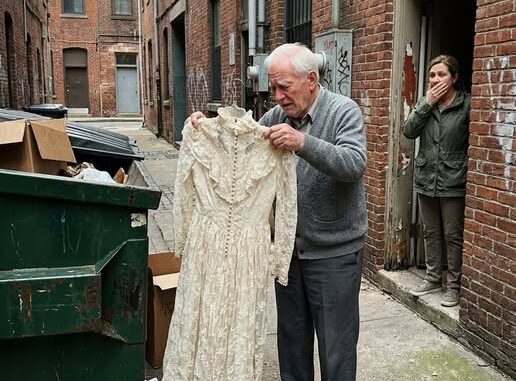
My name is Gene Albright. I’m seventy-seven years old, and some of my most treasured memories are connected to the apple orchard my family has cared for over the years.
Fifty-four years ago, my wife, Dorothy, walked down an aisle between those apple trees to marry me.
She wore an ivory lace wedding gown that her mother had made entirely by hand.
The dress had a delicate high collar and forty-two tiny pearl buttons running down the back.
It took Dorothy’s mother eight months to finish.
I still remember the way Dorothy smiled when I first saw her wearing it.
After our wedding, she had the gown professionally cleaned, carefully wrapped it in tissue paper, and placed it in a protective box beneath our bed.
She told me she hoped one of our granddaughters might wear it someday.
For decades, that dress remained safely tucked away.
Then, four years after Dorothy passed away, our granddaughter Abby announced that she was getting married.
And she had a special request.
She wanted to wear her grandmother’s gown.
I couldn’t have imagined a more meaningful way to celebrate her wedding.
Unfortunately, not everyone shared her enthusiasm.
A Wedding Inspired by Family Memories
Abby got engaged to a thoughtful young man named Connor the previous autumn.
When she told me about their plans, I could see how excited she was.
She and Connor wanted a celebration that reflected their relationship and the people who had helped shape their lives.
Abby had always loved hearing stories about her grandparents’ wedding.
As a child, she’d ask Dorothy to describe the flowers, the music, and the afternoon when our family gathered beneath the apple trees.
So when Abby began planning her own ceremony, she knew exactly where she wanted it.
“Grandpa,” she asked, “could we get married in the orchard?”
I told her I’d be honored.
Over the years, I’d turned part of the property into a wedding venue.
During the warmer months, couples came from nearby towns to exchange vows among the trees.
The standard venue fee was $12,000.
But I had no intention of charging my granddaughter.
The orchard was part of her family history.
I wanted her to celebrate there without worrying about the rental cost.
Then she asked whether Dorothy’s wedding dress was still in good condition.
I brought out the carefully stored box and opened it with her.
The ivory lace had aged beautifully.
The pearl buttons were still in place.
Abby touched the fabric gently and smiled.
“I want to wear this,” she said.
At that moment, I felt as though a small piece of Dorothy’s dream had come true.
An Offer to Help With the Dress
Abby was working long shifts at the hospital while planning her wedding.
Between her schedule and Connor’s responsibilities, there were plenty of arrangements to manage.
Connor’s mother, Victoria, offered to help.
She had strong opinions about wedding planning and enjoyed organizing events.
At first, Abby appreciated her involvement.
Victoria suggested that she take Dorothy’s gown to a bridal boutique downtown to have it examined and altered.
Because the dress was more than fifty years old, it needed careful handling.
Abby agreed, trusting that Victoria would explain how important the gown was to our family.
I was relieved that a professional seamstress would be involved.
I assumed the dress would be returned after a few small adjustments.
But a week later, Abby called me.
Her voice was shaking.
“Grandpa, Victoria says Grandma’s dress can’t be used.”
I asked what had happened.
“She said the fabric was too old and that it came apart.”
I looked toward the bedroom where Dorothy had kept the gown for decades.
Something about the explanation didn’t make sense.
The dress had been in good condition when we’d taken it out of storage.
I knew delicate fabric could deteriorate with age, but I wanted to hear directly from the boutique.
So I drove downtown.
A Conversation at the Bridal Boutique
The boutique was a small, elegant shop with wedding gowns displayed along the walls.
When I introduced myself, the owner, Mrs. Ortiz, seemed to recognize my name.
I explained that I was Dorothy’s husband and Abby’s grandfather.
I told her I’d come to ask about the vintage gown Victoria had brought in.
Mrs. Ortiz grew quiet.
Then she asked whether we could speak privately.
She led me toward the back of the shop and explained what had happened.
According to her, the dress hadn’t fallen apart during alterations.
Victoria had expressed strong objections to Abby wearing a gown that had belonged to someone who was no longer alive.
She believed a new designer dress would be more appropriate.
Despite the seamstress’s concerns, Victoria had instructed the staff to dispose of Dorothy’s gown.
She’d then purchased a different wedding dress for Abby.
The new gown cost approximately $9,000.
I struggled to understand what I was hearing.
Dorothy’s dress wasn’t simply an old garment.
It represented months of careful work by her mother and decades of memories for our family.
I asked Mrs. Ortiz where the dress had been taken.
She hesitated before explaining that it had been placed in a disposal container behind the boutique.
Fortunately, it hadn’t yet been collected.
Finding Dorothy’s Wedding Gown
Mrs. Ortiz led me into the alley behind the shop.
The container was filled with cardboard boxes, packaging materials, and other discarded items.
She pointed toward a garment bag.
I climbed in carefully, mindful of my knee, and retrieved it.
Inside was Dorothy’s wedding dress.
The gown had been folded carelessly, and there was a coffee stain near the hem.
One seam appeared to have been damaged.
But the lace was largely intact.
I examined the back of the gown.
The pearl buttons were still there.
I counted them.
All forty-two.
I sat quietly for a moment, holding the dress.
I remembered Dorothy standing beneath the apple trees on our wedding day.
I remembered her mother carefully sewing those tiny buttons into place.
And I remembered Dorothy saying she hoped a granddaughter would wear the gown someday.
I felt disappointed that someone had disregarded a family keepsake without discussing it with Abby.
But I was also grateful that I’d arrived before the dress was lost.
I thanked Mrs. Ortiz for helping me recover it.
Then I took it home.
An Unexpected Phone Call
That evening, Victoria called.
She wanted to discuss the remaining wedding arrangements.
During our conversation, she mentioned Dorothy’s gown.
She repeated that the dress hadn’t been suitable for alterations and said she’d already found a replacement.
She assured me that everything was under control.
I listened.
I didn’t immediately tell her what I’d discovered.
I wanted to speak with Abby first and consider how best to handle the situation.
After ending the call, I looked at the wedding invitations on my kitchen table.
There were 180 guests invited.
Victoria had insisted on managing the invitation design and much of the venue paperwork.
Every invitation listed the ceremony location:
Albright Family Orchard.
My family’s property.
I’d offered the venue as a gift to Abby.
I hadn’t offered anyone else the authority to make decisions about her wedding without her approval.
That distinction suddenly seemed important.
Reviewing the Venue Agreement
Because I regularly hosted weddings at the orchard, I used written agreements to clarify event arrangements.
Victoria had offered to handle the paperwork on behalf of the groom’s family.
She’d signed the venue agreement in her own name.
The standard rental fee was listed as $12,000, but she’d crossed it out and written that the amount had been waived for family.
I had intended the complimentary use of the orchard as a gift to my granddaughter.
I hadn’t intended to place Victoria in charge of the event.
The following morning, I contacted my attorney.
I explained the circumstances and asked how we could ensure that Abby and Connor controlled their own wedding plans.
After reviewing the agreement, my attorney prepared correspondence outlining the available arrangements.
Victoria could remain the contracting party under the standard rental terms, which required payment of the $12,000 venue fee within ten days.
Alternatively, the agreement could be transferred to Abby, allowing her to use the orchard under the family arrangement I’d originally intended.
The purpose wasn’t to disrupt the wedding.
It was to make sure the couple had the final say over their celebration.
A Difficult Conversation
Victoria was unhappy when she received the attorney’s letter.
She called repeatedly over the following days.
She reminded me that the invitations had already been mailed.
She pointed out that she’d spent $9,000 on a new wedding gown.
She questioned why the venue arrangements were suddenly being reconsidered.
I understood that changing plans could be stressful.
But I also believed Abby deserved to make decisions about her own wedding.
After numerous calls, I finally answered and explained my concerns directly.
I told Victoria that I’d visited Mrs. Ortiz’s boutique.
I also told her that I’d recovered Dorothy’s gown.
For a moment, she said nothing.
Then I explained that the dress was still largely intact.
All forty-two pearl buttons were still attached.
I told her that Abby would be the person deciding whether to wear it.
The conversation ended shortly afterward.
I knew it was time to speak with my granddaughter.
Telling Abby What Really Happened
I invited Abby to my house.
When she arrived, I had Dorothy’s gown laid carefully across the dining room table.
She stopped in the doorway.
“Grandpa, is that Grandma’s dress?”
I nodded.
She walked over and gently touched the lace.
Then I explained what Mrs. Ortiz had told me.
Abby was deeply upset.
She’d trusted Victoria to take the gown for professional alterations.
She hadn’t agreed to replace it.
And she certainly hadn’t agreed to have it discarded.
I told her that the dress appeared repairable.
Mrs. Ortiz had already offered to examine it.
Abby sat beside me for a long time.
She was disappointed by what had happened, but relieved that the gown hadn’t been permanently lost.
Eventually, she called Connor.
He came over that evening.
Connor Takes Abby’s Side
Connor arrived looking concerned.
He listened as Abby explained what had happened.
Then he examined Dorothy’s wedding dress.
He knew how much the gown meant to her.
He also understood that the orchard was part of her family’s history.
Connor apologized for the situation.
He explained that his mother often became deeply involved in family events and sometimes struggled to step away from decisions.
But he hadn’t realized she’d taken such a significant step without Abby’s permission.
He made it clear that he supported Abby.
Then he called Victoria.
With Abby present, he explained that the couple would be managing the rest of their wedding plans.
He told her that Abby intended to wear her grandmother’s gown if it could be restored.
He also explained that the ceremony would remain at the orchard under the arrangements Abby and I had agreed upon.
Victoria was welcome to attend as a guest.
But the final decisions would belong to Abby and Connor.
I was proud of the way Connor handled the conversation.
He didn’t need to embarrass his mother to support his future wife.
He simply established a clear boundary.
Returning the Wedding Plans to the Couple
That Friday, the venue agreement was transferred to Abby.
The orchard remained available for the wedding without a rental fee, just as I’d promised.
Victoria did not pay the $12,000.
Instead, Abby and Connor took responsibility for the remaining arrangements.
They reviewed the guest list.
They confirmed the ceremony schedule.
They worked with the florist and caterer.
And they decided which family traditions they wanted to include.
The atmosphere gradually became more relaxed.
Abby no longer felt that she needed to defend every personal choice.
Connor helped her manage the planning tasks.
And I focused on preparing the orchard.
I wanted the setting to look as beautiful as it had on the day Dorothy and I were married.
Mrs. Ortiz Restores the Dress
Mrs. Ortiz offered to restore Dorothy’s gown herself.
She’d worked with bridal garments for thirty-five years and understood how to handle delicate vintage materials.
She carefully cleaned the stained area.
She repaired the damaged seam.
She also adjusted the waist slightly so the dress would fit Abby comfortably.
The work required patience.
The lace was old, and the original stitching deserved careful treatment.
But Mrs. Ortiz approached the restoration with genuine appreciation.
When I returned to collect the gown, she showed me the finished result.
The dress looked beautiful.
The high collar had retained its shape.
The ivory lace was neatly arranged.
And the forty-two pearl buttons still formed their delicate line down the back.
Mrs. Ortiz told me that the gown was a remarkable example of careful hand sewing.
She said she was glad it would be worn again.
She declined payment for the restoration.
I thanked her sincerely.
Her kindness had helped preserve something irreplaceable to our family.
The Wedding Day Arrives
September brought warm afternoons and the familiar scent of apples ripening in the orchard.
On the morning of the wedding, I walked along the path where Dorothy and I had exchanged our vows fifty-four years earlier.
The trees were older now.
So was I.
But the setting still felt familiar.
Chairs had been arranged along the aisle.
Flowers decorated the ceremony space.
Family members and friends gathered beneath the branches.
I stood near the entrance, waiting for Abby.
When she appeared, I felt my eyes fill with tears.
She was wearing Dorothy’s gown.
The ivory lace rested gently against her shoulders.
The high collar framed her face.
And down the back were those forty-two pearl buttons.
For a moment, I could almost picture Dorothy standing there.
Abby smiled at me.
“Ready, Grandpa?”
I offered her my arm.
“Whenever you are.”
Walking Beneath the Apple Trees
We began walking slowly toward the ceremony.
The guests stood as we passed.
I could hear the soft music and the sound of leaves moving in the afternoon breeze.
Halfway down the aisle, Abby squeezed my arm.
She looked at me and whispered, “I feel like Grandma is here with us.”
I smiled.
“In all the memories we carry of her, sweetheart.”
Abby nodded.
We continued walking.
Connor was waiting at the end of the aisle.
When he saw Abby in the restored gown, his expression softened.
I placed her hand in his.
Then I stepped aside and watched them begin their new chapter together.
It was a moment I would remember for the rest of my life.
A Quiet Moment at the Reception
Victoria attended the wedding.
She sat among the guests and allowed the couple to enjoy their celebration without further disagreements.
We hadn’t resolved every difficult feeling.
But I appreciated that she respected the arrangements Abby and Connor had made.
Later, during the reception, I noticed Victoria standing near the dance floor.
Abby was dancing in Dorothy’s gown.
The lace moved gently as she turned.
Victoria watched quietly.
She appeared emotional.
I couldn’t know exactly what she was thinking.
Perhaps she was reflecting on what had happened.
Perhaps seeing Abby so happy helped her understand why the dress mattered.
Whatever the reason, I was glad the day remained peaceful.
There was no need for another confrontation.
The wedding belonged to Abby and Connor.
And it was beautiful.
Finding a Purpose for the New Gown
The designer gown Victoria had purchased was no longer needed.
It was an expensive dress, and Abby didn’t want it to go to waste.
Eventually, Victoria arranged for it to be donated to a charitable organization that helps brides access wedding attire they might otherwise struggle to afford.
When Abby heard about the donation, she thanked her.
She told Victoria that helping another bride enjoy her wedding day was a thoughtful way to make use of the gown.
I agreed.
The dress could still become part of someone’s happy memory.
It simply wasn’t the dress Abby had chosen for her own ceremony.
That distinction mattered.
What Dorothy’s Dress Meant to Our Family
After the wedding, Abby arranged for Dorothy’s gown to be professionally cleaned and carefully stored.
She wanted to preserve it for the future.
Perhaps another family member would wear it someday.
Or perhaps it would simply remain a treasured keepsake.
Either way, the dress had already fulfilled the hope Dorothy expressed so many years earlier.
Her granddaughter had worn it.
And she’d married beneath the same apple trees where Dorothy and I began our life together.
I often think about the eight months Dorothy’s mother spent sewing that gown.
Every stitch represented time, care, and affection.
The dress wasn’t valuable to us because of a designer label.
Its meaning came from the people connected to it.
It carried our family’s history.
Learning to Respect Personal Traditions
The experience also reminded me that weddings can bring together people with different expectations.
Some families prefer elaborate celebrations.
Others value simple ceremonies.
Some brides dream of wearing a brand-new gown.
Others feel happiest wearing something passed down through generations.
There isn’t one correct way to celebrate a marriage.
What matters is that the couple feels comfortable with the choices being made.
Victoria had wanted to give Abby a beautiful designer dress.
But Abby had already chosen something meaningful to her.
The problem wasn’t that Victoria preferred a different style.
It was that she made a decision about a treasured family possession without the owner’s permission.
Once Abby and Connor took responsibility for their plans, the wedding became what they’d wanted from the beginning.
A celebration of their relationship, surrounded by the people and memories they loved.
The Orchard Still Holds Our Memories
The Albright Family Orchard continues to host weddings.
Every summer, couples gather beneath the trees to exchange vows.
I enjoy seeing new families create their own memories in a place that means so much to mine.
But when I walk along the aisle where Abby and Connor were married, I always think about Dorothy.
I remember her smile.
I remember the ivory lace.
And I remember the way Abby looked when she saw her grandmother’s gown restored.
The orchard has changed over the years.
Trees have grown taller.
New paths have been added.
Different generations have celebrated important moments there.
Yet some things remain constant.
The love we put into our traditions can continue long after the people who began them are gone.
A Wedding Gift That Couldn’t Be Bought
Looking back, I’m grateful that I went to the bridal boutique when I did.
If I’d accepted the explanation that Dorothy’s gown had fallen apart, Abby might never have had the opportunity to wear it.
Instead, the dress was recovered, restored, and given another meaningful place in our family’s history.
The experience wasn’t easy.
There were disagreements and difficult conversations.
But it also brought out kindness.
Mrs. Ortiz helped preserve the gown.
Connor supported Abby’s wishes.
And Abby approached her wedding with a renewed appreciation for the memories she wanted to honor.
As for me, I received a gift I hadn’t expected.
I got to walk my granddaughter down the same aisle where I’d married the love of my life.
And she was wearing the dress Dorothy had saved for her.
Some family treasures cannot be measured by their price. Their true value comes from the memories, care, and love they carry from one generation to the next.
Dorothy understood that fifty-four years ago.
And on a warm September afternoon, beneath our apple trees, I watched her wish become a beautiful reality.
Disclaimer: This story is a work of fiction. The characters, dialogue, businesses, and events are fictional and are presented to explore themes of family traditions, personal boundaries, and meaningful memories.
Leave a Reply