When my younger sister, Rachel, moved into our home, I believed her presence would make life easier for everyone.
I was undergoing medical treatment, our seventy-nine-year-old mother needed help with certain daily activities, and Rachel had recently experienced some personal difficulties.
It seemed like an arrangement that could benefit us all.
Rachel would have a comfortable place to stay while rebuilding her life, and our family would have another person available to help.
At first, I was grateful.
But over the following weeks, I began noticing things that made me question whether the arrangement was working as we’d hoped.
The situation eventually came to light during our mother’s birthday celebration, thanks to an unexpected gesture from my ten-year-old son.
A Difficult Period for Our Family
My name is Dana.
At the time, I was six months into chemotherapy.
Treatment had affected my energy levels, and even ordinary household tasks sometimes felt exhausting.
I tried to maintain a positive attitude, especially around my son, Noah.
He was ten years old and had a wonderful sense of humor.
Together, we’d developed a silly tradition of turning everyday activities into sports commentary.
“Dana has officially made it out of bed,” I would announce dramatically.
Noah would respond from the hallway.
“And she’s approaching the kitchen! What an incredible performance!”
We’d both laugh.
Those little moments helped us get through days that otherwise felt difficult.
Noah also had a goal of his own.
He was saving coins in a large glass jar because he wanted to buy a bicycle.
Every few days, he’d count his savings and proudly announce how much closer he was getting.
Watching his excitement gave me something cheerful to focus on.
Why Rachel Came to Stay
Around that time, Rachel’s relationship ended.
She told me she’d experienced financial difficulties after separating from her boyfriend.
She needed somewhere to stay while she worked out her next steps.
I offered her our spare bedroom.
Rachel had always been organized and practical.
She was good at planning schedules and managing responsibilities.
I thought having her nearby would be helpful.
Our mother lived close to us and frequently visited.
At seventy-nine, Mom was still independent in many ways, but arthritis in her hands made certain activities uncomfortable.
She sometimes needed assistance carrying heavy items, handling household tasks, or completing activities that required a firm grip.
Rachel offered to help.
“Focus on your treatment,” she told me. “I’ll make sure Mom has what she needs.”
I appreciated her willingness.
At the time, I had no reason to question it.
Noah Notices Something Unusual
One afternoon, Noah came into my bedroom looking concerned.
“Mom, can I ask you something?”
“Of course.”
“Why does Grandma have to pay Aunt Rachel to help her?”
I looked at him.
“What do you mean?”
He explained that Grandma had asked Rachel to switch off a hallway light because her hands were hurting.
According to Noah, Rachel had asked for ten dollars in return.
When Grandma said she didn’t have the money available, Rachel reportedly told her to manage the task herself.
I was confused.
It seemed unlikely that Rachel would expect payment for such a small favor.
I wondered whether Noah had misunderstood a conversation.
Still, I decided to ask my sister directly.
Rachel Explains Her System
When I spoke with Rachel, she confirmed that she’d introduced a payment arrangement for certain tasks.
She explained that she wanted Mom to remain as independent as possible.
According to Rachel, our mother had started asking for assistance more frequently.
Rachel believed that assigning small charges to different activities would encourage her to complete the tasks she could still manage.
I understood the importance of supporting independence.
But I wasn’t comfortable with the idea of charging our mother for basic assistance.
“Mom has arthritis,” I reminded her. “Some things genuinely hurt her hands.”
Rachel said she was trying to create structure.
I asked whether Mom had agreed to the arrangement.
Rachel said they’d discussed it.
But when I spoke privately with Mom, she seemed uncomfortable.
She admitted that she sometimes felt unable to ask for help because she didn’t have enough cash available.
That concerned me.
The Requests Became More Frequent
Over the next several days, I paid closer attention.
One afternoon, I found Mom trying to move a heavy laundry basket.
I immediately offered to help.
“Why didn’t you ask Rachel?” I wondered.
Mom hesitated.
Then she explained that Rachel expected twenty dollars for laundry assistance.
I asked whether there were charges for other activities.
Mom nodded.
She said she’d been asked to pay ten dollars for someone to bring her water and thirty dollars for help with bathing.
I was surprised.
There can be legitimate costs associated with professional caregiving.
But this wasn’t a formal care arrangement with agreed services and clear terms.
It involved ordinary family assistance, and Mom didn’t appear comfortable with the expectations.
I told her that we needed to discuss the situation.
Mom Didn’t Want an Argument
When I suggested speaking with Rachel again, Mom became worried.
She didn’t want to create conflict.
She reminded me that Rachel had recently experienced financial difficulties.
“She needs help too,” Mom said.
I understood her compassion.
But I didn’t want her to feel pressured to pay for assistance she genuinely needed.
I reassured her that she deserved support and that we could find a better arrangement.
At the same time, I was physically tired from treatment.
I knew that addressing the situation would require patience and careful communication.
I decided to begin documenting what I’d been told.
I wanted to understand exactly what had happened before making any major decisions.
Different Behavior Around Visitors
As the weeks passed, I noticed that Rachel behaved differently when relatives visited.
Whenever our aunt Carol came over, Rachel was attentive.
She brought Mom drinks.
She adjusted her pillows.
She offered to retrieve things from another room.
Carol often complimented Rachel.
“You’re doing so much for your mother,” she said during one visit.
Rachel thanked her.
I appreciated the assistance she provided while Carol was there.
But I couldn’t ignore the difference between those visits and what Mom had described happening at other times.
After Carol left, Mom asked Rachel to bring her a cardigan.
Rachel reminded her about the payment arrangement.
Mom looked uncomfortable.
I got up and brought the cardigan myself.
That evening, I decided I needed a clearer picture of the situation.
Keeping Track of the Details
Before becoming ill, I’d worked in insurance claims.
The job had taught me to organize information and pay attention to inconsistencies.
I began writing down the incidents I could verify.
I recorded dates, amounts, and descriptions of the assistance Mom said she’d been charged for.
I also asked whether she had kept any receipts or notes.
Noah occasionally mentioned things he’d noticed.
He remembered Rachel asking for different amounts for similar tasks.
He also recalled an occasion when Rachel reportedly charged Mom for transportation even though another relative had driven her.
I didn’t want Noah to feel responsible for resolving an adult disagreement.
I thanked him for telling me what he’d seen and assured him that I would handle it.
But his observations helped me identify questions that needed answers.
Preparing for Mom’s Birthday
A few weeks later, our family gathered to celebrate Mom’s seventy-ninth birthday.
I wanted the day to feel special.
Despite my limited energy, I helped prepare her favorite meal.
I bought a lemon pie and decorated the dining table with yellow tulips.
Mom loved flowers.
When she arrived, she smiled at the arrangement and gently touched the petals.
Relatives brought food and small gifts.
The house felt lively.
For a while, everyone enjoyed the celebration.
Several family members thanked Rachel for helping Mom and supporting me during treatment.
Rachel accepted their compliments.
I wasn’t sure whether to address my concerns that evening.
It was Mom’s birthday, and I didn’t want the gathering to become uncomfortable.
Then Noah stood up.
Noah’s Unexpected Birthday Toast
After dinner, Noah announced that he wanted to make a toast.
Everyone smiled.
He’d always enjoyed entertaining the family.
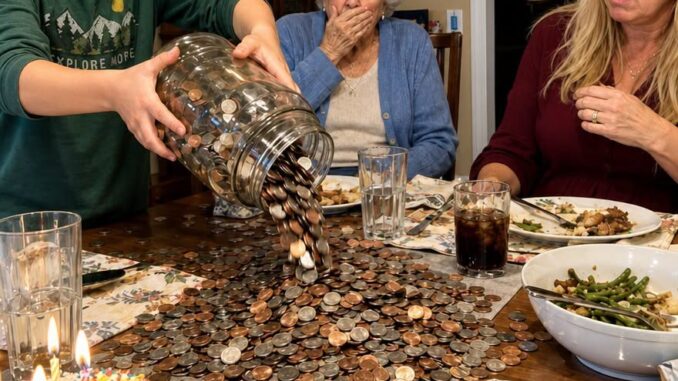
But instead of simply raising his glass, he reached beneath the table and lifted his savings jar.
It was the same jar he’d been filling with coins for his bicycle.
He carried it toward Rachel.
Then he carefully poured some of the coins onto the table.
“Aunt Rachel,” he announced, “I thought you might need these.”
Rachel looked confused.
“What are you talking about?”
Noah explained that he’d noticed she often asked Grandma for money when helping her.
He thought that perhaps she needed financial assistance.
The room became quiet.
I could see that Noah was trying to make sense of something he didn’t fully understand.
Before the conversation continued, I gently asked him to return to his seat.
Then he handed me a folded piece of paper.
The Document Noah Had Found
Noah explained that he’d seen Grandma place the paper in a kitchen drawer.
He hadn’t understood what it meant, but he thought I should read it.
I looked toward Mom.
She nodded.
“It’s all right,” she said. “You can look.”
I unfolded the document.
At the top were the words:
CARE SERVICES — BALANCE DUE
Below the heading was a list of household activities.
There were charges for bringing water, switching off lights, helping with laundry, providing transportation, and assisting with bathing.
At the bottom was a total of $3,760.
I read the document twice.
I hadn’t realized Rachel had been keeping such an extensive record.
I looked toward my sister.
“Rachel, can you explain this?”
A Conversation the Family Needed to Have
Rachel said the document was part of the system she’d introduced.
She insisted that it wasn’t intended to create financial pressure.
But Mom spoke up.
“I’ve already given Rachel money for some of those things.”
I turned toward her.
“How much have you paid?”
Mom explained that she’d handed over several hundred dollars from her pension.
She hadn’t kept a complete record.
Rachel said she believed the payments were voluntary.
Mom disagreed.
She explained that she’d felt expected to pay when requesting assistance.
The conversation was difficult.
I didn’t want Mom to feel embarrassed.
I also didn’t want Rachel to be judged without an opportunity to explain.
But it was clear that the arrangement had become a serious problem.
Looking More Closely at the Charges
I brought out the notes I’d been keeping.
With Mom’s permission, we reviewed the available documents.
Some entries didn’t match what other family members remembered.
One charge involved transportation on a day when Rachel hadn’t been available.
Another listed assistance with household tasks that relatives recalled completing themselves.
Rachel said some of the entries might have been recorded incorrectly.
I acknowledged that mistakes were possible.
But I also explained that we needed to separate verified expenses from unsupported charges.
The family began comparing information.
As we talked, another concern emerged.
Several relatives had provided Rachel with money because they believed she was personally covering Mom’s care expenses.
Contributions From Other Relatives
Aunt Carol explained that Rachel had told her caring for Mom was creating financial difficulties.
Carol had sent her $300 to help.
Our cousin Ben said he’d contributed $250.
Uncle Mike had provided another $180.
They had all believed the money was being used to support Mom’s needs.
Now they wanted to understand how those contributions had been handled.
Rachel appeared uncomfortable.
She explained that she’d been struggling financially since her relationship ended.
She’d hoped to rebuild her savings.
She acknowledged that the payment arrangement had gradually become more extensive than she’d originally intended.
She also admitted that she hadn’t clearly explained to relatives how the money was being used.
The family listened.
Her circumstances helped us understand why she might have felt financial pressure.
But they didn’t resolve the concerns about Mom’s payments.
Rachel Acknowledges the Problem
After a long conversation, Rachel admitted that she should have handled the situation differently.
She said she’d started with small charges and gradually added more.
She hadn’t fully considered how the arrangement affected Mom.
She also acknowledged that accepting contributions from relatives without clearly explaining their purpose had created misunderstandings.
I was disappointed.
I’d trusted Rachel to help during a difficult period.
Mom had trusted her too.
I told Rachel that we needed to make sure Mom received appropriate support without feeling financially pressured.
Rachel agreed that the payment system should end.
But we still needed to address the money she’d already received.
Making New Living Arrangements
After the birthday gathering, Rachel said she wanted to move out.
I understood that living together had become difficult.
Still, I didn’t want her to feel that she had to leave immediately without somewhere to go.
I offered her a few days to make arrangements.
During that time, we focused on Mom’s care.
We discussed which tasks she could comfortably manage and where she needed assistance.
We also considered whether additional professional support might be useful.
I wanted the family to establish a clear, respectful plan.
Mom shouldn’t have to worry about unexpected charges when asking for help.
And no family member should feel pressured to take on responsibilities without discussing them.
A Conversation About Fairness
Over the following days, the family occasionally referred to Rachel’s payment system.
When she asked someone for a ride, Ben jokingly asked whether transportation came with a fee.
When she asked Noah to bring something from another room, he smiled and mentioned the price list.
I understood why the family was using humor.
But I also wanted everyone to remember that the situation had been serious for Mom.
One evening, Rachel said the jokes were making her uncomfortable.
Mom responded gently.
“That’s how I felt when I had to think about paying every time I needed something.”
Rachel became quiet.
Mom continued.
“Helping each other isn’t always easy. But we should talk openly about responsibilities instead of making someone feel they can’t ask for help.”
It was an important conversation.
Mom’s Final Invoice
On the day Rachel moved out, Mom asked everyone to gather in the living room.
She had prepared a document of her own.
At the top, she’d written:
CARE SERVICES — FINAL INVOICE
Rachel looked surprised.
Mom began reading the entries.
There were imaginary charges for using the spare bedroom, household utilities, meals, laundry, and storage space.
She’d also included groceries and transportation.
Rachel frowned.
“But nobody told me I’d have to pay for those things.”
Mom nodded.
“Exactly.”
Then she smiled gently.
“I made this to show you how confusing it feels when someone introduces charges you never expected.”
The document wasn’t a real bill.
Mom had no intention of collecting the amounts she’d listed.
She wanted Rachel to understand why the original arrangement had felt unfair.
Reviewing the Actual Payments
After Mom finished, I explained that we’d also prepared a separate financial summary.
Unlike Mom’s illustrative invoice, this document included only payments we could verify.
We’d reviewed the available records from Mom, Carol, Ben, and Mike.
We removed entries that couldn’t be supported.
The confirmed amount Rachel had received was $1,940.
I explained that the family wanted to discuss returning money that had been collected under unclear or misleading circumstances.
We weren’t asking Rachel to pay invented household charges.
We wanted a fair resolution based on documented transactions.
Rachel said she couldn’t repay the full amount immediately.
I understood that.
So we discussed a manageable repayment schedule.
Agreeing on a Plan
Rachel agreed to return the verified amount over time.
We documented the arrangement so everyone understood the expectations.
The family wanted the matter handled respectfully.
There was no need for public arguments or constant reminders.
Rachel made an initial payment of forty dollars.
Noah, who had been quietly watching, asked whether she wanted a receipt.
For a moment, everyone looked at him.
Then we laughed.
It was the kind of harmless joke that reminded us how much humor had helped our family during difficult times.
Still, I made sure Noah understood that the financial matter was for the adults to resolve.
His bicycle savings remained his own.
The Months That Followed
Over the following months, Rachel continued making payments.
Our aunt Carol helped maintain a simple record of the remaining balance.
The arrangement was eventually completed.
Rachel had repaid the verified amount.
That didn’t mean every family disagreement disappeared.
Trust takes time to rebuild.
My relationship with Rachel remained more cautious than before.
But I appreciated that she’d followed through on the repayment plan.
Mom also decided not to pursue every amount she believed she’d paid.
Some transactions had been made in cash, and the records were incomplete.
She preferred to focus on moving forward rather than arguing over amounts nobody could verify.
Rebuilding Trust
I learned that resolving a financial disagreement and repairing a relationship are two different things.
The repayment plan addressed the documented money.
But the family also needed time to rebuild confidence.
Rachel had to demonstrate that she understood why the arrangement had been inappropriate.
Mom needed reassurance that she could ask for help without worrying about unexpected costs.
Other relatives needed to feel comfortable offering assistance again.
We began communicating more clearly about responsibilities.
When someone needed help, we discussed what was realistic.
If a task required professional care or involved a genuine expense, we talked about it openly.
That approach was much healthier than making assumptions.
Supporting Mom’s Independence
Mom still wanted to remain as independent as possible.
We respected that.
She enjoyed preparing simple meals, reading, and spending time with family.
But arthritis continued to make certain tasks uncomfortable.
We worked together to make daily activities easier.
We moved frequently used items to more accessible places.
We helped with heavier household chores.
We also encouraged her to discuss her symptoms and support needs with her healthcare professionals.
The goal wasn’t to do everything for her.
It was to help her remain comfortable and independent without feeling that asking for assistance was a burden.
My Own Recovery
During this period, I continued my medical treatment and recovery.
Some days were easier than others.
There were appointments, periods of fatigue, and moments when I needed extra rest.
But I gradually became more comfortable accepting help.
For a long time, I’d felt that I needed to manage everything myself.
The experience with Rachel reminded me that asking for support wasn’t a weakness.
It was part of being human.
Families can provide valuable emotional and practical assistance during difficult periods.
But that support works best when expectations are clear and everyone’s circumstances are respected.
I also learned that I didn’t need to solve every problem immediately.
Sometimes careful planning was more useful than reacting in the moment.
Noah’s Important Lesson
Noah continued saving for his bicycle.
He also continued making our family laugh.
I was proud that he’d noticed Grandma’s discomfort and cared enough to ask questions.
At the same time, I wanted him to understand that adults were responsible for managing complicated financial situations.
We talked about the importance of kindness.
We discussed why people sometimes need additional help as they grow older.
I explained that families can share responsibilities while still respecting one another’s time and resources.
Noah listened thoughtfully.
Then he asked whether helping Grandma with small tasks counted as a good deed.
“Of course,” I told him.
He smiled.
“Even if I don’t get paid?”
“Especially then.”
A Familiar Joke Returns
One afternoon, Mom was sitting in the living room when she asked whether someone could switch off the hallway light.
Her hands were bothering her.
I started to get up.
But Noah reached the switch first.
He turned it off and looked around the room with a grin.
“Anybody have ten dollars?”
Mom laughed.
I laughed too.
Noah pretended to be a professional announcer.
“Another successful household service completed!”
It reminded me of the silly sports commentary we’d used during my treatment.
For a moment, everything felt lighter.
The joke wasn’t about making anyone uncomfortable.
It was about recognizing how much our family had learned.
What the Experience Taught Us
Looking back, I understand that Rachel had been dealing with her own financial difficulties.
She needed stability after a difficult relationship ended.
But the way she approached our mother’s care created problems that could have been avoided.
If she needed financial assistance, she could have discussed that openly with the family.
If caregiving responsibilities were becoming overwhelming, we could have explored other arrangements.
Instead, the unexpected charges left Mom feeling uncomfortable and unsure about asking for help.
The situation improved only when we reviewed the facts, communicated directly, and established clear expectations.
It was a difficult lesson for everyone.
Final Thoughts
When Rachel moved into our home, I hoped we could support one another through a challenging period.
I was undergoing chemotherapy.
Our mother needed help with some daily activities.
And Rachel was trying to rebuild her life after financial difficulties.
What began as a family support arrangement became complicated when Mom was asked to pay for everyday assistance.
The issue eventually came to light during her seventy-ninth birthday celebration, when Noah brought attention to a document listing the charges.
After reviewing the available records, our family agreed on a repayment plan and made changes to how we organized Mom’s care.
The experience reminded us that financial arrangements should be transparent, especially when they involve older relatives who depend on others for assistance.
Helping family members should involve clear communication, mutual respect, and consideration for everyone’s needs. When money is involved, expectations should be discussed openly rather than assumed.
Today, Mom continues enjoying time with her family.
Noah is still saving for his bicycle.
And I’m continuing to focus on my health and recovery.
Our family isn’t perfect.
But we’ve learned to ask better questions, communicate more clearly, and recognize when someone needs support.
Sometimes, those lessons are worth more than any amount written on an invoice.
Leave a Reply