For more than fifty years, I believed that the young man I’d once loved had chosen to forget me.
We had shared an unforgettable summer in 1969, making plans for a future that seemed full of possibilities.
Then I left for nursing school.
I wrote him letters.
I waited for his replies.
But none ever arrived.
Eventually, my sister Madge told me he’d moved on with someone else.
I was heartbroken, but I accepted what she said and continued with my life.
Years passed.
I married a kind man, raised a family, and built a life filled with meaningful memories.
Yet a small part of me always wondered what had happened to those letters.
At seventy-four, I finally decided to ask.
And when I visited Dewitt’s ranch house, I discovered that the story I’d believed for fifty-five years wasn’t the whole truth.
Returning to a Familiar Place
The screen door creaked as Dewitt opened it.
He stood in front of me with his reading glasses resting on his head.
An old dog waited patiently beside his boots.
For several seconds, neither of us spoke.
Then he smiled.
“Lulu.”
Hearing him say my childhood nickname brought back memories I hadn’t thought about in years.
“Hello, Dewitt.”
He looked at me carefully.
“I wondered whether you’d ever come.”
I felt nervous.
“Did you know I was thinking about visiting?”
He stepped aside.
“I hoped you would.”
I walked inside.
The house smelled of fresh coffee and cedarwood.
A wooden table stood beside the kitchen window.
Framed photographs decorated the hallway.
Everything felt strangely familiar, even though so much time had passed.
Then I noticed a photograph on the wall.
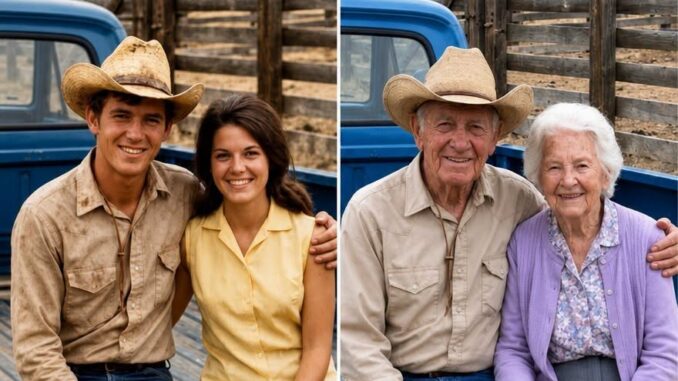
It showed two teenagers standing beside a blue hay truck.
The picture had been taken during the summer of 1969.
I recognized myself immediately.
My hair was tied back with a ribbon.
Dewitt stood beside me, smiling.
I hadn’t seen that photograph in decades.
“You still have this?”
He nodded.
“It reminds me of a good summer.”
I sat down at the kitchen table.
I’d come with questions.
But suddenly, I wasn’t sure how to begin.
The Question I’d Carried for Decades
Dewitt poured two cups of coffee.
We exchanged a few polite words about the weather and the drive.
Then I decided there was no reason to delay.
“Dewitt, can I ask you something?”
“Of course.”
I looked at him.
“Why did you stop answering my letters?”
He became very still.
Then he lowered his eyes.
“Lulu, I never received your letters.”
I stared at him.
“What?”
He looked up.
“I thought you stopped writing to me.”
For a moment, I couldn’t speak.
“That’s impossible. I wrote to you for months.”
Dewitt shook his head.
“Madge told me you’d met someone in Sacramento. She said you wanted to move forward.”
I felt my hands grow cold.
“She told me the same thing about you.”
We sat silently.
The room seemed smaller.
For fifty-five years, we’d both believed the other person had chosen to end our relationship.
And neither of us had known why.
A Box of Old Letters
Dewitt stood and walked toward a cabinet in the living room.
He opened the bottom drawer and removed a small metal box.
When he returned, he placed it between us.
“I’ve kept these for years.”
Inside were several envelopes tied together with a faded blue ribbon.
I recognized his handwriting.
My name was written across the front of the first envelope.
Lulu.
I picked it up.
The postmark was dated December 1969.
There were more letters beneath it.
January 1970.
February 1970.
March 1970.
I looked at him.
“You wrote all of these?”
He nodded.
“I wrote regularly. I thought you might answer eventually.”
I gently untied the ribbon.
The paper had yellowed with age.
But the writing was still clear.
As I began reading, I felt as though I were stepping back into another lifetime.
Memories of the Summer We Shared
The first letter began with a simple greeting.
Dewitt asked how nursing school was going.
He wrote about the ranch and the work he’d been doing.
Then he mentioned the old blue hay truck.
He joked about the afternoon I’d nearly driven it into a fence post.
I laughed.
“I didn’t hit that fence.”
Dewitt smiled.
“No. But you came awfully close.”
For a moment, the years seemed to disappear.
I remembered that summer clearly.
We’d spent afternoons helping around the ranch.
Sometimes, we’d sit outside after dinner and talk about the future.
I was preparing to leave for nursing school in Sacramento.
Dewitt planned to continue working with his family.
We knew the distance would be difficult.
But we’d promised to write.
And we believed we’d find a way to stay close.
Reading those letters reminded me how sincere our hopes had been.
The Letter That Explained His Silence
I continued through the stack.
One letter described Christmas at the ranch.
Another mentioned the weather.
Several included ordinary details about daily life.
They were the kinds of things people share when they want someone far away to feel included.
Then I reached the final envelope.
It was dated April 1970.
The letter was shorter than the others.
Dewitt wrote that he didn’t understand why we’d stopped communicating.
He hoped I was happy.
And he said that if I ever wanted to speak with him again, he’d welcome the conversation.
I placed the letter on the table.
For years, I’d imagined he’d lost interest in me.
Now I knew he’d been confused and disappointed too.
Dewitt looked at me.
“I should have come to Sacramento.”
I shook my head.
“And I should have asked you directly instead of believing what I heard.”
We both understood that the past couldn’t be changed.
But finally knowing the truth about our unanswered letters meant more than I could explain.
The Class Ring
After a while, Dewitt asked another question.
“Do you remember your class ring?”
I smiled faintly.
“Of course.”
During our last summer together, I’d given him the ring to wear on a shoelace.
It was a small gesture, but it had meant a great deal to both of us.
Dewitt reached into his shirt pocket.
He removed a little leather pouch.
Inside was my ring.
I stared at it.
My initials were still engraved on the side.
“You kept it?”
He nodded.
“For a long time, I wore it under my shirt. After I married Madge, I put it away.”
His words brought another complicated memory to the surface.
Madge was my sister.
She’d grown up beside me.
We’d shared a bedroom, family celebrations, and countless childhood experiences.
And she’d eventually married the man I’d once expected to spend my future with.
For decades, I’d accepted that their relationship had developed after Dewitt and I drifted apart.
Now I was beginning to question that understanding.
What Madge Had Told Him
I looked at Dewitt.
“Did Madge ever know you kept the letters?”
He nodded.
“She found them once.”
“What happened?”
“We disagreed about it. She said I needed to leave the past behind.”
I took a breath.
“Did she ever explain what happened back then?”
Dewitt hesitated.
“Yes. But not until many years later.”
I waited.
He explained that approximately ten years earlier, Madge had become seriously ill.
One evening, while looking through an old photograph album, she’d found a picture of the two of us.
She became emotional.
Eventually, she admitted something she’d kept private for decades.
A Confession From Years Earlier
According to Dewitt, Madge had struggled with jealousy when we were young.
She believed I received more attention from our parents.
I was preparing for nursing school, and she felt uncertain about her own future.
She also had feelings for Dewitt.
At first, she hoped he’d notice her.
But he was still committed to our relationship.
When I left for Sacramento, Madge began interfering with our correspondence.
She admitted that she’d kept letters I’d sent to Dewitt.
She also gave each of us misleading information about the other.
Dewitt believed I’d met someone new.
I believed he’d started another relationship.
Over time, we both stopped trying to reach each other.
Madge later acknowledged that she hadn’t expected the misunderstanding to continue for so long.
I sat quietly, trying to absorb what I was hearing.
“She kept my letters?”
Dewitt nodded.
“She told me there were fourteen.”
Fourteen letters.
Fourteen attempts to stay connected.
And none had reached the person I’d written them for.
Understanding the Past Differently
I looked down at the table.
For years, I’d wondered whether Dewitt had simply changed his mind.
I’d questioned whether our relationship had meant as much to him as it had to me.
Now I understood that we’d both been working with incomplete information.
But another question troubled me.
“Dewitt, why didn’t you tell me when Madge confessed?”
He looked uncomfortable.
“She was very ill. We’d been married for decades, and I didn’t know how to tell you without causing more pain.”
I listened.
“I knew you deserved the truth,” he continued. “But I kept postponing the conversation.”
I appreciated his honesty, even though I wished he’d told me sooner.
There was no simple answer.
Madge had made a deeply hurtful choice when we were young.
But she’d also been part of our family for a lifetime.
I had memories of her that had nothing to do with Dewitt.
We’d celebrated birthdays together.
We’d helped each other through difficult times.
We’d watched our families grow.
Learning the truth didn’t erase those experiences.
It simply made my understanding of our relationship more complicated.
A Letter From My Sister
Dewitt stood and returned to the cabinet.
This time, he brought a small white envelope.
My name was written on the front.
I recognized Madge’s handwriting immediately.
“She asked me to give you this,” he said.
I held the envelope for a moment before opening it.
Inside was a folded letter.
Madge had written it during the later years of her life.
She admitted that she’d interfered with my letters because she wanted Dewitt’s attention.
She explained that jealousy and insecurity had influenced her decisions.
At the time, she’d convinced herself that I would eventually meet someone else and move forward.
But as the years passed, she understood how unfair her actions had been.
She wrote about watching me marry Alvis and raise my family.
She remembered seeing me at Thanksgiving and other celebrations while carrying the knowledge of what she’d done.
She said she regretted her dishonesty.
And she apologized.
Near the end, she wrote that she didn’t expect me to excuse her choices.
She simply hoped I could remember that our relationship had included more than that painful chapter.
I read the letter twice.
Then I folded it carefully.
Forgiveness Doesn’t Always Happen Immediately
I didn’t know what to feel.
Part of me was deeply disappointed.
I’d spent decades believing something that wasn’t true.
I’d missed the opportunity to understand why my first relationship had ended.
But I also knew that Madge was no longer here to answer my questions.
Her apology couldn’t change what happened.
And I couldn’t decide in a single afternoon whether I had forgiven her.
Dewitt seemed to understand.
He didn’t pressure me to say anything.
Instead, he poured another cup of coffee.
We sat quietly for a while.
Then he asked about my daughter.
The ordinary question was unexpectedly comforting.
It reminded me that although our past mattered, we still had lives to talk about.
The Life I Built With Alvis
I told Dewitt about my husband, Alvis.
He’d been a thoughtful, hardworking man.
We’d shared many happy years together.
Our marriage had included the ordinary challenges every family faces.
But we’d supported one another.
We raised our daughter.
We celebrated milestones.
We made a home filled with familiar routines and memories.
After Alvis passed away, I missed him terribly.
Dewitt listened without interrupting.
“He sounds like a good man,” he said.
“He was.”
I smiled.
“And I loved him very much.”
Dewitt nodded.
“I’m glad you had a good life, Lulu.”
His words meant something to me.
Learning the truth about our teenage relationship didn’t make my marriage any less important.
I wasn’t wishing away the years I’d spent with Alvis.
I was simply finding an answer to a question I’d carried for a long time.
Could We Be Friends Again?
We talked for another hour.
We remembered the ranch, the old hay truck, and the summers when we were young.
We laughed about small moments that had once seemed ordinary.
Then Dewitt looked at me.
“Lulu, would you like to be friends again?”
I studied his face.
He was seventy-six now.
His hair had turned gray.
His hands showed the effects of decades of ranch work.
We were no longer the teenagers in the photograph.
But there was something familiar about his smile.
“I think I’d like that,” I said.
He looked relieved.
“There’s a county fair next month. Would you like to go?”
I laughed.
“Are you inviting me on a date?”
He grinned.
“I’m inviting an old friend to share a funnel cake.”
“Well,” I said, “that sounds lovely.”
Taking My Ring Home
Before I left, Dewitt handed me the leather pouch containing my class ring.
I tried to return it.
“You’ve kept it all these years. You should have it.”
He shook his head.
“I think it’s time it went back to you.”
I placed it carefully in my handbag.
Outside, the clouds had begun to clear.
I sat in my car for several minutes before starting the engine.
I’d arrived hoping for answers.
I’d received more than I’d expected.
Some of what I’d learned was painful.
But I also felt a sense of relief.
For fifty-five years, I’d believed Dewitt had chosen to stop writing.
Now I knew we’d both been waiting for letters that never arrived.
The truth couldn’t restore our youth.
But it had finally brought an old misunderstanding into the open.
Telling My Daughter
That evening, my daughter called.
“Well, Mama? Did you go?”
“I did.”
There was a pause.
“And?”
I looked at the class ring resting on my kitchen table.
“He showed me his letters.”
“What letters?”
“The ones he wrote after I left for Sacramento.”
I explained that Dewitt had never received the letters I’d sent.
Then I told her about Madge’s confession.
My daughter was quiet for a long time.
“Mama, I don’t know what to say.”
“Neither do I, sweetheart.”
She asked whether I was all right.
I thought about it.
“I’m still sorting through everything.”
Then she asked another question.
“Will you see him again?”
I smiled.
“He invited me to the county fair.”
“Mama!”
I laughed.
“I’m seventy-four. I think I can enjoy an afternoon with an old friend.”
She laughed too.
For the first time that day, I felt a little lighter.
An Afternoon at the County Fair
A month later, Dewitt and I went to the fair.
We walked slowly past the livestock displays.
We watched families enjoying the games.
We shared a funnel cake.
At one point, we stopped to watch a children’s pie-eating contest.
Dewitt laughed so hard that his glasses slipped down his nose.
I laughed with him.
It felt good.
Nobody around us knew our history.
Nobody needed to.
We were simply two old friends enjoying a pleasant afternoon.
Before he drove me home, Dewitt reached into his jacket pocket.
He handed me a photograph.
It was the picture of us standing beside the blue hay truck in 1969.
On the back, he’d written a short message about how some summer memories stay with us throughout life.
I smiled.
Then I handed it back.
“Keep this one,” I told him.
He looked surprised.
“Are you sure?”
“Yes. I have plenty of memories of my own.”
He smiled and carefully returned the photograph to his pocket.
Making Peace With What I Couldn’t Change
That night, I placed Madge’s letter in a drawer beside an old family photograph.
I still missed my sister.
I still wished she’d made different choices.
And I knew there would be days when I’d think about the years we’d spent misunderstanding one another.
But I didn’t want the discovery to overshadow the life I’d actually lived.
I’d loved Alvis.
I’d raised a daughter.
I’d made friends, helped people, and experienced countless meaningful moments.
Those years weren’t a consolation prize.
They were my life.
Dewitt had his own history too.
We couldn’t return to 1969.
And we didn’t need to.
What mattered was that we’d finally been able to speak honestly.
The Value of Asking Questions
For fifty-five years, I believed that silence meant Dewitt had rejected me.
I never considered that he might have been waiting for an answer too.
Our misunderstanding grew because we relied on information from someone else instead of speaking directly.
By the time we learned what happened, decades had passed.
That realization taught me something important.
When a relationship matters, honest communication is worth the effort.
Assumptions can leave questions unanswered for years.
And even when the truth arrives late, it can still bring understanding.
I don’t know exactly what the future holds for Dewitt and me.
Perhaps we’ll visit the fair again.
Perhaps we’ll share coffee and talk about our families.
Perhaps we’ll simply remain old friends who finally understand what happened long ago.
For now, that’s enough.
At seventy-four, I’ve learned that it’s never too late to ask a question, make peace with an old memory, or welcome a meaningful friendship back into your life.
The End
Leave a Reply