Christmas was supposed to be a joyful occasion filled with family traditions, delicious food, and meaningful moments together.
But that year, an unexpected discovery made me reconsider how we treated one of the youngest members of our family.
It also taught my husband an important lesson about parenthood, responsibility, and making sure every child feels included.
An Unexpected Discovery on Christmas Evening
It was nearly eight o’clock on Christmas night when I carried a slice of pecan pie upstairs to the guest room.
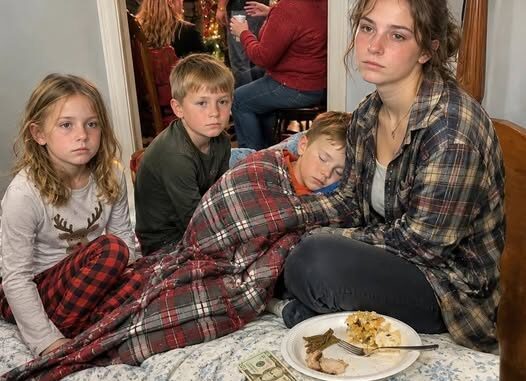
Inside, I found my fourteen-year-old stepdaughter, Tessa, sitting quietly beside the bed.
My two-year-old son, Caleb, was asleep in his portable crib. My husband’s niece and nephew, four-year-old Lucy and six-year-old Finn, were resting on a blanket nearby.
Tessa was still wearing the beautiful green velvet dress she’d arrived in that morning.
Beside her was an untouched plate of Christmas dinner.
“Hey, Julie,” she whispered.
“Sweetheart, why are you still upstairs?”
“Dad asked me to stay with the kids.”
I glanced at the clock.
She’d been there for more than three hours.
Then I noticed a twenty-dollar bill resting on the pillow.
“What’s this?” I asked.
“Dad gave it to me for babysitting.”
“Did you ask him to pay you?”
She shook her head.
“I didn’t really want the money,” she explained. “I just wanted to have Christmas dinner with everyone.”
Her words stayed with me.
I placed the pie beside her and offered to take over.
“You can come downstairs now,” I said.
She looked uncertain.
“Did Dad say it was okay?”
That simple question made me realize there was something about our family dynamic that I hadn’t fully understood.
Our Blended Family
My name is Julie Kessler. I’m thirty-nine and work as a dental office manager in Overland Park, Kansas.
My husband, Mark, and I have been married for five years. Together, we have a two-year-old son named Caleb.
Mark also has a daughter, Tessa, from his previous marriage.
She was nine when I first met her, a thoughtful little girl who carried a sketchbook everywhere.
Now fourteen, she was developing into a talented young artist with a wonderful sense of humor.
Tessa lived primarily with her mother, Nina, and spent alternating weekends and holidays with us.
She was particularly close to Caleb.
Whenever she arrived, he’d run toward her excitedly, calling her name.
I always appreciated how patient she was with him.
I attended her school art shows, bought her favorite breakfast cereal, and made sure her room was comfortable whenever she visited.
I believed we had a good relationship.
But that Christmas, I realized that being kind to someone isn’t always the same as paying attention to what they need.
A Thoughtful Christmas Gift
Tessa arrived shortly before noon on Christmas Day.
She wore a dark green velvet dress with a white collar and carried a small package wrapped in brown paper.
The wrapping was decorated with dozens of tiny Christmas trees she’d drawn herself.
“I made something for Dad,” she told me.
“It’s beautiful,” I said.
“Can I give it to him after dinner? When everything is quieter?”
“Of course.”
She carefully placed the package beneath the Christmas tree, away from the larger presents.
Soon afterward, Caleb came running toward her.
She picked him up, and the two of them laughed together.
Everything seemed perfect.
Opening the Presents
By four o’clock, our house was filled with relatives.
Mark’s brother, Aaron, arrived with his wife, Beth, and their children. Mark’s parents brought dessert, while other relatives contributed dishes for dinner.
The children opened their presents first.
Caleb enjoyed playing with the empty boxes. Finn received a race track, and Lucy was delighted with her new dollhouse.
Tessa received a sweater from her grandparents and a professional watercolor set from Mark and me.
I’d chosen the paints after speaking with her art teacher.
When she opened the wooden box, her face brightened.
“These are the ones my teacher uses!”
“I thought you might like them.”
She smiled and thanked me.
I took a photograph of her sitting beside the Christmas tree with Caleb on her lap.
It was one of those pictures that seemed to capture everything wonderful about the holidays.
Then we began preparing dinner.
A Small Request That Became Something More
The younger children were becoming tired, and the adults needed space to arrange the dining tables.
Mark turned toward Tessa.
“Would you take the little ones upstairs for a while? Put on a Christmas movie until dinner is ready.”
Tessa looked up from her new watercolor paints.
“Can I eat with everyone first?”
“We’re not ready to eat yet,” Mark replied. “It’ll just be for a little while.”
I heard their conversation while carrying a baking dish into the kitchen.
I assumed someone would bring Tessa downstairs when dinner was served.
She gathered the children’s toys and helped them upstairs.
Meanwhile, the rest of us continued preparing the meal.
Looking back, I wish I’d paused and made sure everyone understood that Tessa would be joining us for dinner.
An Empty Seat at the Table
At five-thirty, we gathered around the dining table.
Someone asked where Tessa was.
“She’s upstairs with the kids,” Mark explained. “She doesn’t mind watching them.”
I quietly suggested bringing everyone downstairs.
But Mark said Caleb had finally settled down and that Tessa could eat later.
With so many guests and things happening around me, I became distracted.
Dinner continued, followed by coffee, dessert, and our traditional Christmas trivia game.
Nearly three and a half hours passed before I realized Tessa still hadn’t returned.
That’s when I carried the slice of pecan pie upstairs and found her sitting beside the sleeping children.
I asked Beth to take over so Tessa could finally join the family.
Beth looked surprised when she entered the guest room.
“I thought you’d already come downstairs for dinner,” she told Tessa.
It became clear that several of us had made assumptions without checking on her.
The Present That Stayed Beneath the Tree
When Tessa and I returned downstairs, Mark was organizing another round of Christmas trivia.
“Who’s watching the children?” he asked.
“Beth,” I replied. “Tessa has been upstairs for three and a half hours. She missed dinner.”
Mark explained that he’d brought her a plate.
But I knew that wasn’t the same as sharing a holiday meal with her family.
Tessa quietly asked whether she could give him her present.
“After the game,” he answered.
She nodded and sat near the edge of the living room.
The evening continued.
Eventually, the guests collected their coats and said goodbye.
By ten o’clock, Mark was relaxing on the couch, watching television.
Tessa’s handmade present remained unopened beneath the Christmas tree.
She went upstairs without giving it to him.
The Morning After Christmas
Nina arrived the following day to collect Tessa.
Before leaving, Tessa placed the twenty-dollar bill on the kitchen counter.
She’d also packed her belongings and carefully folded her bedding.
I reminded her about the present she’d made for Mark.
“Would you like me to give it to him?”
She looked at the package for a moment.
“No, I’ll take it home.”
She placed it inside her overnight bag and walked toward her mother’s car.
Something about her quiet departure concerned me.
Later that afternoon, I began looking through photographs from previous family gatherings.
I noticed a pattern I hadn’t recognized before.
At birthday parties, Tessa was holding Caleb.
At summer cookouts, she was supervising the younger children.
At Easter, she was sitting with Lucy while the adults enjoyed their meal.
She was frequently helping everyone else, but rarely participating in the celebrations herself.
I began wondering whether we’d come to expect too much from her.
A Payment Notification Revealed More
Two days after Christmas, Mark left his phone on the kitchen counter while taking Caleb to the park.
A payment notification appeared on the screen.
Aaron had sent him sixty dollars for Christmas babysitting.
Curious, I opened my own Venmo account and reviewed the transactions Mark had shared publicly.
There were fourteen babysitting payments dating back to March, totaling $740.
Each payment corresponded with one of Tessa’s weekends at our house.
I remembered the occasions when Aaron and Beth had brought their children over.
Mark often explained that Tessa enjoyed looking after them.
Sometimes I was working. Other times, I was running errands or taking care of household responsibilities.
I’d never stopped to ask whether Tessa genuinely wanted to spend her weekends babysitting.
I also hadn’t realized Mark was receiving payments for those arrangements.
The discovery prompted me to contact Nina.
An Honest Conversation With Tessa’s Mother
Nina and I met at a café the following afternoon.
It was the first time we’d sat down together without Mark or Tessa present.
She explained that Tessa had returned home from Christmas feeling disappointed.
She’d even asked whether she could spend the following Christmas at her mother’s house.
Then Nina shared something Tessa had told her several months earlier.
“At Dad’s house, sometimes I feel more like a babysitter than his daughter.”
Hearing those words helped me understand why Tessa had become increasingly reluctant to visit.
I told Nina about Christmas dinner and the payments I’d discovered.
She was surprised.
Tessa had never mentioned receiving regular babysitting payments.
Nina also explained that she’d consulted a lawyer about potentially adjusting their parenting arrangements.
She wanted Tessa to feel comfortable expressing her preferences about spending time with each parent.
Neither of us wanted unnecessary conflict.
We simply wanted Tessa to feel valued and welcome.
Before we left, Nina handed me the Christmas present Tessa had taken home.
“She asked me to get rid of it,” Nina explained. “But I thought Mark should see it.”
I promised to give it to him.
A Conversation My Husband Needed to Have
That evening, after Caleb went to bed, I sat across from Mark at the kitchen table.
I showed him the babysitting payments.
“How much of this money did Tessa receive?” I asked.
Mark explained that he’d considered the arrangements a normal part of helping family.
But I reminded him that Tessa had been doing much of the actual babysitting.
“She’s fourteen,” I said. “She deserves time to enjoy her weekends, pursue her interests, and participate in family celebrations.”
I told him about my conversation with Nina.
When he learned that Tessa felt her visits were primarily about childcare, his expression changed.
“That’s not how I feel about her,” he said. “She’s my daughter. I love her.”
“I know,” I replied. “But she needs to experience that through your actions.”
After a long silence, Mark began talking about his childhood.
As the oldest sibling, he’d regularly been responsible for watching his younger brothers while his parents worked.
He’d missed social activities and school events because of those responsibilities.
He’d grown up believing that older children were simply expected to help.
“Did you enjoy it?” I asked.
He shook his head.
“Not really. I wished I’d had more time to do my own things.”
That realization helped him understand Tessa’s perspective.
He’d unintentionally repeated a family pattern that had once disappointed him.
The Handmade Book
I placed Tessa’s Christmas present on the table.
“She wanted to give you this after dinner,” I explained.
Mark carefully removed the brown paper decorated with tiny Christmas trees.
Inside was a handmade watercolor book, stitched together with green thread.
The cover read:
Christmas With Dad
Each page contained a painting of a Christmas memory from Tessa’s childhood.
There was a picture of Mark playing with her when she was three.
Another showed them admiring Christmas lights together.
One captured the gingerbread house they’d built.
Another showed them attending a Christmas Eve service.
As Mark turned the pages, he watched his daughter grow older through her artwork.
There were paintings representing the changes in their family, including his separation from Nina, our marriage, and Caleb’s arrival.
Then he reached the final page.
Tessa had painted our dining room on Christmas Day.
The table was decorated with candles and surrounded by relatives.
Mark was sitting at the head of the table.
Beside him was a girl wearing a green velvet dress.
She was smiling.
Underneath, Tessa had written:
This year. I hope.
She’d painted the scene before Christmas, imagining the dinner she hoped to share with her father.
Instead, she’d spent most of the evening upstairs.
Mark studied the painting for several minutes.
Then he became emotional.
For the first time, he fully understood what his daughter had been trying to communicate.
Taking Responsibility
The following morning, Mark told me he wanted to make things right.
He began by visiting Aaron.
They discussed the babysitting arrangements and the payments Mark had received.
Aaron explained that he’d believed Tessa was receiving the money.
He hadn’t realized that Mark was keeping the payments.
He also acknowledged that he and Beth should have checked on their children during Christmas instead of assuming Tessa was comfortable supervising them.
Aaron transferred $740 directly to Tessa, covering the previous babysitting arrangements.
Mark then contributed the original $740 to an education savings account intended for her future studies.
He also arranged to contribute an additional $100 each month.
He hoped the savings would help support her interest in art if she decided to pursue it after high school.
But we both understood that money alone wouldn’t repair their relationship.
Tessa needed meaningful time with her father.
A Dinner for Two
Mark contacted Nina and asked whether Tessa would be comfortable having dinner with him.
Initially, she declined.
Rather than pressuring her, he decided to write her a letter.
He spent three evenings working on it.
He acknowledged his mistakes, apologized, and explained that he wanted to become more attentive to her needs.
After reading the letter, Tessa agreed to meet him.
She had one request.
She wanted to choose the restaurant, and she wanted it to be just the two of them.
No younger children.
No babysitting responsibilities.
Simply dinner with her dad.
She selected a small Italian restaurant in downtown Olathe.
When Mark returned home, he told me about their conversation.
Tessa had explained that she’d worried he might stop wanting her to visit if she refused to help with the children.
She hadn’t wanted to disappoint him.
Mark assured her that spending time together was important to him regardless of whether she helped around the house.
They also agreed on several changes.
Tessa would no longer be expected to babysit her cousins unless she voluntarily offered.
Any agreed babysitting payments would go directly to her.
Mark and I would remain responsible for Caleb’s care.
And Tessa would always be included in family meals and celebrations.
She decided she wanted to continue spending alternating weekends with us, provided those boundaries were respected.
Showing Change Through Actions
Over the following months, Mark made a consistent effort to honor their agreement.
When Aaron needed childcare on Valentine’s Day, Mark volunteered himself instead of asking Tessa.
At Easter, Tessa sat beside her father at the dining table.
On weekend mornings, Mark took responsibility for Caleb’s breakfast and activities, allowing Tessa to rest or work on her artwork.
Gradually, she became more comfortable in our home.
She began joining me in the kitchen, telling me about school, friendships, and her latest paintings.
In March, she entered a watercolor painting in a local high school art competition.
Her painting of Caleb sleeping beside his stuffed dinosaur won second place in her division.
Mark took time off work to attend the exhibition.
He stood beside her painting proudly, listening as she explained how she’d created it.
Tessa later told me how much it meant to have him there.
During the summer, she voluntarily offered to babysit Finn and Lucy for a week.
She agreed on an hourly rate with Aaron and received her payments directly.
This time, the arrangement was her choice.
The difference was important.
Christmas Came Around Again
A year later, Tessa arrived wearing her green velvet dress.
Nina came inside for coffee, and we spent some time talking before the celebrations began.
By late afternoon, the house was once again filled with relatives, presents, and holiday food.
As we prepared dinner, the younger children became restless.
This time, Mark stood up.
“I’ll take the little ones upstairs for a movie,” he announced. “Aaron, would you help me? We’ll bring everyone down when dinner is ready.”
The two brothers gathered the children and headed upstairs.
Tessa remained in the living room with her sketchbook.
She looked toward me and smiled.
“Would you like to help me with the gravy?” I asked.
“Yes,” she replied happily.
She joined me in the kitchen because she wanted to, not because anyone expected her to.
At five-thirty, everyone gathered around the dining table.
Mark sat at the head.
Tessa sat beside him.
She was wearing the same green dress she’d painted in her watercolor book the previous year.
The scene she’d once imagined had finally become reality.
A Special Christmas Present
Halfway through dinner, Mark gently tapped his glass.
“I have something to give someone,” he announced.
He reached beneath his chair and removed a small package.
It was wrapped in brown paper decorated with hand-drawn Christmas trees.
The drawings weren’t nearly as polished as Tessa’s, but he’d spent two evenings making them himself.
He placed the package in front of his daughter.
Tessa carefully opened it.
Inside was her handmade watercolor book.
Christmas With Dad.
But something was different.
Mark had taken it to an art supply store and arranged for forty additional blank watercolor pages to be added.
Tessa turned to the painting she’d made the previous year.
Beneath her original words, This year. I hope, Mark had written:
This year.
On the following blank page, he’d added another message.
Next year. Your seat is already saved.
Tessa looked at the words for a long moment.
Then she smiled and hugged her father.
The rest of us watched quietly.
It was a simple gesture, but it represented a year of conversations, accountability, and meaningful change.
A Lesson Our Family Will Always Remember
After dinner, we gathered in the living room for our annual Christmas trivia game.
Tessa sat beside Mark, laughing at his ridiculous questions.
Later that evening, I went upstairs to check on Caleb.
The guest room was quiet.
On the nightstand was a framed photograph from the previous Christmas.
It showed Tessa smiling with Caleb on her lap while Mark sat behind them.
I kept that photograph as a reminder that even happy-looking moments don’t always reveal how everyone is feeling.
Sometimes, the people who help the most are the ones we forget to check on.
Children can enjoy helping their families, but they also deserve opportunities to explore their interests, spend time with friends, and participate in family traditions.
Being responsible should never mean feeling responsible for everyone else’s happiness.
That Christmas taught us to communicate more openly, respect personal boundaries, and appreciate each family member for who they are rather than what they can do for others.
Mark learned that becoming a more attentive father required more than an apology. It required consistent effort.
And Tessa learned that she could express her needs without losing her place in our family.
When I returned downstairs, she was laughing beside her father.
Everyone was together.
And the seat that had once been empty was finally occupied.
Because every child deserves to feel like a valued member of the family, not simply someone who helps keep everything running.
Leave a Reply