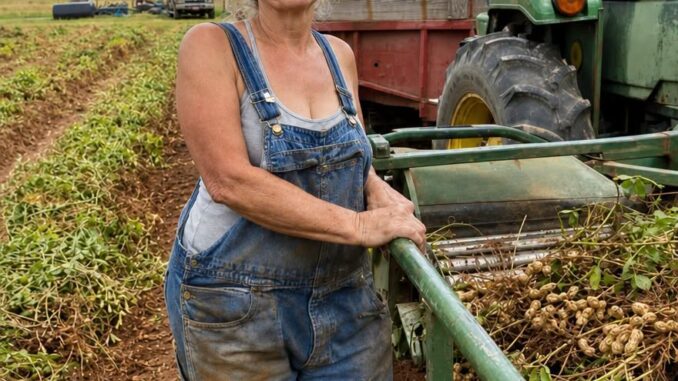
For fifteen years, my husband Hoyt and I had relied on his uncle Lamar to help harvest our peanut crop.
It was an arrangement built on family trust.
Hoyt handled the digging, and Lamar operated the peanut picker. We paid him fifty dollars per acre for our 180 acres, a total of $9,000.
Every season, the arrangement had worked.
Until the year everything changed.
That autumn, Lamar asked us to pay him in advance.
He said he had some expenses to take care of and would appreciate receiving the money early.
Hoyt didn’t hesitate.
He wrote the check and handed it to his uncle.
Lamar promised to arrive on Friday morning, once the dew had dried from the fields.
We had no reason to doubt him.
But when Friday arrived, we discovered that Lamar had made other plans.
And with a storm approaching, our entire harvest was suddenly at risk.
The Morning Our Plans Fell Apart
By Friday morning, our peanut plants had already been dug from the ground.
They lay in long rows across the fields, drying in the sunshine.
The timing was important.
Peanuts need suitable conditions after digging and before they are collected. Too much moisture at the wrong time can affect the quality of the crop.
Everything was ready for Lamar.
At nine-thirty, I prepared sandwiches and sweet tea for the workers.
Hoyt stood outside with a cup of coffee, watching the road.
Ten o’clock came.
Then we heard the familiar sound of Lamar’s harvesting equipment.
For a moment, I felt relieved.
But instead of turning into our driveway, the machine continued toward the field across the road.
Lamar began harvesting his own peanuts.
Hoyt watched for several minutes.
Then he climbed into his truck and drove over to speak with him.
When he returned, his expression told me the conversation hadn’t gone well.
A Promise That Wasn’t Kept
Hoyt explained that he’d reminded Lamar of their agreement.
Our peanuts were ready.
We’d already paid him.
And he’d promised to begin on Friday.
Lamar acknowledged the arrangement but said he needed to harvest his own fields first.
When Hoyt asked when he could expect him, Lamar gave no definite answer.
He would come when he finished his own work.
I asked Hoyt how long that might take.
“Four or five days,” he said. “Maybe longer if something breaks.”
I immediately thought about the weather forecast.
A tropical storm named Pilar was moving toward the Gulf Coast.
Heavy rain was expected to reach our part of Georgia by Monday afternoon.
That left us with very little time.
Our family’s entire year’s work was sitting in the fields.
The 180 acres represented nearly $200,000 in potential crop income before expenses.
And we had no harvesting equipment of our own that was ready to use.
Why the Storm Was Such a Serious Concern
Peanut harvesting depends heavily on weather conditions.
After the plants are dug, they are usually placed in windrows to dry before being picked.
This allows moisture levels to decrease before the crop is collected.
However, heavy rainfall during this period can create problems.
Excessive moisture may delay harvesting, reduce crop quality, and increase the risk of losses.
Strong weather can also scatter plants, damage equipment, and make fields difficult to enter.
We had already invested months of work and considerable money into growing those peanuts.
Losing a large portion of the harvest would affect far more than our annual income.
It would affect our family’s ability to meet expenses and prepare for the next planting season.
But there was another reason we were especially worried.
Sixty of those acres belonged to Hoyt’s mother.
The Sixty Acres That Supported Inez
My mother-in-law, Inez, was eighty-one years old.
She lived in a small white house at the end of our road.
Her husband, Wendell, had passed away years earlier, leaving her the house, some farmland, and an old pickup truck.
Every season, Hoyt farmed her sixty acres along with our own.
After the crop was sold, he gave her the proceeds.
That money helped cover groceries, electricity, medication, medical appointments, and other everyday expenses.
Inez had always been independent.
She rarely asked anyone for help.
But the income from her land made a meaningful difference in her life.
If the harvest was damaged, she would face a much more difficult year.
Hoyt knew that.
So did I.
We needed to find a solution quickly.
Looking for Another Harvester
Our first idea was to hire someone else.
Hoyt began making phone calls to farmers in the surrounding counties.
But everyone was busy.
The Daniels brothers had already committed to other fields through Tuesday.
Another farmer’s equipment was undergoing repairs.
Several others were racing to finish their own harvests before the rain arrived.
Nobody had a machine available in time.
Our sons, Beau and Clayton, joined the conversation.
Beau was twenty-two and had recently graduated from Abraham Baldwin Agricultural College.
Clayton was eighteen and still attending high school.
Both had grown up around the farm.
They understood what the coming storm could mean.
We considered every possibility we could think of.
But without a peanut picker, there was very little we could do.
Then I remembered something that had been sitting unused for years.
“My daddy’s old picker,” I said.
Everyone looked at me.
The Machine My Father Left Behind
My father, Earl Bledsoe, had farmed for more than fifty years.
He grew peanuts, cotton, and corn.
He believed in taking care of his equipment, helping neighbors, and never wasting something that could still be useful.
After he passed away six years earlier, our family sold most of his farming machinery.
But I kept one piece.
His 1985 two-row peanut picker.
It wasn’t nearly as fast as modern harvesting equipment.
It required more attention, more labor, and more patience.
But my father had used it successfully for many seasons.
The machine had been sitting beneath a tarp in his old shed ever since.
Hoyt reminded me that it hadn’t run in six years.
I knew that.
But I also knew we had nothing to lose by inspecting it.
We walked to the shed together.
When we pulled away the tarp, a cloud of dust rose into the air.
There it was.
Old, faded, and covered in years of neglect.
But still standing.
Bringing the Old Picker Back to Life
Hoyt examined the machine carefully.
One tire was flat.
The belts were worn.
Several picking components needed replacement.
The bearings required lubrication.
It wasn’t going to be a quick repair.
Still, Hoyt thought there was a chance we could get it running.
That was all the encouragement I needed.
He drove to equipment dealers and salvage yards looking for parts.
At one salvage yard, a man named Dewey recognized the machine when Hoyt described it.
He remembered my father.
Dewey searched through his workshop and found several parts that might fit.
He also offered a used tire.
When Hoyt tried to pay him for everything, Dewey explained that my father had helped him years earlier.
He wanted to return the kindness.
That small act meant more to me than I could explain.
Even after six years, people still remembered Earl Bledsoe as someone who showed up when others needed help.
A Family Working Together
Back at the farm, everyone found a job.
Beau cleaned the machine and checked the components.
Clayton greased the fittings.
Hoyt replaced the belts and repaired the damaged parts.
I gathered tools and helped wherever I could.
While searching through the shed, I found my father’s old grease gun hanging on the wall.
His initials, E.B., were scratched into the metal.
I held it for a moment.
Suddenly, I remembered being a little girl standing beside him while he worked on the machinery.
He would ask me to hold a flashlight.
I wasn’t always good at pointing it in the right direction.
But he never seemed to mind.
I could almost hear his voice reminding me to move the light a little to the left.
Clayton noticed me standing quietly.
He gently took the grease gun and offered to finish the job.
Watching him work brought back memories I hadn’t thought about in years.
Three generations of our family were connected through that old machine.
The First Test
By midafternoon, the picker was ready for a test.
Hoyt connected it to the tractor.
Everyone stepped back while he carefully engaged the equipment.
At first, the machine rattled.
The belts moved unevenly.
For a moment, I worried that the repairs hadn’t been enough.
Then the mechanism began turning steadily.
The picker was running.
We stood there watching it, almost afraid to celebrate too soon.
But after several minutes, it continued working.
Hoyt looked at me and smiled.
My father’s old machine had another harvest left in it.
We immediately began making plans.
There were 180 acres waiting.
And the storm was still approaching.
Our First Afternoon in the Fields
We started harvesting around three o’clock.
Clayton operated the tractor.
I helped monitor the picker from its designated platform, keeping an eye on how the vines moved through the equipment.
Hoyt and Beau handled the transportation.
They carried the harvested peanuts to the buying point in Donalsonville.
The work was slower than we’d hoped.
We had to wait until the plants were dry enough to collect.
Morning dew limited how early we could begin, and evening moisture eventually forced us to stop.
By the end of the first afternoon, we’d completed twenty-two acres.
It was a promising start.
But when Hoyt calculated how much work remained, his expression became serious.
At that pace, finishing before the storm would be extremely difficult.
We needed more help.
Inez Refuses to Stay Home
The next morning, Inez arrived before sunrise.
She was carrying groceries and had already decided what she was going to cook.
Despite ongoing hip pain, she wanted to contribute.
She prepared biscuits, eggs, bacon, grits, sandwiches, and sweet tea.
She made sure everyone had breakfast before heading into the fields.
Later, she brought cold drinks to the workers.
I told her she didn’t need to push herself.
She reminded me that sixty acres of the crop belonged to her.
She wasn’t going to sit at home while the family worked to protect her livelihood.
Her determination lifted everyone’s spirits.
Saturday was exhausting.
We harvested forty-one acres.
That brought our total to sixty-three.
But there were still 117 acres left.
And the weather forecast wasn’t improving.
Help Arrives From the Community
On Sunday morning, our local pastor, Brother Toby, drove up in his truck.
He’d heard about our situation.
Before becoming a pastor, he’d worked in farming.
He asked where he could help.
Hoyt immediately put him to work transporting trailers.
A little later, two more trucks arrived.
They belonged to Ronnie and Gene Pruitt.
The brothers had already finished harvesting their own crops.
When they heard what was happening at our farm, they decided to come over.
We hadn’t asked them.
They simply showed up.
With additional trucks available, we could keep the picker moving instead of waiting for trailers to return.
The difference was noticeable.
By the end of Sunday, we’d harvested another forty-eight acres.
Our total reached 111.
We were making progress.
But sixty-nine acres remained.
And Monday’s weather looked increasingly concerning.
Monday Morning Brings New Pressure
The sky was cloudy when we woke on Monday.
The air felt unusually still.
The forecast now suggested that rain could arrive earlier than originally expected.
We began working as soon as the vines were dry enough.
Clayton drove the tractor.
I monitored the picker.
Hoyt, Beau, Brother Toby, and the Pruitt brothers kept the transportation moving.
Inez continued preparing meals and checking on everyone.
There was little conversation.
We were all focused on the same goal.
Every completed row brought us closer to finishing.
By early afternoon, the wind began to change.
Dark clouds gathered in the distance.
At two-thirty, we still had twenty-six acres remaining.
By three-fifteen, that number had fallen to eighteen.
We continued.
The Final Acres
As the afternoon progressed, the storm drew closer.
Hoyt drove alongside the tractor and told us that the latest weather report showed rain approaching.
I looked toward the far end of the field.
Twelve acres remained.
The old picker had been running for days.
I kept watching the machinery, hoping it would hold together until we finished.
The wind grew stronger.
A few raindrops began falling.
We were almost there.
Four acres remained.
Then three.
Then two.
Finally, the last rows passed through the machine.
We had completed the entire 180-acre harvest.
Only moments later, the rain became much heavier.
Clayton shut down the tractor.
The machinery fell silent.
For a moment, nobody said anything.
We were exhausted.
Then Hoyt arrived in his truck.
He climbed out, hurried toward us, and wrapped his arms around me.
We’d done it.
The Moment We Realized the Harvest Was Safe
Beau climbed onto the tractor and embraced Clayton.
Our youngest son was overwhelmed by exhaustion and relief.
I looked toward the farmhouse.
Inez stood on the porch with her cane.
She had watched the final acres being collected.
Her sixty acres were safely harvested.
I thought about the uncertainty we’d felt only four days earlier.
We’d had no working picker.
No available contractor.
And very little time before the storm.
Yet somehow, through the efforts of our family and neighbors, we’d finished.
The rain continued through the night.
The storm damaged part of our shed, knocked down two pecan trees, and interrupted the electricity.
But our peanuts were no longer lying exposed in the fields.
That was what mattered most.
The Results at the Buying Point
The following morning, I delivered the final trailer to the peanut buying point.
Farmers from the surrounding area were discussing the storm.
Some hadn’t been able to finish harvesting.
Others had suffered significant crop damage.
I felt grateful that our family had managed to collect everything in time.
When our trailer was weighed, workers took samples for grading.
I waited for the results.
Ardith Coker, who had been grading our peanuts for years, returned with the report.
She looked pleased.
Our crop had graded exceptionally well.
The report showed 76 percent sound mature kernels, less than one percent damage, and moisture within the desired range.
Ardith told me it was among the best results she’d seen that season.
I could hardly believe it.
After everything we’d been through, the quality of our harvest had held up remarkably well.
Then someone entered the scale house.
It was Lamar.
A Conversation I Hadn’t Expected
Lamar looked tired.
His clothes were muddy, and he held his cap in his hands.
When he saw me, he stopped.
For a few moments, neither of us spoke.
Then he walked toward me.
He reached into his shirt pocket and took out a folded check.
It was the $9,000 check Hoyt had given him before the harvest.
Lamar explained that he’d never deposited it.
He’d kept it with him, knowing he’d made a promise he hadn’t fulfilled.
I listened as he described what had happened.
He’d been worried about his own crop and the approaching storm.
Since losing his wife, Bonnie, he’d also been struggling with the idea of retirement and leaving farming behind.
Those concerns had influenced his decision.
He’d chosen to harvest his own fields first, even though he’d already agreed to help us.
Now he regretted it.
Lamar’s Harvest Had Suffered
During the storm, Lamar’s combine had developed a serious mechanical problem.
Forty-one acres of his peanuts remained unharvested.
Much of the crop had been affected by the rain.
He told me he’d made the wrong decision.
He should have kept his promise.
Then he mentioned Wendell, Hoyt’s father and Lamar’s older brother.
He believed Wendell would have been disappointed in the way he’d handled the situation.
That brought back an important memory.
After Wendell passed away in a tractor accident, Lamar had helped Hoyt learn to manage the farm.
For an entire year, he’d arrived early each morning to teach him.
Hoyt had never forgotten that support.
I looked at the check Lamar was holding.
Then I thought about the old picker that had saved our harvest.
There might still be a way to help him.
Choosing to Help Despite Our Disappointment
I told Lamar that I understood why he was worried about his remaining crop.
I also explained that his decision had placed our family in a very difficult position.
We had trusted him.
And that trust had been damaged.
But I didn’t want the conversation to end there.
Some of his higher ground might dry enough for harvesting.
If that happened, we could try using my father’s old picker.
I told him I’d speak with Hoyt and see what we could arrange.
Lamar became emotional.
He hadn’t expected us to consider helping him.
I couldn’t promise we’d recover everything.
The storm had already caused damage.
But perhaps we could save part of the remaining crop.
Sometimes, offering someone another opportunity doesn’t mean ignoring what happened.
It means deciding what kind of response you want to make.
Hoyt Has to Make a Decision
When I returned home, Hoyt was waiting on the porch.
I showed him the grading report.
He was delighted.
Then I told him about Lamar.
I explained that the check had never been deposited.
I also told him that forty-one acres of Lamar’s crop remained in the field.
Finally, I mentioned my suggestion that we might help him harvest what was still recoverable.
Hoyt was quiet.
He was still hurt by his uncle’s decision.
And I understood why.
We’d spent four exhausting days trying to protect a harvest that Lamar had promised to collect.
But I reminded Hoyt of the year after his father’s death.
Lamar had been there every morning.
He’d helped Hoyt learn the skills he needed to keep the farm operating.
That kindness hadn’t disappeared simply because Lamar had made a poor decision years later.
After thinking it over, Hoyt agreed.
He was still disappointed.
But he was willing to help.
Inez Remembers the Past
Later that afternoon, Inez came over.
She’d already heard what had happened.
At first, she was upset.
Lamar’s decision had put her sixty acres at risk.
The income from that land was important to her.
But as we talked, she began remembering the years after Wendell passed away.
Lamar had stood beside her during the funeral.
He’d helped the family through a difficult period.
And he’d spent countless mornings teaching Hoyt how to manage the farm.
Eventually, Inez became quiet.
Then she announced that she’d make biscuits for everyone.
We all understood what she meant.
She was willing to help, too.
Saving What We Could of Lamar’s Crop
By Thursday afternoon, portions of Lamar’s field had dried enough to attempt harvesting.
We brought out the old two-row picker.
Clayton drove the tractor.
I monitored the machine.
Hoyt and the others arranged trucks and trailers.
Even Mr. Sumner, a farmer who’d lost his own crop during the storm, came to help.
Inez arrived with food for the workers.
When Lamar saw the picker, he recognized it immediately.
It had belonged to Earl Bledsoe.
My father.
He walked over and rested a hand on the faded machine.
For a moment, he seemed lost in thought.
Then we began working.
We managed to salvage nineteen acres.
The remaining twenty-two were too badly damaged to recover.
The quality of the saved crop wasn’t particularly high, and the financial return would be limited.
But it was something.
And Lamar was grateful.
The End of an Old Agreement
When the work was finished, Lamar approached Hoyt.
He wanted to thank everyone.
But Hoyt gently told him that they didn’t need to discuss everything that evening.
Everyone was tired.
There would be time for more conversations later.
Lamar nodded.
Then he handed Hoyt the original $9,000 check.
Hoyt looked at it.
He tore it into pieces.
The payment was no longer needed because the original harvesting agreement hadn’t been completed.
It was a simple gesture.
But it marked the end of a difficult chapter.
The trust between them would take time to rebuild.
Still, they’d found a way to work together again.
And that meant something.
A Visit Before Lamar Moved Away
A few months later, Lamar prepared to move to Albany.
He’d sold his land and equipment and planned to live closer to his sister.
Before leaving, he came to our house early one morning.
It was around five o’clock.
He stood near my father’s shed, looking at the old picker.
He remembered the mornings when he’d arrived at that same hour to help Hoyt after Wendell’s death.
Then he told me something I’d never known.
Helping Hoyt had also helped him.
After losing his brother, Lamar had struggled to find his place.
Teaching Hoyt gave him a reason to get up in the morning.
It helped him work through his own grief.
I’d always thought of those mornings as something Lamar had done for our family.
Now I understood that they’d meant something important to him, too.
A Gift From the Past
Before leaving, Lamar reached into his truck.
He handed me an object wrapped in an old feed sack.
Inside was a grease gun.
It had belonged to Wendell.
His initials, W.H., were scratched into the metal.
Lamar explained that he’d kept it after his brother’s accident.
He’d never found the right moment to return it.
Now he thought it belonged in our shed.
Beside my father’s grease gun.
I carried it inside.
The two tools looked ordinary.
They were old, worn, and marked by years of work.
But to our family, they represented something much larger.
One had belonged to Earl Bledsoe.
The other had belonged to Wendell Harrell.
Two men who had spent their lives working the land and helping the people around them.
I hung the grease guns side by side.
They remain there today.
The Next Generation of Farmers
Life on the farm continued.
Beau began working with the local extension service, helping other farmers with soil testing and agricultural questions.
Clayton graduated from high school and enrolled at Abraham Baldwin Agricultural College in Tifton.
It was the same school Hoyt had once hoped to attend before his father’s death changed his plans.
Clayton wanted to study agriculture and eventually return home to farm.
At his graduation celebration, Inez gave him a special gift.
It was a small brass plate.
The engraving read:
EARL BLEDSOE’S PICKER — 1985
180 ACRES IN 4 DAYS
CLAYTON HARRELL, DRIVER
Clayton attached it to the old machine near the hitch.
He promised to keep the picker in working condition.
I smiled when he said that.
My father would have been proud.
Inez’s Recovery and a Visit to the Cemetery
Inez eventually underwent the hip replacement she’d needed for some time.
Her recovery took patience, but she was glad to be moving toward greater comfort.
The income from her peanut harvest helped cover her expenses.
One afternoon, she and I visited Spring Creek Cemetery.
We stood beside Wendell’s grave.
Bonnie, Lamar’s late wife, was buried nearby.
Inez mentioned that Lamar occasionally drove down from Albany to visit both graves.
He’d also called to ask about Clayton’s graduation and the old picker.
Apparently, he hoped to see the machine again someday.
I asked Inez whether she’d invited him.
She smiled.
She’d told him he’d need to ask Hoyt.
I thought that was fair.
Some relationships need time.
And rebuilding trust often begins with small steps.
What That Harvest Season Taught Our Family
People sometimes ask why we didn’t pursue legal action after Lamar failed to fulfill the harvesting agreement.
There wasn’t a simple answer.
We had every reason to feel disappointed.
His decision placed our family under enormous financial pressure.
But at the time, our immediate concern was getting the peanuts out of the fields before the storm.
A legal dispute wouldn’t have solved that urgent problem.
What helped us was something different.
Our sons worked long hours.
Our neighbors brought trucks.
Our pastor volunteered his time.
Inez prepared meals despite her hip pain.
Hoyt kept the operation moving.
And my father’s old machine did a job none of us had expected it to do again.
We couldn’t have completed the harvest without everyone’s contribution.
The Value of What We Inherit
When I think about that season, I don’t remember only the storm or the money.
I remember the people.
I remember Dewey finding parts for the old picker because my father had once helped him.
I remember the Pruitt brothers arriving with their trucks.
I remember Brother Toby volunteering without being asked.
I remember Inez standing on the porch as we finished the final acres.
And I remember Lamar returning with Wendell’s grease gun.
Those moments reminded me that family history is carried through more than photographs and possessions.
It’s carried through the skills people teach us.
The kindness they offer.
The work they do.
And the values they pass from one generation to another.
My father left behind a peanut picker that hadn’t been used for six years.
When we needed it most, we repaired it and put it back to work.
But he left us something even more important.
He taught us to care for our tools, help our neighbors, and keep going when circumstances become difficult.
Final Thoughts
That harvest season began with disappointment.
A trusted family arrangement fell apart just as a major storm approached.
For several days, we worried about losing nearly $200,000 in potential crop income and the sixty acres that helped support Hoyt’s mother.
Then we remembered an old machine sitting beneath a tarp.
With help from family, friends, and neighbors, we repaired it and harvested all 180 acres before the heaviest rain arrived.
Later, we even used it to help Lamar recover part of his own damaged crop.
The experience didn’t erase the disappointment we’d felt.
But it reminded us that relationships can sometimes move forward through responsibility, understanding, and a willingness to help.
Today, two old grease guns hang beside each other in our shed.
One belonged to my father.
The other belonged to Hoyt’s father.
Whenever I see them, I remember the lesson that harvest taught me.
The most valuable things we inherit aren’t always land, equipment, or money. Sometimes they’re the lessons, skills, and kindness that help us face challenges long after the people who taught us are gone.
And sometimes, those lessons are exactly what carry us through our hardest seasons.
Disclaimer: This story is presented as a fictional narrative about family relationships, farming traditions, community support, and second chances.
Leave a Reply