Antique tools and mechanical components often attract curiosity because their original functions are not immediately recognizable. Many were designed for specialized tasks that have since been replaced by modern equipment.
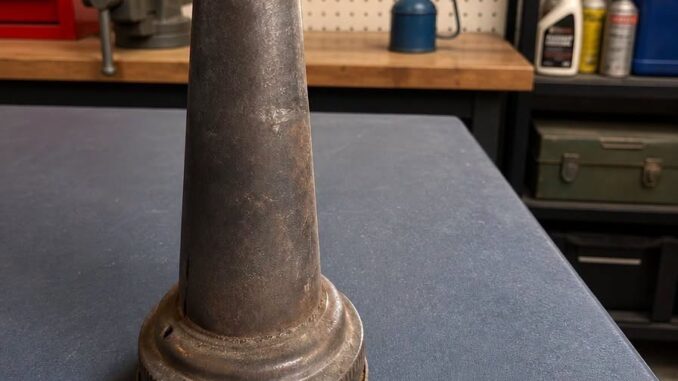
One particularly interesting metal object features a long, tapered tube, a substantial circular base, and a weathered exterior. Its distinctive construction suggests that it may have once served a practical purpose in a workshop, agricultural setting, or industrial environment.
Although its exact identity remains uncertain, several features provide useful clues about its possible origins.
Examining the Tapered Metal Tube
One of the object’s most distinctive characteristics is its elongated metal tube, which gradually narrows toward one end.
This type of design is commonly associated with funnels, nozzles, spouts, and specialized mechanical fittings.
Depending on its original application, the component may have been used to guide or transfer materials such as liquids, grain, powders, or lubricants.
The narrowing shape could have helped direct materials through a smaller opening, allowing for more controlled distribution.
However, similar designs were used across numerous industries, making it difficult to determine the object’s precise function based on its shape alone.
Its measurements would provide valuable information. A smaller component might have belonged to a household or workshop tool, while a larger version could have been associated with agricultural or industrial machinery.
Understanding the Circular Base
Another notable feature is the object’s broad circular base, which reportedly has a textured or ridged outer edge.
Unlike conventional household funnels, this component appears to have a relatively substantial foundation.
The ridged surface may have been designed to provide additional grip when attaching or removing the object. Alternatively, it could have formed part of a connection between two mechanical components.
The wider base might also have provided stability or supported a secure mounting arrangement.
These characteristics suggest that the object could have been a specialized fitting rather than a simple pouring utensil.
What Materials Might Have Been Used?
The object’s dark brown, gray, and black appearance suggests that it may have been manufactured from iron or steel.
However, identifying the exact material would require closer examination.
Older metal tools frequently develop surface discoloration and corrosion after prolonged exposure to moisture, air, and everyday handling.
These changes can create a distinctive aged appearance that collectors often associate with vintage equipment.
Scratches, dents, and areas of uneven wear may also provide clues about how an object was originally handled or attached to other machinery.
Before lightweight plastic components became widely available, manufacturers commonly relied on durable metals to produce tools, connectors, spouts, and mechanical fittings.
Many of these components were designed to withstand repeated use over extended periods.
Could It Have Belonged to Agricultural Equipment?
One possible explanation is that the object originated from an agricultural environment.
Traditional farming equipment included numerous specialized metal components designed to handle grain, feed, liquids, and machinery lubricants.
Farmers frequently repaired equipment rather than replacing entire machines, allowing individual parts to remain in storage long after the original equipment was retired.
A metal spout or fitting could therefore be a surviving component from a larger agricultural assembly.
Its sturdy construction would be consistent with equipment intended for demanding working conditions, although additional evidence would be needed to confirm this connection.
A Possible Connection to Workshops and Industrial Machinery
Another possibility is that the object was once used in a mechanical workshop or industrial setting.
Older machinery often incorporated custom-shaped fittings designed for specific tasks.
Metalworkers and mechanics relied on durable components that could be attached, removed, cleaned, and reused as necessary.
The object’s tapered tube and substantial base could be consistent with a component designed to guide materials or connect to another piece of equipment.
Without identifying markings or information about where it was discovered, however, its industrial origins remain a possibility rather than a confirmed explanation.
How to Identify an Unknown Antique Tool
Determining the original purpose of an unfamiliar metal object often requires examining several important details.
Useful information includes:
-
The object’s overall dimensions and weight.
-
Manufacturer names, numbers, or stamped markings.
-
The presence of screw threads or attachment points.
-
The diameter and shape of its openings.
-
The material used in its construction.
-
Information about where it was originally discovered.
Comparing these details with historical equipment catalogs, antique tool collections, and museum archives may help narrow down the possibilities.
Experienced antique collectors and specialists in agricultural or industrial equipment may also recognize features that are unfamiliar to modern observers.
Preserving Older Metal Objects
Unidentified antique components can be interesting additions to historical tool collections.
Before attempting extensive cleaning or restoration, it is worth documenting the object’s existing condition.
Aggressive cleaning methods may remove original markings, surface finishes, or other details that could assist with identification.
Keeping the object in a dry environment and handling it carefully can help preserve its condition while further research is conducted.
Why Antique Mechanical Components Remain Fascinating
Older tools provide an interesting connection to the craftsmanship and practical engineering of earlier generations.
Their designs often reflect a time when durability, repairability, and specialized functionality were important manufacturing considerations.
Even when an object’s original purpose is unknown, examining its construction can offer insights into historical working practices and equipment design.
For collectors and history enthusiasts, the process of identifying an unfamiliar tool can be just as rewarding as discovering its original function.
Final Thoughts
This unusual antique metal object may have been a specialized funnel, nozzle, spout, or mechanical fitting associated with agricultural, workshop, or industrial equipment.
Its tapered tube, circular base, and durable appearance offer several interesting clues, but they are not sufficient to establish a definitive identification.
Further examination of its measurements, markings, and historical background could help reveal its original purpose.
Sometimes, an unfamiliar piece of metal represents a fascinating reminder of the ingenuity and craftsmanship behind the everyday tools of previous generations.
Leave a Reply