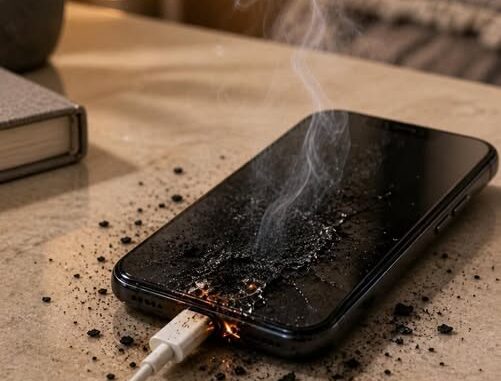
The danger may already be sitting beside your bed.
Every night, millions of people plug in their phones without thinking twice, trusting a small charger and cable to quietly do their job while everyone sleeps. It feels harmless. Routine. Ordinary. But hidden inside that everyday habit is an electrical process most people never stop to consider — one that can become dangerous surprisingly fast when even a single part fails.
A charger sparks.
A cable overheats.
Plastic begins to melt.
And suddenly, what started as a normal bedtime routine turns into smoke, flames, or a house fire in the middle of the night.
Most people assume charger accidents are rare freak events that only happen to someone else. But experts warn that the real danger often comes from the products people trust the most: cheap replacement chargers, counterfeit adapters, damaged cables, and overloaded outlets that quietly deteriorate over time.
The frightening part is how invisible the risk can feel until something finally goes wrong.
We trust phone chargers because they’ve become part of everyday life. They sit beside our beds, under couches, plugged into kitchens, offices, and cars so constantly that they almost disappear into the background. But inside every charger, complex electrical conversion is happening continuously. Voltage is being transformed. Current is being regulated. Heat is being managed and redirected safely away from sensitive components.
When chargers are built properly, that process happens quietly and safely thousands of times.
When they are poorly made, the margin for error becomes dangerously small.
Certified chargers from trusted manufacturers include multiple safety protections specifically designed to prevent overheating, electrical surges, short circuits, and internal failures. These safeguards constantly monitor heat and power flow to protect both the device and the environment around it.
Counterfeit or ultra-cheap chargers often skip many of those protections entirely.
From the outside, fake chargers may look nearly identical to genuine ones. The packaging appears convincing. The cable fits normally. The phone still charges. But internally, cheaper materials, poor insulation, weak soldering, and missing safety components can transform a basic charging routine into a hidden electrical hazard.
And because the danger develops silently, warning signs are often ignored.
A charger that feels unusually warm.
A faint buzzing sound.
A cable bending near the connector.
A loose outlet that flickers slightly.
Many people continue using damaged equipment for weeks or months because the problems seem minor — until the moment they aren’t.
Cables themselves are one of the most overlooked risks in the entire charging process. Frayed insulation, exposed wires, or internal damage caused by bending and twisting can create tiny electrical failures that worsen over time. Even a high-quality charger can become dangerous if paired with a damaged cable or plugged into an overloaded power strip struggling to handle too many devices at once.
That’s why safety experts stress that charger safety is not about one single product.
It’s an entire chain.
The charger.
The cable.
The outlet.
The surface where the device is charging.
Even the environment matters. Charging phones on soft surfaces like beds, blankets, or couches traps heat instead of allowing it to dissipate properly. Excess heat places additional strain on batteries and charging components, increasing long-term wear and, in extreme cases, raising the risk of thermal runaway — the dangerous chain reaction that can lead lithium-ion batteries to ignite.
Simple habits dramatically reduce these risks.
Replacing damaged cables immediately instead of “making them last.”
Using certified chargers rather than suspiciously cheap alternatives.
Avoiding overloaded outlets and unstable power strips.
Charging devices on hard, ventilated surfaces.
Paying attention when outlets feel hot, smell unusual, or flicker unexpectedly.
These small decisions may seem insignificant in the moment, but together they create the difference between safe routine and preventable disaster.
And perhaps that is the most important truth behind charger safety:
It is not about living in fear of technology.
It is about respecting how much power quietly flows through the objects surrounding us every day.
Because the devices we rely on most often become invisible through familiarity. We stop noticing them. Stop questioning them. Stop checking whether they are still safe.
But electricity never becomes harmless simply because it feels ordinary.
And sometimes, the smallest overlooked cable on a nightstand can become the weakest link in an entire home’s safety.
Leave a Reply