I was seventeen when my life split into something unrecognizable, though I didn’t have the words for it then. I only knew I had two newborn daughters, no real support, and a future that suddenly felt fragile, something I had to carry carefully through each day.
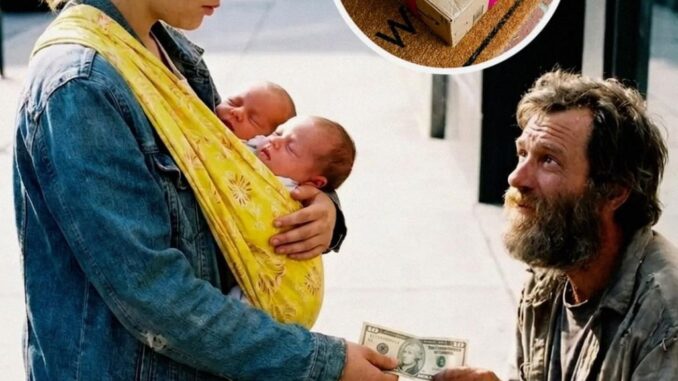
My parents were blunt. They told me I had ruined everything. Within days, I was out of the house, trying to stay afloat with Lily and Mae pressed against my chest in a worn sling while I clung to school like it was the last solid ground I had left.
By November 1998, survival had become routine. Classes during the day, work at the university library at night, and whatever scraps of rest I could steal in between. My meals were instant noodles, cheap coffee, and the quiet hope that if I just kept going, something might stabilize.
That night, rain hammered Seattle relentlessly. I stepped out of the library counting my last ten dollars. Bus fare or food. Not both. And that’s when I saw him.
He sat across the street under a rusted awning, soaked through, shivering, and asking nothing of anyone. Something—I don’t know what—made me cross the street. Recognition. Instinct. Exhaustion stripping away hesitation.
I pressed the money into his hand.
“Please… get something warm.”
He looked at me strangely—not gratitude exactly, but with attention, like the moment mattered.
“What’s your name?” I asked.
“Arthur,” he said.
“I’m Nora,” I replied, adjusting the sling so he could see the girls.
He repeated my name softly, as though storing it somewhere.
I walked home that night instead of taking the bus. Three miles in the rain. Soaked, cold, and staring at an empty wallet, I wondered if I’d just made a mistake I couldn’t afford. For a long time, I believed I had.
Life didn’t get easier. Work, school, motherhood—they all blurred together. What saved me wasn’t luck but people. A neighbor named Mrs. Greene watched my girls without asking for anything in return. Small acts of kindness kept us afloat.
Years passed. Then decades.
I was forty-four when life pulled me under again. Mae got sick. What started small became relentless, heavy, and expensive. Bills stacked faster than I could manage. I worked more, slept less, and still came up short.
That morning, staring at another overdue notice, a man walked into my office.
“Are you Nora?”
When I said yes, he placed a small, worn box on my desk.
“My name is Carter. I represent the estate of Arthur.”
The name hit me instantly. The man from the rain. I hadn’t seen him again. Hadn’t known what became of him. But I’d never forgotten that night.
“He spent years trying to find you,” Carter said. “He asked me to deliver this personally.”
Inside the box was a leather notebook. I opened the first page and froze.
“Nov. 12, 1998 — Girl named Nora. Two babies. Gave me $10. Don’t forget this.”
My hands shook as I flipped through the pages. Entries spanned decades. Names. Moments. And mine appeared again and again:
“Still looking for Nora.”
“Hope Nora and her girls are safe.”
Arthur hadn’t forgotten.
Carter explained that Arthur hadn’t always been homeless. He’d owned a small business that failed. That night, our brief encounter had been the first time someone treated him like he mattered. From then on, he wrote in his notebook every year, sometimes every day, keeping track of the life he’d once glimpsed through our shared moment.
Two years before his death, he found me—through a fundraiser I’d posted for Mae’s treatment. He recognized my name. My daughters. And instead of reaching out directly, he left instructions with his attorney. Carter pointed to the box.
Inside was a check: $62,000. Every dollar Arthur had saved.
“He believed it was never really his,” Carter said. “He said it belonged to the moment that changed his life.”
I didn’t cry because of the amount. I cried because of what it meant. That ten dollars I thought I couldn’t afford hadn’t disappeared. It had lived quietly, carried forward for nearly thirty years. It had mattered.
In the weeks that followed, everything changed. Mae’s medical debt was gone. The pressure that had sat on my chest for years finally lifted. But the real shift wasn’t financial. It was understanding.
One evening, at my kitchen table with Arthur’s notebook, I opened to a blank page. For a long time, I just stared. Then I wrote:
“April 3 — Paid Mrs. Greene back for helping raise my daughters.”
Simple words. But they carried more weight than any financial windfall. I began adding more small acts of kindness—quiet gestures, unnoticed by the world. I understood something now that I hadn’t back then: it wasn’t about the amount. It was about being seen.
A week later, I stood at Arthur’s grave. I placed a ten-dollar bill at the base of the stone.
“I found you, too,” I whispered.
For years, I had believed that kindness could be lost if you gave too much. I was wrong. Sometimes, it doesn’t disappear at all. Sometimes, it waits. And when it returns, it doesn’t just come back—it changes everything.
Leave a Reply