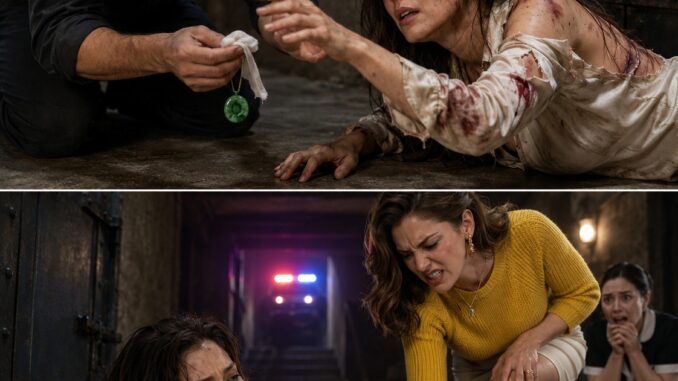
The sirens screamed outside the mansion like the sky itself had finally decided to testify. Sofía’s face went white so quickly that for a second, even through the blur of blood and pain, I saw the mask fall off her. The woman who had walked down those stairs to mock me suddenly looked like a frightened child caught holding a match beside a burning house. Her heel was still crushing my hand, but her body had frozen.
“What did you do?” she whispered.
I tasted blood when I smiled. “I remembered who I was.”
She stepped back as red and blue lights flashed through the narrow basement windows. Above us, the estate erupted into chaos. Doors slammed. Men shouted. Someone dropped a glass. The kind of panic that only visits rich houses when they realize money cannot lock every door.
Sofía turned toward the staircase and snapped at the two maids behind her. “Go upstairs. Tell Alejandro to get the lawyers. Now.”
Neither woman moved.
That was when Sofía understood what I had known for years: fear can buy silence, but it cannot buy loyalty forever.
One maid lowered her eyes and stepped away from Sofía. The other crossed herself. Neither one helped her.
Sofía’s voice cracked. “I said go!”
A calm male voice answered from the top of the stairs. “No one is going anywhere.”
She looked up.
A man in a dark suit stood there with a federal badge clipped to his belt. Behind him were two police officers, a paramedic team, and Martín—alive, breathing hard, holding my jade pendant in one trembling hand.
For the first time that night, I let my eyes close.
Not because I was safe.
Because they had come.
The man in the suit descended the stairs slowly, his eyes moving from Sofía to my body on the floor. His expression changed when he saw me. Not with shock. Not exactly. With a kind of old grief returning to a wound it already knew.
“Elena,” he said softly.
I opened my eyes again.
Thirty years had carved lines into his face, silver into his hair, and sorrow into the corners of his mouth. But I knew him. I would have known him in fire, in darkness, in another life.
“Gabriel,” I whispered.
Sofía stared between us. “Who the hell is Gabriel?”
He did not look at her. “Her brother.”
The word hit the basement like a gunshot.
My brother.
The brother I had sworn never to see again. The brother I blamed for leaving me alone with an empire too heavy for one woman to carry. The brother who disappeared after our father’s funeral and let the world believe the Mendoza family had collapsed into lawsuits, scandals, and death. The brother whose name I had not spoken out loud in three decades until my body had almost no breath left to spend.
Sofía shook her head. “No. Her family is gone.”
Gabriel finally turned to her. “That is what we needed people like you to believe.”
The paramedics rushed to me. Hands touched my neck, my ribs, my wrists. Someone cut away part of my blouse. Someone said my blood pressure was dropping. Someone else said they needed to move now. Their voices sounded distant, like I was underwater.
I grabbed Gabriel’s sleeve before they lifted me. My fingers barely worked.
“Martín?” I asked.
Gabriel looked at the old employee standing by the wall. “He got out through the kitchen passage. Your husband’s men caught him, yes. But they didn’t know he had already passed the pendant to one of ours.”
Martín’s eyes filled. “Forgive me, señora. I thought I had failed you.”
I tried to speak, but the air would not hold my words.
Gabriel leaned closer. “Save your strength. I know everything.”
No, I thought. You don’t.
You don’t know what it costs to survive inside a house where everyone calls your suffering discipline. You don’t know what it feels like to be hit by the man who once kissed your hands in front of two thousand wedding guests. You don’t know how many nights I slept beside a monster and told myself tomorrow would be different.
But maybe Gabriel did know something about monsters.
Because when he looked at Sofía, she stopped breathing for a second.
“Ms. Beltran,” he said, “you’re being detained for questioning related to false reporting, conspiracy, and attempted murder.”
“Attempted murder?” she shrieked. “I didn’t touch her.”
I forced my head to turn. “Your heel says otherwise.”
An officer looked down at my crushed hand, then at the blood smeared beneath Sofía’s shoe. His jaw tightened.
Sofía backed up. “This is insane. Alejandro will destroy all of you.”
Gabriel’s face did not move. “Alejandro is upstairs discovering the difference between owning a mansion and owning the people inside it.”
They lifted me onto a stretcher. Pain tore through me so violently that the basement disappeared for a moment. I heard myself make a sound I did not recognize. Gabriel walked beside me as they carried me up the stairs.
Every step brought back another memory.
The first dinner where Alejandro squeezed my thigh under the table hard enough to bruise because I corrected him in front of a senator.
The first time Sofía appeared at our gate crying, claiming she had nowhere to go after a car accident.
The first lie.
The first apology.
The first slap.
The first time I locked myself in the bathroom and stared at the woman in the mirror, asking why a Mendoza heiress was whispering prayers inside her own home.
When the stretcher reached the main floor, the grand foyer looked nothing like the palace Alejandro loved to show off. Officers moved through the marble halls. Evidence technicians photographed broken glass and blood drops. Staff members stood in corners, some crying, some giving statements. The chandelier glittered above us like it had no idea what kind of evil it had been lighting for years.
Alejandro stood near the front door in a white shirt and black trousers, surrounded by police.
His face was flushed with rage, but when he saw Gabriel walking beside my stretcher, his expression changed.
Not fear yet.
Recognition first.
Then calculation.
Then fear.
“Who are you?” Alejandro demanded.
Gabriel stopped beside him. “The mistake your lawyers failed to research.”
Alejandro looked at me. “Elena, tell them this is a misunderstanding.”
I stared at him from the stretcher. His voice was softer now, almost tender. He used to do that after hurting me. He would turn gentle just long enough to make me question the bruise.
I did not answer.
He stepped closer, but an officer blocked him.
“Elena,” he said, louder now, “you fell. You were hysterical. You know how you get.”
Even half-dead, I laughed.
It hurt so much that I almost passed out.
Gabriel leaned toward him. “She recorded everything.”
Alejandro’s eyes flicked.
There it was.
The tiny crack.
Sofía had lied. Alejandro had ordered the cameras checked, yes. But he had looked for what he expected: hallway footage, stair footage, proof to protect his mistress. He had never imagined I had spent months recording the rooms where powerful men become honest because they think wounded women are too afraid to collect evidence.
The paramedic pushed the stretcher forward.
As I passed Alejandro, he whispered, “You’ll regret this.”
I turned my head just enough to see him.
“No,” I breathed. “I regret waiting.”
Then the night swallowed him behind flashing lights.
I woke up two days later in a private hospital room in Los Angeles.
At first, I did not know where I was. Everything was white. The sheets. The walls. The bandages on my hand. Machines beeped beside me, slow and steady, reminding the room that my heart had not surrendered. My body felt like it had been rebuilt out of fire and glass.
Gabriel sat in a chair by the window.
He was asleep, one hand resting near a folder on his lap, his head tilted back. I watched him for a long time. Thirty years ago, he had been the golden son of the Mendoza family, the one everyone expected to inherit leadership, the one our father trusted with the keys to everything. Then he vanished after accusing our uncles of stealing from the company. I believed he abandoned me. I believed he left me alone to fight wolves in silk suits.
Now he looked like a tired old soldier who had been fighting a war I never knew existed.
“You look terrible,” I rasped.
His eyes opened immediately.
For one second, the old Gabriel returned—the protective brother who used to carry me on his shoulders when we were children.
Then he stood. “You’re awake.”
“I noticed.”
His mouth trembled, but he smiled. “Still sarcastic. Good sign.”
I tried to move and gasped.
“Don’t,” he said. “You had surgery. Your spleen was damaged. Several ribs are fractured. Your hand needs more treatment. The doctors said if the ambulance had arrived fifteen minutes later—”
He stopped.
We both knew the rest.
If Martín had hesitated.
If the jade pendant had not reached Don Chuy’s old tailor shop.
If Gabriel had decided thirty years of silence mattered more than blood.
I would be dead.
I looked at the folder in his hand. “Where is Alejandro?”
“In custody. His attorneys are already screaming. It won’t help.”
“Sofía?”
“Also in custody. She gave three different statements in six hours.”
“That sounds like her.”
Gabriel pulled the chair closer. “Elena, there’s more.”
I closed my eyes. “There always is.”
He hesitated, and that worried me more than anything.
“Alejandro didn’t just hurt you because of Sofía’s lie. That was the excuse. We have evidence he’s been trying to gain control over your shares, trusts, and voting rights for years.”
My eyes opened.
“He couldn’t access the core assets while you were alive and legally competent,” Gabriel continued. “But if you were declared unstable, incapacitated, or dead under certain circumstances, he believed he could challenge the trust structure.”
The machines beside me seemed louder suddenly.
“He was planning this,” I whispered.
Gabriel’s jaw tightened. “Not exactly this way. Men like him prefer clean paperwork. But yes, he was planning to remove you.”
I stared at the ceiling.
For years, I thought Alejandro hated my independence because it wounded his pride. I thought he resented my money, my name, my locked study, my refusal to sign certain documents without reading them three times. I thought Sofía’s arrival had poisoned what was left of our marriage.
But the truth was worse.
I had not been married to a jealous man.
I had been married to a predator who learned to call control love.
Gabriel opened the folder and placed several documents on the table beside me. “Your financial team flagged unusual pressure six months ago. Your assistant sent messages to an old Mendoza security contact. That’s how I first knew something was wrong.”
I turned toward him slowly. “You were watching me?”
“Yes.”
“For how long?”
He looked away. “Since the day you married him.”
Anger sparked in me, weak but alive. “You watched me suffer?”
“No,” he said sharply. “I watched from a distance because you told every person connected to me that if I came near you, you would cut them off forever.”
I remembered saying that.
I had meant it.
Gabriel continued, softer now. “I respected it until respecting it became dangerous.”
“You could have called.”
“You would not have answered.”
I hated that he was right.
The silence between us was old and heavy. Thirty years of pride sat in that hospital room like a third person.
Finally, I whispered, “Why did you leave?”
Gabriel looked at the floor.
For the first time, he seemed afraid.
“Because Dad asked me to.”
I blinked. “What?”
He rubbed his face with both hands. “Before he died, he found out our uncles were moving money through shell companies tied to organized crime. Not street criminals. Corporate criminals. Judges, bankers, politicians, men who could erase people without touching a weapon. Dad knew if he exposed them too soon, they’d come after both of us.”
My throat tightened.
“He asked me to disappear with part of the evidence,” Gabriel said. “He asked me to build a network outside the company. Lawyers, investigators, old loyalists, people who could act if the family name was ever attacked from the inside. You were supposed to inherit publicly. I was supposed to protect privately.”
“That’s insane.”
“Yes.”
“You let me think you abandoned me.”
His eyes filled. “That was the one thing I never forgave myself for.”
My chest hurt in a place no doctor could repair.
“Why didn’t Dad tell me?”
“Because you were twenty-four and furious at the world. Because you would have fought in public. Because he knew you had courage, but not patience yet.”
A tear slid into my hair.
Our father had always called me fire. I used to think it was praise. Maybe it was also warning.
Gabriel reached into his pocket and pulled out the jade pendant. The old green stone rested in his palm, scratched but whole. “Dad gave us two. Yours and mine. He said if one of us ever sent it through Don Chuy, it meant blood before pride.”
I closed my eyes.
Blood before pride.
And I had waited until I was nearly out of blood.
Over the next week, the world I knew fell apart in precise, legal pieces.
My attorneys filed for divorce, emergency protective orders, and criminal cooperation agreements. My financial team froze every access point Alejandro had ever touched. The Mendoza Trust removed him from all advisory positions he had manipulated his way into. His friends stopped answering calls the moment federal subpoenas appeared. Sofía’s social media vanished overnight.
Then the story broke.
Not the whole story. Not the worst parts. My lawyers protected what they could. But enough came out: wealthy Los Angeles businessman arrested after wife found severely injured in basement of Bel Air estate. Allegations of abuse, financial coercion, and conspiracy. Mistress accused of staging incident that led to assault.
The mansion gates filled with cameras.
For years, Alejandro had wanted the world to look at our home and envy him.
Now the world looked.
And he hid his face.
The police later told me what happened upstairs after the sirens arrived. Alejandro had tried to order the staff into silence. He threatened Martín’s family. He told security to erase footage. But Gabriel’s people had already copied the external feeds. My study cameras, the ones Alejandro never knew were hidden in the molding, had captured enough. Audio from the basement hallway caught Sofía admitting she threw herself down the stairs. My phone records showed three emergency calls. Martín’s statement sealed the timeline.
And the jade pendant?
That opened a door Alejandro never knew existed.
Don Chuy’s tailor shop in downtown Los Angeles looked like nothing from the outside. Faded sign. Dusty windows. Old mannequins in outdated suits. But behind the fitting room was a secure office that had served Mendoza loyalists for thirty years. Retired investigators, former prosecutors, accountants, drivers, tailors, cleaners, cooks—ordinary people who had once been saved by my father and never forgot.
Alejandro had underestimated me because I was his wife.
He underestimated them because they looked invisible.
That was his final mistake.
A month after the assault, I left the hospital in a wheelchair.
I hated the wheelchair. I hated the weakness in my legs, the bandages, the way everyone spoke gently as if my bones had turned me into glass. But when the hospital doors opened and sunlight touched my face, I cried anyway.
Gabriel pushed me toward a black SUV.
Reporters waited at the curb, shouting questions.
“Elena, did your husband try to kill you?”
“Is it true your family is taking back control of Mendoza Global?”
“Did Sofía Beltran confess?”
“Are you afraid?”
That last question reached me through the noise.
I looked toward the cameras.
Was I afraid?
Yes.
I was afraid of sleeping. Afraid of footsteps. Afraid of closed doors. Afraid of my own memories. Afraid that one day I would miss the man Alejandro pretended to be and mistake that grief for love.
But fear was no longer my master.
I lifted my bandaged hand slightly and said, “I survived.”
Gabriel leaned down. “You don’t have to say more.”
“I know.”
For the first time in years, knowing I did not have to explain myself felt like power.
I did not return to the Bel Air mansion.
Not immediately.
The house was a crime scene, then a legal battlefield, then an empty shell full of echoes. I stayed at a private recovery residence near the coast, where the mornings smelled like salt and eucalyptus. Nurses came and went. Physical therapists pushed me until I cried. My attorney came with documents. Gabriel came with soup he did not know how to make and stories he did not know how to tell without sounding guilty.
We had to learn each other again.
At first, we spoke only about practical things. Court dates. Trust structures. Security. Doctors. My hand. My ribs. Alejandro’s charges. Sofía’s deal negotiations. But grief is patient. It waits until the paperwork is done.
One evening, Gabriel found me on the terrace watching the ocean. I had been crying and pretending not to. He sat beside me without speaking.
“I hate him,” I said.
Gabriel nodded.
“I hate her.”
He nodded again.
“I hate myself more.”
That made him turn.
I swallowed hard. “For staying. For hiding it. For letting him make me small. For calling you only when I had no other choice.”
Gabriel’s voice was low. “Elena, he did this. Not you.”
“I was Elena Mendoza.”
“You still are.”
“I had money. Lawyers. Security. A name people feared. And still I ended up bleeding on a basement floor.”
Gabriel looked at the water for a long moment. “Power doesn’t protect you from manipulation when the person hurting you sleeps beside you.”
That sentence stayed with me.
Because people think abused women are weak. They imagine poverty, ignorance, dependence, no options. They do not imagine marble floors, private bankers, art collections, board seats, and a woman with enough wealth to buy every lock in the house but not enough courage to admit she needed to run.
The cage was not made of money.
It was made of shame.
Two months later, Sofía made her deal.
Her attorney claimed she had been manipulated by Alejandro, but the evidence showed she had manipulated him too. She admitted to staging the fall, lying about me pushing her, and taunting me in the basement after the assault. She also revealed that Alejandro had promised her a property in Malibu and a large payout once my assets were “settled.”
Settled.
That was the word he had used for my disappearance.
When Rebecca read me the transcript, my hands went cold.
Sofía said Alejandro had complained that I would never sign over full control. He said I was “too proud to obey and too valuable to divorce.” He told Sofía that if I became medically incapacitated after a “domestic episode,” his legal team could argue for management rights.
My husband had not lost control that night.
He had simply lost patience.
Alejandro refused a deal.
That was pure Alejandro. Pride first, strategy second. He believed no jury would convict a man like him if enough experts, suits, and polished language stood between his hands and my injuries. He believed he could turn my strength against me. He believed people would ask why a rich woman stayed, why a powerful woman hid, why an intelligent woman let it happen.
And some people did ask.
Online strangers called me dramatic. Gold digger. Liar. Cold wife. Publicity seeker. They said no man beats a woman for three hours without a reason. They said if it were real, I would have left sooner.
I read those comments once.
Then never again.
Because I already knew the answer.
I stayed because the first time he hurt me, he cried harder than I did. I stayed because the second time, he blamed stress and I wanted to believe love could heal pride. I stayed because by the third time, I was already hiding the truth, and shame grows teeth in the dark. I stayed because leaving a dangerous man is not one decision. It is a war plan.
And finally, I left because Martín brought a jade pendant to a tailor shop.
The trial began the following spring.
By then, I could walk with a cane. My hand still ached when it rained. My ribs had healed, but some nights I woke gasping, certain I was back on the concrete floor. Gabriel sat behind me in court every day. Not beside me. Behind me. He said he wanted me to know he had my back this time.
Alejandro looked polished on the first day. Dark suit, trimmed beard, controlled expression. If you had not seen the photos, heard the recordings, read the medical reports, you might have thought he was the victim of an elegant misunderstanding. His mother sat behind him, wearing black like she was attending a funeral for her son’s reputation.
Sofía testified on the third day.
She looked smaller without her expensive clothes and perfect makeup. When prosecutors asked why she lied, she cried. When they asked why she stepped on my hand, she said she panicked. When they played the basement audio of her laughing, the jury did not look away.
Then Martín testified.
He wore his best suit, old but clean. His voice shook when he described finding me on the floor. He cried when he admitted he had been too afraid to call an ambulance immediately. I wanted to stand up and tell him he had saved my life, but Rebecca touched my arm and shook her head gently.
So I waited.
The prosecutor played the recording from the basement hallway. Alejandro’s voice. My weak breathing. Sofía’s heels. Martín whispering. Then Sofía’s voice saying, “Alejandro is stupid and adores me.”
Alejandro stared straight ahead.
His mother lowered her head.
When it was my turn, I walked to the witness stand slowly, cane tapping against the floor. The courtroom was silent. I sat, swore to tell the truth, and looked at the man who had left me to die.
For three years, I had avoided his eyes when he was angry.
Now I held them.
The prosecutor asked me to describe the night of the assault. I did. Not with drama. Not with hatred. With details. The coffee. Sofía’s staged fall. Alejandro’s accusation. The locked basement. The blows. Martín. The jade pendant. The sirens.
Then Alejandro’s attorney stood.
He was smooth, expensive, and cruel in the way only educated men can be when paid well enough.
“Mrs. Mendoza,” he began, “you are an experienced businesswoman, correct?”
“Yes.”
“You control significant assets?”
“Yes.”
“You have access to legal counsel, security teams, private staff?”
“Yes.”
“So you want this jury to believe that a woman of your intelligence and resources simply allowed herself to remain in an abusive marriage?”
There it was.
The question everyone hides inside politeness.
I looked at the jury before answering.
“No,” I said. “I want them to understand that abuse does not ask for your resume before it begins.”
The attorney paused.
I continued, “It starts with charm. Then criticism. Then isolation. Then apologies. Then fear. By the time the violence becomes undeniable, you are not asking, ‘Why doesn’t she leave?’ You are asking, ‘How do I leave without dying?’”
The courtroom was so quiet I could hear someone sniffle.
The attorney tried again. “You never reported prior incidents.”
“No.”
“Why?”
“Because I was ashamed.”
“Of what?”
I turned back to Alejandro. “Of loving someone who hated me when no one was watching.”
Alejandro looked away first.
That was the moment I took back the last piece of myself.
The jury deliberated for two days.
Alejandro was convicted on multiple charges related to aggravated assault, coercive control, evidence tampering, and conspiracy. Sofía received a lesser sentence because of her deal, but she did not walk free. Alejandro’s mother was not charged for the assault itself, but her testimony contradicted evidence badly enough that perjury investigations followed. More importantly, society gave her the punishment she feared most: doors closed quietly around her.
Alejandro was sentenced on a rainy morning.
Before the judge spoke, he asked to address me.
My attorneys advised against reacting, but I agreed to listen.
He stood in his prison uniform, stripped of watches, cufflinks, tailored arrogance. “Elena,” he said, voice hoarse, “I became someone I don’t recognize. I was sick with jealousy. I felt small beside you. I let anger—”
“No,” I said.
The judge looked at me.
I stood with my cane. “You recognized yourself. That was the problem. You knew exactly who you were when the doors were closed.”
Alejandro’s face tightened.
“You were not jealous of my power,” I said. “You wanted it. You were not angry because I disrespected you. You were angry because I survived without needing your permission.”
He swallowed.
“I hope prison teaches you what my silence could not: fear is not love, control is not respect, and a woman’s body is not a place for a man to lose his temper.”
I sat down.
The judge sentenced him.
I did not smile.
Justice is not joy. It is a door closing properly.
After the trial, I returned to the Bel Air mansion one last time.
The house was spotless again. The blood was gone. The basement floor had been cleaned. The broken furniture replaced. The staff had moved on, except for Martín, who waited by the front door with tears in his eyes.
“Señora,” he said.
I hugged him with the arm that healed best. “You saved me.”
He shook his head. “You saved my sister once. I only repaid a debt.”
“No,” I said. “You chose courage.”
I gave him the deed to a small house in Pasadena that afternoon. He tried to refuse. I told him it was not payment. It was protection. His sister moved in with him two weeks later.
As for the mansion, I did not keep it.
People expected me to sell it quietly to some tech billionaire or foreign investor. Instead, I donated it through the Mendoza Foundation and turned it into a recovery residence for women escaping high-risk domestic violence situations. The basement was sealed and rebuilt into a legal resource center. The dining room became a communal kitchen. The master suite became medical consultation rooms. The locked study became a counseling library.
On the wall near the entrance, I placed a small jade pendant behind glass.
Under it were the words:
When you have one breath left, use it to call yourself back.
Gabriel stood beside me at the opening ceremony. Cameras flashed. Reporters asked questions. Survivors walked through the doors quietly, some holding children, some holding folders, some holding nothing but the terrifying hope that this time, someone would believe them.
My brother looked at the house and said, “Dad would be proud.”
I looked at him. “Of which one of us?”
Gabriel smiled sadly. “Both, finally.”
We were not healed. Not completely. Maybe siblings separated by thirty years never become what they were. But we became something new. Every Sunday, he came to lunch. Sometimes we argued. Sometimes we sat in silence. Sometimes we spoke of our father. Sometimes we spoke of nothing important at all, which felt like its own kind of miracle.
A year later, I visited Alejandro in prison.
Not because he asked. He had sent letters, but I never answered. I went because I wanted to see whether my fear still belonged to him.
He looked older behind the glass. Smaller. Prison had carved away the performance, but not the ego entirely. When he picked up the phone, his hand trembled.
“Elena,” he said.
I picked up my phone. “Alejandro.”
He stared at me. “You look well.”
“I am.”
“I think about that night every day.”
“So do I.”
His eyes filled. “I’m sorry.”
I waited to feel something—rage, grief, satisfaction, longing.
Nothing came.
Not emptiness. Freedom.
“I believe you are sorry for where you ended up,” I said. “I don’t know if you’re sorry for what you did to get there.”
He closed his eyes.
“I’m not here to forgive you,” I continued. “I’m here to tell you that I no longer carry you.”
He opened his eyes again.
“You left me in a basement to die,” I said. “But the woman who walked out of that hospital is not yours. Not in memory, not in fear, not in law, not in spirit.”
“Elena—”
I hung up the phone.
Then I stood and walked out without looking back.
That night, I drove to the recovery residence that used to be my mansion. The porch lights were on. A little girl sat on the steps drawing with chalk while her mother watched from a bench. Through the windows, I saw women cooking, laughing softly, filling plates, passing bread. Life had entered the rooms where control once lived.
The girl looked up at me. “Are you the lady who owns the house?”
I smiled. “No, sweetheart. The house belongs to women who need it.”
She considered that seriously. “My mom says it’s safe here.”
My throat tightened. “Your mom is right.”
I went inside and walked down the hallway to the legal resource center. The basement no longer smelled like blood, cement, or fear. It smelled like fresh paint, paper, coffee, and lavender cleaner. On the wall, the jade pendant caught the light.
I stood before it for a long time.
Thirty years of silence had brought my brother back.
Three hours of violence had ended my marriage.
One loyal employee had carried a stone through the dark.
And one breath, the last breath I thought I had, had opened a door I believed was sealed forever.
People often ask when my revenge began.
They expect me to say it began with the sirens, or the arrest, or the trial, or the moment Alejandro lost everything he tried to steal.
But they are wrong.
My revenge began the second I stopped believing that survival was something to be ashamed of.
Alejandro wanted me broken, hidden, and silent beneath the house he thought he controlled. Sofía wanted to watch me disappear so she could step into my life like a dress stolen from a closet. His mother wanted me punished into obedience. They all thought the Mendoza family was dead because I had spent years living like a ghost.
But blood remembers.
Names remember.
Women remember.
And sometimes, even when a man leaves you in the dark, the part of you he failed to kill reaches for one tiny piece of jade and calls the storm home.
I am Elena Mendoza.
I was not rescued because I was weak.
I was rescued because, at the very end, I chose to live loudly enough for the past to hear me.
And when the past answered, it did not come alone.
Leave a Reply