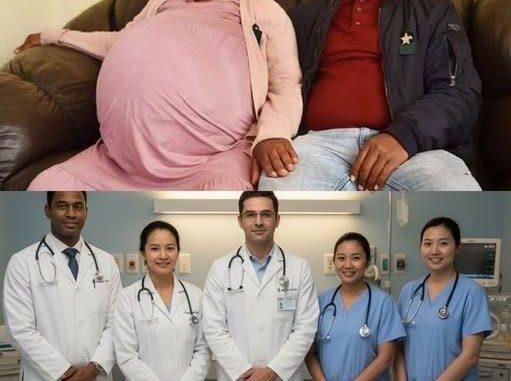
Few events in life are as remarkable as the birth of a child. A pregnancy involving twins or triplets can already bring additional medical challenges, but a reported pregnancy involving ten babies would be extraordinarily unusual and would require an exceptional level of medical care.
Stories describing extremely large multiple births can quickly attract worldwide attention. The numbers alone are enough to make people curious about how such a pregnancy could develop, how doctors might manage the mother’s health, and what would be required to care for the newborns after delivery.
However, extraordinary claims about very large multiple births should always be approached carefully. Headlines and social media posts can sometimes repeat information without providing enough medical evidence or reliable documentation. The reality of a pregnancy involving many fetuses is considerably more complicated than a sensational headline may suggest.
Why Multiple Pregnancies Are So Challenging
A multiple pregnancy occurs when more than one fetus develops during the same pregnancy. Twins are relatively familiar, while triplets and higher-order multiples become progressively less common.
As the number of fetuses increases, the pregnancy generally becomes more medically complicated. The mother’s body must support multiple developing babies at the same time, while doctors must monitor each fetus individually as well as the mother’s overall health.
A pregnancy involving a very large number of fetuses would therefore require specialized medical supervision.
Doctors would closely monitor fetal growth, the mother’s blood pressure, nutritional needs, and other aspects of her health. Ultrasound examinations and other forms of prenatal assessment can help medical teams evaluate how the pregnancy is progressing.
The goal is to identify potential complications as early as possible and determine the safest approach for both the mother and the babies.
The Physical Demands on the Mother
Pregnancy already places significant demands on the body. With multiple fetuses, those demands can increase considerably.
The uterus must accommodate several developing babies, while the mother’s cardiovascular system works to support increased blood flow. Nutritional requirements can also become more significant.
Carrying several fetuses can make ordinary activities increasingly difficult as pregnancy progresses. Physical discomfort, fatigue, shortness of breath, and other pregnancy-related symptoms may become more pronounced.
For a pregnancy involving an exceptionally large number of fetuses, these challenges could be even greater.
This is one reason pregnancies involving higher-order multiples require careful medical supervision rather than being treated like routine pregnancies.
Monitoring the Babies
One of the most important parts of managing a multiple pregnancy is monitoring fetal development.
Doctors may use ultrasound examinations to evaluate the growth and development of each baby. They can also examine the placenta, amniotic fluid, and other features that may provide information about the pregnancy.
When multiple fetuses are present, the medical team needs to consider each baby individually.
Not all fetuses necessarily grow at exactly the same rate. Differences in growth can sometimes indicate that additional monitoring is necessary.
The medical team must therefore balance the health of the mother with the needs of every fetus.
The Risk of Premature Birth
One of the major concerns associated with higher-order multiple pregnancies is premature birth.
The uterus has physical limits, and carrying multiple fetuses can make it difficult for a pregnancy to continue to the same gestational age as a typical singleton pregnancy.
Premature babies may be born before their organs, particularly their lungs, have fully matured. Depending on how early they are born, they may require specialized care in a neonatal intensive care unit.
The earlier a baby is born, the greater the potential for medical complications.
For this reason, doctors managing a high-risk multiple pregnancy carefully monitor signs that labor may begin early and prepare for the possibility of premature delivery.
Preparing for the Delivery
A delivery involving several babies would require extensive preparation.
A medical team would need to be ready to care for the mother while simultaneously assessing and treating multiple newborns. This could involve obstetricians, anesthesiologists, neonatologists, nurses, respiratory specialists, and other healthcare professionals.
The exact number and type of specialists required would depend on the medical circumstances.
The delivery location would also be important. A hospital with appropriate maternal and neonatal facilities would generally be better equipped to manage a highly complex multiple birth.
Preparation would need to happen well before delivery because the medical team could not assume that every baby would have identical needs.
What Happens After Birth?
The challenges do not necessarily end once the babies are delivered.
Newborns, particularly those born prematurely, may require specialized medical support. Some may need assistance with breathing, maintaining body temperature, feeding, or other essential functions.
Neonatal intensive care units are specifically designed to provide this type of support.
If several newborns require intensive care at the same time, the hospital must have sufficient staff, equipment, monitoring systems, incubators, and other resources available.
This illustrates why an extremely large multiple birth would be such a significant medical event.
The Emotional Side of an Extraordinary Pregnancy
Behind the medical statistics is also a deeply personal experience for the family.
A pregnancy involving multiple babies could bring a mixture of excitement, hope, anxiety, and uncertainty. Parents may spend months wondering how the pregnancy will progress and what life will look like after the children arrive.
The emotional experience could become particularly intense if doctors identify complications or recommend extended hospitalization.
Families may also need practical support. Caring for several newborns simultaneously can require considerable time, organization, and assistance from relatives, medical professionals, and community resources.
The transition from pregnancy to parenthood can therefore be challenging even under normal circumstances. With multiple newborns, the practical demands can become much greater.
Why Extraordinary Birth Claims Spread So Quickly
Stories about unusually large families often attract enormous attention online because they are naturally surprising.
A headline claiming that one mother has given birth to an extraordinary number of babies can quickly spread through social media, blogs, and news websites.
However, the popularity of a story does not necessarily confirm its accuracy.
Online articles may repeat information from earlier posts without independently verifying the original claim. Photographs can also be reused or presented with captions that do not accurately describe what they show.
For this reason, readers should be cautious when encountering remarkable medical stories.
Reliable reporting should ideally include verifiable information from medical institutions, healthcare professionals, official records, or other trustworthy sources.
The Importance of Medical Verification
Extraordinary medical claims require particularly careful verification.
If a story describes an exceptionally rare pregnancy or birth, readers should look for evidence beyond a dramatic headline. Information about the hospital, medical team, date of delivery, pregnancy details, and outcomes can help establish whether the report is credible.
This is especially important because multiple births involving unusually large numbers of babies are exceptionally rare.
Medical science has documented higher-order multiple births, but each case has its own circumstances and risks. A claim involving an unusually high number of babies should therefore not be accepted simply because it has been repeated across several websites.
The number of websites repeating a claim does not necessarily make the underlying information more reliable.
Advances in Maternal and Neonatal Medicine
Modern medicine has significantly improved the ability of doctors to monitor complicated pregnancies and care for premature newborns.
Ultrasound technology allows physicians to observe fetal development during pregnancy. Specialized neonatal units can provide intensive support to babies who require additional care after birth.
Advances in respiratory support, nutrition, monitoring, infection control, and other areas have also improved outcomes for many premature infants.
Nevertheless, medical technology does not eliminate the risks associated with extremely complicated pregnancies.
Every pregnancy is different, and the outcome depends on numerous factors, including the mother’s health, the gestational age at delivery, fetal development, and the availability of specialized care.
A Remarkable Scenario With Serious Medical Challenges
A pregnancy involving ten babies would represent an extraordinarily complex medical situation. It would raise important questions about fetal development, maternal health, premature birth, delivery planning, and neonatal care.
At the same time, it is important to distinguish between what is medically possible, what has been documented, and what may simply be an exaggerated or inaccurately reported story.
The more extraordinary the claim, the more important reliable evidence becomes.
Rather than focusing only on the shocking number in a headline, it is useful to consider the medical realities behind such a pregnancy.
What Such a Pregnancy Would Require
If a pregnancy involved an exceptionally high number of fetuses, medical care would likely require close coordination throughout the pregnancy.
The mother would need regular assessments, while doctors would monitor the development and well-being of the fetuses. The medical team would also need to prepare for potential complications and determine when and how delivery should take place.
After birth, the newborns could require specialized neonatal support, particularly if they arrived prematurely.
Such an event would therefore involve far more than the delivery itself. It would require months of planning, medical monitoring, specialized equipment, trained personnel, and significant family support.
Final Thoughts
A reported birth involving ten babies is the kind of story that naturally captures worldwide attention. The idea of one pregnancy resulting in such a large number of infants raises fascinating questions about the limits of pregnancy and the capabilities of modern medicine.
However, the medical reality behind an extremely large multiple pregnancy is much more complicated than a headline suggests. Higher-order multiple pregnancies can place substantial demands on the mother’s body and increase the risk of premature birth and other complications.
Care would require close monitoring during pregnancy, careful delivery planning, and potentially extensive neonatal support after birth.
Most importantly, extraordinary claims should be verified before being treated as established fact. Reliable medical information and trustworthy sources are essential when discussing unusual pregnancies and births.
Whether viewed from the perspective of medicine, family life, or modern healthcare, extremely large multiple pregnancies demonstrate just how complex pregnancy can be—and why careful medical supervision is so important when several babies are developing at the same time.
Leave a Reply