When I got him home that night, Leo barely spoke. He sat on the edge of his bed like his body had finally caught up with what his mind had already endured. His hands were scraped, his shoes destroyed, and his silence said more than any explanation ever could. I wanted answers, but something in me told me to wait.
The next morning, the phone rang before sunrise.
The school principal didn’t even try to sound calm. Her voice was tight, urgent, almost breathless. “You need to come in immediately. There are people here who need to speak with you about your son.”
That was all she said before hanging up.
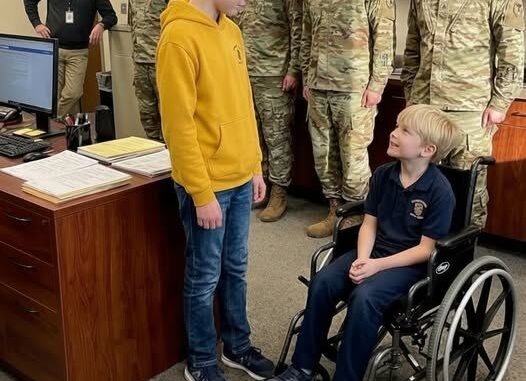
When I arrived, the atmosphere in the school felt different—heavier, like the air itself had changed overnight. Teachers avoided eye contact. Students were being held in classrooms. And in the main office, I saw the reason: men in military uniforms standing in silence, waiting.
Leo stood beside the wall, small in comparison to the moment unfolding around him.
One of the officers finally stepped forward and explained everything. They had heard what happened on the trail—the six-mile route, the steep terrain, the way Leo refused to leave his disabled best friend behind even when it would have been easier, even when no one would have blamed him for giving up.
The patch sat on Leo’s desk for days.
Not moved. Not touched much. Just there—like a question he didn’t know how to answer yet. Every time I passed his room, I saw him glance at it the same way, like he was trying to figure out when “just helping a friend” turned into something adults in uniforms treated like history.
At school, things didn’t go back to normal either.
Whispers followed him in the hallway. Not cruel ones—just curious ones. People who had heard fragments of the story but didn’t quite understand the full weight of it. Teachers who had once looked concerned now looked… careful. Like they weren’t sure how to speak to a boy who had been treated like both a student and something else entirely.
Leo hated it.
“I didn’t do anything special,” he said one night, kicking his backpack under his desk. “Why does everyone keep acting like I did?”
I sat on the edge of his bed. “Because most people don’t do what you did when it gets hard.”
He frowned. “But it wasn’t hard. I just didn’t want him to fall.”
That was the part no one else seemed to hear. To him, it wasn’t a story about heroism. It was a story about responsibility. About friendship. About the simple fact that his best friend couldn’t make it on his own, so he helped.
A few days later, the principal called me again. This time her voice was different—less panic, more reflection.
“We’d like Leo to speak at a school assembly,” she said.
I almost laughed. “He’s twelve.”
“I know,” she replied. “But what he did… it’s affecting the students. In a good way.”
When I told Leo, he immediately shook his head. “No way.”
“Why not?” I asked.
“Because everyone will think I’m trying to show off.”
But deep down, I could tell that wasn’t the real reason. He wasn’t afraid of speaking. He was afraid of being misunderstood.
Still, the assembly happened.
The gym was full, the kind of full where the noise never fully settles. Students sat cross-legged on the floor, teachers lined the walls, and there was that familiar restless energy that always comes before someone important says something no one is quite ready to hear.
Leo walked to the microphone slowly.
No dramatic entrance. No confidence trick. Just a boy who looked like he wished he could disappear.
For a long moment, he didn’t speak.
Then he looked up.
“My friend can’t walk the trail like everyone else,” he said quietly. “He uses a wheelchair most days. That day, the path got worse than we expected.”
The room stayed still.
“I didn’t think about rules. Or getting in trouble. I just knew he couldn’t get down safely alone.”
He paused, swallowing hard.
“So I carried him.”
A few students shifted. Someone in the back dropped a pen, and the sound felt louder than it should have.
“I keep hearing people say it was brave,” Leo continued. “But I don’t think it was. I think it would’ve been worse if I left him.”
That sentence landed differently than anything else.
Not dramatic. Not rehearsed. Just honest.
After the assembly, no one rushed the stage. No applause explosion like in movies. Instead, something quieter happened.
People thought.
Students who usually laughed too loudly walked out without speaking. Teachers stayed longer than usual. Even the principal stood at the back of the gym, arms folded, watching like she was trying to understand something she hadn’t been taught to recognize.
That afternoon, something shifted between Leo and his friend too.
They walked home together like always, backpacks hanging low. But there was a different kind of silence between them now—not awkward, just aware.
“You know,” his friend said after a while, “you didn’t have to do all that.”
Leo shrugged. “Yeah, I did.”
And that was it.
No speech. No reflection. No attempt to turn it into something bigger.
Just two kids walking home, like they always had, except now the world had decided their ordinary moment wasn’t ordinary at all.
That night, Leo finally picked up the military patch again.
He turned it over in his fingers.
“Do you think I deserved this?” he asked me suddenly.
I didn’t answer right away. Because the truth wasn’t about deserving.
“It’s not about deserving,” I said. “It’s about what they saw in you.”
He nodded slowly, like he didn’t fully agree—but maybe he was starting to understand.
And for the first time since the trail, he placed the patch carefully into a small box in his drawer.
Not hidden.
Not displayed.
Just kept.
Like a reminder that sometimes the world notices the quietest kind of strength first—and calls it something bigger than the person who carried it ever intended it to be.
Leave a Reply