Forests often contain reminders of the past that are easy to overlook. Old stone walls, abandoned pathways, weathered foundations, and forgotten structures can remain hidden beneath vegetation for decades.
Sometimes, these discoveries are immediately recognizable. Other times, even a relatively simple object can raise questions about how an area was once used.
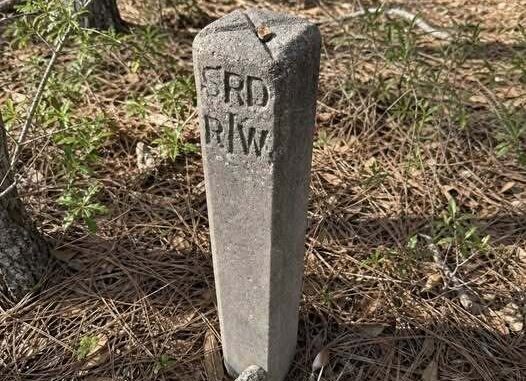
That was the case when a hiker noticed a small concrete structure standing beside an overgrown road in a wooded area.
The object was approximately knee-high and appeared to have been deliberately constructed. Yet there were no nearby signs or obvious features explaining its purpose.
Its location beside an old roadbed suggested that it might once have been connected to transportation, utilities, property boundaries, or another practical activity.
Without additional information, however, its original function remained uncertain.
The discovery offers an interesting opportunity to explore why unfamiliar structures appear in wooded areas and how their history can sometimes be uncovered.
An Unexpected Discovery During a Woodland Walk
The hiker was exploring a quiet section of forest when the concrete object caught their attention.
The surrounding area appeared largely undeveloped, with trees and vegetation growing around what looked like an abandoned road.
There were no occupied buildings immediately visible.
The road itself showed signs of having fallen out of regular use.
Near its edge stood the small concrete feature.
At first, it might have seemed like an ordinary piece of construction material.
But its shape and position suggested that it had been placed there for a particular reason.
Unlike loose rubble, the structure appeared to be a fixed feature of the landscape.
That raised a simple question: what had it originally been used for?
The hiker shared a photograph and invited others to offer possible explanations.
Several theories emerged, although the available information was not sufficient to confirm any one of them.
Why Small Structures Can Be Difficult to Identify
Identifying an unfamiliar object is not always as straightforward as recognizing its material or shape.
Concrete has been used for many purposes, including construction, transportation, utilities, agriculture, and surveying.
A small concrete block might have supported a larger structure.
It could have marked a boundary or protected equipment.
It might also have been part of an installation that was later removed.
When the surrounding infrastructure disappears, the remaining pieces can become difficult to interpret.
For example, a concrete foundation may look unusual after the building it supported has been demolished.
A roadside fixture may seem unnecessary after the road is abandoned.
And a utility installation may be difficult to recognize once its associated equipment has been removed.
This is why the object’s location is often as important as its appearance.
The Abandoned Road May Provide an Important Clue
One of the most interesting details about the discovery was the nearby roadbed.
Although it was no longer in regular use, the route suggested that people had once traveled through the area.
Old roads can reveal important information about former settlements, businesses, agricultural activity, and transportation networks.
A road that is now surrounded by trees may once have connected homes, farms, or neighboring communities.
It might have served as a route for vehicles, wagons, or pedestrians.
Over time, transportation needs can change.
New roads are constructed.
Existing routes are redirected.
Communities expand or relocate.
Some roads eventually become unnecessary and are no longer maintained.
When that happens, vegetation gradually begins reclaiming the area.
However, certain roadside structures may remain.
The concrete object could be one of those surviving features.
Could It Have Been a Roadside Marker?
One possibility is that the structure was associated with the former road.
Concrete markers have historically been used in some places to identify boundaries, distances, or specific roadside locations.
They can also serve practical functions related to road maintenance or infrastructure.
A small concrete feature positioned near a road may have marked an important point.
However, this explanation would depend on the object’s exact design.
Some markers contain inscriptions, numbers, symbols, or metal plates.
Others have distinctive shapes associated with particular transportation systems.
If the discovered object has no visible markings, identifying it as a roadside marker becomes more difficult.
Its distance from the road and orientation could also provide useful clues.
For now, the roadside-marker theory remains only one possibility.
Could It Have Supported a Sign or Gate?
Another possible explanation is that the concrete structure once supported something larger.
Concrete bases are sometimes used to anchor signs, gates, fencing, or other installations.
Over time, the attached components may deteriorate or be removed.
A wooden post could decay.
A metal fixture might be taken away.
A gate could disappear after the surrounding property changes ownership.
The concrete base, however, might remain in place.
If the structure contains holes, embedded metal, or signs of previous attachments, that could support this interpretation.
Matching concrete features nearby might also suggest that it formed part of a larger installation.
For example, two similar bases positioned opposite each other could indicate that something once extended between them.
Without photographs showing these details, it is difficult to evaluate the possibility.
A Possible Connection to Underground Utilities
Concrete structures are also used to support or protect utility infrastructure.
Water systems, electrical equipment, communication networks, and drainage installations may all involve concrete components.
In some cases, the visible concrete is only a small portion of a larger system.
Pipes, cables, or other equipment may be located underground.
A structure that appears isolated today could once have been connected to infrastructure serving nearby buildings or facilities.
If those facilities were later removed, the concrete component might have been left behind.
The object’s construction details would be important when considering this explanation.
Openings, channels, embedded fittings, or nearby utility remnants could provide useful evidence.
However, an unfamiliar concrete structure should never be opened, moved, or disturbed simply to investigate what may be inside it.
Some abandoned-looking installations can still contain active infrastructure.
Could Drainage Have Been Its Original Purpose?
Roads often require drainage systems to manage rainwater and prevent erosion.
Even relatively simple rural roads may have used culverts, channels, or other structures to direct water away from the travel surface.
Concrete is commonly used in drainage infrastructure because of its durability.
A small concrete feature near an old road might therefore have been associated with water management.
This possibility becomes more relevant if the structure is located near a ditch, stream, low-lying area, or former drainage channel.
Its shape could also provide clues.
A hollow opening or visible channel might suggest that water once passed through or around it.
However, the presence of concrete alone is not enough to establish a drainage function.
A closer examination of the surrounding terrain would be necessary.
Property Boundaries and Surveying Features
Another possibility involves land ownership and surveying.
Property boundaries are sometimes identified using permanent physical markers.
Depending on the region and period, these may include concrete monuments, metal rods, stone markers, or other durable materials.
Some survey markers contain identifying numbers, inscriptions, or embedded metal discs.
Others are relatively plain.
A concrete object near an old road could potentially mark a property boundary or survey reference point.
But not every concrete post is a survey marker.
Its dimensions, position, and any visible identifying features would need to be compared with local surveying practices.
Historical property records or official survey documents could help determine whether a recognized boundary point exists at that location.
It is important not to move or alter suspected survey monuments, as they may have legal significance.
The Object Might Be Part of a Former Building Site
Wooded areas are not always as untouched as they appear.
Land that is currently covered by forest may previously have contained homes, farms, workshops, or other buildings.
When structures are demolished or abandoned, portions of their foundations can remain.
Concrete footings, steps, supports, and other construction features may survive long after walls and roofs have disappeared.
A knee-high concrete structure could potentially be associated with a former building or outdoor installation.
This possibility would be more convincing if other evidence of past development were nearby.
Examples might include old bricks, stone foundations, cleared ground, abandoned wells, or additional concrete features.
Historical maps could help establish whether buildings once stood in the area.
Without such evidence, the building-foundation explanation remains speculative.
Why Concrete Can Survive for Decades
Concrete is widely used in construction because it can withstand substantial environmental exposure when properly designed and maintained.
Although concrete can crack, deteriorate, and erode over time, some structures remain recognizable for many decades.
This durability explains why concrete remnants can outlast the equipment or buildings they once supported.
Wooden components may decay.
Metal can corrode or be removed.
Vegetation may conceal surrounding features.
Yet a concrete base may remain standing.
Weathering can also make relatively recent concrete appear older than it is.
Moss, staining, cracks, and accumulated soil can change its appearance.
Therefore, an object that looks very old may not necessarily date back to the earliest period of road use.
Its age would need to be established through additional evidence.
How Forests Gradually Reclaim Abandoned Roads
When a road is no longer maintained, natural processes begin changing its appearance.
Leaves and organic material accumulate along the surface.
Grass and small plants grow through cracks or gaps.
Shrubs spread into open areas.
Over time, tree roots can disturb pavement or compacted soil.
Depending on local conditions, sections of a former road may eventually become difficult to distinguish from the surrounding forest.
However, the original route can sometimes remain visible through subtle landscape features.
A straight corridor between trees may indicate a former road.
An unusually level strip of ground might reveal an old travel surface.
Drainage ditches or embankments can also preserve evidence of past construction.
Recognizing these features can help researchers understand how the area was previously used.
The Landscape May Have Looked Very Different
It is easy to assume that a wooded area has always looked much the same.
In reality, landscapes can change considerably over several generations.
A forest might have grown over former farmland.
A quiet trail may follow the route of a road that once served a busy community.
An isolated concrete structure could have been located beside a building, fence, or utility installation that no longer exists.
Understanding these changes requires looking beyond the present-day landscape.
Historical photographs, maps, property records, and local accounts may reveal how an area developed over time.
A structure that seems puzzling today might have had an obvious purpose when it was first installed.
The challenge is reconstructing enough of that earlier environment to understand it.
What Details Could Help Identify the Structure?
A closer visual examination could provide useful information about the concrete object.
Its height, width, and depth would be important.
So would its overall shape.
A square concrete post may suggest different possibilities from a hollow cylindrical structure or a block with an angled surface.
Other potentially useful details include:
- Holes, grooves, or openings
- Embedded metal components
- Numbers, letters, or other markings
- Evidence of previous attachments
- Cracks or construction joints
- Signs that part of the object extends underground
- Similar structures located nearby
- Its exact distance and orientation relative to the road
These observations could help narrow the range of possible explanations.
However, measurements and photographs should be collected without damaging or disturbing the structure.
Why the Surrounding Area Matters
An object’s surroundings can be just as informative as the object itself.
Consider how different the interpretation might be if the concrete structure stood beside a stream rather than a road.
A nearby stream could make drainage-related explanations more plausible.
A former railway corridor might suggest transportation infrastructure.
An old building foundation could indicate that the concrete feature was part of a larger structure.
Likewise, nearby fencing or gate hardware might point toward property access.
Even the direction the object faces could be relevant.
A feature aligned with the road may have served a different function from one positioned perpendicular to it.
Documenting the surrounding landscape can therefore be an important part of identifying historical remnants.
Using Old Maps to Investigate the Area
Historical maps are among the most useful resources for researching unfamiliar structures.
They can reveal roads, buildings, property boundaries, railways, and other features that no longer exist.
A modern forest trail might appear on an older map as a maintained road.
Nearby land that is currently wooded may once have been divided into farms or residential properties.
Comparing maps from different periods can show when roads appeared, changed direction, or disappeared.
This information may help estimate when the concrete object could have been installed.
For example, if an old map shows a building near the location, the structure might be associated with that property.
If the map identifies a former transportation route, roadside infrastructure becomes another possibility.
Maps rarely provide every answer, but they can help establish the historical context.
Other Sources of Local History
Beyond maps, several types of records may help explain the discovery.
Local historical societies sometimes preserve photographs, documents, and accounts of former roads or settlements.
Municipal archives may contain information about public works projects.
Property records can reveal how land ownership and use changed over time.
Old newspapers may describe road construction, bridge repairs, utility installations, or changes to nearby communities.
Historical aerial photographs can also be valuable.
They may show buildings or roads that are no longer visible from the ground.
Combining several sources can provide a more reliable explanation than relying on a single photograph.
Why Online Discussions Produce So Many Theories
Unusual discoveries often attract attention when photographs are shared online.
People enjoy trying to identify unfamiliar objects, especially when the original purpose is not immediately obvious.
Someone with construction experience might recognize a particular shape.
A person familiar with surveying may suggest a boundary marker.
Another viewer may notice similarities to older utility equipment.
These observations can be useful starting points.
However, visual similarities do not always establish an object’s identity.
Different structures can share the same basic design.
A concrete base used for a sign may resemble one used for a fence.
A drainage component may look similar to part of an old utility installation.
Without supporting evidence, several explanations may remain plausible.
Why It Is Better Not to Guess Too Quickly
Assigning a definite identity to an unfamiliar structure can be tempting.
A convincing explanation may seem obvious after someone suggests it.
But a single photograph rarely provides all the information needed for certainty.
Important details may be hidden underground or outside the camera frame.
The object’s original location may have changed due to erosion or ground movement.
Other components may have disappeared.
Historical context may also be missing.
A careful investigation should distinguish between what can be observed and what is only a possibility.
In this case, the observable details are limited.
The object was described as a small concrete structure, approximately knee-high, located near an abandoned road in a wooded area.
Its exact function has not been established.
Exploring Historical Sites Responsibly
Discovering an unfamiliar structure can be exciting, but safety should remain a priority.
Old roads and abandoned sites may contain unstable ground, concealed openings, deteriorating structures, or active utilities.
Some locations may also be on private property.
Before exploring, visitors should confirm that access is permitted.
It is best to observe and photograph unfamiliar structures without climbing on, opening, or moving them.
Objects that appear abandoned may still serve a practical purpose.
Historical features may also be protected by local preservation rules.
Leaving discoveries undisturbed helps protect both visitors and the information that researchers may eventually use to identify them.
What If You Find Something Similar?
If you encounter an unfamiliar concrete or stone structure while hiking, begin by observing it from a safe distance.
Take photographs showing the object and its surroundings, if photography is permitted.
Try to include a recognizable reference for scale without touching or altering the structure.
Record the general location and note nearby features such as roads, streams, foundations, or utility corridors.
If the site is publicly accessible, local historical organizations or land-management authorities may be able to provide information.
You can also compare historical maps with the present-day landscape.
Avoid digging around the object or removing attached materials.
Preserving its original condition may help others investigate it more accurately.
Sometimes the Explanation Is Surprisingly Ordinary
Not every unfamiliar structure has a remarkable or unusual history.
Some objects turn out to be remnants of routine maintenance work.
Others were once part of fences, signs, drainage systems, or utility installations.
Their original purpose may have been completely practical.
What makes them interesting is often the passage of time.
A feature that was familiar to local residents decades ago can become difficult to recognize after the surrounding landscape changes.
The mystery may not lie in an extraordinary function.
It may simply reflect how much information disappears when roads, buildings, and communities change.
What the Concrete Structure Can Teach Us About Local History
Even without a confirmed identification, the discovery highlights an interesting aspect of historical research.
Physical objects can preserve evidence of how people once used a landscape.
An abandoned road suggests earlier patterns of movement.
A concrete foundation may indicate former construction.
A marker could reveal past property boundaries.
Together, these details can help reconstruct the history of a place.
Small remnants are especially interesting because they are easy to overlook.
They may not appear significant on their own.
But when combined with maps, records, and local knowledge, they can contribute to a broader understanding of the area’s past.
Final Thoughts
The knee-high concrete structure discovered beside an abandoned forest road remains unidentified based on the available description.
Several explanations are possible.
It may have been connected to roadside infrastructure, a sign or gate, utility equipment, drainage, surveying, or a former building.
However, none of these possibilities can be confirmed without more detailed evidence.
The surrounding roadbed offers an important clue, but understanding the object’s purpose would require additional photographs, measurements, and historical research.
The most interesting part of a discovery like this is not necessarily finding an immediate answer. It is learning how ordinary structures can reveal changes in the places people once lived, worked, and traveled.
The next time you walk through an old woodland trail, pay attention to the details around you.
A weathered foundation, an overgrown road, or a small concrete structure may be a surviving reminder of how the landscape was used in an earlier time.
And sometimes, understanding that history begins with a simple question: what was this originally built for?
Leave a Reply