The Day Our Lives Changed
When my son Caleb was twelve years old, a serious car accident changed our family’s future.
Before that day, my life revolved around familiar responsibilities.
I prepared breakfast, reminded Caleb about homework, managed household chores, and attended his school activities whenever I could.
I was an ordinary mother doing her best to raise a happy, confident child.
Then everything changed.
I woke up in a hospital and learned that I had sustained a significant spinal injury.
After several examinations, my medical team explained that I would need to use a wheelchair for mobility.
The news was difficult to process.
I had so many questions.
How would I manage our home?
Would I be able to continue working?
What changes would we need to make?
But my greatest concern was Caleb.
He was only twelve.
I wanted him to have a normal childhood, full of friendships, school activities, and opportunities to discover his interests.
I worried that our new circumstances would make those experiences harder for him.
I didn’t yet know how much we would learn together.
Another Unexpected Change
During the weeks following the accident, I focused on recovery and rehabilitation.
I learned new ways to complete everyday activities and began planning how to make our home more accessible.
Then my husband told me he wanted to leave our marriage.
He said he felt unprepared for the changes our family was facing.
I was deeply disappointed.
We had built a life together, and I had expected us to support each other through difficult times.
Instead, I found myself preparing for a future as a single parent.
The conversation was painful.
But I knew Caleb needed reassurance.
That evening, he sat beside me on the couch.
For a while, neither of us spoke.
Then he took my hand.
“Mom, are we going to be okay?”
I looked at him.
I didn’t have all the answers.
But I knew we could begin by taking things one day at a time.
“We’re going to figure things out,” I told him.
Caleb nodded.
“Together?”
I smiled.
“Together.”
Those words became something we returned to whenever life felt uncertain.
Learning a New Routine
The first few years required patience.
I had to learn how to complete familiar tasks in different ways.
Getting dressed took more planning.
Preparing meals required adjustments to the kitchen.
Moving through the house meant thinking carefully about furniture placement and accessibility.
Some days were frustrating.
There were moments when I missed the ease of my previous routines.
But gradually, I discovered what worked.
I rearranged frequently used kitchen supplies so they were easier to reach.
I found equipment that helped me prepare meals more independently.
I also began exploring remote work opportunities.
Eventually, I found work I could do from home.
It gave me a source of income and allowed me to maintain a schedule that suited our family’s needs.
Money was sometimes tight.
I learned to budget carefully and prioritize essential expenses.
Through it all, Caleb remained an important part of my life.
But I was determined that he would still have the freedom to enjoy being a child.
Making Room for Childhood
Caleb naturally wanted to help around the house.
He carried grocery bags, helped with laundry, and learned to prepare a few simple meals.
Whenever I thanked him, he would smile.
“You help me all the time, Mom.”
I appreciated his kindness.
Still, I reminded him that he wasn’t responsible for managing our household.
He had schoolwork, friends, and interests of his own.
I wanted him to understand that helping family members was valuable, but so was having time to grow and explore.
We developed routines that allowed us to share appropriate responsibilities.
I continued managing our finances, making household decisions, and arranging the support I needed.
Caleb helped with age-appropriate chores, just as many children do.
We also made time for ordinary family activities.
We watched movies, cooked together, and celebrated birthdays.
Our lives were different from what I had once imagined.
But they were still full of meaningful moments.
The Boy Who Loved Technology
As Caleb grew older, he developed a strong interest in technology.
He enjoyed understanding how things worked.
He took apart old electronics, studied diagrams, and spent hours experimenting with small projects.
Sometimes our kitchen table became a temporary workspace.
I would find notebooks covered in measurements and sketches.
Other times, he would show me a simple device he had assembled from spare components.
I loved watching his curiosity develop.
He wasn’t afraid to ask questions.
If something didn’t work, he tried to understand why.
Then he would make adjustments and try again.
His teachers noticed his enthusiasm.
They encouraged him to participate in school projects and explore engineering-related subjects.
I supported him whenever I could.
I wanted him to follow his interests without feeling limited by our family’s circumstances.
A Son Who Understood Accessibility
Growing up with a mother who used a wheelchair had made Caleb aware of accessibility in everyday life.
Whenever we visited a new place, he noticed whether the entrance had a ramp.
At school events, he checked whether there was an accessible seating area.
If we encountered a difficult doorway or an inconvenient layout, he often asked why the building hadn’t been designed differently.
I appreciated his awareness.
But I also encouraged him to see accessibility as something that benefits many people, not just our family.
Wheelchair users have different needs and preferences.
Some require particular types of equipment.
Others benefit from accessible transportation, adjustable furniture, or better building design.
I explained that accessibility isn’t about treating people as helpless.
It’s about making environments easier to use so people can participate as independently as possible.
Caleb listened carefully.
At the time, I didn’t realize how much those conversations would influence him.
The Notebook He Wouldn’t Show Me
When Caleb was about sixteen, I noticed him spending more time with a particular notebook.
He often sat at the kitchen table after finishing his homework.
He drew diagrams, wrote measurements, and made lists of materials.
One evening, I asked what he was working on.
He quickly closed the notebook.
“Just a school project,” he said.
I smiled.
“That must be an interesting project.”
He laughed.
“It is. But it’s not ready yet.”
I didn’t press him.
Teenagers need room to develop their own ideas.
I was happy that he had found something that kept him engaged.
Over the following months, I occasionally noticed more drawings.
Some appeared to show cabinets.
Others looked like door mechanisms or furniture designs.
Whenever I asked, Caleb gave me the same answer.
“It’s something I’m working on.”
I assumed he was preparing for a technology competition.
I had no idea that the project was connected to our family.
The Years Passed Quickly
Before I knew it, Caleb was eighteen and preparing to graduate from high school.
I could hardly believe how quickly the years had passed.
It seemed like only yesterday that he had been a twelve-year-old boy sitting beside me on the couch.
Now he was making plans for college and considering future opportunities in engineering and design.
I was proud of the young man he had become.
He worked hard in school.
He treated people with kindness.
And he approached problems with curiosity rather than giving up when something became difficult.
Graduation felt like a celebration of all those qualities.
The evening before the ceremony, I chose my favorite printed blouse.
I wanted to look nice in the photographs.
A friend helped me select accessories.
When Caleb walked into the room, he smiled.
“Mom, you look beautiful.”
I laughed.
“You’re only saying that because you know I’m going to take a hundred pictures tomorrow.”
He shook his head.
“No. I’m saying it because it’s true.”
I reached for his hand.
“I’m so proud of you.”
He squeezed mine gently.
“Thank you, Mom.”
Arriving at the Graduation Ceremony
The following morning, we arrived at the school auditorium early.
The building was decorated with banners, flowers, and graduation displays.
Families were taking photographs.
Students were adjusting their caps and gowns.
Teachers were greeting parents and directing guests toward their seats.
I found an accessible seating area near the stage.
It gave me a clear view of the ceremony.
I spotted Caleb among his classmates.
He looked so grown up in his graduation gown.
For a moment, I remembered him as a little boy carrying an oversized backpack on his first day of school.
Now he was preparing to receive his diploma.
I took out my phone.
I wanted photographs of every important moment.
The ceremony began with speeches from students and school representatives.
The principal spoke about hard work, perseverance, and the opportunities waiting for the graduating class.
Then the graduates began receiving their diplomas.
I clapped for each student.
But I was waiting for one name.
Caleb’s Name Is Called
Finally, I heard the announcement.
“Caleb Anderson!”
I raised my phone immediately.
Caleb stood and adjusted his gown.
He started walking toward the stage.
Then, halfway down the aisle, he stopped.
He looked toward the audience.
His eyes found mine.
Instead of continuing forward, he turned and walked toward me.
I lowered my phone.
“Caleb? Is everything okay?”
He smiled.
“Everything’s fine, Mom.”
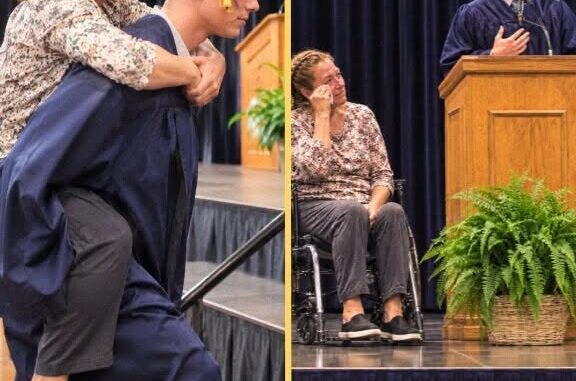
Then he knelt beside my wheelchair.
“I want you to come up there with me.”
I looked at him in surprise.
“Sweetheart, this is your graduation. You should enjoy your moment.”
He shook his head.
“I want you to be part of it.”
I glanced toward the stage.
“How are we going to manage that?”
Caleb explained that he had already spoken with the school staff about arranging assistance.
I was surprised that he had planned something without telling me.
But he looked so excited that I agreed.
A Special Moment on Stage
With the help of trained staff and an agreed transfer arrangement, Caleb assisted me for the short journey toward the stage.
Several classmates helped bring my wheelchair forward.
School staff made sure everything was positioned safely.
Once I was comfortably seated again, I looked out at the auditorium.
Families were watching with warm smiles.
Some were taking photographs.
Others were applauding.
Caleb stood beside me.
The principal handed him his diploma.
I clapped enthusiastically.
“That’s my boy!”
He laughed.
For a moment, I thought that was the entire surprise.
But then Caleb asked the principal whether he could say a few words.
The principal agreed and handed him the microphone.
Caleb took a breath.
“There’s something I’d like to share,” he began.
The room became quiet.
A Message I Never Expected
Caleb looked toward his classmates.
Then he turned toward me.
“Today is a special day for everyone graduating,” he said. “But I want to thank someone who helped me get here.”
I smiled.
He continued.
“When I was twelve, our family went through a major change. I didn’t understand everything that was happening, and I was worried about what our future would look like.”
He paused.
“My mom was learning how to do everyday things in new ways. But she still made sure I had opportunities to learn, play sports, spend time with friends, and follow my interests.”
I felt my eyes filling with tears.
Caleb looked directly at me.
“She taught me that when something is difficult, you can look for another way forward.”
I reached for a tissue.
Then he said something that caught me completely off guard.
“Mom, there’s a project I’ve been working on for the past two years. And I want to show you what it is.”
The Folder of Drawings
Caleb reached for a folder he had brought onto the stage.
He opened it carefully.
Inside were photographs, sketches, and detailed plans.
I recognized some of the drawings immediately.
They looked like the diagrams I had occasionally seen in his notebook.
But now I could see the full designs.
There were adjustable kitchen storage units.
There were plans for improving access between rooms.
And there was a concept for a simple automated door-opening mechanism.
Caleb explained that he had been working with his technology teacher and a local engineering workshop.
Together, they had been exploring affordable home modifications that could improve accessibility for wheelchair users.
I stared at the pages.
I couldn’t believe what I was seeing.
The project wasn’t just a school assignment.
It was something he had been developing for years.
Where the Idea Began
Caleb continued speaking.
“I started thinking about this because I noticed how many everyday spaces aren’t designed for everyone.”
He explained that he had watched me make adjustments around our home.
He remembered how difficult it had been to reach certain shelves.
He had noticed the challenges of opening some doors and moving through narrow spaces.
At first, he wanted to design something specifically for our house.
But as he researched accessibility, he realized that many other people encountered similar barriers.
“So I decided to think bigger,” he said.
He wanted to explore practical, affordable modifications that could be adapted to different homes.
He knew that professional accessibility assessments and safe installation would be important.
His designs were still at an early stage.
But he hoped they could eventually become useful solutions.
I was overwhelmed by the thought he had put into the project.
Support From His Teachers
Caleb explained that his teachers had encouraged him to develop the idea.
They helped him research materials, understand basic engineering principles, and improve his technical drawings.
A local community organization had also expressed interest in supporting the project.
With guidance from experienced designers, Caleb had begun exploring how to create prototypes.
He had entered a student innovation competition.
And his work had received an award.
I looked at him in amazement.
He had never mentioned any of this.
He had been quietly developing his skills while preparing for graduation.
Then he turned another page in the folder.
There was a photograph of a small workshop.
Beside it was a letter.
Caleb smiled.
“And there’s one more thing.”
An Opportunity for the Future
A school representative brought an envelope onto the stage.
Caleb opened it.
Inside was a letter confirming that the community organization would provide additional support for his project.
The arrangement included access to equipment, guidance from experienced professionals, and a grant to help him continue developing his designs after graduation.
Caleb explained that the funding would allow him to explore the next stage of the project.
He hoped to create prototypes and test whether his ideas could be practical and affordable.
He understood that the designs would need further evaluation.
But he was excited to have the opportunity.
I looked at my son.
I had spent years encouraging him to follow his interests.
Now he was using those interests to explore ways of making everyday environments more accessible.
It was a moment I would never forget.
The Words That Meant the Most
Caleb stepped closer to my wheelchair.
He took my hand.
“Mom, you’ve always encouraged me to keep learning,” he said.
“You taught me that needing to do something differently doesn’t mean giving up on it.”
I couldn’t stop smiling through my tears.
He continued.
“I know you never asked me to make this project. But I wanted to create something that might help you and other people.”
Then he added:
“You’ve supported me in so many ways. I hope I can use what I’ve learned to make a positive difference.”
I pulled him into a hug.
The auditorium filled with applause.
His classmates stood.
Teachers smiled.
The principal congratulated him.
For a few moments, the graduation ceremony became an unforgettable celebration of kindness, creativity, and determination.
After the Ceremony
When the ceremony ended, families gathered outside for photographs.
Caleb stayed beside me.
He introduced me to his teachers and thanked the classmates who had helped during the ceremony.
Several people asked questions about his project.
He showed them the drawings and explained how the designs might work.
One of his teachers approached us.
“Your son has worked very hard,” she told me. “He’s thoughtful, creative, and genuinely interested in helping others.”
I smiled proudly.
“Thank you. I’m very proud of him.”
Caleb looked at me.
“She’s the reason I started.”
I shook my head.
“You did the work, sweetheart. You deserve the credit.”
He smiled.
“Maybe. But you helped me see what mattered.”
That meant more to me than he could have known.
Two Important Things on the Table
Later that afternoon, we returned home.
Caleb placed his diploma on the living room table.
Beside it, he set down the folder containing his project.
I looked at the two items.
One represented years of studying, assignments, examinations, and school activities.
The other represented curiosity, compassion, and a desire to solve a real-world problem.
Both made me proud.
I thought about the little boy who had once worried about our future.
I remembered our first conversations after the accident.
I remembered teaching him that our circumstances might change, but his opportunities didn’t have to disappear.
Now he was standing at the beginning of adulthood with plans of his own.
I couldn’t have asked for a better graduation gift.
Remembering an Old Promise
That evening, Caleb sat beside me on the couch.
He looked thoughtful.
“Mom, do you remember what you told me when I was twelve?”
I smiled.
“I told you a lot of things when you were twelve.”
He laughed.
“After everything changed, you said we would figure things out together.”
I nodded.
“I remember.”
He took my hand.
“We did, didn’t we?”
I looked at him.
We had faced difficult years.
We had adjusted to new routines, managed unexpected expenses, and learned how to ask for help when we needed it.
But we had also shared happy memories.
We had celebrated birthdays, school achievements, and ordinary afternoons at home.
Our lives hadn’t been defined only by the challenges we faced.
They had also been shaped by the choices we made afterward.
“Yes,” I told him. “We really did.”
What My Son Taught Me
For years, I had worried that my disability might limit Caleb’s opportunities.
I wanted him to have a childhood filled with possibility.
I never wanted him to feel responsible for circumstances beyond his control.
Watching him graduate reminded me that he had developed his own understanding of our experiences.
He hadn’t grown up seeing disability as something that made a person less capable or less valuable.
He had learned that environments and systems can create unnecessary barriers.
And he had become interested in finding practical ways to reduce those barriers.
I was proud of his compassion.
But I was equally proud of his independence.
He had chosen his project because it interested him.
He had put in the work.
He had sought guidance.
And he had developed an idea that might eventually benefit people beyond our family.
A Future Full of Possibilities
In the weeks after graduation, Caleb began preparing for the next stage of his education.
He continued meeting with his teachers and the community organization supporting his project.
He researched materials and reviewed his designs.
Some ideas needed to be revised.
Others required additional testing.
Caleb understood that meaningful engineering work takes time.
He didn’t expect every concept to succeed immediately.
Instead, he focused on learning.
I watched him work at the kitchen table, just as he had done when he was younger.
Only now, the notebooks were filled with more detailed plans.
Sometimes he asked for my perspective as a wheelchair user.
I appreciated that.
I reminded him that my experiences were only one person’s perspective and that accessibility solutions should involve a wide range of users.
He agreed.
He wanted his designs to be informed by the people who might eventually use them.
That made me even prouder.
Final Thoughts: A Graduation I Will Always Remember
I had attended Caleb’s graduation expecting to celebrate his academic achievements.
Instead, I learned about a project he had been quietly developing for years.
He had taken something he observed in everyday life and turned it into an opportunity to learn, create, and help others.
The moment he invited me onto the stage was meaningful.
But the greatest gift was seeing the thoughtful young man he had become.
He understood that accessibility is about independence, dignity, and participation.
He understood the value of seeking support and learning from others.
And he understood that challenges can sometimes inspire useful ideas.
I thought I was going to graduation to celebrate everything my son had accomplished. I left realizing that one of his greatest achievements was learning how to turn compassion into action.
That evening, his diploma and project folder rested side by side on our living room table.
They represented different parts of his journey.
One celebrated what he had already achieved.
The other held possibilities for what he might do next.
And as I watched him excitedly discuss his plans for the future, I remembered the promise we had made years earlier.
We would figure things out together.
In many ways, we already had.
And there was still so much ahead of us.
Leave a Reply