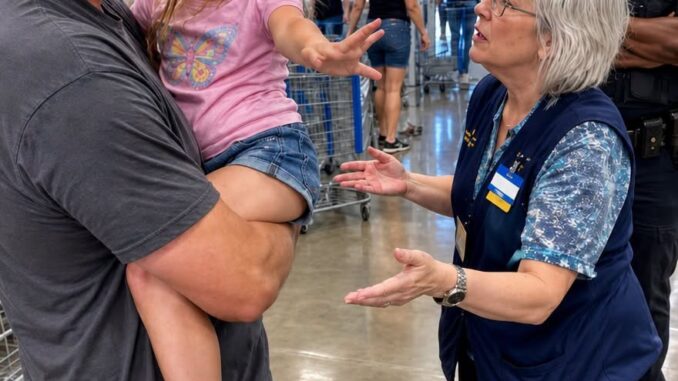
An Ordinary Afternoon in Arkansas
At sixty-seven, Mavis Keller enjoyed the simple routines of her part-time job at a retail store in Fort Smith, Arkansas.
After more than thirty years working for the postal service, she had retired from her full-time career. But she wasn’t quite ready to spend every day at home.
She liked meeting people.
She enjoyed greeting familiar customers, helping visitors find their way around the store, and exchanging a few friendly words with families.
Her favorite part of the job was welcoming children.
Mavis kept a small collection of yellow smiley-face stickers in the pocket of her blue work vest.
Whenever a parent agreed, she offered one to a child.
It was a small gesture, but it often made someone’s day a little brighter.
She had worked at the store for nine years and knew many of the regular customers by name.
Most days passed without anything unusual happening.
Then, on a rainy Tuesday afternoon, Mavis noticed something near the entrance that made her pause.
A man was walking toward the exit carrying a young girl.
The child was crying.
And what she was saying immediately concerned Mavis.
The Little Girl in the Purple Raincoat
The girl appeared to be about three years old.
She wore a purple raincoat and bright pink boots.
Her cheeks were wet with tears, and she seemed deeply upset.
As the man carried her toward the automatic doors, she repeatedly called for her mother.
“You’re not my daddy! I want my mommy!”
Mavis watched them for a moment.
She understood that young children sometimes become distressed in public.
A tired or overwhelmed child might cry, resist being carried, or ask for another parent.
Mavis had raised children of her own and helped care for her grandchildren.
She knew that a single emotional moment didn’t necessarily mean something was wrong.
Still, the girl’s repeated words and frightened expression troubled her.
Rather than making assumptions, Mavis decided to approach them calmly.
A Gentle Attempt to Help
Mavis stepped closer and offered the little girl a warm smile.
“Would you like a sticker, sweetheart?”
She held out one of her familiar yellow smiley-face stickers.
The child didn’t take it.
Instead, she reached toward Mavis and gripped the front of her blue vest.
The man adjusted his hold on the girl.
“She’s fine,” he said. “She’s just having a difficult afternoon.”
Mavis nodded politely.
“I understand. Is there anything we can do to help?”
He told her he was the child’s father.
Mavis looked toward the girl.
“Are you looking for your mommy?”
The child nodded.
Then she repeated that the man wasn’t her daddy.
She mentioned someone named Miss Corliss and said the man had taken her from that person’s house.
Mavis didn’t know what the statement meant.
But it was enough to make her concerned about the child’s well-being.
Asking for Assistance
Mavis asked the man whether he would mind waiting briefly while she contacted a manager.
She explained that she wanted to make sure everything was all right.
The man became irritated.
He insisted that he was the girl’s father and that he had every right to leave with her.
Mavis tried to keep her voice calm.
“I’m not trying to cause trouble,” she said. “I just want to make sure the little one is okay.”
The store manager arrived a few moments later.
The man showed him identification and a photograph of himself holding a baby.
He said the photograph showed him with his daughter when she was younger.
The manager examined the information.
He told Mavis that the man had identified himself as the child’s parent.
He also reminded her that employees needed to follow company procedures when dealing with customer disputes.
Mavis understood that she couldn’t determine custody or parental rights from a brief conversation.
But she remained uneasy.
The little girl was still crying.
Watching Them Leave
The manager instructed Mavis to return to her usual duties.
The man carried the child through the automatic doors.
Mavis watched them cross the parking lot.
The rain had slowed to a light drizzle.
The man approached a vehicle and prepared to leave.
Mavis knew that she shouldn’t attempt to physically stop him or create a confrontation.
Instead, she decided to report her concerns to the appropriate authorities.
From a safe location, she noted the vehicle’s description and registration number.
She also took photographs that could help identify the car.
Then she contacted emergency services.
She explained what she had witnessed, including the child’s words, the man’s statements, and the direction the vehicle had traveled.
The dispatcher asked several questions.
Mavis answered as accurately as she could.
She was careful to distinguish what she had personally observed from what she suspected.
Giving Her Statement
An officer arrived later that afternoon.
Mavis described the encounter again.
She explained that the child had been distressed and had repeatedly said the man wasn’t her father.
She also mentioned the reference to Miss Corliss.
The officer reviewed the information she had collected.
He thanked her for making the report and explained that the circumstances would need to be checked.
Mavis understood that the man might have a legitimate explanation.
She wasn’t claiming to know the full situation.
She simply believed the child’s distress deserved attention.
After the officer left, Mavis returned to work.
She greeted customers and helped a family find the correct department.
But throughout the afternoon, she kept thinking about the little girl in the purple raincoat.
She hoped someone would confirm that the child was safe.
An Unexpected Meeting With Management
The following morning, Mavis was called into the manager’s office.
She assumed he wanted to discuss the previous day’s incident.
But when she entered, she noticed several documents on his desk.
The manager explained that the man had contacted the company’s customer service department.
He had complained about Mavis’s actions.
According to the complaint, she had interfered with him, followed him toward the parking lot, and photographed his vehicle.
He also mentioned the possibility of legal action.
Management had reviewed the store’s security footage.
They believed Mavis had not followed the company’s procedures for handling customer concerns.
Mavis explained that she had been worried about the child.
She said she hadn’t tried to determine whether the man was legally entitled to care for her.
She had simply reported what she observed.
But the manager told her the company had decided to end her employment.
Leaving the Store
Mavis was stunned.
She had worked there for nine years.
She had always tried to be helpful, respectful, and professional.
Now she was losing her job because of a situation she believed required attention.
Before leaving the office, she asked one question.
“Has anyone found out whether the little girl is okay?”
The manager said he didn’t know.
Mavis collected her belongings.
She folded her blue work vest and placed it in her bag.
The yellow smiley-face stickers were still in the pocket.
As she walked out of the store, she felt disappointed and uncertain.
She didn’t know whether the company’s decision would be reconsidered.
She didn’t know whether she had misunderstood the situation.
And she didn’t know what had happened to the child.
But she still believed contacting the authorities had been the responsible choice.
A Call From the Police
Several days later, Mavis received a telephone call from a detective.
The detective explained that the little girl had been located and was safe with her mother.
Mavis felt an immediate sense of relief.
The detective also told her that the vehicle information she had provided had helped officers locate the car.
According to the update, a state trooper had stopped the vehicle near the Oklahoma border.
The circumstances were being reviewed as part of an investigation involving a family custody dispute.
The detective couldn’t share every detail.
Mavis understood.
There were privacy concerns, particularly because a young child was involved.
But knowing the girl was safe meant more to her than anything else.
She thanked the detective for calling.
After hanging up, she sat quietly for a long time.
She had lost her job.
But the child had returned to her mother.
For Mavis, that mattered enormously.
A Letter Arrives Weeks Later
Mavis hoped life would gradually return to normal.
She began looking for another part-time job and spent more time with her grandchildren.
Then, several weeks after the incident, a large envelope arrived at her house.
Inside were legal documents.
The man from the store, Wade Harlan, had filed a civil lawsuit against her.
He alleged that her actions had interfered with his rights and caused reputational and emotional harm.
The complaint also raised privacy concerns related to the photographs she had taken.
He sought $250,000 in damages.
Mavis read the amount several times.
She lived on retirement income and Social Security benefits.
Her savings were modest.
The possibility of defending herself against such a large claim frightened her.
She didn’t know where to begin.
Finding Legal Support
Mavis called her son.
She explained what had happened and told him about the lawsuit.
He encouraged her not to respond to the documents without legal advice.
Together, they began looking for an attorney.
A few days later, someone from her church offered assistance.
His name was Harold Vaughn.
Harold was a retired attorney with many years of legal experience.
After reviewing the situation, he offered to help Mavis without charging a fee.
She was deeply grateful.
Harold carefully examined the complaint.
He explained that the legal protections available to someone who reports a genuine safety concern depend on the circumstances and applicable law.
He also told her that the lawsuit’s allegations would need to be addressed through the proper legal process.
Mavis had not been found responsible for anything simply because someone had filed a complaint.
That distinction helped her feel less overwhelmed.
Preparing Her Defense
Harold asked Mavis to describe the incident from beginning to end.
He wanted every detail.
What had the child said?
How had the man responded?
What had Mavis done before contacting emergency services?
Had she physically prevented anyone from leaving?
Mavis answered each question carefully.
She also provided copies of the photographs and the information she had given police.
Harold explained that consistency and accuracy were important.
They would focus on what Mavis had actually observed and the steps she had taken.
He reminded her not to exaggerate the situation or make assumptions about Wade’s intentions.
The facts needed to speak for themselves.
Mavis agreed.
She had never wanted to accuse someone unfairly.
She had wanted a frightened child to receive help.
Remembering Miss Corliss
As the case continued, Mavis kept thinking about something the girl had said.
She had mentioned Miss Corliss.
Mavis wondered whether that person might have been a caregiver.
After discussing the matter with Harold, she learned about a nearby daycare operated by Corliss Washington.
Rather than conducting her own investigation, Mavis arranged an appropriate conversation through the people assisting with the case.
Corliss confirmed that the child had attended her daycare.
She also recognized the description of the man who had collected her.
According to Corliss, Wade had arrived claiming that he needed to take the child home early.
He had presented identification and information that appeared to support his relationship to the girl.
But the child had become upset when she saw him.
Corliss later contacted the child’s mother to clarify the situation.
The mother had not expected the child to be collected by Wade.
That information became important to the authorities reviewing the incident.
A Letter to the Child’s Mother
Mavis was relieved to learn that the daycare provider had also been concerned.
She felt less alone in her decision to report what she had witnessed.
Still, she knew the child’s mother had experienced a frightening situation.
Mavis wanted to express her support.
With appropriate assistance, she wrote a short letter.
She explained that she had been working at the store when she noticed the little girl.
She said she hoped the child was recovering well and that the family had the support they needed.
She didn’t ask for recognition.
She didn’t expect a reply.
She simply wanted the mother to know that someone had cared about her daughter’s safety.
Before sealing the envelope, Mavis placed a small yellow smiley-face sticker inside.
It was the same kind she had offered the child at the store.
The Case Reaches Court
By October, the civil case had reached trial.
Mavis arrived at the courthouse with her son, Harold, and several friends from church.
She was nervous.
She had never imagined being involved in a lawsuit.
Wade attended with his attorney.
His legal team argued that Mavis had acted without knowing the full circumstances.
They described him as a father who had been trying to leave a store with his daughter.
They also argued that Mavis’s actions had caused embarrassment and distress.
Harold prepared to present her defense.
He intended to explain why she had become concerned and how she had responded.
Mavis sat quietly, listening.
She knew the court would need to consider the evidence rather than anyone’s personal feelings.
Then an unexpected development changed the direction of the proceedings.
The Child’s Mother Comes Forward
A woman named Kendra Lowe had contacted the attorneys with information relevant to the case.
Kendra was the little girl’s mother.
She had been following the legal proceedings and wanted to provide records that could clarify the circumstances.
The judge allowed the attorneys time to review the material and determine how it could properly be presented.
Among the documents were custody orders and other records concerning Wade’s permitted contact with the child.
According to those records, Kendra had sole legal and physical custody.
Wade’s contact with the girl was subject to supervised visitation conditions.
The documents also included information about earlier family disputes.
These records were relevant because Wade’s lawsuit relied partly on his account of the incident.
Kendra’s evidence provided additional context.
Why Kendra Had Hesitated
Kendra explained that the family situation had been difficult for some time.
She had been worried about further conflict.
For that reason, she had initially been reluctant to become involved in another legal proceeding.
But when she learned that Mavis was facing a substantial lawsuit, she reconsidered.
She had also received the letter Mavis sent.
The message had meant a great deal to her.
It reminded her that a stranger had noticed her daughter’s distress and had tried to help through the proper channels.
Kendra decided that she wanted the court to understand the circumstances surrounding the incident.
She wasn’t there to create a public confrontation.
She wanted the relevant records considered.
And she wanted Mavis’s actions to be evaluated in light of the information available.
A Clearer Understanding of What Happened
As the evidence was reviewed, the circumstances became clearer.
The custody documents showed that Wade’s contact with the child was restricted under an existing court arrangement.
The investigation had also established that the child had been taken from daycare without Kendra’s authorization.
Mavis’s report and the vehicle information had helped officers locate them.
These details were important to the civil case.
They did not mean that every action Mavis took was automatically beyond legal review.
But they provided context for why she had become concerned and contacted emergency services.
Harold presented her account carefully.
He emphasized that Mavis had reported observable facts rather than attempting to resolve the custody dispute herself.
The case continued through the appropriate legal procedures.
The Lawsuit Is Withdrawn
After reviewing the additional evidence, Wade’s attorney consulted with his client.
The following morning, the legal team requested dismissal of the civil claim with prejudice.
The court approved the request.
The lawsuit against Mavis was over.
She would no longer have to defend herself against the $250,000 demand.
Mavis felt enormous relief.
For weeks, she had worried about the potential cost of the proceedings.
She had wondered whether she would lose her savings.
Now she could begin putting that uncertainty behind her.
Harold reminded her that the outcome reflected the particular facts of the case.
Every legal dispute is different.
But in Mavis’s situation, the additional records had played an important role.
The Separate Investigation
The civil lawsuit was not the only legal matter connected to the incident.
Authorities continued reviewing the circumstances of Wade’s actions involving his daughter.
Kendra cooperated with investigators and provided relevant records.
The matter eventually led to criminal proceedings in Oklahoma.
According to the fictional case’s outcome, Wade later entered a guilty plea to charges arising from the custody incident and received a custodial sentence.
Mavis was not involved in determining that outcome.
Her role had been limited to reporting what she observed and providing information when requested.
She understood that law enforcement and the courts were responsible for investigating allegations and making legal decisions.
She was grateful that the child was safe.
That remained her greatest concern.
An Unexpected Offer From the Store
Several weeks after the civil case ended, Mavis received a call from her former employer.
The company had reviewed the circumstances of her dismissal.
Management acknowledged that its handling of the incident had not adequately addressed employees’ responsibilities when they encountered possible safety concerns.
The company offered to reinstate Mavis.
It also offered back pay for the period she had been away.
Mavis was surprised.
She had enjoyed her job and missed the familiar customers.
But before accepting, she wanted to discuss something important.
She believed the store needed clearer guidance for employees who encountered situations involving potentially vulnerable customers.
Workers shouldn’t have to decide on their own whether a child is safe.
They should know when to involve a manager, how to contact emergency services, and how to avoid escalating a situation.
The Keller Protocol
The company agreed to review its procedures.
It introduced additional employee guidance and training.
The new approach emphasized observing and reporting concerns, avoiding physical confrontation, and allowing trained authorities to assess situations involving possible danger.
The guidance also addressed privacy, documentation, and the importance of following company procedures.
In recognition of Mavis’s experience, the store referred to the updated guidance as the Keller Protocol.
Mavis appreciated the gesture.
But she was more interested in whether the policy would help employees make responsible decisions.
She didn’t want anyone to feel pressured to ignore a genuine concern.
At the same time, she understood that employees needed clear limits on their responsibilities.
The goal wasn’t to encourage people to investigate strangers.
It was to make sure they knew how to seek help safely.
Returning to Work
Mavis accepted the company’s offer.
On her first day back, she put on her familiar blue vest.
She filled the pocket with yellow smiley-face stickers.
Several coworkers welcomed her warmly.
Regular customers asked where she had been.
Mavis kept her explanations brief.
She was happy to return to her routine.
She greeted families, helped visitors find their way around the store, and exchanged friendly words with people entering the building.
The experience had changed her perspective.
She now understood how quickly an ordinary workday could become complicated.
But it hadn’t changed her belief in treating people with kindness.
A Special Visit
A few weeks later, a young mother entered the store holding a little girl’s hand.
The child wore a red winter coat and pink boots.
Her curly hair was arranged in two small puffs.
Mavis recognized her.
It was Quinn.
The little girl from the rainy afternoon.
Her mother, Kendra, smiled as they approached.
“We wanted to come and say thank you,” she explained.
Mavis felt emotional.
She had thought about Quinn often.
Seeing her safe and smiling was more meaningful than any recognition she could have received.
Quinn looked up at her mother.
“Is this the lady?”
Kendra nodded.
“Yes, sweetheart.”
The Gold Star
Quinn stepped closer.
She reached into her coat pocket and pulled out a small sheet of gold star stickers.
Carefully, she peeled one from the sheet.
Then she placed it on Mavis’s blue vest.
“This is for you,” she said.
Mavis smiled.
“Thank you, sweetheart.”
Quinn explained that her mother had told her Mavis had helped when she was frightened.
The little girl wanted to give her something special.
Mavis knelt so they were at eye level.
Then she reached into her own pocket.
She took out a yellow smiley-face sticker.
“Would you like one of these?”
Quinn nodded eagerly.
With Kendra’s permission, Mavis placed it on the child’s coat.
Quinn gave her a quick hug.
It was a simple exchange.
But Mavis knew she would remember it for the rest of her life.
A Reminder for New Employees
Mavis kept the gold star on her vest beside her name tag.
Whenever younger employees asked about it, she shared a brief version of what had happened.
She didn’t describe Quinn’s private family circumstances in detail.
Instead, she focused on the lesson.
If someone appears to be in danger, employees should take concerns seriously and follow the appropriate reporting procedures.
They should avoid making assumptions.
They should not attempt to determine legal custody or physically intervene unless directed by qualified authorities or necessary under applicable emergency guidance.
And they should remember that children may communicate distress in ways adults don’t immediately understand.
Mavis encouraged coworkers to remain calm, seek help, and document only what was appropriate.
She believed clear procedures could protect customers and employees alike.
What Mavis Learned
Looking back, Mavis never considered herself a hero.
She was a grandmother who noticed a child in distress.
She didn’t know the family’s history.
She didn’t know the legal arrangements.
And she couldn’t determine what was happening from a few minutes near a store entrance.
But she knew she could report her concerns.
That decision led to an investigation, a difficult employment dispute, and a civil lawsuit.
The experience was stressful.
There were moments when Mavis wondered whether she would ever feel comfortable returning to work.
But the support she received from her son, Harold, and her community helped her through it.
She also learned that good intentions do not remove the need for responsible action.
When a situation is uncertain, it is important to follow established procedures and allow qualified professionals to assess the facts.
Final Thoughts: Compassion and Responsibility
Mavis returned to the work she loved.
She greeted customers with the same warmth she had shown for years.
She continued offering smiley-face stickers to children whose caregivers welcomed the gesture.
And she kept Quinn’s gold star beside her name tag.
The sticker reminded her of a rainy afternoon, a difficult decision, and the importance of responding thoughtfully when someone may need assistance.
Her experience also encouraged her employer to improve its safety procedures.
That was an outcome she valued deeply.
Compassion is most effective when it is paired with good judgment, calm communication, and a willingness to seek appropriate help.
Mavis couldn’t solve every problem she encountered.
She couldn’t know every family’s circumstances.
But she could pay attention, act responsibly, and treat people with dignity.
And sometimes, that is where meaningful help begins.
Leave a Reply