An original fictional family story about a mother’s unexpected return, a child’s safety, financial trust, and the difficult decisions involved in protecting a family.
I had imagined my homecoming hundreds of times.
After months away on military deployment, I was finally returning to my husband, Derek, and our four-year-old daughter, Lily.
My assignment had ended three weeks earlier than expected. Instead of telling my family immediately, I decided to surprise them.
I pictured Lily running toward me with her arms open. I imagined Derek smiling when he saw me standing in the doorway.
But when I arrived at our house, something was wrong.
The rooms were unusually quiet.
There were no toys scattered across the living room floor, no television playing cartoons, and no familiar sounds coming from the kitchen.
Then I found Lily.
She had been left at home without appropriate adult supervision.
Within minutes, I was calling emergency services.
And before the day was over, I would discover that my daughter’s situation was connected to a much larger problem involving my husband’s family and our finances.
The Homecoming I Had Planned
My name is Hannah Nolan, and I serve in the military.
Being away from my family is one of the most difficult parts of my work.
During deployment, I tried to maintain a routine with Lily.
Whenever possible, we spoke over video.
She showed me her drawings, told me about her favorite toys, and asked when I would come home.
Derek usually sat beside her during those calls.
He reassured me that everything was going well.
I trusted him.
He was Lily’s father, and we had agreed that he would be responsible for her daily care while I was away.
His mother, Patricia, also lived nearby.
She frequently offered to help with childcare and household responsibilities.
Knowing that family support was available gave me some comfort.
I believed Lily was safe.
Arriving at an Empty House
When my assignment ended early, I arranged my return journey and decided to keep the news a surprise.
I wanted to see my daughter’s face when she opened the door.
But when I reached the house, Derek’s car was gone.
I knocked.
Nobody answered.
I used my key and stepped inside.
The house felt strangely still.
I called Derek’s name.
Then Lily’s.
After searching the main rooms, I finally heard a faint sound.
It was coming from the back of the house.
I followed it and found my daughter.
She was frightened, tired, and clearly in need of care.
She told me that her father had gone away and that she had been waiting for someone to return.
I immediately contacted emergency services.
Making Lily’s Safety the Priority
While waiting for help, I stayed beside Lily.
I offered reassurance and followed the emergency dispatcher’s instructions.
I tried to remain calm.
Inside, I was overwhelmed.
I had expected a joyful reunion.
Instead, I was trying to understand how a four-year-old child could have been left without a responsible adult.
When the paramedics arrived, they assessed Lily’s condition.
A police officer, Officer Bell, also responded.
The emergency team recommended that Lily receive a medical evaluation.
I agreed immediately.
Before leaving, I asked Officer Bell to help me understand what had happened.
He began documenting the circumstances.
Then I called Derek.
A Call to My Husband
Derek answered after several attempts.
I could hear people talking in the background.
He sounded surprised.
“Hannah? You’re home?”
“Yes,” I replied. “Where are you?”
He hesitated.
Then he told me he was on a cruise with his mother, Patricia, and his sister, Jenna.
I struggled to process his answer.
“Where is Lily supposed to be?”
There was a long silence.
Derek said his mother had arranged for someone to care for her.
I explained that Lily was alone when I arrived.
He insisted that there must have been a misunderstanding.
But he couldn’t immediately tell me who was responsible for supervising our daughter.
Officer Bell asked me to keep the conversation brief so we could focus on Lily’s care.
Before ending the call, I asked Derek one more question.
“How long have you been away?”
He admitted that the cruise had begun several days earlier.
A Locked Closet
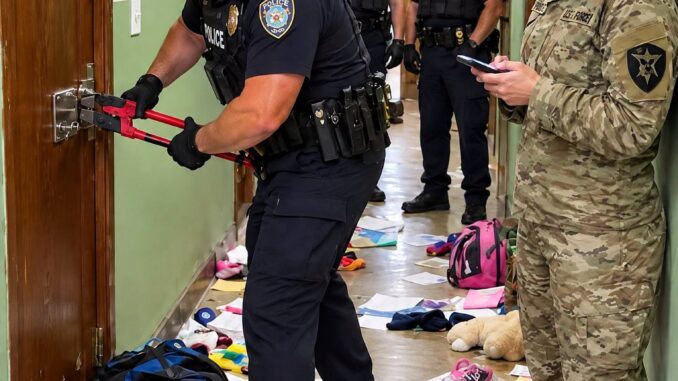
While the emergency team prepared to take Lily to the hospital, Officer Bell noticed a locked storage closet near the hallway.
I recognized it.
Before deployment, we had used the space for household supplies and seasonal decorations.
Now a heavy padlock secured the door.
I had never seen that lock before.
When I asked Derek about it, his tone changed.
He told me not to open the closet.
I asked why.
He wouldn’t explain.
Instead, he repeatedly insisted that we wait until he returned.
His reaction concerned me.
I informed Officer Bell that the closet was inside my home and that I had not agreed to restrict access to it.
Because the circumstances involved a possible child welfare investigation and potentially relevant household records, the officer explained that any examination or collection of evidence needed to follow the applicable legal procedures.
After the necessary steps were taken, the closet was opened.
What we found raised entirely new questions.
Documents I Had Never Seen
The closet contained cardboard boxes, plastic storage containers, and several folders.
A small filing cabinet stood against the back wall.
On top of it were a laptop, an external hard drive, and a stack of envelopes.
Some envelopes had my name on them.
One folder was labeled:
HANNAH — FINANCIAL RECORDS
Inside were copies of my military pay statements, banking information, insurance documents, and records related to our home.
At first, I assumed Derek had organized our household paperwork.
Then I noticed several forms that appeared to contain my signature.
I didn’t recognize them.
I had never knowingly approved the arrangements described in those documents.
I showed Officer Bell.
He advised me not to move or alter anything further.
The documents would need to be examined by qualified investigators before anyone could determine whether they were authentic or legally valid.
The Folder Marked Lily
Another folder contained records relating to my daughter.
It was labeled with her name.
Inside were copies of her birth certificate, medical information, photographs, and correspondence between Derek and Patricia.
Some of those records were ordinary documents that parents might keep for practical reasons.
Others were more concerning because of the messages attached to them.
One email from Patricia discussed making sure certain financial arrangements were completed before I returned.
Derek’s response mentioned using the cruise period to finish paperwork.
The messages did not explain every detail of their plans.
But they suggested that important decisions were being discussed without my knowledge.
I felt increasingly uneasy.
I had trusted Derek to care for Lily while I was away.
Now I was finding documents that raised questions about whether he had also been making financial arrangements on my behalf.
The Cruise Reservation
Among the papers was a printed cruise reservation.
Four names appeared on the original booking.
Derek.
Patricia.
Jenna.
And Lily.
My daughter had been included in the reservation.
But a later notation indicated that her ticket had been canceled before departure.
A handwritten note stated that she would remain at home.
There was no clear explanation of who was supposed to care for her.
I showed the document to Officer Bell.
He recorded the information for the investigation.
At that moment, I wasn’t interested in understanding why the family had chosen to take a vacation.
I wanted to know why nobody had ensured that Lily was safely supervised.
A Troubling Admission
Derek called again while the officers were still at the house.
He sounded frightened.
He asked whether we had opened the closet.
I told him that investigators were reviewing the situation.
He became quiet.
Then he said something unexpected.
“There are things on the laptop you don’t understand.”
I asked him what he meant.
He claimed that Patricia had been involved in preparing some of the financial documents.
He also said there was an audio recording stored on the computer.
According to Derek, the recording contained a conversation from before my deployment.
He said Patricia had asked him to delete it.
But he had kept a copy.
I asked what the recording contained.
He refused to explain over the phone.
Officer Bell instructed me to avoid discussing potential evidence further.
The devices would need to be preserved and examined through appropriate procedures.
I ended the call.
My priority was Lily.
Following the Ambulance
I traveled to the hospital with my daughter.
Before leaving the house, I retrieved her favorite stuffed rabbit.
She had owned it since she was a baby.
During our video calls, she often held it up to the camera so I could say hello.
Now she clutched it tightly against her chest.
At the hospital, the medical team evaluated her.
They identified dehydration and concerns related to inadequate food intake.
The doctors recommended treatment and observation.
They were cautiously optimistic about her recovery.
I stayed beside her bed.
When she woke, she looked at me and asked, “Mommy, are you staying tonight?”
I kissed her forehead.
“Yes, sweetheart. I’m right here.”
She closed her eyes again.
I sat beside her for a long time.
The Questions I Couldn’t Answer
That night, I thought about every conversation I’d had with Derek during deployment.
He had told me that Lily was doing well.
He had described school activities, meals, and weekend plans.
I had believed him.
I also remembered Patricia’s repeated offers to help.
She had often told me not to worry about the household.
Now I wondered how much she knew about the childcare arrangements.
Had someone agreed to supervise Lily and failed to arrive?
Had Derek misunderstood a plan?
Or had the adults simply assumed someone else would take responsibility?
I didn’t have enough information to know.
But I knew that Lily had been left in an unsafe situation.
And I knew that I needed answers.
The First Update From Investigators
The following morning, investigators contacted me.
They had begun reviewing the documents recovered from the closet.
Several forms appeared to contain signatures that required verification.
They were also examining relevant financial transactions.
The investigators explained that they could not yet determine whether every document had been improperly created or used.
That would require further analysis.
They also planned to review the electronic devices.
I provided information about my accounts and the documents I had authorized before deployment.
I wanted the investigation to establish the facts.
I didn’t want to make assumptions.
But I was deeply concerned about what the records might reveal.
Patricia’s Phone Call
Later that day, Patricia called.
She sounded upset.
Rather than asking how Lily was feeling, she immediately questioned why I had involved the police.
She said I was creating unnecessary trouble for the family.
I told her that Lily had been found without appropriate supervision and had required medical attention.
That was not something I could ignore.
Patricia insisted that there had been a childcare arrangement.
I asked her to identify the person responsible.
She didn’t provide a clear answer.
Instead, she told me to stop cooperating with investigators.
I refused.
“If there’s an explanation, you can share it with them,” I said.
Patricia became quiet.
Then she ended the call.
When Derek Returned
Three days later, Derek, Patricia, and Jenna returned from their cruise.
Investigators contacted them for interviews.
They wanted to understand the childcare arrangements, the financial documents, and the circumstances surrounding Lily’s time alone.
Derek initially maintained that someone had agreed to look after her.
But the accounts provided by the family members were inconsistent.
Investigators worked to establish who had made the arrangements and whether anyone had actually accepted responsibility for Lily’s care.
Meanwhile, I continued speaking with medical staff and child welfare professionals about my daughter’s needs.
I was determined to provide a stable environment while the situation was reviewed.
The Recording on the Laptop
As the investigation continued, specialists recovered an audio file from the laptop.
The recording contained a conversation between Derek and Patricia from before my deployment.
They discussed financial paperwork, access to accounts, and changes they hoped to make while I was away.
Some of the comments suggested that they intended to complete those arrangements without informing me.
The recording raised further questions about the documents in the closet.
However, investigators still needed to verify the context, authenticity, and legal significance of the material.
I was informed that the financial records would be examined alongside banking information and other evidence.
I felt disappointed and betrayed.
But I also understood the importance of allowing the investigation to proceed properly.
Protecting Our Finances
With professional assistance, I began reviewing my financial accounts.
I contacted the relevant institutions and explained that I was concerned about possible unauthorized activity.
I requested copies of account records and asked about available security measures.
I also consulted an attorney regarding the documents that appeared to contain my signature.
We discussed how to verify their authenticity and address any unauthorized transactions.
I reviewed our property records and insurance arrangements.
I wanted to understand exactly what had been changed, if anything.
The process was time-consuming.
But it helped me regain a sense of control.
I had worked hard to build financial stability for my family.
I wasn’t willing to leave important questions unanswered.
Making Difficult Family Decisions
As more information emerged, I realized that my marriage could not continue in the same way.
I had serious concerns about Derek’s judgment, his honesty, and the decisions made during my absence.
Most importantly, I could not ignore what had happened to Lily.
I consulted my attorney about separation, divorce, and appropriate arrangements for our daughter’s care.
I also worked with professionals familiar with military family circumstances.
The legal process would take time.
There were questions about property, finances, parenting responsibilities, and the ongoing investigation.
I knew the outcome would depend on the evidence and applicable law.
But I was certain about one thing.
Lily’s safety and well-being had to come first.
Helping Lily Recover
After leaving the hospital, Lily needed time to regain her confidence.
She sometimes became anxious when I left the room.
At bedtime, she wanted to know exactly where I would be.
She asked whether someone would always be home with her.
I answered her questions gently.
I explained that adults were responsible for making sure children were safe.
I reminded her that she had done nothing wrong.
We also sought age-appropriate professional support to help her process what had happened.
I learned that recovery wasn’t simply about physical health.
It was also about rebuilding a sense of security.
We returned to familiar routines.
Breakfast at the kitchen table.
Storytime before bed.
Drawing pictures in the afternoon.
Little by little, Lily became more comfortable.
The Importance of Reliable Support
My experience also changed the way I thought about childcare arrangements during military service.
Before deployment, I had trusted that the people closest to me would make responsible decisions.
I hadn’t imagined that I would need to question whether my daughter was being properly supervised.
Now I understood the importance of having clear, documented plans.
I worked with the appropriate military resources to review my family care arrangements.
I identified trusted caregivers and made sure responsibilities were clearly understood.
I also established reliable communication procedures.
No plan can prevent every unexpected problem.
But careful preparation can reduce confusion and help ensure that children receive consistent care.
I wanted Lily to know that even when I had to travel for work, responsible adults would be there for her.
A Different Kind of Homecoming
Months passed.
The legal and financial matters continued through the appropriate processes.
Investigators examined the available evidence, and the people involved were required to respond to the questions raised.
I focused on what I could control.
I cared for Lily.
I worked with my attorney.
I reviewed my finances.
And I began rebuilding our daily life.
The house gradually felt like home again.
We rearranged Lily’s bedroom and added new shelves for her books.
She chose a bright yellow blanket for her bed.
We planted flowers near the front porch.
Those small changes helped us create a sense of normality.
The Question at the Kitchen Table
One evening, Lily and I were coloring together.
She was drawing a house with a purple roof, green grass, and a large yellow sun.
I was coloring a butterfly.
Suddenly, she looked up.
“Mommy, are you going away again?”
I put down my pencil.
I knew that military service could require me to travel in the future.
I didn’t want to promise something I couldn’t guarantee.
“Sometimes I may have to go away for work,” I explained. “But I’ll make sure you have someone safe and responsible taking care of you.”
She thought about that.
“Someone who stays?”
“Yes,” I said. “Someone who stays with you and makes sure you’re okay.”
She nodded.
Then she returned to her drawing.
A few minutes later, she asked another question.
“Can we keep that closet locked forever?”
I looked toward the hallway.
The old padlock had been removed.
The closet had been cleared after the necessary evidence was collected.
It was now an ordinary storage space again.
“We don’t need to be afraid of the closet,” I told her. “And you can always tell me if something worries you.”
She smiled.
Then she asked whether we could put her winter coats inside.
I laughed softly.
“Of course we can.”
What I Learned
Before my deployment, I believed that trust meant not having to question the people closest to me.
Now I understood that trust also requires responsibility, honesty, and clear communication.
Parents and caregivers must understand their obligations.
Financial decisions should be made with informed consent.
And when serious concerns arise, it is important to seek appropriate professional assistance rather than rely on assumptions.
I also learned that difficult circumstances don’t have to define a family’s future.
Lily and I had experienced something frightening.
But we were receiving support, rebuilding routines, and creating a safer environment.
I couldn’t change what had happened.
I could only decide how to move forward.
Final Thoughts
My early return from deployment was supposed to be a happy surprise.
Instead, it became the beginning of a difficult period for my family.
I discovered that Lily had been left without proper supervision.
I found financial documents that raised serious questions.
And I learned that some of the people I trusted had made decisions I couldn’t understand or accept.
The months that followed required patience, professional guidance, and difficult choices.
But they also reminded me of what mattered most.
My daughter’s safety.
Our stability.
And the responsibility I had to make informed decisions about our future.
Trust is important in every family, but it must be supported by honesty, accountability, and actions that protect the people who depend on us.
Today, when I watch Lily drawing at the kitchen table or playing in the garden, I feel grateful for the progress we’ve made.
Our lives are different from what I once imagined.
But our home is becoming a place of comfort again.
And that is the beginning I am choosing to focus on.
Leave a Reply