An original fictional story about family relationships, financial independence, rebuilding trust, and learning that love and healthy boundaries can exist together.
At seventy-seven, I thought I understood my place in the family.
I was a mother of three, a grandmother, and a widow who had spent most of her life caring for others. I believed that being there for my children meant helping whenever I could, especially when life became difficult.
But one Saturday evening in October, a message from my youngest son made me reconsider something I had believed for decades.
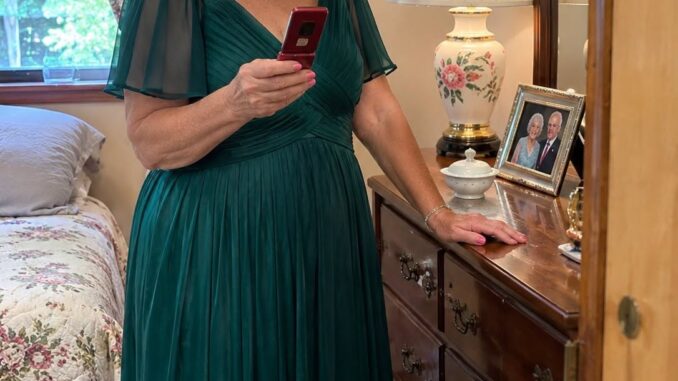
I was sitting at my kitchen table in Richmond, Virginia, wearing a navy-blue dress and the pearl earrings my late husband, Thomas, had given me for our fiftieth wedding anniversary.
My coat was ready. My handbag sat beside me.
I had been invited to dinner at my son Benjamin’s home, where he and his wife were celebrating their newly renovated dining room.
Then my phone lit up.
Mom, plans have changed.
Before I could finish typing a reply, another message appeared.
You weren’t invited. My wife doesn’t want you there.
I stared at the screen.
Dinner was scheduled for seven o’clock. It was already after six.
I had spent the afternoon getting ready, looking forward to seeing my family.
And now, without a telephone call or explanation, I was being told to stay home.
What made the situation especially difficult was that I had spent the previous year providing substantial financial support to Benjamin and his household.
When I eventually reviewed my records, the total came to $93,600.
Yet that evening, I wasn’t thinking about money.
I was thinking about how much I had wanted to sit at the table with my family.
The House That Had Grown Quiet
My name is Eleanor Kelley.
Thomas and I bought our brick house in Richmond’s Fan District thirty-nine years earlier.
It has black shutters, a magnolia tree in the front yard, and a porch swing Thomas installed during our first summer there.
We raised our three children in that house.
Wesley, our oldest, became a pharmacist in Charlottesville. Serena, our daughter, became a high school principal in Norfolk. Benjamin, our youngest, eventually started a landscaping business.
Thomas passed away four years ago.
Since then, the house has felt different.
I still keep busy. I attend church, volunteer at the Library of Virginia, and visit friends.
But evenings can be lonely.
Sometimes I turn on the television simply because I miss hearing another person’s voice.
An invitation from one of my children means a great deal to me.
It means there is something to look forward to and another opportunity to share ordinary moments with people I love.
That was why I had been so pleased when Benjamin called earlier that week.
“We finally finished the dining room, Mom,” he told me. “Come Saturday at seven. You can see everything.”
I had looked forward to it all week.
How Helping Became a Habit
Benjamin had always been the child I worried about most.
Wesley and Serena were independent from an early age.
Benjamin needed more encouragement.
He struggled in school, got into childhood scrapes, and had a particularly difficult time adjusting to summer camp.
Even after he became an adult, I sometimes found myself remembering the little boy who had stood crying on the steps of his camp cabin.
Thomas used to remind me that Benjamin was capable of managing his own responsibilities.
I knew that in theory.
But when Benjamin called about a financial problem, my first instinct was to help.
Sometimes it was a mortgage payment.
Other times, it was a household repair, an insurance bill, or an expense related to my granddaughter June’s education.
Benjamin’s landscaping business also required money from time to time.
I told myself each contribution was temporary.
The business would improve.
The next month would be easier.
But there always seemed to be another expense.
The Promises That Made Me Feel Included
Benjamin and his wife, Genevieve, bought a townhouse in Short Pump eleven years earlier.
Thomas and I had contributed $40,000 toward the down payment.
Later, I helped with renovations.
There was a new kitchen, hardwood flooring, and a screened porch.
Benjamin often reassured me that I would always be welcome.
He once showed me their guest bedroom and said it was available whenever I wanted to visit.
I imagined spending Christmas there, hearing June’s footsteps in the hallway, and sharing breakfast with everyone.
I believed the family home was a place where I belonged.
That was part of why the canceled invitation hurt so much.
I had never expected to be thanked for every contribution.
But I had assumed that our relationship was built on something deeper than financial assistance.
Sitting alone that Saturday evening, I began to wonder whether I had confused being needed with being included.
Remembering Thomas’s Advice
After reading Benjamin’s message, I walked into the living room.
Thomas’s photograph stood on the mantel.
It showed him sitting in our old blue Buick at Virginia Beach, smiling into the sunlight.
I picked it up.
“You would have known what to say,” I whispered.
Then I remembered a conversation we had shared several years earlier.
Benjamin had called asking for help with June’s preschool tuition.
After the call, I reached for my checkbook.
Thomas gently placed his hand over mine.
“Eleanor,” he said, “helping someone get back on their feet is one thing. Taking responsibility for everything indefinitely is another.”
I hadn’t appreciated the advice.
I thought he was being too strict with our youngest son.
But Thomas wasn’t suggesting that we stop loving Benjamin.
He was concerned that our financial support had become an expectation rather than occasional assistance.
Now, years later, I began to understand what he meant.
The Folder in My Desk
In the corner of the living room stood an old walnut desk that had belonged to my mother.
Inside the bottom drawer was a thick folder labeled BENJAMIN.
I had kept financial records for years.
There were old tuition receipts, car insurance payments, records of help with his first apartment, and documentation of the townhouse down payment.
More recent papers included school expenses, household bills, and transfers related to his business.
At the front was a summary I had prepared for my accountant.
It covered the previous twelve months.
The total was $93,600.
I read the figure twice.
That was an average of $7,800 a month.
Some payments were substantial, including home repairs and business expenses.
Others were smaller recurring charges that had gradually accumulated.
Looking at everything together was unsettling.
I had always considered myself careful with money.
Yet I had allowed so many expenses to become part of my routine that I no longer stopped to evaluate them individually.
A Message From My Granddaughter
While I was reviewing the folder, my phone chimed.
It was June.
She was six years old and loved butterflies, picture books, and baking cookies with me.
Her message was simple.
Grandma, are you coming?
I looked toward the kitchen counter.
Earlier that afternoon, I had decorated a small bag of butterfly-shaped cookies for her.
I had tied the bag with a ribbon.
I wanted to explain why I wasn’t coming.
But June was too young to be placed in the middle of an adult disagreement.
So I replied:
Not tonight, sweetheart. I love you very much.
She sent back three pink hearts.
I put down my phone and cried.
I wasn’t angry with my granddaughter.
I was sad that a family gathering I had anticipated all week had become something painful.
Then I wiped my eyes and made a decision.
Taking Responsibility for My Finances
My first instinct was to call Wesley or Serena.
Both had expressed concern about how much I was helping Benjamin.
But I wasn’t ready for another conversation about what I should have done differently.
Instead, I contacted my bank.
I explained that I wanted to review the recurring payments and transfers connected to Benjamin’s household.
The representative explained that certain scheduled transfers could be canceled through the available account controls, while other payments might require additional authorization or direct contact with the billing companies.
I understood.
I wasn’t reporting that every payment was unauthorized.
Most had been approved by me.
I simply wanted to reconsider which expenses I would continue covering.
The representative helped me arrange a meeting with my personal banker for the next business day.
Then I sent Benjamin a message.
I love you, but I need to stop paying your household expenses. We need to talk about a different arrangement.
I turned off my phone.
For the first time in a long while, I had made a financial decision based on my own needs.
Reviewing the Accounts
On Monday morning, I met with Clara Washington, my longtime banker.
Clara had known Thomas and me for more than twenty years.
She had helped us manage accounts through retirement, Thomas’s passing, and the changes that followed.
I brought the folder.
Together, we reviewed the records carefully.
There were mortgage-related transfers, utility payments, insurance charges, school expenses, subscriptions, and business costs.
Some were regular monthly payments.
Others were scheduled transfers or one-time transactions.
The combined list contained 174 payment entries and arrangements requiring review.
I hadn’t realized how complicated everything had become.
Clara explained that canceling a bank transfer was not necessarily the same as ending a contractual obligation.
We identified the payments I could discontinue, those requiring notice, and those that needed further investigation.
I signed the necessary instructions and kept copies.
Then Clara pointed out something unfamiliar.
An Account I Didn’t Recognize
Among the transactions was a recurring $2,400 payment to a business called GKA Design LLC.
The payments had started in February.
I had no memory of approving them.
Clara reviewed the available account information.
The transfer appeared to have been established through online banking credentials associated with Benjamin’s household.
But the records did not establish who had personally initiated it.
I told Clara I wanted to dispute the transactions and determine whether they had been properly authorized.
She explained the bank’s review process and helped me document my concerns.
I also planned to seek independent legal advice.
I had no intention of making accusations without understanding the facts.
Still, the discovery worried me.
For years, I had trusted Benjamin to tell me when he needed help.
Now I was finding financial activity I couldn’t explain.
A Different Kind of Sunday Afternoon
The day before my bank appointment, I had done something small but meaningful.
I took a porcelain teacup from the china cabinet.
It was white with painted violets and a gold rim.
Thomas had bought it for our fortieth anniversary.
I usually saved it for visitors.
That afternoon, I made Earl Grey tea and used it myself.
I sat on the sofa, looked at Thomas’s photograph, and allowed myself a quiet moment.
I had spent so much time thinking about what everyone else needed that I sometimes forgot to enjoy the things already in my home.
The teacup reminded me that my own comfort mattered too.
I didn’t need to wait for a special occasion to use something beautiful.
And I didn’t need anyone’s invitation to feel at home in my own house.
An Unexpected Visit
After I began changing the payment arrangements, Benjamin called repeatedly.
Genevieve called too.
I wanted to speak with them, but I needed time to collect my thoughts.
Later, they arrived at my house.
Their white SUV pulled into the driveway.
Benjamin stepped out first, holding his phone.
Genevieve followed.
Then a third person emerged from the back seat.
It was Genevieve’s mother, Patricia Ashford.
Patricia was seventy-four and lived in Charleston, South Carolina.
I had met her only a few times during Benjamin and Genevieve’s marriage.
She had never visited my home.
Seeing her on the driveway was a surprise.
I opened the front door.
“Mom,” Benjamin said, “we’ve been getting notices about the payments. What’s going on?”
“I’ve decided I can’t keep covering your household expenses,” I replied.
Genevieve looked concerned.
She suggested that I might be making a rushed decision because of the stress I had experienced since Thomas’s passing.
I told her I had considered the matter carefully.
Then Patricia spoke.
And I realized that she had been given a very different understanding of our family’s situation.
Two Different Stories
Patricia said she had been told that Benjamin and Genevieve were supporting me financially.
She believed I had moved into an assisted living facility.
According to what she had heard, I was struggling with memory problems and required expensive care.
I was stunned.
I had never lived in assisted living.
I had not received the diagnosis Patricia described.
I was still managing my household, driving, volunteering, and handling my own affairs.
I invited Patricia inside for tea.
Benjamin and Genevieve followed us into the living room.
I took down the second violet teacup.
Then I retrieved the folder from my desk.
I explained that the documents showed financial support flowing from my accounts to Benjamin’s household, not the other way around.
Patricia read the summary.
$93,600 over twelve months.
She looked up at me in confusion.
“Then I don’t understand,” she said. “I’ve been sending money to help pay for your care.”
A Discovery Neither Mother Expected
Patricia explained that she had been transferring $4,000 a month to Genevieve since February.
She believed the money was helping cover my supposed care expenses.
Nine months of payments totaled $36,000.
I had known nothing about them.
Benjamin appeared equally surprised.
He asked Genevieve to explain.
For a long moment, she said nothing.
Then she admitted that she had misrepresented my circumstances to her mother.
She had been worried about the family’s finances and had asked Patricia for assistance under a false explanation.
Patricia was deeply hurt.
I was too.
The situation was more complicated than a simple disagreement about a dinner invitation.
There were now questions about money, honesty, and whether someone had used my personal information without permission.
The Business Account
I mentioned the unfamiliar transfers to GKA Design LLC.
The initials matched Genevieve’s name.
She acknowledged that the business belonged to her.
She also admitted that the recurring transfers had been arranged without my informed consent.
Benjamin said he hadn’t known about them.
I explained that the bank was reviewing the transactions and that I intended to seek professional advice about recovering the funds.
The total transferred over nine months was $21,600.
Patricia was also considering how to address the money she had sent for expenses that did not exist.
I wanted the financial matters handled properly, with records and clear agreements.
I wasn’t interested in an argument that would leave everyone more confused.
But I was no longer willing to overlook what had happened.
Why I Had Been Excluded
As we discussed the situation, I began to understand why I had been removed from the dinner invitation.
Patricia had attended the gathering.
Genevieve had told her that I was living in a care facility and was unable to visit.
If I had arrived, Patricia would have discovered that the explanation was untrue.
I asked Benjamin what he had known.
He admitted that Genevieve had told him Patricia didn’t feel comfortable around me.
Rather than ask questions or speak with me directly, he had sent the message telling me not to come.
He had believed he was avoiding an awkward family disagreement.
Instead, he had hurt me.
“I should have called you,” he said quietly.
I agreed.
The hardest part wasn’t that he had listened to his wife.
It was that he had made a decision about me without including me in the conversation.
Understanding Genevieve’s Fear
As the conversation continued, Genevieve began to explain the pressure she had felt.
When she was twelve, her father’s law firm had experienced serious financial problems.
Her family lost their home in Charleston and moved into a smaller apartment.
Patricia had been embarrassed by the change.
She tried to keep their difficulties private and continued presenting their lives as though nothing had changed.
Genevieve said she grew up believing that financial hardship was something to hide.
As an adult, she felt compelled to maintain an appearance of success.
The townhouse, the country club, the expensive car, and the renovations had become part of that image.
When Benjamin’s business struggled, she became increasingly frightened of admitting the truth.
I could understand how those experiences might have influenced her.
But understanding the circumstances did not make the dishonesty acceptable.
Genevieve still needed to take responsibility for her choices.
A Difficult Conversation Between Mother and Daughter
Patricia listened as Genevieve described her childhood memories.
She acknowledged that she had placed too much importance on appearances.
She remembered telling friends that the family was redecorating when they had actually moved because of financial problems.
At the time, she thought she was protecting her children from embarrassment.
Now she saw that Genevieve had interpreted those choices as lessons about hiding difficulties at any cost.
Patricia apologized for the example she had set.
Genevieve apologized for deceiving her.
Their conversation was painful.
But it was also the first time they had spoken openly about those years.
I listened quietly.
I had my own mistakes to acknowledge.
For years, I had provided financial help without asking enough questions or establishing clear limits.
We had all avoided difficult conversations in different ways.
My Son’s Apology
Benjamin came over and sat beside my chair.
“I’m sorry, Mom,” he said.
He admitted that he had known I was contributing a great deal to his household.
He had simply avoided calculating the full amount.
Every month, he told himself the business would improve.
He expected that eventually he would be able to repay me.
But he never developed a realistic plan.
He also acknowledged that sending the dinner message had been unkind.
I told him how much I had been looking forward to the evening.
I described the navy dress, Thomas’s pearls, and the cookies I had made for June.
Benjamin lowered his eyes.
“I didn’t think about any of that,” he said.
That was what hurt.
Not only the cancellation, but the lack of consideration.
Still, I could see that he was beginning to understand.
The Boundaries I Needed
I told Benjamin and Genevieve that my decision about their household expenses was final.
I would no longer pay their mortgage, utility bills, memberships, or business costs.
They would need to create a budget based on their own income.
If that meant selling their townhouse or changing their lifestyle, those were decisions they would have to make.
I also explained that the disputed business transfers needed to be addressed through the bank’s investigation and appropriate professional guidance.
Patricia would decide separately how to handle the money she had sent.
I wasn’t going to negotiate those issues informally at my kitchen table.
But I wanted them to know something important.
I still loved them.
Setting boundaries did not mean ending our relationship.
It meant changing a pattern that had become unhealthy for everyone.
Making a Separate Plan for June
Then we discussed my granddaughter.
June had no responsibility for the adults’ financial decisions.
I wanted her education and sense of stability to be considered separately.
I told Benjamin that I was willing to explore paying certain school expenses directly, provided I could afford them and they fit my long-term financial plan.
I also wanted to discuss a 529 education savings plan with my financial adviser.
That would allow me to set aside money for June’s future under an arrangement I could manage.
I made it clear that any assistance would be a deliberate gift, not an open-ended commitment.
Benjamin agreed.
For the first time in years, we were talking about financial help with actual limits.
Tea on the Porch Swing
After Benjamin and Genevieve left, Patricia stayed.
We made another pot of Earl Grey and sat on the porch swing Thomas had built.
The October air was cool.
We wrapped blankets around our shoulders and watched the afternoon light move across the magnolia tree.
Patricia apologized for believing what she had been told without speaking to me.
She explained that she had felt guilty about not reaching out after Thomas died.
When Genevieve described my supposed need for care, Patricia saw an opportunity to help.
She had sent money partly because she wanted to make up for years of distance between us.
I appreciated her honesty.
Then she told me more about the difficult period her family had experienced in Charleston.
We talked about pride, financial worries, and the pressure to appear as though everything is fine.
By the time the afternoon ended, we knew each other better than we had in fourteen years.
Reconnecting With My Other Children
That evening, I called Wesley and Serena.
I told them what had happened.
Both were concerned.
They had known I was providing financial assistance, but they hadn’t understood how extensive it had become.
Wesley asked whether I was all right.
I told him I felt relieved.
Serena admitted that she had been frustrated because she worried about my retirement savings.
Then she apologized for sometimes speaking too sharply about Benjamin.
We agreed that concern and criticism were not always the same thing.
Serena asked whether she could visit the following weekend.
I said yes.
I wanted to spend time with my family without every conversation revolving around money.
And I wanted my children to know that I was capable of making my own decisions.
A Year of Practical Changes
The following months were difficult for Benjamin and Genevieve.
Without my regular financial support, they had to reconsider their expenses.
They ended the country club membership.
They sold one of their expensive vehicles and bought a more affordable used car.
Benjamin reviewed his landscaping company’s finances and realized the business had been operating at a loss for some time.
In December, he decided to close it.
He later accepted a job as a grounds supervisor with the City of Richmond’s Parks Department.
The salary was lower than he had hoped to earn through his business.
But the income was predictable, and the position included benefits.
He seemed more relaxed once he no longer had to worry about finding enough work to keep the company operating.
A Smaller Home and a Different Routine
In February, Benjamin and Genevieve sold the townhouse in Short Pump.
They moved into a rented duplex in Richmond’s Museum District.
It was smaller and older.
There was no landscaped courtyard or elegant shared lounge.
But the house had a backyard with a dogwood tree.
Benjamin planted a vegetable garden in the spring.
He hadn’t gardened seriously since he was a boy helping Thomas.
One afternoon, he sent me a photograph of the first tomatoes.
I smiled when I saw it.
He seemed proud of something he had grown with his own hands.
Their lifestyle was simpler.
But they were learning to manage it themselves.
Addressing the Financial Dispute
The disputed transfers required careful review.
With professional assistance, we documented the payments and worked toward a written repayment arrangement.
Genevieve accepted responsibility for the $21,600 transferred to GKA Design LLC.
She found employment doing interior design for a furniture showroom on Broad Street.
Over the following months, she made scheduled repayments.
Patricia separately reviewed the money she had sent based on the false explanation about my care.
The family worked through those obligations with written records rather than informal promises.
The process took time.
It wasn’t resolved by a single apology.
But it helped establish accountability.
And it gave us a clearer foundation for rebuilding trust.
Genevieve’s Visit
In April, Genevieve came to see me alone.
She stood on my porch wearing jeans and a gray sweater.
In her hands was a small potted gardenia.
“May I come in?” she asked.
I invited her into the living room.
She sat on the sofa while I took Thomas’s old chair.
Genevieve explained that she had started counseling several months earlier.
She was trying to understand why she had been so afraid of admitting financial difficulties.
She had also been thinking about the ways she treated other people.
She apologized for the misleading statements about my health, the financial transfers, and the canceled invitation.
Then she mentioned something I had almost forgotten.
The Birthday Party
Years earlier, at June’s fifth birthday party, Genevieve had introduced me to another parent as someone who “liked to help out with things.”
I had been holding a tray of sandwiches I had prepared that morning.
I had also paid for much of the celebration.
At the time, the introduction made me feel as though my role in the family was being reduced to the things I provided.
I hadn’t said anything.
Now Genevieve brought it up herself.
“I remember that day,” she said. “I know I made you feel unappreciated.”
I was surprised she remembered.
She told me that she was trying to become more thoughtful about how she spoke to people.
Especially June.
She didn’t want her daughter to grow up believing that appearances mattered more than honesty.
An Invitation to Begin Again
Genevieve told me she didn’t expect immediate forgiveness.
She understood that rebuilding trust would take time.
I appreciated that.
I wasn’t ready to pretend the previous year hadn’t happened.
But I could see that she was making an effort.
We talked for a while.
Then I looked at the gardenia resting on the coffee table.
“Would you like a cup of tea?” I asked.
She smiled through her tears.
“Yes,” she said. “I would.”
I went to the china cabinet and took down one of my violet teacups.
We sat together that afternoon without trying to solve every problem.
Sometimes a relationship begins to improve through small, consistent changes.
That was enough for one day.
A Dinner of My Own
One year after the canceled invitation, I decided to host a family dinner.
I didn’t renovate the dining room.
I didn’t buy new curtains.
The wallpaper was the same cream pattern with tiny blue cornflowers that Thomas and I had hung decades earlier.
Our mahogany dining table still stood in the center of the room.
I invited Wesley and his wife.
Serena came with her husband and their two teenage sons.
Patricia traveled from Charleston.
Clara, my longtime banker and friend, joined us with her husband.
And Benjamin and Genevieve came with June.
I prepared the table myself.
I used my mother’s china, my grandmother’s silver, and linen napkins I had carefully ironed.
At every place setting, I placed a handwritten name card.
Wearing Thomas’s Pearls Again
At seven o’clock, I put on my navy-blue dress.
It was the same dress I had worn the previous October.
Then I opened the velvet jewelry box and put on Thomas’s pearls.
This time, I wasn’t waiting for someone else’s invitation.
I was welcoming people into my home.
The house filled with conversation.
Wesley carved the roast.
Serena’s boys discussed football.
Patricia and Clara discovered they had attended the same summer camp in North Carolina many years earlier.
Benjamin helped serve drinks.
Genevieve joined me in the kitchen and asked what I needed.
I handed her a whisk.
She stirred the gravy while I took the rolls from the oven.
It was an ordinary family evening.
And that was exactly what made it special.
June’s Question
When dinner was ready, June hurried into the dining room wearing a purple dress decorated with butterflies.
She studied the name cards.
Then she found hers.
I had placed her seat beside mine.
She climbed onto the chair and looked at my earrings.
“Grandma, those are Grandpa’s pearls.”
“Yes, sweetheart,” I said.
She smiled.
Then she looked around the table.
“Grandma, you didn’t come to our dinner last year.”
The conversation became quiet.
“No,” I said gently. “I didn’t.”
“Why not?”
I considered how to answer without placing blame on anyone.
“Because there was a disagreement, and the plans changed,” I said. “But we’ve been working on making things better.”
June thought about that.
“Is that why everybody came here tonight?”
“Partly,” I said. “And because I love having everyone together.”
She seemed satisfied.
Then she asked for a dinner roll without the crust.
Everyone laughed.
What I Learned About Family
After the guests left, I sat alone at the dining table.
The dishes had been washed.
The leftover pecan pie was wrapped and stored.
The house was quiet again.
But the quiet felt different.
On the table was one of my violet teacups.
June had insisted on using it for her apple juice.
I smiled at the thought.
Then I looked toward Thomas’s photograph, which I had placed nearby.
For years, I had believed that helping my family meant saying yes whenever they asked.
I had been afraid that refusing would make me less loving.
Now I understood that generosity works best when it is freely chosen and sustainable.
I could care about Benjamin without paying every bill.
I could support June’s future without giving up control of my savings.
I could rebuild a relationship with Genevieve while still expecting honesty and accountability.
And I could enjoy my own life without waiting for someone else to make room for me.
Final Thoughts
That year changed our family.
It wasn’t an easy transformation.
There were difficult conversations, financial adjustments, apologies, and responsibilities that took months to address.
Not everything returned to the way it had been.
In some ways, that was a good thing.
We were learning to build relationships based on honesty rather than obligation.
I still love my children as much as I ever did.
But I no longer measure that love by how much money I give them.
And I no longer save my favorite things only for special occasions.
I wear Thomas’s pearls to church, to the library, and sometimes even to the grocery store.
I drink tea from the violet cups whenever I feel like it.
Because I’ve learned something important at seventy-seven:
You can be generous without neglecting yourself. You can love your family while maintaining boundaries. And you don’t need anyone else’s permission to recognize your own worth.
Sometimes the most meaningful invitation is the one you extend to yourself—to live with dignity, independence, and peace.
Leave a Reply