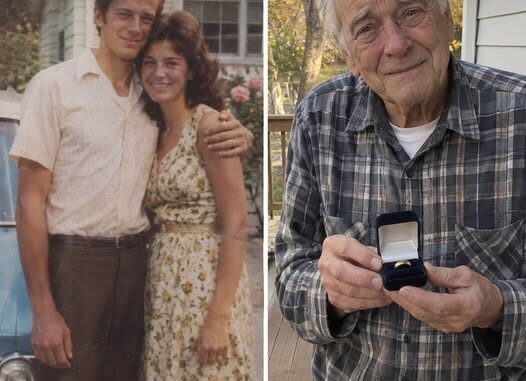
An original fictional story about enduring love, unexpected reunions, family connections, and finding meaning after decades of unanswered questions.
For more than sixty years, Isobel Carver believed that the young man she had once planned to marry had never returned from military service.
She had been nineteen when she learned that Benjamin Hale was missing in action. Later, she was told he was presumed dead.
Although her life continued, she never forgot him.
Every year on his birthday, she bought twelve red carnations and visited the willow tree where they had spent their final evening together.
Then, at eighty years old, Isobel received an unexpected visit from a stranger who looked remarkably familiar.
He carried a small blue box containing a silver ring, an old photograph, and a message written decades earlier.
The discovery would lead Isobel to a truth she had never imagined.
An Unexpected Meeting at a Coffee Shop
On a quiet June morning, Isobel sat beside the window of a neighborhood coffee shop called the Marigold.
A bouquet of red carnations rested on the table beside her untouched coffee.
Her niece, Wren, had invited her to meet for breakfast.
But before Wren arrived, an unfamiliar man approached Isobel’s table.
He appeared to be in his sixties and wore a blue windbreaker.
In his hands was a small cardboard box.
“Are you Isobel Carver?” he asked.
She nodded.
The man sat down carefully.
“My name is Edward,” he said. “I have something that belongs to you.”
He placed the box between them.
Isobel studied his face.
His blue eyes, crooked smile, and distinctive chin reminded her of someone she had loved many years earlier.
For a moment, she struggled to speak.
“Who are you?” she finally asked.
Edward looked down at the box.
“My father asked me to find you.”
A Silver Ring From the Past
Isobel slowly lifted the lid.
Inside, wrapped in yellowed tissue paper, was a thin silver ring.
She recognized it immediately.
More than six decades earlier, Benjamin had bought the ring from a small pawn shop near his uncle’s garage.
It had cost eleven dollars, with another two dollars for the engraving.
On the flat surface were two sets of initials.
B.H. and I.C.
Benjamin Hale and Isobel Carver.
Beneath the ring was a faded photograph.
It showed Isobel and Benjamin standing beneath a willow tree.
She was wearing a yellow dress, and Benjamin had his arms around her waist.
On the back, in his familiar handwriting, were seven words:
Isobel, I will come home to you.
Isobel held the photograph for several moments.
Then she looked at Edward.
“Where did you get this?”
He took a breath.
“Benjamin Hale is my father.”
The News She Had Never Expected
Isobel stared at him.
“That’s impossible,” she replied. “Benjamin died during the war.”
Edward spoke gently.
“He was reported missing in action. Later, he was presumed dead. But he survived.”
Isobel shook her head.
She remembered the day Benjamin’s mother had visited her home with the military notification.
She remembered the second message that arrived months later.
For sixty-two years, she had accepted that Benjamin would never return.
Edward opened a folder.
Inside were copies of military records and documents from a veterans’ hospital.
He explained that Benjamin had sustained a severe head injury during his service.
The injury affected his memory, leaving him unable to identify himself or remember much of his earlier life.
His identity was eventually established, and his military records were corrected in 1971.
But by then, his mother had died, and her former home had changed owners.
The corrected information never reached Isobel.
She looked at the papers.
For the first time in decades, she realized that the story she had believed about Benjamin was incomplete.
A Love That Began in High School
Isobel and Benjamin had met as teenagers at Roosevelt High School.
Their first conversation happened when Isobel dropped a chemistry textbook in the hallway.
Benjamin accidentally stepped on it.
He picked it up, examined the dusty cover, and joked that the book had suffered a terrible fate.
Isobel laughed.
That small moment became the beginning of their friendship.
Benjamin worked afternoons at his uncle’s garage.
He wasn’t particularly interested in schoolwork, but he was curious, funny, and thoughtful.
Isobel loved that he listened carefully whenever she spoke.
He remembered small details about her day and always found ways to make her smile.
Before long, they were spending nearly every afternoon together.
Their favorite place was an old willow tree at the edge of Miller’s field.
The branches hung low enough to create a quiet space beneath them.
There, they talked about school, family, and their hopes for the future.
The Dreams They Shared
Like many young couples, Isobel and Benjamin imagined what their adult lives might look like.
They talked about owning a house with a large porch.
They imagined raising children and having a dog.
Benjamin insisted that the dog should be named Rooster.
Isobel never understood why.
“That’s a strange name for a dog,” she told him.
Benjamin only laughed.
“It’s a good name.”
They also talked about traveling and building a life together.
Neither had much money.
But their plans felt possible because they believed they would have time.
During their final year of high school, Benjamin bought Isobel the silver ring.
He explained that it wasn’t an engagement ring.
It was simply a promise that he hoped they would have a future together.
Isobel accepted it gladly.
To her, the meaning mattered more than the price.
The Day Benjamin Left
Shortly before his eighteenth birthday, Benjamin received orders to report for military service.
He was scheduled to leave on June 17.
The day before, he took Isobel to a neighborhood store.
He wanted to buy her flowers.
The only flowers available were red carnations.
He purchased one and placed it behind her ear.
That evening, they went to their willow tree.
Isobel wore a yellow dress because Benjamin had once told her it made her look like sunshine.
They stayed beneath the branches for hours.
They spoke about their future and tried to reassure each other.
Benjamin admitted that he was afraid.
Isobel told him that courage didn’t mean never feeling frightened.
It meant continuing forward even when things were difficult.
Before they left, Benjamin promised he would come home.
He placed their photograph and the silver ring in his pocket.
The following morning, his uncle drove him to the bus station.
Isobel watched the truck disappear down the street.
She didn’t know it would be the last time she would see Benjamin for more than sixty years.
The Letters That Kept Them Connected
During his service, Benjamin wrote eleven letters to Isobel.
Some were short.
Others contained stories about the weather, his fellow servicemen, and ordinary moments from daily life.
He rarely described the difficulties he was experiencing.
Instead, he tried to reassure her.
At the end of each letter, he wrote a familiar message.
Still coming home. — B.
Isobel saved every letter.
She read them repeatedly and waited for the next one.
Then the letters stopped arriving.
Eleven months after Benjamin left, his mother appeared at Isobel’s door.
She carried a notification stating that Benjamin was missing in action.
Months later, another notification indicated that he was presumed dead.
Isobel was nineteen.
Her plans for the future changed completely.
Building a Meaningful Life
Although Isobel never married, she did not spend her life isolated from others.
She worked, maintained friendships, and remained involved in her community.
For twenty years, she taught Sunday school.
She also helped operate a food pantry that provided groceries and household essentials to local families.
When her sister experienced a difficult separation, Isobel helped care for her nieces.
Wren, in particular, became an important part of her life.
As a teenager, Wren spent two years living with Isobel.
They developed a close relationship that continued into adulthood.
Isobel also began volunteering at a children’s hospital in 1984.
Every Thursday afternoon, she read stories to young patients.
She continued this work for decades.
The experience brought her friendships, purpose, and a sense of connection to the community.
Although she still remembered Benjamin, she had built a full life of her own.
The Tradition of Red Carnations
Every June 16, Benjamin’s birthday, Isobel returned to the willow tree.
Miller’s field had eventually become a public park.
The city added walking paths, benches, and a playground.
But the old willow remained.
Isobel continued visiting it each year.
She brought twelve red carnations and spent time remembering the young man who had once shared his dreams with her.
Sometimes she spoke aloud about important events that had happened since his departure.
She told him about changes in technology, family celebrations, and the people she had met.
The visits became a personal tradition.
They gave her a quiet opportunity to remember an important chapter of her life.
She never imagined that Benjamin might still be alive.
How Edward Found Isobel
Back at the coffee shop, Edward explained how he had discovered the blue box.
His father had kept it in a locked drawer for many years.
Edward had assumed it contained old documents.
But after Benjamin moved into a residential care facility, Edward began organizing his belongings.
He found the box.
Inside were the ring, photograph, and an old high school yearbook page.
The yearbook included Isobel’s name.
Edward began researching the information.
Eventually, he discovered a newspaper article about Isobel’s volunteer work at the children’s hospital.
He contacted the hospital and was directed to Wren.
At first, Wren was cautious.
She asked Edward to provide documentation and took steps to verify his account.
Only after she was satisfied did she help arrange the meeting.
Isobel understood her niece’s concern, even though she wished she had been told sooner.
Why Benjamin Had Never Contacted Her
Edward explained that his father had lived with significant memory difficulties following his injury.
For many years, Benjamin remembered little about his childhood or the people he had known before the war.
He eventually married a woman named Dorothy.
She had worked in the rehabilitation hospital where he received treatment.
Over time, they built a life together.
They raised a family, and Benjamin worked in insurance for many years.
Dorothy died five years before Edward met Isobel.
More recently, Benjamin had developed dementia, which further affected his memory and daily functioning.
Edward had arranged residential care when his father’s needs became greater than he could safely manage at home.
While sorting through his belongings, Edward showed him the blue box.
Benjamin appeared unusually emotional.
During a brief period of clarity, he mentioned a name.
“Belle must have the box,” he said.
Belle was the nickname Benjamin had given Isobel when they were teenagers.
Edward realized that the items might hold an important connection to his father’s past.
He decided to investigate.
Learning About Benjamin’s Second Chapter
During their conversation, Isobel asked whether Benjamin had been happy.
Edward told her about Dorothy.
She had supported Benjamin during his rehabilitation and remained beside him throughout their marriage.
They had shared fifty-one years together.
Isobel listened carefully.
At first, the news was difficult to absorb.
She had spent decades imagining a future that never happened.
Now she was learning that Benjamin had experienced a different life, one filled with relationships and memories she had never known.
But she did not resent Dorothy.
Instead, she felt grateful that Benjamin had found companionship and support.
“She sounds like a wonderful woman,” Isobel said.
Edward nodded.
“She was.”
Isobel smiled gently.
“I’m glad he had someone who loved him.”
The Decision to Visit Benjamin
Edward explained that Benjamin was living in a care facility approximately two hours away.
His health had declined, and his memory was unpredictable.
He might not recognize Isobel.
He might not remember their relationship.
Edward wanted her to understand that before making a decision.
Wren suggested that Isobel take time to consider everything.
But Isobel knew what she wanted.
She had spent more than sixty years believing she would never see Benjamin again.
Now she had an opportunity.
“I’d like to visit him,” she said.
Edward agreed to arrange the meeting.
That afternoon, they traveled to the care facility.
Isobel carried the blue box on her lap.
During the drive, she asked Edward questions about his father.
She learned about his work, his marriage, and his family.
By the time they arrived, she understood that the man she was about to meet would be very different from the teenager she remembered.
Still, she wanted to see him.
Their First Reunion After Six Decades
Benjamin was sitting beside a window when Isobel entered his room.
A bird feeder hung outside.
He was watching a bright red cardinal.
His hair had turned white.
His face was lined with age.
He sat in a wheelchair with a blanket across his knees.
But Isobel recognized his eyes immediately.
Edward approached him.
“Dad, someone has come to visit.”
Benjamin turned toward Isobel.
He smiled politely.
“Hello,” he said.
She introduced herself.
“My name is Isobel.”
He repeated her name.
But there was no sign that he remembered her.
Isobel sat beside him and opened the blue box.
She showed him the ring.
Benjamin studied it carefully.
“That’s pretty,” he said.
She mentioned the willow tree and the yellow dress.
He appeared uncertain.
When he became uncomfortable, a staff member gently suggested ending the visit.
Isobel agreed.
The reunion had not unfolded as she had imagined.
But she was grateful to have seen him.
Choosing to Return
Outside Benjamin’s room, Edward apologized.
He had hoped his father might recognize Isobel.
She reassured him that he had nothing to apologize for.
Benjamin’s memory difficulties were not anyone’s fault.
After a moment, she asked whether she could visit again.
Edward was surprised.
“Are you sure?”
Isobel nodded.
“I’d like to get to know him as he is now.”
Two days later, she returned.
Then she visited again the following week.
Gradually, her visits became part of her routine.
She stopped asking Benjamin to remember specific events.
Instead, she brought books and read aloud.
Sometimes he listened.
Sometimes he watched the birds outside.
Occasionally, he fell asleep.
Isobel didn’t mind.
She had spent decades reading to children at the hospital.
Now she was happy to share stories with Benjamin.
A New Friendship With Edward
As Isobel continued visiting, she also became closer to Edward.
They began meeting for coffee after her visits.
He told her about his daughter, Nora, who lived in Denver and worked at an animal shelter.
He shared stories about his mother, Dorothy, and his childhood.
Isobel told him about Benjamin’s teenage years.
She described his work at the garage, his sense of humor, and the unusual ideas he used to have.
Edward was fascinated.
He had known his father as a husband, parent, and insurance salesman.
Now he was learning about the young man Benjamin had been before the war.
Their conversations helped connect two different chapters of his life.
Over time, Isobel and Edward developed a friendship of their own.
They shared memories, laughed together, and supported one another through a difficult period.
An Unexpected Moment Beneath the Willow
Several months later, Edward arranged a special outing.
With guidance and approval from Benjamin’s care team, he organized a visit to the old willow tree.
Transportation and assistance were arranged to ensure Benjamin could participate comfortably.
It was a cool November afternoon.
The willow’s leaves had turned golden.
Edward helped Benjamin settle near the tree.
Isobel sat beside him.
She took a red carnation from her coat pocket and placed it gently in his hand.
Benjamin examined the flower.
Isobel spoke softly.
“We used to sit here together.”
He looked around.
She mentioned their last evening beneath the tree.
Then she reminded him of the yellow dress.
For a moment, Benjamin appeared thoughtful.
He looked directly at her.
“Belle?” he asked.
Isobel’s eyes filled with tears.
“Yes,” she whispered.
Benjamin smiled.
“You wore yellow.”
She laughed softly.
“I did.”
For a few minutes, they spoke about small memories from their youth.
Then Benjamin’s attention shifted, and the moment passed.
Isobel understood that his ability to recall the past might change from one moment to another.
But she treasured the conversation.
Finding Comfort in the Present
After the visit to the willow tree, Isobel continued spending time with Benjamin.
She no longer focused on recovering every lost memory.
Instead, she appreciated the moments they could share.
They read books.
They watched birds.
They enjoyed occasional visits from Edward and Wren.
At Christmas, the family brought a small decorated tree to Benjamin’s room.
Isobel gave him a stuffed toy dog.
When she asked what he wanted to name it, Benjamin considered the question.
“Rooster,” he replied.
Isobel laughed.
It was the same unusual name he had suggested when they were teenagers.
Edward smiled as she explained the story.
For everyone in the room, it became a cheerful holiday memory.
A Conversation About the Life Isobel Had Lived
During one winter visit, Benjamin asked Isobel whether she had been lonely.
She considered the question.
“Sometimes,” she replied.
Then she told him about her life.
She described the children she had read to at the hospital.
She spoke about the food pantry, her nieces, and the friendships she had developed.
She explained that although she had never married, she had found many ways to share her time and care with others.
Benjamin listened quietly.
Isobel wasn’t sure how much he understood.
But he reached for her hand.
She smiled.
For her, the moment was meaningful without needing to be explained.
Saying Goodbye
As winter continued, Benjamin’s health declined.
His care team kept Edward informed about his condition.
One morning in March, Edward called Isobel and told her that his father appeared to be nearing the end of his life.
Wren drove Isobel to the care facility.
When they arrived, Benjamin was resting in bed.
Edward sat beside him.
Isobel took a seat on the other side.
A red carnation stood in a small glass near the window.
The stuffed dog, Rooster, rested nearby.
Isobel opened a familiar book and began reading.
After a while, Edward continued.
Then Wren took a turn.
They remained together, offering companionship and comfort.
Near sunrise, Benjamin briefly opened his eyes.
He looked toward Edward and then toward Isobel.
She held his hand.
“You’re home,” she told him softly.
Benjamin smiled.
He died peacefully with his loved ones nearby.
A Funeral That Brought Two Families Together
Isobel attended Benjamin’s funeral several days later.
She initially planned to sit near the back of the church.
She knew that many people had shared important parts of Benjamin’s life.
There were relatives, neighbors, former colleagues, and friends from his community.
But Edward approached her before the service.
“Please sit with us,” he said.
Isobel joined him and Wren near the front.
During the service, people shared stories about Benjamin’s kindness and generosity.
One neighbor remembered how he had repaired lawn equipment without accepting payment.
Others spoke about his years of community involvement.
Edward also honored his mother, Dorothy, for the life she had shared with Benjamin.
Then he acknowledged Isobel.
He explained that she had been part of his father’s early life and that their unexpected reunion had brought meaningful connections to the family.
Isobel was deeply touched.
She had come to remember Benjamin.
She had not expected to be welcomed so warmly.
A Gift Beneath the Willow Tree
Several weeks later, Edward visited Isobel and Wren.
They met beneath the willow tree.
Edward brought the small blue box.
Inside were the silver ring and the original photograph.
But there was also something new.
It was a photograph taken during Benjamin’s November visit to the park.
The picture showed Isobel sitting beside him beneath the golden branches.
They were smiling at each other.
Wren had taken the photograph quietly from a distance.
Isobel studied it for a long time.
Then she placed the silver ring on a chain and wore it around her neck.
She also brought red carnations.
This time, she shared them with Edward and Wren.
Together, they placed the flowers beneath the tree.
The tradition that had once belonged to Isobel alone had become something they could share.
The Family She Never Expected
In the months that followed, Isobel remained close to Edward.
They spoke regularly by telephone.
He visited when he could.
His daughter, Nora, also became part of Isobel’s life.
During one visit, Nora sat beside Isobel on her porch swing.
She asked about Benjamin and the years Isobel had spent remembering him.
Then she asked a thoughtful question.
“Do you regret waiting so long?”
Isobel smiled.
“I didn’t spend my whole life waiting,” she replied. “I lived my life. I just never stopped remembering someone I loved.”
Nora considered her answer.
Then she rested her head on Isobel’s shoulder.
They sat together, watching the evening settle over the neighborhood.
For Isobel, the moment represented something she had never expected.
Her connection to Benjamin had brought new people into her life.
Returning to the Willow Together
The following June, Isobel returned to the willow tree on Benjamin’s birthday.
But she wasn’t alone.
Edward came.
Wren joined them.
Nora traveled from Denver.
Even Marisol, a staff member from Benjamin’s care facility, attended with her children.
Isobel brought twelve red carnations.
She handed them out so everyone could participate.
Together, they placed the flowers beneath the tree.
Then they sat on the grass and shared cherry pie.
Isobel told stories about Benjamin’s teenage years.
Edward shared memories from his childhood.
Nora asked questions.
The younger children listened.
For the first time in more than sixty years, Isobel’s birthday tradition had become a family gathering.
She looked around at the people sitting beneath the willow.
She felt grateful.
What Isobel Learned About Love and Memory
Isobel’s experience taught her that life rarely unfolds exactly as people expect.
When she was young, she imagined marrying Benjamin and building a home with him.
Instead, they followed separate paths shaped by circumstances neither had anticipated.
Benjamin found a loving marriage and raised a family.
Isobel developed a meaningful life through work, friendship, volunteering, and caring for others.
Their reunion did not erase the years they had spent apart.
It did not restore every memory Benjamin had lost.
But it gave them an opportunity to reconnect in the time they still had.
It also created relationships between people who might otherwise never have met.
Isobel came to appreciate that love and memory can remain meaningful even when life takes an unexpected direction.
Final Thoughts
For sixty-two years, Isobel Carver believed that Benjamin Hale had never returned from military service.
Then an unexpected meeting with his son revealed that Benjamin had survived and built a different life.
Their reunion was complicated by memory loss and the passage of time.
But Isobel chose to appreciate the moments they could still share.
She visited him, read to him, and eventually became close to his family.
After his passing, those relationships continued.
The willow tree that had once represented a private memory became a gathering place for people connected by Benjamin’s life.
Isobel’s story is a reminder that meaningful relationships can take many forms, and that a life can be full of love even when it follows a different path from the one originally imagined.
She had spent decades remembering a young man beneath a willow tree.
In the end, she discovered that the memories she carried could also become the beginning of new friendships and family connections.
Leave a Reply