An original fictional family story about personal boundaries, misplaced generosity, and the importance of respecting other people’s decisions.
When my husband and I brought our newborn daughter home from the hospital, we expected to find the quiet, familiar house we had purchased just weeks earlier.
Instead, we discovered that someone had completely changed its appearance.
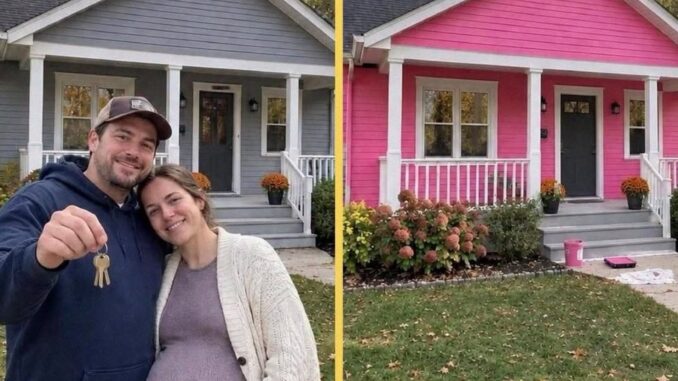
Our soft-gray exterior walls were now bright pink.
The white front door was pink.
Even the mailbox had been painted to match.
Standing proudly on our porch were my mother-in-law, Diane, and my sister-in-law, Brooke.
“Surprise!” Diane announced.
She looked delighted.
My husband, Ryan, looked stunned.
And I was too exhausted from childbirth and a difficult week in the hospital to know what to say.
What initially seemed like an unwanted home makeover soon became a much bigger family disagreement.
We discovered that the paint had been purchased using money relatives had collected to help us care for our newborn daughter.
And that wasn’t the only decision Diane had made without our knowledge.
Our First Family Home
My name is Rosalie, and I was thirty years old when Ryan and I bought our first house.
It was a modest, single-story property with gray siding, a white front door, and a small front garden.
We had spent four years saving for the down payment.
For most of our marriage, we had lived in rented apartments.
We couldn’t make many changes to those spaces, and we dreamed of having a home that was truly ours.
When we finally received the keys, I stood in the empty living room and cried.
Ryan hugged me.
“We finally did it,” he said.
I looked around at the bare walls and sunlight coming through the windows.
“This is where our daughter will grow up,” I told him.
I was due to give birth in approximately a month.
Everything seemed to be falling into place.
My Mother-in-Law Had Other Ideas
Ryan’s mother, Diane, had always been outspoken about her preferences.
She had strong opinions about decorating, clothing, and how other people should organize their homes.
Sometimes her suggestions were useful.
Other times, they felt more like instructions.
At our housewarming gathering, Diane stood outside studying the exterior.
“Gray?” she asked. “Don’t you think that’s a little dull?”
Brooke, Ryan’s younger sister, laughed.
“You should paint it pink. That would make it more cheerful.”
I smiled politely.
“We actually love the gray,” I said.
Ryan agreed.
“We bought it because we liked how it looked.”
Diane shook her head.
“Well, perhaps you’ll change your minds once you’ve lived here for a while.”
I didn’t argue.
I assumed the conversation was over.
I was wrong.
A Pattern of Unwanted Advice
Diane had criticized my decorating choices before.
When Ryan and I lived in our previous apartment, she disliked the curtains I had chosen.
She said they made the living room appear smaller.
I told her I liked them.
Brooke initially agreed with her mother, then admitted that the curtains were attractive.
It was a small incident, but it reflected a familiar pattern.
Diane offered an opinion.
If someone disagreed, she continued pressing the issue.
Ryan often tried to keep the peace by changing the subject.
After one visit, I asked him why he rarely spoke up.
“That’s just how Mom is,” he said.
“I understand,” I replied. “But I’d appreciate it if you supported me when she dismisses my decisions.”
He acknowledged my feelings.
Still, the pattern continued.
I hoped things would improve once we settled into our new home.
An Unexpected Hospital Stay
Four weeks later, I went into labor.
Our daughter, Alice, was born after a difficult delivery.
Both of us needed additional medical care and monitoring, so our hospital stay lasted seven days.
By the fifth day, I was physically exhausted.
I wanted to rest, recover, and focus on caring for my baby.
Diane and Brooke visited us at the hospital.
Diane offered to take care of things at home.
“We’ll collect your mail, water the plants, and make sure everything is ready when you return,” she said.
We had already given her a spare key for emergencies.
I appreciated the offer.
“Could you help arrange a few meals?” I asked. “I don’t think I’ll have much energy for cooking when we get home.”
“Of course,” she replied. “I’ll make sure you’re taken care of.”
I felt relieved.
At the time, I had no reason to believe she was planning something entirely different.
A Family Fund for Baby Alice
That afternoon, my brother Jake called.
Jake owned a hardware store and had helped Ryan and me with small repairs before we moved in.
He told me that several relatives wanted to contribute money to help us during the first weeks after Alice’s birth.
The fund was intended for prepared meals, baby supplies, and household assistance.
“Everyone wants to make things a little easier for you,” Jake explained.
I thanked him.
Then he mentioned that Diane had offered to organize the purchases.
I was surprised.
But Jake was busy with work, and Diane had already volunteered to help at the house.
It seemed reasonable.
“Please tell everyone how grateful we are,” I said.
Jake promised he would.
I returned my attention to Alice.
I didn’t know that Diane had already started making plans for our home.
The Surprise Waiting in Our Driveway
A few days later, Ryan drove Alice and me home.
I was looking forward to sleeping in my own bed.
I wanted a quiet afternoon, a simple meal, and time to settle into our new routine.
As we approached the house, I noticed something strange.
The front door looked different.
Then I saw the walls.
“Ryan,” I said, “is that our house?”
He slowed the car.
Our gray home had been painted bright pink.
The color covered the exterior walls, the front door, and the mailbox.
Diane and Brooke were waiting on the porch.
They smiled as we pulled into the driveway.
“Surprise!” Diane called.
Brooke raised her phone to record our reaction.
Ryan got out of the car.
“Mom, did you paint the whole house?”
Diane nodded proudly.
“Doesn’t it look wonderful?”
A Surprise We Had Never Requested
Ryan stared at the walls.
“We told you we liked the gray.”
Diane waved away his concern.
“I know, but I thought this would brighten everything up.”
I carefully lifted Alice from her car seat.
My body was still sore, and I was eager to get inside.
Brooke continued holding up her phone.
“Could you please stop recording?” I asked.
She lowered it.
Diane looked disappointed.
“We worked so hard on this. I thought you’d be happy.”
I didn’t have the energy for an argument.
“I need to get Alice inside,” I said.
Diane and Brooke left shortly afterward.
Ryan carried our bags into the house.
Once the door closed, he turned to me.
“Are we really going to leave it like this?”
“No,” I said. “But I don’t want to deal with it tonight.”
Then I called Jake.
My Brother’s Unexpected Reaction
“Our house is pink,” I told him.
Jake laughed.
“Very funny.”
“I’m serious.”
I sent him a photograph.
A moment later, he called back.
“Wait. She painted the exterior?”
“Every wall. Even the mailbox.”
Jake sounded confused.
He explained that Diane had purchased exterior paint from his store.
She had told him that Ryan and I wanted to update the house.
According to Diane, the project was supposed to be a surprise.
Jake had questioned the amount of paint she requested.
But she assured him that Ryan had approved the work.
I looked at my husband.
“Did you tell your mother she could repaint the house?”
“Absolutely not,” he said.
Jake became quiet.
“Then she gave me the wrong information.”
I asked how much the paint had cost.
He checked his records.
“$1,364.”
That was when I remembered the family fund.
Where the Baby Fund Went
I asked Jake whether Diane had paid for the paint herself.
He checked the purchase details and the family contributions.
Then he called me back.
Relatives had donated a total of $1,920.
Diane had used $1,364 of that money to purchase paint and supplies.
The remaining balance was $556.
I was stunned.
The fund had been created to help us care for Alice and manage our household while I recovered.
Nobody had asked us whether we wanted the money spent on decorating.
I walked into the kitchen.
There were no prepared meals in the refrigerator.
No containers in the freezer.
Only a few groceries we had purchased before going to the hospital.
I felt increasingly upset.
Diane had changed our home without permission.
And she had used money given for an entirely different purpose.
Asking for an Explanation
I sent Diane a message.
Did you use the money our relatives collected for Alice to paint the house?
She replied shortly afterward.
We used it to do something nice for your family. You should be happy with the result.
I showed Ryan.
Then I asked Diane about the meals she had promised.
She replied that we could arrange food ourselves.
I put down my phone.
Ryan shook his head.
“This isn’t okay.”
For once, we agreed completely.
But I wanted to understand what had happened before deciding what to do next.
I called Jake again and asked him to send me the messages from the family group.
What the Relatives Had Been Told
Jake forwarded screenshots of the conversation.
Diane had told our relatives that I wanted a cheerful exterior makeover.
She claimed that Ryan had approved the color.
She also asked everyone not to contact us directly because we were exhausted.
Several family members had offered to prepare meals.
Diane had declined those offers on our behalf.
One aunt had already cooked several dishes.
Diane told her to keep them in her freezer because we didn’t need them.
Another relative had offered to help clean the house.
That offer had also been turned down.
I read the messages twice.
The issue was no longer simply about paint.
Diane had presented her own preferences as our decisions.
She had also prevented relatives from checking with us directly.
A Conversation With Ryan
Ryan sat beside me on the sofa while Alice slept in her bassinet.
“I should have been firmer with Mom before this,” he admitted.
I appreciated hearing him say it.
For years, I had felt that he minimized his mother’s behavior because he wanted to avoid conflict.
Now he understood why I was upset.
We discussed what needed to happen.
The family should know how its contributions had been spent.
We needed an accurate record of the expenses.
We also wanted our house restored to the color we had chosen.
And Diane’s spare key needed to be returned.
Those seemed like reasonable first steps.
But I was still angry.
Angrier than I wanted to admit.
An Idea I Almost Regretted Immediately
While speaking with Jake, I asked whether he had dark-gray exterior paint available.
He sounded suspicious.
“Why?”
I asked how much paint would be needed to cover the front of Diane’s house.
There was a long silence.
“Rosalie, don’t do that.”
I told him I wanted Diane to understand how it felt when someone changed her property without permission.
Ryan overheard the conversation.
“Painting her house won’t fix ours,” he said.
He was right.
But I was exhausted, hurt, and frustrated.
I felt that Diane had repeatedly ignored our choices.
Now she had done it during one of the most vulnerable periods of my life.
For a few moments, I seriously considered responding in the same way.
I wanted her to experience the inconvenience she had caused us.
But wanting someone to understand a mistake is different from having the right to repeat it.
Choosing a Better Response
Jake came over that evening.
He brought copies of the purchase records and family messages.
Together, we reviewed what had happened.
I explained that I had considered painting Diane’s house in return.
Jake reminded me that changing someone else’s property without permission could create further legal and financial problems.
Ryan agreed.
I looked at Alice sleeping peacefully nearby.
I didn’t want the first week of her life at home to become a series of escalating arguments.
So I changed my mind.
Instead of repainting Diane’s house, I decided to document the situation and address it directly.
I was still upset.
But I wanted a solution that wouldn’t make the problem worse.
Telling the Family What Happened
I wrote a message to the eleven relatives who had contributed to the fund.
I thanked each of them for their generosity.
Then I explained that Ryan and I had not requested the exterior painting.
I told them that $1,364 had been spent on paint and supplies without our approval.
I also explained that the remaining $556 had not yet been accounted for in the way we expected.
I attached the relevant receipts and messages.
I tried to keep the explanation factual.
I didn’t want to embarrass anyone unnecessarily.
But the contributors deserved to know how their money had been used.
The replies began arriving almost immediately.
Several relatives expressed surprise.
Others offered to help us with meals and household tasks.
One aunt asked whether she could bring over the dishes she had already prepared.
I gratefully accepted.
A Family Meeting
The next morning, Ryan called his mother.
He told her we needed to discuss the situation.
Diane initially insisted that the painting had been a generous surprise.
She believed the house looked better.
Ryan explained that the appearance of the house wasn’t the main issue.
We had chosen the original color.
We owned the property.
And we hadn’t authorized anyone to repaint it.
He also told her that using the baby fund for the project was unacceptable.
Diane became defensive.
She said she had been trying to help.
Ryan replied that help needed to reflect what the recipient actually wanted.
Eventually, she agreed to meet with us and Jake.
The Conversation at Diane’s House
When we arrived, Diane and Brooke were waiting in the living room.
Alice remained safely at home with a trusted relative while Ryan and I attended the meeting.
Jake brought the receipts.
Ryan began by explaining our concerns.
“We appreciate that you wanted to do something for us,” he said. “But we never gave permission for the painting.”
Diane looked toward me.
“I thought Rosalie would like it once she saw it.”
I shook my head.
“I told you I liked the gray. More than once.”
Brooke admitted that she remembered those conversations.
She said she had assumed Diane had obtained permission from Ryan.
Ryan made it clear that she had not.
The room became quiet.
The Missing Money
Jake placed the purchase records on the table.
He explained that the family had collected $1,920.
The paint and supplies cost $1,364.
That left $556.
Ryan asked where the remaining money was.
Diane said she had intended to use it for additional decorative touches.
She hadn’t spent it yet.
I explained that the money belonged to the purpose for which relatives had contributed.
If the family wanted to help with meals and baby supplies, that was how the funds should be used unless the contributors agreed otherwise.
Diane looked uncomfortable.
For the first time, she seemed to recognize that the problem involved more than a disagreement about color.
Brooke’s Admission
Brooke had been quiet for most of the conversation.
Then she spoke.
“Mom told me to wait until they were at the hospital before starting the painting.”
Ryan turned toward her.
“What?”
Brooke explained that Diane had expected us to reject the idea if she asked directly.
She believed it would be easier to complete the project while we were away.
Once the work was finished, Diane assumed we would accept it.
I looked at Ryan.
That was the part that hurt most.
Diane hadn’t simply misunderstood our preferences.
She had known we were likely to say no.
And she had made the decision anyway.
Ryan told his mother that he was disappointed.
He wanted her to understand that being a grandparent did not give her authority over our home.
Establishing Clear Boundaries
We explained what needed to happen next.
First, Diane would return the remaining money from the family fund.
Second, we would obtain professional estimates for restoring the house to its original color.
Third, we wanted a written agreement about how the painting costs would be handled.
Finally, we asked Diane to return our spare key.
She seemed particularly upset about the key.
“Don’t you trust me anymore?” she asked.
Ryan answered calmly.
“We trusted you to help with mail and plants. We didn’t give you permission to make changes to our property.”
Diane handed him the key.
It was an uncomfortable moment.
But it was necessary.
We weren’t trying to punish her.
We were protecting our ability to make decisions about our own home.
Repairing the Damage
Over the next few days, Jake helped us obtain estimates from professional painters.
We wanted the exterior restored properly.
The contractors assessed the existing paint and explained what preparation would be required.
Diane eventually agreed in writing to cover the reasonable cost of restoring the exterior.
She also returned the unused portion of the baby fund.
The family contributors were informed about the final accounting.
Some chose to leave their donations available for our original needs.
Others requested that their contributions be returned.
We respected their decisions.
The remaining assistance went toward meals, baby supplies, and practical support during my recovery.
I was grateful that the situation could be resolved without further escalation.
The Meals We Finally Received
One of Ryan’s aunts arrived that afternoon carrying several containers of food.
She had prepared them days earlier.
There was chicken casserole, vegetable soup, and a tray of baked pasta.
She also brought fresh bread and a small bag of cookies.
“I wanted you to have these when you came home,” she told me.
I thanked her.
That evening, Ryan warmed the casserole while I fed Alice.
For the first time since leaving the hospital, we had the simple dinner I had hoped for.
There was no elaborate surprise.
No decorating project.
Just a meal prepared by someone who cared about us.
It was exactly the kind of help we had needed.
A Conversation Between Husband and Wife
Later that evening, Ryan stood beside Alice’s bassinet.
He asked whether I regretted how we had handled the situation.
I thought about my earlier idea of painting Diane’s house.
“I regret that I even considered doing the same thing to her,” I admitted.
Ryan nodded.
“I understand why you were angry.”
“I was angry enough to make a bad decision,” I said.
He took my hand.
“But you didn’t.”
I was glad we had stopped before turning one mistake into another.
We had chosen to address the problem with documentation, conversation, and clear boundaries.
That didn’t erase what had happened.
But it gave us a way forward.
Learning to Say No
Over the following weeks, Ryan and I talked about how we wanted to manage family relationships.
We agreed that major decisions about our home, our daughter, and our finances belonged to us.
Relatives could offer advice.
They could suggest ideas.
They could volunteer to help.
But an offer was not permission to act.
We also agreed that Ryan would take a more active role in addressing disagreements with his family.
I didn’t want him to argue with his mother over every small difference of opinion.
I simply wanted us to make decisions as a team.
And I wanted our choices to be respected.
Rebuilding Trust With Diane
Diane didn’t immediately understand why we had been so upset.
She continued to say that she had meant well.
Over time, however, she began acknowledging that her intentions did not excuse the way she had acted.
She apologized for using the family fund without consulting us.
She also admitted that repainting the house while we were away had been inappropriate.
We accepted the apology cautiously.
Trust takes time to rebuild.
For a while, visits were arranged in advance.
We didn’t provide another spare key.
When Diane wanted to bring something for Alice, she asked first.
Sometimes we said yes.
Sometimes we declined.
Gradually, our conversations became easier.
What the Experience Taught Us
Looking back, I realized that the pink house was only the most visible part of the disagreement.
The real problem was that Diane had repeatedly treated our preferences as less important than her own.
She believed she was helping.
But she had not listened when we explained what we wanted.
And when relatives contributed money for our newborn daughter, she redirected those funds without checking with us.
The situation reminded me that generosity requires more than good intentions.
It also requires respect.
A gift is meaningful when it considers the recipient’s needs.
Help is useful when it is welcome.
And family relationships work better when everyone understands that love does not eliminate personal boundaries.
Final Thoughts
Our first week at home with Alice was nothing like we had imagined.
We were exhausted, adjusting to life with a newborn, and dealing with an unexpected dispute over our house.
But we learned something important.
We didn’t need to accept an unwanted decision simply because it came from a family member.
We also didn’t need to retaliate to make our feelings understood.
By communicating clearly, keeping accurate records, and setting reasonable boundaries, we were able to address the problem without creating another one.
Eventually, our house was restored to the soft-gray color we had chosen.
The white front door returned.
And our family settled into a calmer routine.
The experience taught us that respecting someone’s wishes is one of the most important ways to show care.
Sometimes the most helpful thing a person can do is simply ask:
What do you actually need?
Leave a Reply