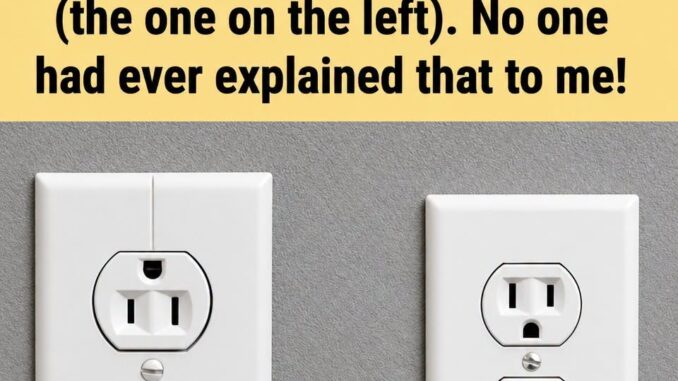
Have you ever noticed an electrical outlet that appears to be installed upside down compared with the others in a room?
In many North American homes, standard three-prong outlets are positioned with the rounded grounding opening at the bottom. However, some receptacles are installed with that opening facing upward.
Although this arrangement may look unusual, it isn’t necessarily an installation mistake.
There are several possible explanations, including electrical design choices, switched outlets, and individual installation preferences.
Understanding these differences can help homeowners recognize how certain electrical features work without making assumptions based on appearance alone.
What Does an Upside-Down Outlet Mean?
A standard three-prong electrical receptacle has two vertical slots and a rounded or U-shaped grounding opening.
When the grounding opening faces downward, many people consider the outlet to be in its usual position.
When the grounding opening faces upward, the receptacle may appear reversed.
However, the orientation itself doesn’t automatically indicate a problem.
In many installations, either position may be acceptable, depending on applicable electrical requirements and the type of receptacle.
The important factors are proper installation, correct wiring, and the condition of the electrical components.
Why Electricians Sometimes Install Outlets Differently
One reason an outlet may be installed in a different orientation is to make it visually distinguishable from other receptacles.
For example, some electricians use an inverted position to identify an outlet controlled by a wall switch.
This practice can be useful in rooms where a switch operates a table lamp or floor lamp rather than a ceiling light.
However, it is not a universal identification system.
An outlet with its grounding opening facing upward may be switched, continuously powered, or installed that way for another reason.
The only way to know how it functions is to verify its operation.
What Is a Switched Electrical Outlet?
A switched outlet is a receptacle that receives power through a wall switch.
Instead of turning a lamp on and off using the lamp’s own controls, a person can operate it from a switch near the doorway.
This arrangement has been used in many residential buildings, particularly in rooms without permanent overhead lighting.
For example, imagine a living room with a floor lamp positioned beside a sofa.
If the lamp is connected to a switched receptacle, the homeowner can turn it on or off using the wall switch.
This provides a convenient lighting option without requiring a ceiling-mounted fixture.
How Split Receptacles Work
Some duplex receptacles have two plug-in positions that operate independently.
In certain configurations, one position is controlled by a wall switch while the other remains continuously powered.
This is commonly described as a split or half-switched receptacle.
For example, a floor lamp could be connected to the switched portion while another device uses the continuously powered portion.
Turning off the wall switch would affect the lamp without interrupting power to the other device.
This arrangement offers flexibility in rooms where both controlled lighting and regular electrical access are needed.
Because split receptacles require specific wiring arrangements, installation or modification should be handled by a qualified electrician.
Does an Upside-Down Outlet Always Indicate a Wall Switch?
No.
Although some electricians use outlet orientation as a visual indicator, the practice is not consistent across every home or building.
An inverted outlet may simply reflect the preference of the person who installed it.
Builders may also follow different installation conventions.
In other cases, an outlet may have been replaced and positioned differently from nearby receptacles.
Regional construction practices and individual project requirements can also influence orientation.
For these reasons, appearance alone cannot confirm whether a receptacle is switched.
Is There a Required Outlet Orientation?
In the United States, the National Electrical Code generally does not establish one universal ground-up or ground-down orientation for ordinary wall-mounted receptacles.
However, particular installations, equipment instructions, local requirements, or other applicable standards may impose additional conditions.
This means homeowners may encounter receptacles installed in different directions.
Some have the grounding opening at the bottom, others at the top, and certain installations use horizontal positioning.
The correct arrangement depends on the circumstances and applicable requirements.
If there is uncertainty about an installation, a licensed electrician can evaluate it.
How to Check Whether an Outlet Is Controlled by a Switch
If an outlet appears to be in good condition, you can make a basic observation using a suitable lamp.
First, plug the lamp into the receptacle and turn it on.
Next, operate the nearby wall switches one at a time.
If the lamp turns on or off with a particular switch, that suggests the receptacle is switch-controlled.
For a duplex receptacle, one plug-in position may behave differently from the other.
You can check each position separately using the same suitable device.
However, this simple observation only helps identify whether a switch controls power. It does not establish that the receptacle is wired correctly or safely.
Never remove the outlet cover, touch internal wiring, or attempt electrical modifications without appropriate training.
If the receptacle is damaged, loose, unusually warm, discolored, or producing an unusual smell, stop using it and seek professional assistance.
Why Switched Outlets Were Useful in Older Homes
Switched receptacles became a practical lighting solution in homes where rooms did not always have ceiling-mounted light fixtures.
Portable lamps could provide the main source of illumination.
Connecting a lamp to a wall-controlled outlet allowed someone to turn on the light when entering a room.
This was particularly convenient in bedrooms and living areas.
As residential lighting developed, built-in ceiling fixtures and other lighting systems became more common.
However, switched outlets remain useful and continue to appear in both older and newer properties.
Why Some Outlets Have One Switched Position
A half-switched receptacle combines two functions in a single location.
One position provides power controlled by a wall switch.
The other provides continuous power.
This arrangement can be convenient when two nearby devices have different electrical needs.
For example, a lamp may only need power when someone is using the room, while another device may need to remain connected.
The configuration allows both functions without requiring separate receptacles.
However, not all duplex receptacles are wired this way.
The presence of two plug-in positions does not automatically mean they operate independently.
What Is the Purpose of the Grounding Opening?
The rounded opening on a standard three-prong receptacle is associated with the equipment grounding connection.
When properly installed, this connection provides a protective path for certain electrical faults involving compatible equipment.
Its purpose is related to electrical safety rather than the operation of a wall switch.
Whether the grounding opening faces upward or downward does not, by itself, confirm that the receptacle is properly grounded.
Grounding and wiring conditions require appropriate testing to verify.
A qualified electrician can assess these connections if there are concerns.
Can Outlet Orientation Affect Safety?
The safety of an electrical receptacle depends on several factors, including its wiring, grounding, condition, installation, and compliance with applicable requirements.
Some installers prefer a ground-up orientation because of the way a grounded plug is positioned when inserted.
Others use a ground-down orientation because it is familiar or consistent with nearby outlets.
Neither orientation should be treated as a guarantee of safety.
A correctly installed receptacle in good condition is more important than whether its grounding opening faces upward or downward.
Homeowners should avoid changing an outlet’s orientation solely for appearance without understanding the electrical work involved.
Why Outlet Positions May Differ Throughout a Home
There are several reasons electrical outlets in the same building may not all face the same direction.
A home may have undergone renovations at different times.
Individual outlets may have been replaced by different electricians.
Some receptacles may be connected to wall switches, while others provide continuous power.
In addition, builders and contractors may have followed different installation preferences.
These variations are not necessarily evidence of faulty wiring.
However, an unusual installation should not be assumed safe simply because it appears to function normally.
When Should You Contact an Electrician?
If an outlet is working properly and shows no signs of damage, its orientation alone is generally not a reason for concern.
However, professional evaluation is advisable if you notice problems such as:
- A loose or damaged receptacle
- Discoloration or signs of overheating
- Frequent circuit breaker trips
- Unusual sounds or odors
- Intermittent power
- Uncertainty about grounding or wiring
Electrical problems should be addressed promptly and by someone qualified to perform the work.
Avoid attempting repairs or wiring changes without the necessary knowledge and safety precautions.
What This Small Detail Tells Us About Home Design
The position of an electrical outlet may seem like a minor feature, but it can reflect decisions made during construction or renovation.
In some homes, an inverted receptacle may indicate a switched lighting arrangement.
In others, it may simply be the result of an installation preference.
These differences illustrate how residential electrical systems have adapted to changing lighting needs and household technology.
Understanding the purpose of switched outlets can also help explain why some older homes have wiring arrangements that differ from what homeowners expect today.
Final Thoughts
An electrical outlet installed with its grounding opening facing upward is not automatically incorrect.
Sometimes, the orientation is used to identify a switched receptacle or a particular wiring arrangement.
In other situations, it reflects the preferences of the electrician, builder, or homeowner.
The most important thing to remember is that outlet orientation alone cannot reveal how a receptacle is wired or whether it is safe.
If you’re curious about an unusual outlet, basic observation may help determine whether it is controlled by a switch.
For questions involving wiring, grounding, repairs, or electrical safety, consult a qualified electrician.
What appears to be a small installation difference may have a practical explanation, but understanding that explanation requires looking beyond appearance.
Leave a Reply