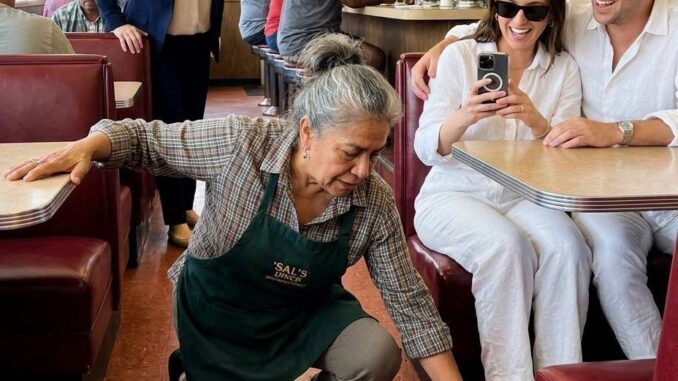
My mother, Rosa, has spent thirty-one years working at the same small-town diner.
She’s sixty-six now, and almost everyone in our community knows her.
She remembers which customers prefer their coffee black, who likes extra butter on their toast, and which regulars always order the same breakfast.
For decades, she’s been part of the familiar rhythm of the Sunny Side Diner.
Every afternoon at exactly two o’clock, she takes a ten-minute break in the booth beside the window.
It’s her favorite place to sit, especially on days when her knees are bothering her.
I always thought that booth was simply where she rested between shifts.
I never imagined that one afternoon, it would become part of a moment that changed her life.
It began with two customers who seemed determined to make an ordinary lunch unnecessarily difficult.
What they didn’t know was that the diner had recently changed ownership.
And I was the person who had bought it.
The Surprise I’d Been Planning for Months
My name is Nina. I’m thirty-eight years old, and I own a small accounting firm about two towns away.
My mother raised me while working long hours at the Sunny Side Diner.
When I was little, I sometimes sat at the counter after school, finishing homework while she worked.
I remember watching her carry plates, refill coffee cups, and greet customers with the same warmth, even after a tiring day.
The diner was more than her workplace.
It was where she had spent much of her adult life.
A few months earlier, Gus, the longtime owner, told me he was considering retirement.
He’d owned the diner for as long as I could remember.
Over coffee one afternoon, he asked whether I’d ever thought about buying it.
At first, I laughed.
Running an accounting firm was already a significant responsibility.
But the more we talked, the more I began considering the possibility.
I knew the business.
I understood its financial history.
Most importantly, I knew how much the place meant to my mother and the community.
After reviewing the numbers and arranging financing, I decided to move forward.
The purchase price was $410,000.
It required my savings and a small-business loan, but I believed the diner had a future worth investing in.
On Monday afternoon, I signed the final paperwork.
The Sunny Side Diner officially belonged to me.
I wanted to tell my mother immediately.
But Gus and I had planned something special.
That Friday would mark her thirty-first anniversary working there.
We decided to surprise her with the news during a small celebration.
I’d even ordered a new sign.
A Tuesday Lunch That Didn’t Go as Expected
The following day, I stopped by the diner for lunch.
I wanted to enjoy a quiet meal, observe the afternoon routine, and think about the changes I hoped to make.
Gus was sitting in his usual corner booth, working on a crossword puzzle.
Every so often, he looked in my direction and smiled.
We were both trying to keep our secret.
My mother was busy serving the lunch crowd.
She moved between tables with her familiar coffee pot, chatting with customers and making sure everyone had what they needed.
At approximately 12:40 p.m., a couple entered the diner.
They were dressed in matching white outfits and wore expensive-looking sunglasses.
They paused near the entrance, looking around before choosing a table in my mother’s section.
I didn’t think much of them at first.
Customers come from all walks of life, and everyone has different preferences.
But their visit soon became difficult.
A Series of Complaints
The man ordered an egg-white omelet with specific preparation instructions.
His companion requested several changes to her meal.
My mother wrote everything down carefully.
When she brought their food, the couple began expressing dissatisfaction.
They questioned the texture of the eggs.
They complained about the toast.
They also seemed irritated by the time it took to process their payment.
Throughout the interaction, my mother remained polite.
She offered to correct anything that wasn’t prepared to their liking.
I watched her handle the situation with the patience she’d developed over more than three decades of customer service.
I knew that not every customer would be easy to please.
But I also knew my mother deserved to be treated respectfully.
Then something happened that made me put down my coffee.
The Fork That Started Everything
The woman had positioned her phone near the edge of the table.
It appeared that she was recording part of their visit.
While my mother was nearby, the woman dropped her fork onto the floor.
She asked my mother to retrieve it.
Mom bent down slowly, using the booth for support.
Her knees had been troubling her for years.
Two years earlier, a doctor had explained that surgery might eventually be necessary for her left knee.
She rarely complained about the discomfort.
But I knew that bending down repeatedly wasn’t easy for her.
She picked up the fork and brought the customer a clean replacement.
A moment later, the man knocked his knife onto the floor.
My mother retrieved that, too.
Then another utensil fell.
After that, a sugar packet ended up beneath the table.
By the fourth time, it was difficult to believe the repeated incidents were accidental.
The woman continued recording.
She made remarks about my mother’s age and the effort required to pick up the dropped items.
I could see my mother trying to remain professional.
But when she stood up for the fourth time, she held the edge of the table longer than usual.
Her expression briefly revealed how uncomfortable she felt.
That was the moment I decided the situation needed to stop.
A Message Left on the Receipt
The couple eventually finished their meal.
When they prepared to leave, I noticed that they hadn’t left a tip.
Instead, they’d written a single word across the receipt:
RETIRE.
I stared at it for a moment.
My mother had spent thirty-one years making customers feel welcome.
She’d worked through busy mornings, holiday shifts, and countless difficult days.
Seeing someone dismiss her experience and dedication with one word was deeply disappointing.
I stood up and approached the table.
I kept my voice calm.
I told the couple that their behavior toward my mother had been inappropriate and that they would not be welcome to return.
The man looked surprised.
He asked who I was and suggested I speak to the manager.
I explained that I was the owner.
As of the previous afternoon, the diner belonged to me.
The Secret Came Out Early
For a moment, the couple seemed unsure what to say.
Then the man questioned whether I was serious.
Gus looked up from his crossword puzzle.
He confirmed that he’d sold the business to me the day before.
Behind me, I heard my mother set down the coffee pot.
When I turned around, she was staring at us.
“Nina?” she asked.
I could tell she was trying to understand what she’d just heard.
I’d imagined revealing the news on Friday, surrounded by familiar faces and a new sign.
Instead, I was standing in the middle of the dining room, explaining that I’d bought the place.
The woman continued recording and questioned my decision to ask them not to return.
I explained that customers were always welcome to raise concerns about their meals.
However, repeatedly dropping items and making disrespectful comments toward an employee was not acceptable.
The couple gathered their belongings and left.
When the door closed, the diner became unusually quiet.
Then Mr. Delgado, one of our longtime regulars, began applauding.
A few other customers joined him.
Within moments, several people were expressing their support.
My mother looked overwhelmed.
She walked toward me and asked why I hadn’t told her about the purchase.
I smiled.
“It was supposed to be your anniversary surprise.”
She shook her head, laughed softly, and hugged me.
I thought the most difficult part of the day was over.
I was wrong.
An Edited Video Appeared Online
That evening, shortly after nine o’clock, my phone began receiving notifications.
The woman from the diner had uploaded a video of our interaction.
But the clip didn’t show everything that had happened.
The repeated dropped utensils weren’t included.
Neither were the remarks directed at my mother.
Instead, the video focused on the moment when I asked the couple to leave.
Its caption suggested that they’d been treated unfairly after requesting clean silverware.
The woman had a sizable online following.
Within hours, the video attracted considerable attention.
People who hadn’t witnessed the incident began leaving negative comments about the diner.
Some posted one-star reviews despite apparently never having visited.
By midnight, our business page had received dozens of unfavorable ratings.
I was concerned.
I’d owned the diner for barely a day.
Now its reputation was being discussed by people who had only seen a short, edited recording.
But I also knew there was more information available.
Finding the Complete Record
Several years earlier, Gus had installed security cameras after a break-in.
The system recorded video and audio in the dining area.
Before doing anything else, I reviewed the footage to understand exactly what had been captured.
It showed the couple’s arrival, their complaints, and the repeated incidents involving the utensils.
It also recorded their comments toward my mother.
Marco, our seventeen-year-old busboy, had witnessed much of the interaction from the kitchen pass-through.
He told me he’d also recorded part of it on his phone because he’d been concerned about the way Rosa was being treated.
I appreciated that he wanted to help.
However, I knew we needed to handle the situation carefully.
I didn’t want to encourage harassment or turn a disagreement into an online argument.
My priority was correcting the misleading impression while protecting my mother’s dignity.
After reviewing the available footage and considering privacy concerns, I prepared a factual response.
Sharing What Happened
The next morning, I posted a statement on the diner’s official page.
I explained that the couple had not been asked to leave because they requested clean utensils.
They’d been asked not to return because of repeated conduct toward an employee.
I also shared the relevant footage documenting the interaction, without including unrelated customers.
My caption was simple:
“This is my mother, Rosa. She has worked at this diner for 31 years. We believe every employee deserves to be treated with respect.”
The response was immediate.
Customers who knew my mother began sharing their own experiences.
Some described how she’d remembered their orders for years.
Others recalled her kindness during difficult times.
Former residents wrote about visiting the diner with their parents or grandparents.
By lunchtime, the post had attracted hundreds of thousands of views.
By the following evening, it had reportedly reached more than two million.
The attention was overwhelming.
But for the first time since the original video appeared, people were hearing a fuller account of what had happened.
The Community Responded
As more people learned about the incident, support for the diner increased.
Our regular customers encouraged others to visit.
People from nearby towns asked about our opening hours.
Some even contacted us from other states and countries to send kind messages to my mother.
Many wrote that they appreciated her years of service.
Others encouraged me to make sure she had opportunities to rest and enjoy life outside work.
The online reviews also began changing.
The earlier wave of negative ratings was followed by many positive comments, although I knew that online attention wasn’t a substitute for genuine customer experiences.
I wanted the diner to be known for its food, service, and welcoming atmosphere.
Not simply for a viral disagreement.
The woman eventually removed her original video.
Later, she posted an apology acknowledging that the situation had been presented without its full context.
I was relieved that the disagreement was beginning to settle.
I had no interest in prolonging it.
My focus was on my mother and the future of the diner.
A Busy Thursday Morning
On Thursday, I arrived at 5:30 a.m. to prepare for opening.
To my surprise, several people were already waiting outside.
Some were familiar regulars.
Others had driven from nearby communities after hearing the story.
One truck driver told me he’d traveled several hours because he wanted to thank my mother for her years of work.
When Rosa arrived, she looked at the small crowd in disbelief.
She wasn’t accustomed to being the center of attention.
For decades, she’d been the person making everyone else comfortable.
Now people wanted to express their appreciation for her.
The diner was busier than I’d ever seen it.
We served breakfast after breakfast.
Coffee pots seemed to empty as soon as they were filled.
By ten o’clock, we’d run out of eggs.
Gus told me he couldn’t remember the last time that had happened.
My mother received generous tips and countless kind words.
At one point, she tried to hand me some of the money to help cover the extra expenses.
I told her it belonged to her.
She’d earned it.
But I also reminded her to take her usual break.
No matter how busy we were, she still needed to rest.
The Anniversary Surprise
Friday finally arrived.
It was my mother’s thirty-first anniversary at the diner.
Despite everything that had happened that week, I was determined to give her the celebration Gus and I had planned.
At two o’clock, I temporarily closed the diner for an hour.
The timing was deliberate.
That was when my mother normally sat in her favorite booth to rest her knees.
This time, I asked her to come outside.
Several regular customers had gathered in the parking lot.
Marco stood beside Gus near the entrance.
Above the door, a large covering concealed the new sign.
My mother looked around, confused but smiling.
Then Gus and Marco pulled the covering away.
The new sign read:
ROSA’S — Since 1994
My mother stared at it.
For several seconds, she didn’t speak.
Then she covered her mouth with one hand.
She’d spent thirty-one years working in that building.
Now the diner carried her name.
I hugged her and told her that nobody had done more to make the place feel like home.
But there was one more surprise.
A Gift That Changed Her Future
I handed my mother an envelope.
Inside were a set of keys and documents I’d arranged with professional assistance.
They outlined the transfer of a 51 percent ownership interest in the diner to her, subject to the necessary formalities.
She read the first page.
Then she looked at me.
“Nina, what is this?”
I explained that I wanted her to have a meaningful role in the business she’d helped build.
She had given decades of her life to the diner.
She knew its customers, its traditions, and the small details that made people return.
I wanted her experience to be recognized.
More importantly, I wanted her to have greater control over how she spent her time.
She wouldn’t need to continue working long shifts simply because that was what she’d always done.
She could decide how involved she wanted to be.
She could train new employees.
She could help shape the menu.
And she could spend more afternoons sitting comfortably by the window.
Mom looked at the documents again.
Then she laughed through her tears.
“But who’s going to pour the coffee?”
“We’ll hire someone,” I told her. “And you can teach them how you like it done.”
Making Changes That Mattered
Over the following weeks, we began making improvements.
We reviewed staffing so employees wouldn’t feel pressured to skip breaks.
We discussed practical ways to reduce unnecessary physical strain during busy shifts.
We also established clearer expectations for customer interactions.
I wanted everyone who worked at Rosa’s to know that respectful service was a shared responsibility.
Customers deserved courtesy and attention.
Employees deserved consideration and dignity.
My mother helped with the changes.
She had thirty-one years of experience, and I valued her perspective.
She knew which parts of the diner worked well and which routines could be improved.
For the first time, she was able to participate in those decisions as an owner rather than only as an employee.
That meant more to her than I could have predicted.
A Different Kind of Retirement
My mother eventually underwent the knee surgery her doctor had discussed with her.
After taking time to recover and following her medical team’s guidance, she returned to the diner on a reduced schedule.
These days, she comes in three days a week.
She doesn’t rush from table to table the way she once did.
Instead, she spends much of her time helping new staff members learn the routines.
She tells them which regulars like extra cream.
She explains why Mr. Delgado prefers the booth near the window on rainy days.
She reminds everyone that a welcoming greeting can make a customer’s morning better.
And at two o’clock, she still sits in her favorite booth.
Only now, she can stay there as long as she wants.
Sometimes she drinks coffee.
Sometimes she reads.
Sometimes she simply watches the activity around her and smiles.
The Receipt We Decided to Keep
We kept the receipt from that Tuesday afternoon.
The one with the single word written across it.
RETIRE.
At first, I considered throwing it away.
It reminded me of an unpleasant moment.
But my mother asked me to keep it.
She said it represented how much had changed.
We eventually placed it in a small frame behind the register, beneath a photograph of her standing outside the diner on anniversary day.
Visitors sometimes ask about it.
When they do, my mother usually smiles.
She doesn’t tell the story with bitterness.
She talks about the surprise.
The new sign.
The ownership documents.
And the people who showed up to support her.
She says the receipt reminds her that an uncomfortable experience can sometimes lead to an unexpected turning point.
What My Mother Taught Me
I used to think that buying the diner would be the greatest gift I could give my mother.
I imagined surprising her with the news and watching her realize that the place she’d loved for decades would remain part of our family.
But the experience taught me something more important.
Owning a business isn’t only about managing finances or making decisions.
It’s also about the people who keep it running.
My mother spent thirty-one years welcoming customers, remembering their preferences, and helping the diner feel like part of the community.
Her work deserved recognition long before I purchased the building.
I couldn’t change every difficult shift she’d experienced.
But I could help create a different future.
One where her contributions were valued.
One where she had more freedom to make decisions.
And one where she could continue doing what she loved without feeling obligated to work beyond her comfort.
A New Chapter at Rosa’s
The diner still serves the same familiar breakfasts.
The coffee is still hot.
Mr. Delgado still comes in regularly.
Gus occasionally stops by with a crossword puzzle.
Marco has become one of our most dependable team members.
And my mother is still the person everyone asks about.
The difference is that she no longer has to carry the entire weight of a busy dining room on her shoulders.
She has more time to enjoy the community she helped create.
She has a say in the business’s future.
And she knows how much her years of dedication have meant to the people around her.
That Tuesday afternoon began with a difficult customer interaction.
It ended up revealing a secret I’d been keeping and setting several unexpected events in motion.
But when I look back, I don’t think the most important moment was when I announced that I owned the diner.
It was the moment my mother stood beneath the new sign and realized that her years of hard work had not gone unnoticed.
After thirty-one years of taking care of everyone else, Rosa finally had the opportunity to enjoy a new chapter on her own terms.
And every afternoon at two o’clock, when I see her relaxing in that familiar booth by the window, I’m reminded that success isn’t only about what we build.
Sometimes, it’s about making sure the people who helped build it get to enjoy it, too.
Leave a Reply