
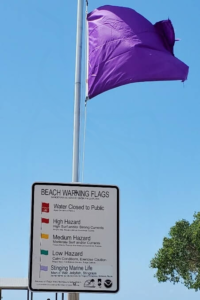
When you arrive at a beach, you may notice colorful flags displayed near lifeguard stations or along the shoreline. These flags serve an important purpose: they help visitors understand potential hazards before entering the water.
Most people are familiar with red, yellow, and green beach flags. However, the meaning of a purple flag is not always as widely understood.
At many beaches, a purple flag indicates the presence of potentially hazardous marine life. This can include jellyfish, stingrays, Portuguese man o’ war, and other sea creatures that may cause injuries or irritation.
The flag doesn’t necessarily mean the beach is closed or swimming is prohibited. Instead, it alerts visitors to conditions that require additional caution.
Because flag systems vary by location, it’s important to check the official guidance displayed at the beach and follow lifeguard instructions.
Understanding these warnings can help you make informed decisions and enjoy your time by the water more safely.
What Does the Purple Beach Flag Indicate?
In commonly used beach warning systems, purple flags alert visitors to potentially dangerous marine animals in or near designated swimming areas.
These animals may include:
- Jellyfish
- Portuguese man o’ war
- Stingrays
- Marine organisms associated with seabather’s eruption, sometimes called sea lice
- Other potentially harmful marine creatures
Some animals have stinging cells, while others may cause injuries through defensive spines or other natural mechanisms.
The purpose of the warning is not to suggest that every marine animal is dangerous.
Rather, it informs beachgoers that certain species have been observed or that conditions may increase the likelihood of encountering them.
A purple flag can also appear alongside another warning flag.
For example, a beach might display a yellow flag for moderate surf conditions and a purple flag for marine-life concerns.
Both warnings should be considered before entering the water.
Why Do Lifeguards Raise Purple Flags?
Marine conditions can change throughout the day.
Ocean currents, tides, wind patterns, water temperatures, and seasonal changes influence where marine animals are found.
Jellyfish may drift closer to shore after changes in currents.
Stingrays may gather in shallow coastal waters.
Other marine organisms can become more common during certain seasons.
Lifeguards monitor local conditions and communicate important information through warning signs, announcements, and flags.
When potentially hazardous marine life is reported, a purple flag may be raised to notify visitors.
This allows swimmers to take precautions before entering the ocean.
1. Jellyfish Near Swimming Areas
Jellyfish are among the marine animals commonly associated with purple beach warnings.
These creatures move through the water using gentle contractions, but many also drift with ocean currents.
Some species have specialized cells that can deliver stings when their tentacles come into contact with skin.
Depending on the species, symptoms may include:
- Localized pain or burning
- Redness
- Itching
- Skin irritation
- Swelling
Most encounters with relatively mild-stinging species cause temporary discomfort, but some species can cause serious medical problems.
The risk varies significantly by region.
If jellyfish are present, follow the guidance of local lifeguards.
Avoid touching them in the water or on the sand.
Even a jellyfish that appears inactive may still have functioning stinging cells.
2. Portuguese Man O’ War
The Portuguese man o’ war is another marine organism that may prompt a purple flag.
It is often mistaken for a jellyfish because of its floating appearance and long tentacles.
However, it is actually a colonial organism composed of specialized individual units working together.
Its tentacles contain stinging cells that can cause significant pain.
The floating portion may appear blue, purple, or pinkish.
Some specimens wash ashore after changes in wind or currents.
Visitors should never touch a Portuguese man o’ war, even when it appears stranded or no longer alive.
Its tentacles may remain capable of stinging.
If you notice one near a swimming area, notify a lifeguard and keep a safe distance.
3. Stingrays in Shallow Water
Stingrays are common in certain coastal environments.
They often rest on sandy seabeds, sometimes partially buried beneath the surface.
Most stingrays do not seek contact with humans.
However, if accidentally stepped on or threatened, a stingray may use its defensive tail spine.
This can cause a painful injury that requires medical attention.
At beaches where stingrays are frequently encountered, lifeguards may provide specific instructions for entering shallow water.
Some coastal authorities recommend gently shuffling your feet along the sandy bottom rather than taking large steps, which may help alert nearby stingrays.
However, local recommendations should always take priority.
Never attempt to touch, chase, or handle a stingray.
4. Small Marine Organisms That Cause Skin Irritation
Some beach warnings involve organisms that are difficult to see.
The term sea lice is sometimes used informally to describe the tiny larvae of certain marine animals associated with an irritating skin condition called seabather’s eruption.
These organisms can become trapped beneath swimwear and cause itching or a rash.
The condition is different from an ordinary jellyfish sting.
Symptoms may develop after swimming and can vary depending on the organism and individual sensitivity.
If local authorities report these organisms, ask whether swimming is recommended.
Following local guidance and changing out of wet swimwear after swimming may help reduce prolonged contact with irritating material.
Seek medical advice if symptoms are severe, persistent, or accompanied by other concerning reactions.
Can You Swim When a Purple Flag Is Flying?
A purple flag does not always mean that swimming is prohibited.
At many beaches, it serves as a marine-life warning rather than an automatic closure.
However, the appropriate decision depends on the local situation.
For example, a beach with occasional jellyfish sightings may remain open with additional precautions.
Another location experiencing a significant marine-life hazard may restrict access to the water.
Before swimming, ask a lifeguard what prompted the warning.
Check whether other flags are displayed.
Pay attention to any announcements or posted restrictions.
If beach authorities advise visitors to stay out of the water, follow those instructions.
Never assume that a purple flag has exactly the same meaning at every beach.
Understanding Other Common Beach Flag Colors
Beach warning systems differ between countries and local authorities, but several colors are widely used.
Green flag: Lower hazard
A green flag commonly indicates relatively favorable water conditions.
Surf and currents may be less hazardous than under higher warning levels.
However, a green flag does not mean the ocean is completely risk-free.
Conditions can change, and swimmers should remain aware of their surroundings.
Yellow flag: Moderate hazard
A yellow flag often signals moderate surf, currents, or other water hazards.
Swimming may be permitted, but additional caution is recommended.
Children and inexperienced swimmers should be particularly careful.
Red flag: High hazard
A red flag generally warns of dangerous water conditions.
Strong currents, large waves, or other hazards may make swimming unsafe.
Depending on local rules, entering the water may be prohibited or strongly discouraged.
Double red flags: Water closed
In some widely used beach warning systems, two red flags indicate that the water is closed to public swimming.
Visitors should remain out of the water and follow local instructions.
Purple flag: Potentially hazardous marine life
A purple flag commonly indicates that marine animals capable of causing injuries or irritation may be present.
It can be displayed alongside other flags to communicate multiple hazards.
Important: Always consult the posted flag legend at your beach, since colors and restrictions can differ by location.
What Should You Do When You See a Purple Flag?
A purple flag is a reason to be attentive, not necessarily a reason to abandon your beach plans.
A few practical precautions can help.
Ask the lifeguard about current conditions
Lifeguards can often explain which marine animals have been reported and whether swimming is advisable.
They may also identify areas where the risk is higher.
Avoid touching unfamiliar marine life
Never handle jellyfish, stingrays, or other sea creatures you cannot identify.
Some animals can cause injuries even when they appear harmless or have washed ashore.
Supervise children carefully
Children may be curious about unusual creatures found in the sand or shallow water.
Explain that they should observe marine animals from a distance and notify an adult if they find something unfamiliar.
Pay attention to the shoreline
Look for stranded jellyfish, tentacles, or other potentially hazardous organisms before walking barefoot near the water.
Follow all displayed warnings
A purple flag may be accompanied by red, yellow, or other warning signs.
Each provides different information.
Consider the full set of warnings before deciding whether to swim.
What Should You Do After a Jellyfish Sting?
Jellyfish stings vary considerably in severity.
Some cause mild, temporary irritation.
Others can produce intense pain or more serious symptoms.
The appropriate first aid depends on the species involved, so it’s important not to assume that every sting should be treated in the same way.
If someone is stung:
- Leave the water safely and alert a lifeguard.
- Avoid rubbing or scratching the affected skin.
- Do not handle attached tentacles with bare hands.
- Follow species-specific first-aid guidance from local lifeguards or medical professionals.
- Seek medical evaluation for severe or persistent symptoms.
Call emergency services immediately if the person experiences breathing difficulties, chest pain, fainting, collapse, or signs of a severe allergic reaction.
Avoid relying on unverified home remedies. Treatments that may be appropriate for one species can be unsuitable for another.
Local medical guidance is particularly important in regions where dangerous jellyfish species occur.
Does a Purple Flag Mean Sharks Are Nearby?
Not necessarily.
In many beach flag systems, purple warnings are primarily associated with marine hazards such as jellyfish, stingrays, and Portuguese man o’ war.
Shark sightings may be communicated through separate signs, announcements, or beach closures.
However, warning procedures vary by region.
A purple flag should not be treated as a universal shark alert, nor should its absence be interpreted as a guarantee that sharks are not present.
Always follow the instructions of local beach authorities.
Can You Still Walk Along the Beach?
In many locations, visitors can continue walking, relaxing, or enjoying activities on the sand while a purple flag is displayed.
The warning is often focused on hazards in or near the water.
However, some marine organisms may wash ashore.
Jellyfish and Portuguese man o’ war can retain the ability to sting after becoming stranded.
For that reason, visitors should watch where they step and avoid touching unfamiliar organisms.
Parents should also remind children not to collect marine animals they find along the shoreline.
If local authorities have restricted access to part of the beach, respect those boundaries.
Why Beach Warning Flags Matter
Beach conditions can change quickly.
A calm-looking ocean may contain strong currents, unexpected waves, or marine animals that are difficult to spot.
Warning flags provide a simple visual system for communicating these risks.
They are particularly useful for travelers who are unfamiliar with local conditions.
Families with children, inexperienced swimmers, and people visiting a new coastline can benefit from checking the flags before entering the water.
Even experienced swimmers should pay attention to warnings.
Knowledge of one beach does not necessarily apply to another.
The safest approach is to combine flag information with current lifeguard advice and your own swimming abilities.
Frequently Asked Questions
1. What does a purple flag mean at the beach?
At many beaches, a purple flag warns of potentially hazardous marine life, such as jellyfish, stingrays, or Portuguese man o’ war.
2. Does a purple flag mean swimming is banned?
Not always. It often indicates a caution rather than a complete swimming prohibition. Check local rules and lifeguard instructions.
3. What marine animals can cause a purple flag warning?
Depending on the region, warnings may involve jellyfish, Portuguese man o’ war, stingrays, or other organisms capable of causing injuries or irritation.
4. Can a purple flag and a red flag appear together?
Yes. Some beaches display multiple flags to communicate different hazards, such as dangerous water conditions and potentially harmful marine life.
5. Does a purple flag mean sharks are present?
Not generally. Shark warnings are often communicated through separate local procedures. Ask lifeguards for clarification.
6. Should I leave the beach when I see a purple flag?
Not necessarily. In many cases, visitors can remain on the sand while taking precautions. Follow any local restrictions.
7. Can jellyfish sting after washing ashore?
Yes. Some jellyfish and related marine organisms can still sting after becoming stranded. Avoid touching them.
8. Are all jellyfish dangerous?
No. The severity of jellyfish stings varies widely by species. Some cause mild irritation, while others can produce serious reactions.
9. Is a green flag a guarantee that swimming is safe?
No. Green generally indicates lower hazard conditions, but natural water environments always require caution.
10. Who should I ask about beach flag meanings?
Local lifeguards, posted beach safety signs, and official beach authority information are the best sources for current warnings.
Final Thoughts
A purple flag at the beach is an important signal that visitors should recognize.
In many commonly used warning systems, it indicates the possible presence of hazardous marine life, including jellyfish, stingrays, and Portuguese man o’ war.
The flag does not always mean swimming is prohibited, but it should never be ignored.
Before entering the water, check the other warning flags, ask lifeguards about current conditions, and follow local instructions.
Keep children supervised and avoid handling unfamiliar marine animals, whether they’re in the water or on the sand.
Understanding beach warning flags is a simple way to make more informed decisions and enjoy coastal activities with greater awareness and confidence.
Leave a Reply