For most of my adult life, I believed “enough” was something you earned only after years of struggle. Enough money. Enough food in the fridge. Enough security to finally stop worrying every time a bill arrived in the mail.
Until then, life felt like a constant balancing act.
Every grocery trip required calculations. Every extra expense meant something else had to wait. I learned how to stretch meals, reuse leftovers creatively, and make a single pack of chicken last two days longer than it probably should have. My husband, Dan, worked long hours, and I did everything I could to keep our household running without letting our daughter, Sam, feel the pressure we carried silently every day.
We weren’t starving. We weren’t homeless. But there was never much extra.
I thought I understood what it meant to live carefully.
Then one ordinary evening changed me completely.
I was in the kitchen preparing dinner — rice, roasted vegetables, and chicken I had carefully portioned out so there would be enough for the three of us plus maybe a little leftover for lunch the next day. I had already mentally divided the servings before the food even finished cooking.
That was normal for me.
Then the front door opened.
“Mom?” Sam called.
“In here,” I answered.
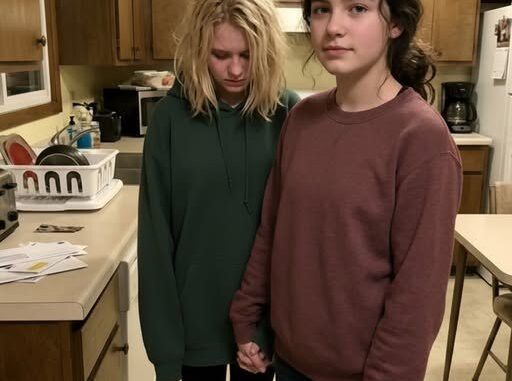
A second later she walked into the kitchen with another girl standing quietly beside her.
“This is Lizie,” Sam said casually. “She’s having dinner with us tonight.”
I froze for half a second.
Not because I didn’t want her there — but because my mind instantly jumped to the math.
One more person.
One more plate.
One more serving from a meal that had already been carefully measured.
I hate admitting that now, but it’s true.
Lizie stood awkwardly near the doorway, clutching the straps of her backpack tightly against her chest. She barely looked up when I greeted her.
“Hi, Lizie,” I said with a smile.
“Hi,” she whispered.
There was something about her immediately that made my heart ache. She looked exhausted in a way kids shouldn’t look. Not sleepy — worn down. Careful. Like she was trying not to take up too much space.
At dinner, she spoke very little.
She ate slowly, taking tiny bites like she was afraid to finish what was on her plate too quickly. Several times I noticed her glance at the food before reaching for another bite, almost as if she needed permission.
Dan tried making conversation.
“So, you and Sam have classes together?”
Lizie nodded softly. “Science.”
“She says you’re really good at math,” Sam added.
A tiny smile appeared on Lizie’s face for maybe two seconds before disappearing again.
When dinner ended, she immediately stood to help clear the table.
“You don’t have to do that,” I told her.
“It’s okay,” she said quietly. “I want to.”
Later that night, after Lizie had gone home, I finally asked Sam the question that had been sitting heavily in my chest.
“Sweetheart… why didn’t you tell me she was coming?”
Sam looked confused.
“Because she needed dinner.”
I sighed gently. “Honey, I just wish you’d asked first. We don’t always have extra food lying around.”
What Sam said next completely stopped me.
“Mom,” she said softly, “sometimes Lizie doesn’t eat dinner at all.”
The room suddenly felt still.
“She gets headaches at school because she’s hungry,” Sam continued. “Last week she almost fainted during gym.”
I stared at my daughter, unable to speak for a moment.
Then she added quietly, “I just didn’t want her to be hungry tonight.”
That sentence hit harder than I can explain.
I had spent years focusing on what we lacked that I never stopped to realize someone else might see our home as abundant.
The next afternoon, I cooked extra food.
Not a feast. Nothing fancy. Just enough so that if Lizie showed up again, I wouldn’t panic internally about portions.
And she did show up again.
Then again the next week.
Eventually it became routine.
The girls would come home from school, spread homework across the kitchen table, and talk while I cooked dinner. Lizie slowly became more comfortable. She laughed more. She started helping with dishes before I even asked. Sometimes I’d catch her standing quietly in the kitchen just watching the normal chaos of family life like it was something unfamiliar.
One evening, her backpack accidentally spilled open onto the floor.
Papers scattered everywhere.
Among them were overdue notices, utility shutoff warnings, and folded documents I could immediately recognize as unpaid bills.
Lizie rushed to gather them, embarrassed.
“I’m sorry,” she whispered quickly.
My chest tightened.
That was the moment I realized things were far worse than I’d imagined.
Over time, we learned more about her situation. Her father was trying, but he was overwhelmed financially and emotionally after losing steady work. They were surviving month to month, barely holding things together.
I understood that feeling more than I wanted to admit.
Dan and I started helping quietly where we could. We connected them with local assistance programs and spoke with school counselors about resources. Nothing dramatic. Nothing that would embarrass Lizie or make her feel like a charity case.
We simply made room for them in our lives.
And somehow, that small decision changed our home too.
The atmosphere felt different after a while. Warmer somehow.
The funny thing is, our financial situation didn’t magically improve. The bills still came. The grocery budget still mattered. Life was still complicated.
But emotionally, something shifted.
I stopped seeing generosity as something reserved for people who had plenty.
One night while eating spaghetti together, Lizie hesitated before asking quietly, “Should we save some so there’s enough for tomorrow?”
I smiled gently.
“There’s enough, sweetheart.”
She looked down at her plate before saying softly, “At our house, leftovers have to last a long time.”
Dan looked away quickly, pretending to focus on his drink.
That night after the girls went upstairs, he sat beside me on the couch and said something I still think about constantly.
“All this time,” he said quietly, “we thought we were struggling because we didn’t have more.”
I nodded.
“But maybe,” he continued, “having enough isn’t about having extra. Maybe it’s about being willing to share what you already have.”
I think that was the moment everything truly changed for me.
A few weeks later, the school hosted a parent night event.
Families crowded into the gym while students showed projects and artwork around the room.
Lizie found me near the snack table.
She looked nervous.
“Mrs. Carter?”
“Yeah?”
“I got an A on my math test.”
“That’s amazing!”
Then she smiled — a real smile this time — and quietly said:
“I think I want to become a teacher someday.”
I told her she absolutely could.
Then she said something I will never forget for the rest of my life.
“I didn’t really think about my future before.”
That sentence broke my heart and healed part of it at the same time.
Because I realized kindness does more than feed someone for a night.
Sometimes it gives them permission to believe tomorrow exists.
And ever since then, whenever I think about the word “enough,” I no longer think about numbers in a bank account or portions on a plate.
I think about safety.
I think about inclusion.
I think about making room at the table.
Because sometimes the richest thing a family can offer isn’t abundance.
It’s simply making another person feel like they belong.
Leave a Reply