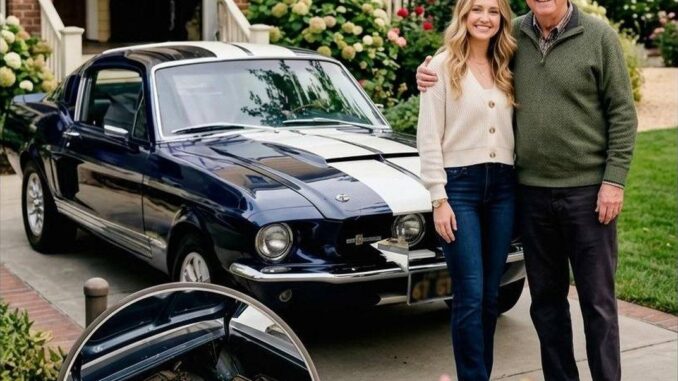
The morning of my father’s funeral carried the kind of silence that presses against your chest until breathing itself feels difficult. I sat alone in the kitchen of the house where I had grown up, holding a mug of coffee that had gone cold long ago while the digital photo frame on the counter slowly cycled through fragments of a life that no longer existed. One picture showed him laughing beside a smoking grill during a summer barbecue. Another showed him crouched beside me, patiently teaching me how to tie my shoes. Then came the image that always made his face light up most: him standing proudly beside his restored 1967 Shelby GT500, a polishing cloth draped over one shoulder like a badge of honor. That car had never been just a machine to my father. It was his sanctuary, his obsession, the one thing he rebuilt with his own hands piece by piece over countless weekends. Every bolt, every panel, every deep growl of the engine carried years of his patience and pride.
When my stepmother Karen called down from upstairs to say she would not be attending the funeral service, I felt no surprise at all. Her marriage to my father had always seemed built more on convenience than genuine affection, a partnership that never gave him the warmth or loyalty he deserved. She claimed she was too consumed by grief to stand at the cemetery, but even through the intercom her voice sounded distant and rehearsed, brittle in a way that felt more performative than heartbroken. I didn’t argue with her. I no longer had the energy for conflict. Instead, I walked quietly into the garage, slid behind the wheel of the Shelby, and turned the key. The roar of the engine vibrated through my body with familiar force, and for one brief moment it felt as though my father himself was sitting beside me. Driving that car to the church felt less like transportation and more like carrying part of him with me one final time.
The funeral itself was beautiful in the painful way only honest grief can be. The church overflowed with people whose lives my father had touched over decades — coworkers from the plant still smelling faintly of machine oil beneath their suits, neighbors who had borrowed his tools for years, old friends who knew exactly how stubborn and dependable he had always been. When I stood at the podium to speak, I talked about his steadiness. I spoke about the way he never gave up on anything broken, whether it was a damaged engine or a struggling human being. As I looked out at the crowd, I felt something inside my chest beginning to settle, as though closure itself was finally trying to take shape.
But the moment I stepped outside into the sunlight, that fragile peace shattered instantly.
The parking spot where I had left the Shelby was empty.
For one stunned second, my brain refused to process what I was seeing. Then I noticed the yellow flatbed tow truck nearby, hydraulics hissing softly as chains rattled against metal. Standing beside it, dressed not in funeral black but in an expensive beige trench coat, was Karen. In one hand she held a thick manila folder. In the other, she casually adjusted her sunglasses as though this were just another business transaction.
I ran toward her, heels striking the pavement sharply, panic already rising in my throat. I demanded to know where the car was going. Karen barely reacted. Her expression remained cold, detached, almost professional as she calmly explained that she had already finalized a private sale to a collector. According to her, the Shelby was nothing more than a “painful reminder” and she believed it was time for everyone to “move forward instead of clinging to the past.” The cruelty of it hit me harder than I expected. While I had been inside honoring my father’s memory, she had been outside selling away the thing he loved most in the world.
The buyer’s representative — a stern man with clipped movements and no emotional investment in the situation — began fastening chains around the Shelby’s frame. I pleaded with them, explaining that the estate had not even been settled yet, but Karen simply waved the paperwork in my direction. I knew instantly what must have happened. Somehow she had convinced my father, likely during his heavily medicated final days, to sign documents she intended to use against me later. In that moment, it felt like I was losing him all over again.
Then, just as the tow truck driver climbed into the cab, another vehicle tore into the cemetery lot.
It was Elias.
His small white pickup slid into a crooked parking spot before he even fully stopped moving. The local mechanic jumped out holding a grease-stained plastic bag, breathing hard as though he had driven there in a panic. Elias had worked with my father on the Shelby for years, helping him track down rare parts and solve impossible restoration problems. Ignoring Karen completely, he rushed directly toward me and told the tow truck driver to wait because there was “a serious mechanical liability” connected to the vehicle that had not been disclosed.
Then he handed me the bag.
A few weeks before my father died, Elias explained, the Shelby had been brought into the shop for one final tune-up. During the inspection, Elias had discovered something hidden behind the glove compartment — a tiny velvet-lined compartment built so carefully into the dashboard that nobody would ever notice it unless they were searching intentionally. Inside that compartment sat the envelope now trembling in my hands. Thick. Sealed with wax. Deliberate.
Karen immediately stepped forward, demanding the envelope as “estate property,” but Elias moved between us like a wall. His silence alone was enough to stop her.
I broke the seal.
Inside rested a handwritten letter in my father’s familiar looping script along with several folded legal documents. The moment I recognized his handwriting, the noise of the parking lot seemed to disappear completely. Suddenly all I could hear was his voice inside my head as I began to read.
The letter was not about the Shelby’s horsepower, value, or collector status. It was about meaning.
My father revealed that he had known his time was running out far earlier than he admitted publicly. More painfully, he confessed that he also understood Karen’s intentions better than anyone realized. The Shelby, he explained, was never meant to become some rich collector’s trophy. It was supposed to remain part of the family because it represented perseverance — proof that damaged things could still be rebuilt with enough patience and love.
Then came the real shock.
The legal documents weren’t connected to the car’s sale at all. They were deeds to a small cabin hidden deep in the mountains, a property my father had secretly purchased years earlier. According to the letter, the Shelby itself held the “key” to the family’s future. Inside the cabin were additional instructions connected to a private trust fund established for me through life insurance policies Karen knew nothing about. He explained that he had hoped the Shelby would eventually bring us together for one final journey to the cabin — one last attempt to preserve some sense of family before his death destroyed it completely.
But the final section of the letter changed everything legally.
My father explained that the money used to restore the Shelby had originally come from an inheritance left to him by his own mother — assets he intentionally kept separate from his marriage. Included in the envelope was proof that the car had already been transferred to me legally through a “transfer on death” filing that bypassed Karen entirely. She had never owned the vehicle. Which meant she had no legal right to sell it.
I looked up from the letter and saw Karen’s face draining from pale shock into furious red embarrassment. For the first time since my father died, I wasn’t afraid of her anymore.
I turned toward the tow truck driver and calmly told him to remove the chains.
“The sale is void,” I said. “She doesn’t own the title.”
What followed was ugly — shouting, accusations, legal threats — but none of it touched me the same way anymore. I had my father’s words in my hands. His foresight had protected me even after death itself. Karen eventually stormed back toward her car, realizing her attempt to profit from his memory had collapsed completely. She had tried to sell away his legacy, but my father had secured it too carefully for greed to erase.
I kept the Shelby.
A month later, I drove it through winding mountain roads toward the cabin my father had left behind. The engine hummed steadily beneath me, carrying the same calm strength that had defined his entire life. Sitting on the porch with cold mountain air moving through the trees, I finished reading the remaining instructions about the trust and the future he had carefully prepared for me.
By then, the day of the funeral no longer felt defined by betrayal or grief alone.
Instead, it became the day I finally understood who my father truly was: a man who loved carefully enough to protect his daughter even beyond death itself. A man who understood that possessions are temporary, but intention lasts forever.
As I turned the ignition key once more and listened to the Shelby roar to life beneath the mountain sky, I realized something important.
Karen had tried to sell a car.
What my father left me was an entire future.
Leave a Reply