An Unexpected Start to the Day
Early one morning, I stepped outside hoping to enjoy a bit of fresh air and a quiet moment before the day began. The surroundings were calm, the light was soft, and everything felt familiar—until something unusual caught my attention.
On the ground was a creature that didn’t seem to belong.
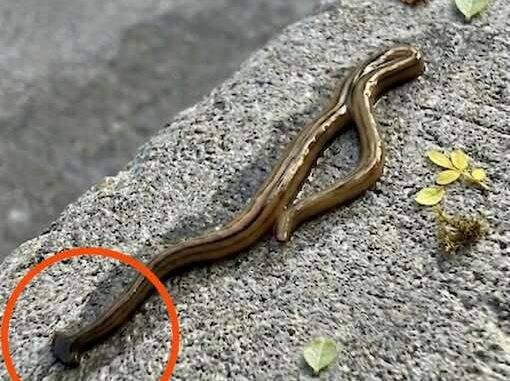
At first glance, it looked almost unreal. Its body was long and slender, moving slowly with a smooth, gliding motion. What stood out the most was its head—flat and wide, shaped in a way that made it resemble a small hammer or shovel. The way it moved gave the impression that it was actively searching its surroundings.
What I had come across was something known as a hammerhead worm.
What Is a Hammerhead Worm?
Despite its unusual appearance, this creature is a real and recognized organism. Hammerhead worms are a type of terrestrial flatworm, meaning they live on land rather than in water.
They are most commonly found in environments that provide moisture and shade. This includes places such as:
- Garden soil
- Mulch beds
- Leaf-covered areas
- Damp outdoor spaces
Because of their preference for these conditions, they often go unnoticed until someone happens to spot one during routine outdoor activities.
A Closer Look at Their Appearance
One of the reasons hammerhead worms attract attention is their distinctive look.
Their elongated bodies can vary in size, sometimes growing quite long compared to other common garden organisms. Their movement is slow and fluid, almost as if they are gliding rather than crawling.
The most recognizable feature is their head shape. Flattened and widened at the front, it gives them their name and contributes to their unusual presence.
While their movement can appear calm or even fascinating to observe, their role in the environment is more complex than it may seem at first glance.
Their Role in the Ecosystem
Hammerhead worms are not simply passive inhabitants of the soil. They are active predators.
Their primary food source is earthworms—organisms that play a crucial role in maintaining healthy soil. Earthworms help improve soil structure by:
- Aerating the ground
- Enhancing water drainage
- Breaking down organic matter into nutrients for plants
Because of this, earthworms are often considered beneficial for gardens and natural ecosystems.
When a predator like the hammerhead worm is introduced into this environment, it can gradually disrupt that balance. By reducing earthworm populations, it may indirectly affect soil quality over time.
This impact is not always immediately visible, which makes it easy to overlook until changes begin to accumulate.
Unique Survival Traits
One of the reasons hammerhead worms are notable is their ability to adapt and survive in various conditions.
They produce a layer of mucus that serves multiple purposes. This coating helps them:
- Retain moisture
- Move smoothly across surfaces
- Navigate different types of terrain
This mucus also contains compounds that can cause mild irritation if handled directly. While these worms are not considered highly dangerous to humans, it is generally recommended to avoid direct contact.
Using gloves or tools when interacting with them is a safer approach.
Why They Are Difficult to Control
Another characteristic that sets hammerhead worms apart is their resilience.
Unlike many common garden pests, they are not easily eliminated through simple methods. In fact, some instinctive approaches can actually make the situation worse.
For example, cutting or breaking the worm may not destroy it. Instead, each piece has the potential to regenerate into a new worm. This regenerative ability means that improper handling can unintentionally increase their numbers.
Because of this, more careful and informed methods are recommended when dealing with them.
Safe and Responsible Handling
If removal is necessary, it’s important to approach the situation with care.
Experts often suggest the following guidelines:
- Avoid touching the worm with bare hands
- Use gloves, tools, or a container to handle it
- Place it in a sealed container if removal is needed
- Use substances like salt or vinegar, which can break down the organism more effectively
In some areas, local environmental or agricultural authorities may provide specific recommendations, especially if the species is considered invasive.
Taking a cautious and informed approach helps prevent unintended consequences while maintaining safety.
The Psychological Impact of the Encounter
Beyond the biological and environmental aspects, encountering a creature like this can feel unsettling in a different way.
There’s something about finding an unfamiliar organism in a familiar space that creates a moment of pause. A backyard or garden—places that typically feel predictable—suddenly seem a bit less certain.
It’s not necessarily fear, but rather a heightened awareness.
Moments like this remind us that even in well-known environments, there are layers of activity happening beneath the surface.
A Reminder of Nature’s Complexity
Discoveries like this highlight how interconnected natural systems are.
Even small organisms can play significant roles in their environment. When new species appear or existing balances shift, the effects can ripple outward in ways that aren’t immediately obvious.
This doesn’t mean every encounter is cause for concern, but it does emphasize the importance of awareness.
Understanding what we’re seeing allows us to respond thoughtfully rather than react out of uncertainty.
Turning Curiosity Into Knowledge
Instead of viewing the experience as purely unsettling, it can also be an opportunity to learn.
Taking the time to identify unfamiliar organisms, understand their behavior, and recognize their role in the ecosystem can make future encounters less surprising.
Knowledge transforms uncertainty into confidence.
What begins as a strange or unexpected moment can become a reminder of how diverse and intricate the natural world really is.
That quiet morning started as something simple—just a moment to step outside and enjoy fresh air.
But the discovery of a hammerhead worm turned it into something more memorable.
It served as a reminder that nature is always active, even in the spaces we think we fully understand. Beneath the surface, there are countless interactions taking place—some beneficial, some neutral, and others that require a bit more attention.
Encounters like this don’t have to be alarming. With the right knowledge and approach, they can be handled calmly and responsibly.
In the end, it’s not just about what we find—but how we respond to it.
And sometimes, a small discovery can lead to a much deeper appreciation of the world right outside our door.
Leave a Reply