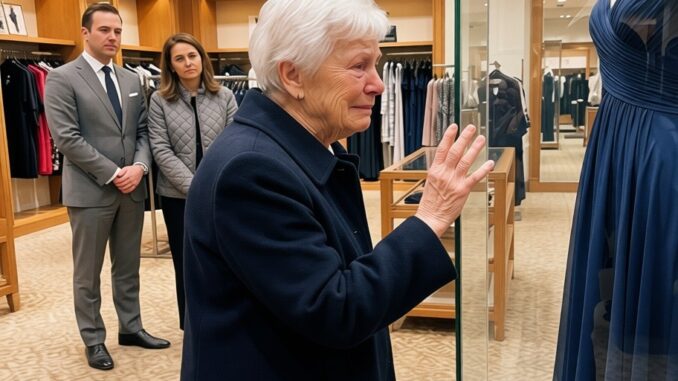
The automatic glass doors slid shut behind us, sealing out the cool air of an early April morning. My mother, eighty-two and steady on her cane, didn’t pause to admire the bright displays or the expensive fabrics showcased under perfect lighting. She moved forward with a quiet determination I hadn’t seen in years.
“Mom… please,” I said under my breath, aware of the curious looks around us. “Can you just tell me why we’re here?”
She didn’t respond. Her grip tightened slightly on her worn leather purse as she continued walking. To the well-dressed staff moving gracefully across polished floors, she barely registered. To them, she looked like someone who didn’t belong—an elderly woman out of place in a high-end store.
I noticed everything—the sideways glances, the hushed whispers between employees, the subtle way a manager picked up a phone while watching us head toward the formalwear section.
But my mother either didn’t notice or chose not to. Pride had always been her armor.
When we reached the Heritage Collection display, she slowed. Her hands—aged, careful, and practiced—moved gently over the garments. She wasn’t browsing. She was studying.
She turned a sleeve inside out, running her fingers along the seam with remarkable precision. I recognized that expression instantly. It was the same look she used to have decades ago at our kitchen table, sewing late into the night. Back then, she created beautiful things for others while wearing the same simple dresses herself until they wore thin.
Then she stopped.
Under a soft spotlight stood a midnight-blue gown. It was elegant, detailed, and clearly handmade with care. A small placard read: Heritage Collection. Fall 1984. One of One.
My mother placed her hand against the glass. Tears filled her eyes so suddenly that it caught me off guard.
That was when the staff stepped in.
Two sharply dressed managers approached, accompanied by a security guard. They formed a quiet barrier around her—not openly aggressive, but clearly ready to intervene.
“Is there something you need help with?” one of them asked, his tone polite but distant.
“She’s fine,” I said quickly. “We’re just looking.”
They didn’t move.
Then, unexpectedly, a young employee stepped forward. She looked no older than her early twenties, and unlike the others, her expression wasn’t suspicious—it was thoughtful.
Without hesitation, she unlocked the display case, carefully lifted the gown, and turned the collar inside out.
Her expression changed instantly.
“Ma’am…” she said softly, her voice shaking slightly. “Is your name Evelyn Moore?”
“It used to be Evelyn Morrow,” my mother replied quietly. “Before I remarried.”
The young woman turned the lining outward.
There, sewn in tiny, careful stitches, were the words: Made by hand by E. Morrow. September 1984.
The air seemed to go still.
The managers stepped back. The guard looked away. In that moment, everything shifted.
My mother hadn’t just recognized the dress—she had made it.
Decades ago, she had worked in this very building, in a sewing room long forgotten, creating pieces that were now displayed as part of the store’s “heritage.”
But what should have been a moment of recognition quickly turned tense.
A senior executive arrived—Daniel Cross, the regional director. His focus wasn’t on the emotional discovery unfolding before him. Instead, he saw a situation that could disrupt business.
“Put the dress back,” he said firmly. “It’s needed for tonight’s event.”
My mother straightened as much as she could. “Before that,” she said calmly, “I’d like to know why the work of women is being treated as if it belongs to the building instead of the people who made it.”
A small crowd had gathered, and quiet murmurs began to ripple through the store.
She asked to be taken to the third floor—the old sewing area.
At first, Cross resisted, citing policies and restricted access. But the attention from customers made it difficult to refuse.
Eventually, he led us through a side passage and up a narrow staircase.
Behind the elegant showroom floors was a completely different space—dim, dusty, and forgotten.
As we climbed, my mother pointed out details from memory.
“There used to be a clock there,” she said. “It was set a few minutes fast so no one would return late from breaks.”
When we reached the top, the room was filled with old equipment, broken mannequins, and storage crates. But to her, it was something else entirely.
She saw people.
“Alma worked over there,” she said softly. “Ruth sat by the window. Clara was near the corner.”
She moved slowly but with purpose toward a radiator along the wall. Asking for a tool, she pried at the baseboard until a small hidden panel came loose.
Inside was a cloth-wrapped bundle.
My hands trembled slightly as I opened it.
Inside was an old ledger, its cover faded but still legible: Upstairs Women, 1981–1985.
It wasn’t a company record. It was something far more personal.
Page after page listed names—women who had worked there—along with notes about their lives. Short, human details. Families. Struggles. Skills.
Tucked into the back was a sketch.
The same midnight-blue gown.
The truth was undeniable.
The store’s “Heritage Collection,” presented as an in-house legacy, had been built on the work of individuals whose names had never been acknowledged.
Cross flipped through the pages, his expression tightening. He understood the situation immediately.
He began to shift his tone, offering compensation, recognition, and promises of future acknowledgment. His words were careful, measured—an attempt to contain the moment.
But my mother didn’t respond to the offers.
Instead, she turned to the young employee who had first recognized her work.
“If someone had asked you earlier,” she said gently, “whether I belonged near that dress, what would you have said?”
The young woman hesitated. “I would have said I didn’t know.”
My mother nodded. “That’s how it happens. People simply don’t know.”
Then she looked back at Cross.
“You’re not asking for time,” she said. “You’re asking to keep control of something that was never yours alone.”
She closed the ledger carefully and held it close.
We left through the main entrance, not the side exit.
Out on the street, the noise of the city returned, but something had changed.
For years, her work had existed quietly, hidden in seams and stitches no one thought to examine.
But that day, it was finally seen.
And heard.
As we stepped onto the sidewalk, the afternoon light felt different—brighter somehow, as if something long buried had finally surfaced. My mother didn’t say much at first. She simply held the ledger close, her fingers resting on its worn cover as though it were something fragile and irreplaceable.
We found a quiet bench a short distance from the store. The city moved around us in its usual rhythm—cars passing, people talking, life continuing as if nothing had happened. But for us, everything had shifted.
“Do you remember any of them?” I asked gently, nodding toward the book.
She smiled faintly, her eyes soft with memory. “All of them,” she said. “Not just their names—their stories.”
She opened the ledger carefully, turning the pages one by one. Each entry seemed to carry more than ink. There were small notes written in the margins, bits of personality captured in a few words. It wasn’t just a record of work—it was a record of lives.
“They were fast,” she continued. “Talented. Patient. We had to be. There wasn’t room for mistakes, not with the kind of expectations placed on us.”
I listened quietly as she spoke, realizing how much of her life had gone unrecognized—not just by the company, but by time itself. The gowns displayed under perfect lighting inside that store were more than products. They were pieces of history, shaped by hands that had never been credited.
“What will you do now?” I asked.
She closed the book and rested it in her lap. “I don’t know yet,” she admitted. “But I do know one thing—I won’t let them stay forgotten.”
There was no anger in her voice. Just certainty.
Over the next few days, word began to spread. It started quietly—someone who had witnessed the moment in the store shared the story, and then someone else. Soon, people were asking questions. Not in a confrontational way, but with genuine curiosity.
Who were the “Upstairs Women”?
Why hadn’t their contributions been acknowledged?
And how many stories like this had been overlooked?
My mother didn’t seek attention, but she also didn’t hide. When a local writer reached out to learn more, she agreed to speak—not for herself, but for the others whose names filled the pages of that ledger.
She spoke about long hours and careful craftsmanship. About pride in doing work well, even when no one was watching. About friendships formed over shared effort and quiet resilience.
And slowly, something began to change.
People started to look closer—not just at clothing, but at the stories behind it. The idea of “heritage” began to mean more than branding. It became about truth, recognition, and respect for the people who made things possible.
One evening, as we sat together at her kitchen table—the same table where she had once sewn late into the night—she ran her hand over the ledger again.
“They were never just workers,” she said. “They were creators.”
I nodded, understanding now in a way I hadn’t before.
The stitches hidden inside that gown had lasted for decades, quietly holding their place. And in the end, they had done more than hold fabric together.
They had carried a story forward—waiting for the moment someone would finally see it.
Leave a Reply