The house had learned to hold its breath after Mason died. A year of silence had settled into the walls, into the unwashed coffee mugs, into the closed door at the end of the hall where my daughter lived like a ghost in her own bedroom.
I would stand at that door most mornings, palm pressed flat against the wood, listening for the faint sound of her breathing, waiting for some sign that she still existed in the world outside her grief. Hazel was seventeen. She used to dance in the kitchen while I made pancakes, her laughter echoing off the walls.
After the funeral, everything changed. Hazel stopped eating. Then she ate too much. Then she stopped going outside. Mason had been her twin in mischief and laughter. He used to call her Hazelnut and steal the syrup from her pancakes. He used to promise, loud enough for the whole table to hear, that if no boy was smart enough to ask her to prom, he would put on a tux himself and take her. That promise would never be kept. A truck on Route 9, a wet road, a Tuesday.
Eli was the only person she let near her. The quiet boy from two houses down, her best friend since sixth grade, would show up after school with her homework folded under his arm. He never knocked too loudly, never asked too many questions, never pushed. To him, I think, it was nothing. But to Hazel, it meant the world.
Some afternoons, I would find them on the porch, not speaking, Hazel’s head tipped sideways against the railing while Eli sketched something in a notebook.
“Mrs. Mave,” he said one afternoon, looking up at me. He had called me that since he was twelve, when calling me by my first name felt too casual and anything more formal felt too far. “She ate half a sandwich today.”
“Thank you, Eli,” I said softly.
“For what?”
“For sitting with her,” I whispered.
I had found Hazel’s journals once, tucked behind a row of paperbacks. Names of girls, names of boys, cruel little phrases written in her round handwriting—the kind of words you only write down because you cannot speak them aloud. I put the journals back exactly where I found them, feeling helpless and protective at once.
Spring arrived, and with it, prom invitations in the mailboxes of her classmates. Pictures appeared online: daughters in pastel dresses, holding bouquets, smiling into cameras. I knocked on Hazel’s door.
“Mason wanted you to go,” I said, gently.
“I’m not going, Mom,” she replied, voice flat.
“He wanted you to wear a dress. He wanted you to laugh and dance. I know it,” I persisted.
She was silent for a long moment. Then I heard the creak of her bed, the shuffle of her feet, and the door cracked open an inch.
“Mason wanted a lot of things,” she whispered.
“Just try one dress. One. If you hate it, we come home and never speak of it again. Deal?”
“One dress,” she said. It wasn’t hope. Not yet. But it was something—a small permission.
We spent Saturday driving from boutique to boutique. By the fourth shop, Hazel had folded into herself. Each soft rejection, each polite excuse, was a mirror of Mason’s funeral: the shoulders rising toward her ears, the quiet withdrawal into a world only she could inhabit.
“Just one more,” I said, pointing to a boutique on Maple. I had already pictured the gown in the window. Ivory, soft, romantic. Hazel stood still in front of it.
The saleswoman gave her a slow once-over, mouth tightening. “That’s not going to work for you, honey. You’re too big.”
Hazel didn’t cry. She didn’t argue. She turned and walked out, the door clicking shut behind her. I followed her in the car, gripping the steering wheel until my knuckles went white. Hazel stared straight ahead the whole way home. Nothing could touch her.
She locked herself in her room. I pressed my forehead against the door, crying quietly. My daughter—the child who had laughed in the kitchen, danced on our driveway, stolen syrup with her brother—was slipping away, buried under grief I could not reach.
Then, a knock on the door changed everything.
It was Eli. Hoodie faded, small notebook pressed to his chest. Seventeen, with bitten nails and steady determination.
“Mrs. Mave. Can I talk to you?” he asked.
“Is Hazel okay?”
“No, ma’am. I need her measurements,” he said.
“You’ve never made a dress like this in your life,” I whispered.
“I just need you to say yes,” he replied. There was something in his eyes—older, steadier than anyone his age should carry.
“Yes,” I said.
That night, I watched the light burn from Eli’s bedroom long past midnight. Past one. Past two. Past three.
His mother called on day three. “Mave, his fingers are sore. He missed a chemistry test. He’s been at that machine since he could reach the pedal.”
I pressed my forehead to the window, staring at the faint glow. Two weeks felt impossible. I didn’t know if Hazel would ever step outside her grief again.
Hazel sank. She stopped coming downstairs. The gray hoodie became a uniform. Her new journals were darker, angrier, filled with names, whispers, screenshots, evidence of a cruel world she had been carrying for years.
I photographed the pages, sent them to Eli. A simple note: I don’t know if this helps. I just can’t hold this alone.
A minute later, a message from him: I know what to do with them.
By day six, I had learned to trust Eli completely. He had been watching, listening, and learning for years. The dress, I realized, was not just fabric. It was history transformed.
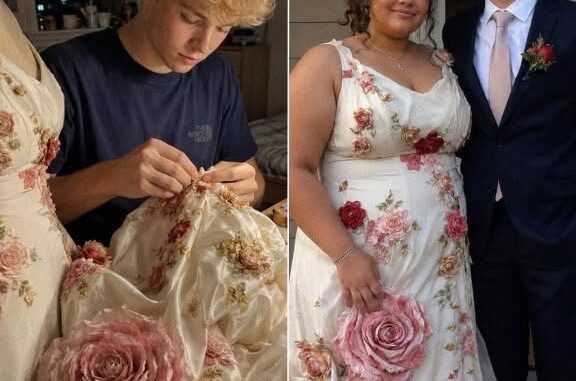
Prom night came. Eli, in a thrifted suit, carried the gown like a sacred object. Hazel refused him at first. Then she saw the ivory silk, the roses blooming down the skirt.
“Just put it on, Hazelnut,” he whispered, using Mason’s nickname. My knees nearly buckled.
She pressed her hands to her mouth. He didn’t push. He sat on the floor, waiting. “One song. That’s all. Then we go.”
Hazel breathed in. Breathed out. Took his arm.
Inside, heads turned. Whispers stopped. Every girl, every boy, noticed. Eli walked to the DJ booth, took the mic, and spoke softly:
“Hazel, look under the biggest rose.”
Her hands shook as she lifted a folded length of embroidered silk. Names, words, cruelties, stitched into the petals of the gown. Eli had transformed every insult, every harsh word, every moment of cruelty into something beautiful.
The room fell silent. Faces softened. Tears were shed. Hazel finally cried—not from shame, but from being seen. Truly seen, in a way she hadn’t been since Mason died.
I drove home alone that night, standing in Mason’s old room, pressing my palm to his dresser.
“Someone kept your promise, baby. She wasn’t alone,” I whispered.
And for the first time in a year, I knew Hazel would eat breakfast at the table again.
Leave a Reply