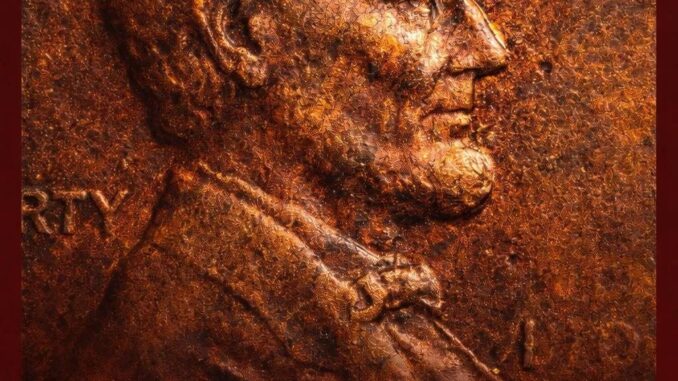
Sometimes history hides in the smallest places.
Not in museums.
Not behind glass displays.
But in ordinary pockets, old jars, forgotten drawers, and loose change passed from one person to another without a second thought.
That’s exactly what makes the legendary 1943 Bronze Lincoln Penny so fascinating.
What began as a quiet rumor eventually became one of the most famous coin-collecting stories in American history — a story involving wartime shortages, accidental minting errors, and coins worth hundreds of thousands of dollars.
And remarkably, experts believe a few may still be undiscovered today.
The Coin That Was Never Supposed to Exist
To understand why the 1943 Bronze Lincoln Penny became so valuable, you have to go back to the middle of World War II.
During the war, materials like copper became extremely important for military production. Copper was needed for ammunition, wiring, communications equipment, and other wartime supplies.
Because of this, the United States Mint made a major decision in 1943: United States Mint
Pennies would no longer be produced using copper-based bronze.
Instead, the Mint began manufacturing pennies from zinc-coated steel.
These new steel cents looked completely different from traditional pennies. Rather than appearing copper-colored, they looked silver or gray and were magnetic because of their steel composition.
Millions of these steel pennies entered circulation across the country.
But during the transition, something unexpected happened.
The Wartime Mistake That Created a Legend
Before the switch to steel, the Mint had been producing pennies using bronze planchets — flat metal discs primarily made from copper.
Although production officially changed in 1943, a small number of bronze planchets accidentally remained inside minting equipment.
When the new steel pennies began production, a few leftover bronze blanks were mistakenly struck with 1943 penny designs.
The result was extraordinary:
A tiny number of genuine 1943 pennies made from bronze instead of steel.
These coins were never intended to exist.
They were accidents.
And that mistake created one of the most famous error coins in American history.
Fewer Than Twenty Are Believed to Exist
Experts estimate that fewer than twenty authentic 1943 Bronze Lincoln Penny examples have ever been confirmed.
Known examples were produced at several U.S. Mint facilities, including:
- Philadelphia
- Denver
- San Francisco
Each mint produced slightly different versions that specialists can identify through detailed analysis and authentication.
Because so few survived, these coins became incredibly valuable to collectors.
But rarity alone isn’t the only reason people are fascinated by them.
The story behind the coin matters just as much.
Why Collectors Are Obsessed With the 1943 Bronze Penny
The appeal of the coin goes beyond money.
The 1943 Bronze Lincoln Penny represents:
- A wartime manufacturing mistake
- A connection to American history
- The possibility of accidental fortune
- A treasure hidden in plain sight
Unlike many collectibles locked away in private vaults from the beginning, these coins may have circulated unnoticed for years before being discovered.
That possibility helped fuel the legend.
People suddenly realized that an ordinary-looking penny might secretly be worth a fortune.
The Rumor That Sparked a Nationwide Treasure Hunt
When stories about copper-colored 1943 pennies first began circulating, many people dismissed them as myths or misunderstandings.
After all, everyone knew 1943 pennies were supposed to be steel.
Even government officials initially suspected the reported coins were fakes or altered pieces.
But collectors continued bringing examples forward.
Eventually, experts performed metallurgical testing on several coins.
The results confirmed the unbelievable truth:
Some 1943 pennies really were bronze.
The rumor became reality.
And once that happened, Americans everywhere started checking their spare change.
How People Tested Their Pennies
One simple test became famous among collectors:
Use a magnet.
Normal 1943 steel pennies stick to magnets because they contain steel.
Authentic bronze versions do not.
Suddenly, kitchen tables across the country turned into mini treasure-hunting stations.
People searched through:
- Coin jars
- Piggy banks
- Old collections
- Inherited coins
- Cash drawers
- Loose pocket change
For many, it became an obsession.
Because even a tiny possibility of finding one felt exciting.
The Famous Lunch Money Story
One of the stories that made the legend even more famous involved a teenager who reportedly discovered a bronze 1943 penny in his school lunch money.
At first, it seemed insignificant.
Just another penny.
But later, experts confirmed it was authentic.
The coin eventually sold for more than $200,000.
Stories like that transformed the coin into something larger than a collectible.
It became part of American folklore.
Why Some 1943 Pennies Are Common
It’s important to understand that most 1943 pennies are not rare.
The vast majority were made from steel and are generally worth only modest amounts unless they are in exceptional condition.
Many people mistakenly assume every 1943 penny is valuable simply because of the date.
The rare and valuable versions are specifically the bronze or copper-colored error coins.
That distinction matters enormously.
Counterfeits and Altered Coins
Because of the coin’s fame and value, counterfeit versions have appeared over the years.
Some altered coins are created by:
- Copper-plating steel pennies
- Modifying dates on other coins
- Using altered materials to imitate bronze examples
Authentic examples require professional verification and testing by coin experts.
Collectors often rely on professional grading services for authentication before buying or selling rare coins.
Could One Still Be Out There?
This question is what keeps the fascination alive.
Even though many known examples have already been discovered, some collectors believe additional coins could still remain hidden somewhere unnoticed.
Perhaps in:
- A forgotten collection
- An inherited coin jar
- An old safe
- A box of spare change
- A family keepsake
The idea that extraordinary value might still be hiding inside something ordinary continues inspiring people to search.
More Than Just a Coin
The story of the 1943 Bronze Lincoln Penny resonates because it represents something larger than money.
It reminds people that mistakes sometimes create history.
That ordinary objects can hold extraordinary stories.
And that small details often matter more than we realize.
Final Thoughts
The 1943 Bronze Lincoln Penny remains one of the most famous and valuable error coins ever produced in the United States.
Created accidentally during World War II, these rare pennies transformed from unnoticed minting mistakes into legendary collectibles worth hundreds of thousands of dollars.
What makes the story truly unforgettable is how simple it all seems.
A single penny.
Something most people barely notice.
And yet, in extremely rare cases, that tiny coin could represent a remarkable piece of history — and potentially a life-changing discovery.
Leave a Reply