A Subtle Detail in the Coca-Cola Logo Is Getting Attention
The Coca-Cola logo is one of the most widely recognized designs in the world. With its flowing script and bold red color, it has remained a consistent visual symbol for generations.
Most people can recognize it instantly without giving it much thought.
However, a growing number of people have recently started noticing something unusual—a small detail that had gone largely overlooked.
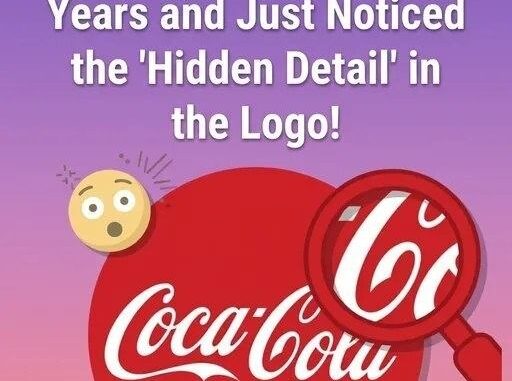
Some believe there’s a hidden “smile” within the logo.
More specifically, they point to the second “C” in the word “Coca-Cola.” The way the letter curves outward and then loops downward has led some viewers to interpret it as the shape of a subtle grin.
Once this idea is introduced, it becomes surprisingly difficult to ignore.
This raises an interesting question:
Is this a deliberate design choice, or simply a creative interpretation?
Taking a Closer Look at the Design
To understand where this idea comes from, it helps to look at the structure of the logo itself.
The Coca-Cola wordmark was created in the late 19th century using Spencerian script—a handwriting style known for its elegance and flowing curves. This style was widely used at the time for formal writing and business branding.
The letters are smooth, rounded, and connected in a way that feels natural and balanced.
The second “C” stands out because of its shape. Its upper curve extends outward before curling back underneath, forming a soft arc. When viewed from a certain perspective, that arc can resemble a smiling expression.
It’s not a perfect or obvious smile—but it’s close enough that many people make the connection.
And once they do, the logo can feel slightly different.
Why People See a “Smile”
There’s a simple psychological explanation behind this observation.
Humans are naturally inclined to recognize patterns, especially faces. This tendency is often referred to as pareidolia—a phenomenon where the brain identifies familiar shapes in random or unrelated visuals.
This is why people sometimes see faces in clouds, objects, or shadows.
The same concept applies here.
Once someone points out that the curve of the letter looks like a smile, the brain begins to recognize it that way automatically. From that point on, it becomes difficult to view the shape as just a letter.
Instead, it starts to feel expressive.
The Power of Suggestion
Another reason this idea spreads so quickly is the power of suggestion.
Most people have seen the Coca-Cola logo countless times. Because it’s so familiar, they rarely stop to examine its details.
But when someone introduces a new perspective—like the idea of a hidden smile—it encourages people to look again.
That second look often leads to a new interpretation.
This creates a kind of “aha moment,” where something ordinary suddenly feels interesting again.
It’s not that the logo has changed—it’s that the way people see it has.
Was It Designed That Way?
Despite the growing popularity of this theory, there is no confirmed evidence that the Coca-Cola logo was intentionally designed to include a smiling shape.
The original designer focused on creating a logo that was stylish, readable, and visually appealing. At the time, branding was more about clarity and elegance than about hidden meanings.
The curves in the letters were simply part of the writing style.
Because of this, the “smile” interpretation is most likely a modern perspective rather than an original design feature.
Still, that doesn’t make it any less meaningful to those who notice it.
Why the Idea Feels So Convincing
Even without historical proof, the idea of a hidden smile feels believable.
One reason is the brand’s long-standing identity. Coca-Cola has consistently been associated with themes like happiness, enjoyment, and shared experiences. Because of this, people naturally connect the brand with positive emotions.
Seeing a smile in the logo seems to match that image perfectly.
Another reason is how modern audiences approach design. Today, many logos are created with subtle symbolism or hidden elements. This has made people more attentive to details and more likely to search for deeper meaning.
So when they notice something that looks like a smile, it feels intentional—even if it isn’t.
How Meaning Changes Over Time
One of the most interesting aspects of design is that meaning can evolve.
A logo that was created with a simple purpose can take on new interpretations as time passes. Cultural shifts, personal experiences, and modern design awareness all influence how people see familiar symbols.
The Coca-Cola logo is a great example of this.
While it began as a straightforward piece of lettering, it has grown into a global symbol with emotional significance. Over time, people have added their own interpretations, giving it layers of meaning beyond its original design.
The “hidden smile” is just one of those layers.
The Impact of Small Details
This trend highlights how even the smallest design elements can influence perception.
A single curve in a letter can change how a logo feels. Rounded shapes are often associated with friendliness and warmth, while sharp angles can feel more formal or distant.
In this case, the soft curve of the “C” contributes to a more approachable appearance.
Even if the smile wasn’t intentional, it still enhances the emotional connection people have with the logo.
A New Way to See Something Familiar
Part of what makes this discovery so engaging is its simplicity.
It doesn’t require any special knowledge or tools—just a shift in perspective.
People enjoy finding new details in things they’ve seen many times before. It creates a sense of curiosity and makes the familiar feel fresh again.
In a way, it turns a static design into something interactive.
Final Thoughts
So, is there truly a hidden smile in the Coca-Cola logo?
There’s no official confirmation to support that idea. The shape of the letter was most likely created for stylistic reasons rather than symbolic ones.
However, the fact that so many people see a smile says something important.
It shows how powerful design can be—not just in how it looks, but in how it’s interpreted.
Whether you see a simple curve or a subtle grin, the Coca-Cola logo continues to capture attention in new ways.
And sometimes, all it takes is a small detail to change how we see something we thought we already knew.
Leave a Reply