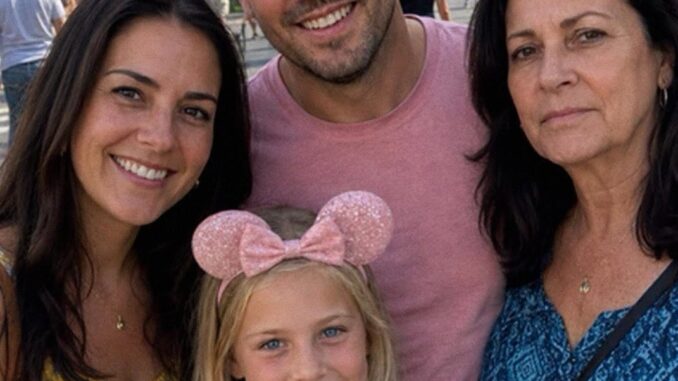
For eight years, Patricia made my life a living hell with her stinging, soft-spoken barbs. She constantly questioned my daughter Nora’s paternity, sneering at her fair skin and bright blue eyes, acting as if my child was a shameful anomaly. I endured it in silence, playing the dutiful daughter-in-law to keep the peace. But on Nora’s eighth birthday, Patricia finally went too far. She presented a DNA kit as a “gift,” demanding we prove my daughter’s heritage. Little did the toxic woman know, that box didn’t just expose my family—it blew the lid off a lie that shattered her own world forever.
My kitchen always smelled of cinnamon on Sunday mornings, and the sunlight hitting the floor felt like a sanctuary. I would pour coffee for my husband, Caleb—who shared my dark eyes and brown hair—and watch him read the paper. Our life was modest and predictable, which I usually called a blessing. I was thirty-four, three months pregnant with our second child, and foolishly hopeful that things might change.
Patricia arrived at eleven forty-five sharp. She was the type of person who viewed punctuality as a moral imperative and kindness as a weapon. She kissed Caleb, scanned my outfit with a look of practiced judgment, and let her smile stretch just a beat too long. “That color is quite brave on you,” she said, her voice dripping with artificial sweetness. I felt that familiar, sharp ache of dread in my chest. I had spent nearly a decade learning the rhythm of her cruelty: the polite compliment hiding a razor blade, the subtle jab meant to make me feel small.
Caleb would always tell me to let it go. “She’s just old-fashioned,” he would say, as if that excused her blatant disrespect. “Don’t make a thing of it, or she’ll go cold. If we keep the peace, she’s manageable.” I swallowed my tongue, time and time again, believing that silence was the price of a stable marriage.
When Nora was born, her blonde hair and sky-blue eyes were a miracle to me, but a condemnation to Patricia. At the hospital, she didn’t offer warm congratulations. She just stared at my daughter with a cold, measuring gaze. Over the next eight years, that silence turned into a suffocating campaign of doubt. Every birthday, every holiday, Patricia would bring up the “mismatch.” She would hold up photos of a young, dark-haired Caleb and sigh, talking about how traits “skip a generation” or questioning if I had accidentally swapped babies in the nursery. It was a joke that wasn’t funny, a shadow that stretched across every family dinner.
The breaking point finally arrived on Nora’s eighth birthday. Patricia marched in with a pink gift bag, beaming with that same brittle, fake joy. She insisted it was a “grown-up present” for all of us. Caleb opened it, and my stomach dropped. It was a paternity test.
“So we can finally stop wondering,” she said, her voice light and terrifyingly bright.
Nora, standing in the doorway, looked at me with anxious eyes. She had been taught by her grandmother’s constant jabs to feel like an outsider in her own skin, to apologize for her very appearance. Seeing that fear in my daughter’s eyes broke the last thread of my restraint. I was done being the victim of her projection. I told Caleb we were doing the test, but I didn’t stop there. I had already ordered a more comprehensive family-matching kit online, one that could verify biological links between all of us. I even managed to swipe a used wine glass Patricia had left behind, ensuring I had enough DNA to trace the truth to its source.
Leave a Reply