Cleaning out an old barn can feel like stepping into a different era. Under layers of dust, rusted nails, broken crates, and forgotten machinery, you often find objects that don’t make sense at first glance. Some look almost modern, others strangely mechanical, and a few are so unusual they spark immediate confusion.
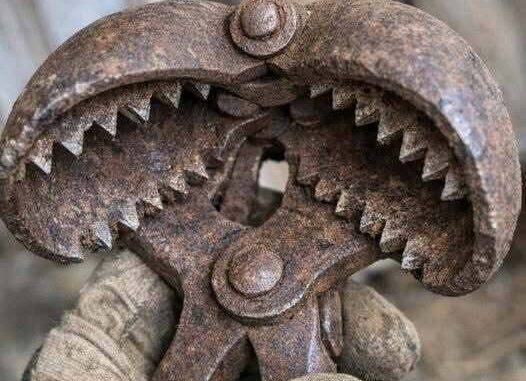
One such discovery has been making rounds online: a heavy iron tool with a hinged body, curved jaws, and jagged inner teeth. At first, it appears intimidating—something closer to a trap or industrial clamp than a household implement. But despite its strange appearance, this object once played a very practical and important role in everyday farm life.
It turns out this mysterious item is a handheld corn sheller, a simple but highly effective tool that helped farmers remove kernels from dried corn cobs long before modern agricultural machines took over.
A Forgotten Tool From a Different Era
Before grocery stores stocked corn in cans, frozen bags, or vacuum-sealed packages, corn processing was entirely manual. Families who farmed relied on the crop not just for food, but also for livestock feed, seed saving, and even trade. After harvest, one of the most time-consuming tasks was removing kernels from dried cobs.
Today, that process is done quickly with industrial machines. But in earlier rural communities, it required patience, effort, and repetitive hand work. To reduce this labor, farmers used specially designed tools like the corn sheller.
These handheld devices were compact, durable, and built for efficiency. They allowed a person to strip kernels from a cob in a fraction of the time it would take by hand.
Why the Tool Looks So Unusual
The confusion around this object comes from its design. The hinged jaws and inner jagged teeth can easily be mistaken for something more aggressive or industrial. However, every feature served a specific agricultural function.
The curved interior was shaped to match the form of a corn cob. The rows of teeth weren’t sharp like blades—instead, they were rounded and positioned to slide between kernel rows. Rather than cutting, they worked by gripping and loosening the kernels as pressure and twisting motion were applied.
From a modern perspective, the tool looks strange because it reflects a time when mechanical solutions were built for single, very specific tasks. There was no need for multipurpose design—just practicality.
How a Handheld Corn Sheller Was Used
Using the tool was straightforward, but effective. Farmers typically followed a simple routine:
First, the corn had to be properly dried. Fresh corn is too soft, and the kernels don’t separate easily. Drying made the cobs firm and prepared them for processing and long-term storage.
Next, a dried cob would be placed inside the curved jaws of the sheller. The interior teeth would align with the rows of kernels.
Then the user would squeeze the handles while rotating or pulling the cob through the device. This motion allowed the teeth to catch under the kernels and pop them free in strips.
Finally, the kernels would fall into a container—often a bucket or sack—ready for storage or further use. The empty cob was rarely wasted and could be repurposed as animal bedding, fuel, or compost.
Why It Was So Valuable on Farms
Corn has always been one of the most important crops in rural agriculture. It served multiple purposes: feeding livestock, producing flour and meal, and providing seed for the next planting season. Because of this, harvesting and processing corn was a major seasonal task.
Without tools like the sheller, families would have had to remove kernels entirely by hand, which was slow and exhausting work. During peak harvest periods, hundreds or even thousands of cobs might need processing.
The handheld sheller dramatically reduced this workload. It wasn’t a luxury—it was a practical necessity that saved time and physical effort, especially in households where every pair of hands mattered.
Built for Strength and Longevity
One reason these tools are still found today in barns and sheds is their incredible durability. Most were made from cast iron or forged steel, materials chosen specifically to withstand heavy, repeated use.
Unlike modern disposable tools, these were designed with longevity in mind. Farmers depended on their equipment daily, so reliability mattered more than comfort or aesthetics.
Even after decades of storage, many of these shellers remain structurally intact. Surface rust is common, but the core mechanism often still works, a testament to the craftsmanship of the time.
Why Old Farm Tools Become Mysteries
As farming modernized, tools like the corn sheller slowly disappeared from daily use. Machines replaced manual labor, electricity replaced hand-powered devices, and agricultural practices became more industrialized.
At the same time, rural populations shifted, and knowledge of older tools began to fade. Items that once had clear, essential purposes were left behind in barns, sheds, and storage spaces.
Without context, their original function is no longer obvious. That’s why many people today misidentify them as traps, kitchen gadgets, or unrelated mechanical parts.
What was once a common household tool has now become a historical puzzle.
A Glimpse Into Practical Innovation
What makes the corn sheller interesting is not just its function, but the simplicity behind its design. It didn’t require electricity, fuel, or complicated maintenance. It solved a very specific problem using basic mechanical principles.
This kind of innovation reflects a different mindset—one focused on efficiency through simplicity. Instead of complex machinery, people relied on clever shaping, leverage, and repetition to achieve results.
It’s a reminder that many effective inventions in history were born from necessity rather than technology.
From Tool to Collectible
Today, antique corn shellers are no longer essential farming equipment, but they have found new life among collectors, historians, and farmhouse decorators.
Some are restored and displayed in agricultural museums, while others are kept as rustic decor pieces that represent rural heritage. Depending on age, condition, and markings, certain models can even hold collectible value.
Beyond monetary worth, they serve as physical reminders of a time when farming was slower, more manual, and deeply tied to everyday survival.
Final Thoughts
What might look like a strange, heavy iron object in an old barn is actually a piece of practical agricultural history. The handheld corn sheller represents a time when simple tools made a significant difference in daily life, helping families process food more efficiently and sustain themselves through hard work.
It may no longer be part of modern farming, but its design and purpose still tell an important story—one of ingenuity, practicality, and adaptation.
So the next time an unfamiliar tool appears in an old shed or barn, it’s worth taking a closer look. It might not be a mystery at all, but rather a forgotten solution that once made everyday life a little easier, one kernel at a time.
Leave a Reply