Michael left the clinic that day with absolute confidence, the kind that only comes from believing you’ve eliminated uncertainty from your life. The vasectomy had been, in his mind, a final solution—clean, irreversible, and proof that he controlled every outcome that mattered.
I remember how calm he looked afterward. Almost relieved. Like he had closed a chapter of life he never intended to revisit.
I wanted to believe him.
I wanted to believe in certainty too.
In a life that didn’t suddenly change direction without warning.
But life rarely asks permission.
Two months later, everything I thought was stable collapsed in the smallest, quietest moment imaginable.
I was sitting on the bathroom floor, still half-dressed, holding a pregnancy test between trembling fingers. I had taken it without expectation—more out of habit than hope. My mind had already prepared itself for a negative result.
But the test didn’t agree with my assumptions.
Two lines.
Clear. Undeniable. Real.
For a moment, I couldn’t even breathe properly. It felt like my body had forgotten how.
And then came the second shock—the deeper one.
Because this wasn’t just a pregnancy.
It was a complication of certainty. Of misplaced trust. Of a man who refused to follow through with medical guidance because he believed inconvenience was the same thing as unnecessary.
I knew I had to tell him.
I didn’t expect comfort.
I didn’t expect celebration.
But I also didn’t expect what came next.
When I told Michael, I saw the exact moment his interpretation replaced reality.
Confusion first.
Then rejection.
Then anger.
And finally, accusation.
“No,” he said flatly. “That’s not possible.”
And just like that, I stopped being a partner in his eyes and became a problem he needed to explain away.
He didn’t ask questions.
He didn’t consider medical failure.
He didn’t think about follow-ups or statistics or the fact that no procedure is absolute without confirmation testing.
He chose the easiest story instead.
He chose betrayal.
By the end of the conversation, he had already decided I had been unfaithful.
Not because of evidence.
But because it allowed him to avoid responsibility.
He left that same day.
No discussion.
No attempt to understand.
Just packing, silence, and the sound of a life being rewritten without my consent.
Two weeks later, I learned he had moved in with Natalie.
The coworker who always smiled a little too quickly at him. The one who always called herself “neutral” in our arguments. The one who had been close enough to watch our relationship crack—and close enough to step into the space it left behind.
It didn’t feel like a surprise.
It felt like confirmation of a pattern I had ignored for too long: how quickly he replaced discomfort with escape.
While he rebuilt his life elsewhere, I stayed in mine.
Only now it wasn’t just mine anymore.
And that realization changed everything.
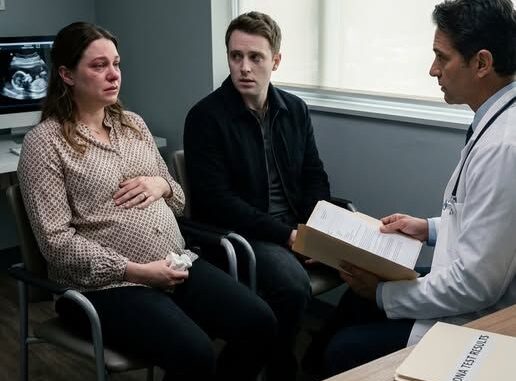
The doctor’s office was where the truth finally stopped being negotiable.
I remember the sterile light, the soft hum of machines, the way everything felt too calm for what was about to be revealed.
The doctor studied the screen longer than I liked.
Then he spoke.
“Anna… I need you to look at this carefully.”
My stomach tightened instantly.
“There isn’t just one heartbeat.”
Silence.
Then the world shifted.
Two.
Not one.
Two separate, steady flickers on the monitor.
Two lives.
Two undeniable confirmations that something had not gone according to plan—medically, not morally.
The doctor continued explaining, but I barely heard him. Something about failure rates, follow-up testing, rare but documented cases.
All I could think was that Michael had skipped everything he was supposed to do after the procedure. He had treated medical advice like an optional inconvenience.
And now I was the one living inside the consequences.
The months that followed were not dramatic in the way people expect stories like this to be.
There were no loud confrontations.
No dramatic returns.
No sudden apologies.
Just silence.
And endurance.
My mother became my anchor during that time. She didn’t ask me to justify anything. She didn’t offer speeches or forced optimism. She simply showed up, again and again, until I stopped feeling like I was falling.
Slowly, something else replaced the shock.
Clarity.
Not bitterness—clarity.
I stopped waiting for Michael to understand.
I stopped rehearsing conversations that would never happen.
And I started preparing for the two lives growing inside me.
When the twins were born, everything changed again—but this time in a way that didn’t break me.
It rebuilt me.
Holding them for the first time erased every remaining illusion I had about the past. Whatever had happened between adults suddenly felt smaller in comparison to the reality of two fragile, breathing lives depending entirely on me.
I didn’t call Michael.
I didn’t update him.
I didn’t chase explanations.
I focused on survival, routine, and healing.
But life has a way of delivering consequences without permission.
And eventually, the truth reached him anyway.
He showed up without warning.
Standing in my mother’s living room like a man trying to enter a world he no longer belonged to.
He looked smaller than I remembered. Not physically—but emotionally. Like every assumption he had built his identity on had quietly collapsed.
In his hands, a stuffed giraffe.
A gesture that felt painfully late.
He didn’t speak right away.
He just looked at the cribs.
At the two children he had once insisted were impossible.
And something in him broke.
He cried before he even asked to hold them.
I let him.
Not because he earned it.
But because they deserved to see the truth for themselves someday, without my anger standing in the way.
He held them like something fragile and unfamiliar. Like he was afraid they might disappear if he moved too quickly.
And maybe, in a way, he knew they already had—at least the version of their life that included him as a certainty.
I didn’t comfort him.
I didn’t soften the moment.
I didn’t offer forgiveness as a shortcut to ease his guilt.
Because forgiveness, I realized, is not something you owe to someone who chose certainty over responsibility.
It is something you give only when it doesn’t erase your own truth.
That day, I made a different kind of decision.
Not about him.
About us.
I looked at my children and made a quiet promise:
Their life would not be shaped by someone else’s refusal to face reality.
It would be shaped by stability.
Honesty.
And a mother who learned the hard way that belief is not the same thing as proof.
Michael left that day carrying nothing but regret.
And I stayed.
Carrying everything that mattered.
After that day, life didn’t suddenly become easy. It became quieter in a different way—less chaos from the past, but more responsibility in the present. The kind that doesn’t leave room for distraction.
There were nights when exhaustion pressed down so heavily that even simple tasks felt distant. Bottles, diapers, laundry, medical checkups—everything moved in cycles that didn’t care about emotional timing. The world kept going, whether I felt ready or not.
And still, in those repetitive routines, something steady began to form.
A rhythm.
A sense that even after betrayal, confusion, and abandonment, life could still organize itself around something real.
My mother often said very little, but her presence filled every gap that silence created. She never revisited the past unless I did first. She never forced forgiveness or pushed me to reinterpret what had happened. Instead, she focused on what was right in front of us—feeding, resting, caring, and simply being there.
That consistency became a kind of healing I didn’t recognize at first.
Michael, meanwhile, became a distant figure in my life—not erased, but no longer central. He existed in memory, in paperwork, in the biological fact that he was connected to my children, but not in their daily reality.
And over time, I stopped waiting for him to become someone different.
Because I finally understood something I had been avoiding for too long: people only change when they choose to, not when circumstances force them to see what they refused to believe.
What mattered now wasn’t the story that broke me.
It was the life I was still building afterward.
Leave a Reply