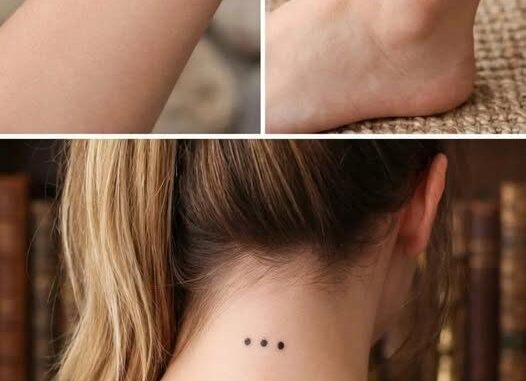
At first glance, the three-dot tattoo may seem extremely simple—almost too minimal to carry any real significance. Just three small marks, often placed in a triangle or a straight line, might not appear meaningful at all.
Yet beneath this simplicity lies a surprisingly deep and layered symbol that has been interpreted in many different ways across cultures, communities, and personal experiences.
What makes the three-dot tattoo so powerful is not its complexity, but its flexibility. Its meaning is not fixed. Instead, it shifts depending on the person who wears it and the story they carry.
Origins and Common Symbolism
One of the most widely recognized interpretations of the three-dot tattoo is its connection to the ancient concept of the Three Wise Monkeys.
This idea is based on a moral teaching centered around self-awareness and restraint:
- See no evil
- Hear no evil
- Speak no evil
While it may sound simple, the meaning is often misunderstood. Rather than encouraging ignorance, it promotes mindfulness—choosing not to engage in negativity, harmful behavior, or destructive communication.
For many people, the tattoo serves as a quiet reminder to live with intention, awareness, and discipline.
In other contexts, the three-dot design also represents unity, loyalty, or belonging within close communities. It can act as a subtle symbol shared between individuals who understand its deeper meaning while remaining unnoticed by others.
This dual nature—personal yet shared—adds to its emotional strength.
A Personal Interpretation of Life and Growth
Beyond cultural meanings, many individuals assign deeply personal significance to the three dots.
A common interpretation is that each dot represents a stage of life:
- The past, shaped by lessons and experience
- The present, grounded in awareness
- The future, filled with hope and direction
Others see it as a symbol of transformation. Each dot can represent struggle, survival, and growth—marking the journey through difficult periods toward strength and resilience.
Some also associate the dots with important relationships, such as family, friendship, and self. In this way, the tattoo becomes a permanent reminder of what truly matters in life.
Unlike detailed or decorative tattoos that tell a specific story, the three-dot design remains open-ended. It invites reflection rather than explanation, allowing meaning to evolve over time.
Cultural Differences and Evolving Meanings
The interpretation of the three-dot tattoo varies widely depending on cultural background and environment.
In some traditions, it is understood as a symbol of life’s journey—often summarized as “my path, my story.” This emphasizes independence and personal growth, highlighting the idea that each person shapes their own destiny.
In other communities, the tattoo is linked to resilience and survival, often representing experiences shared within certain social groups.
Even small design differences can influence meaning. A straight line of dots may suggest continuity, while a triangular arrangement may symbolize balance or connection.
Placement also plays a role. A visible tattoo may represent confidence or openness, while a hidden one may reflect a more private, personal meaning.
Because of this flexibility, the three-dot tattoo rarely has a single definition. It is shaped by context, intention, and personal experience.
Misunderstandings and Public Perception
Despite its simple design and personal meanings, the three-dot tattoo is sometimes misunderstood.
In certain regions or social contexts, it has been associated with subcultures or negative stereotypes. These assumptions, however, do not reflect its true diversity of meaning.
This gap between perception and intention highlights an important issue: symbols can be interpreted differently depending on who is viewing them.
For some wearers, this misunderstanding becomes part of the experience. It reinforces the idea that meaning is personal and cannot always be defined by outside opinion.
It also serves as a reminder that appearances rarely tell the full story of a person’s identity.
The Strength of Minimalist Design
One of the reasons the three-dot tattoo remains so popular is its simplicity.
In a world where tattoos are often detailed and visually complex, minimal designs stand out in a different way. They do not rely on size or detail to communicate meaning.
Instead, they create space for interpretation.
Minimalist tattoos like this encourage curiosity. They do not explain themselves directly, which allows each person to assign their own significance.
This simplicity is also what makes the design timeless. It remains relevant regardless of changing trends in tattoo art.
Historical Influences and Early Symbolism
While modern interpretations are diverse, the use of simple dot markings in body art has existed for centuries.
Many ancient cultures used minimal symbols to represent identity, spirituality, or social meaning. In some traditions, three marks were believed to represent balance between mind, body, and spirit.
In others, they were linked to ancestry, protection, or personal identity.
Over time, these simple markings evolved into modern tattoo culture, adapting to new environments while preserving their symbolic nature.
The three-dot design continues this tradition by maintaining simplicity while allowing endless interpretation.
The Importance of Placement
Where the tattoo is placed often adds another layer of meaning.
Common locations include the hand, wrist, fingers, or ankle.
A visible placement may suggest confidence or a willingness to express identity openly. A hidden placement, on the other hand, often reflects a more private or personal meaning known only to the wearer.
In this way, placement becomes part of the message itself. It influences how the tattoo is experienced both by the individual and by others.
A Symbol of Resilience and Identity
For many people, the three-dot tattoo represents survival and personal strength.
Each dot can symbolize a moment of struggle, a lesson learned, or a turning point in life. Together, they become a quiet reminder of everything someone has overcome.
These meanings are often deeply personal and not immediately visible to others.
The tattoo becomes a form of self-expression that does not need explanation. It exists as a private symbol of endurance, growth, and identity.
Because of its simplicity, it can adapt over time, reflecting different phases of a person’s life.
Why the Three-Dot Tattoo Remains Popular
The lasting appeal of the three-dot tattoo comes from its versatility.
It can represent philosophy, memory, growth, resilience, or personal identity—all within a design that is extremely simple.
Its strength lies in its openness. It does not restrict meaning. Instead, it allows it to expand.
In a world filled with complex visuals and loud expression, the three-dot tattoo stands out for being quiet, subtle, and deeply personal.
The three-dot tattoo is far more than just a minimalist design. It is a symbol shaped by culture, personal experience, and individual interpretation.
Whether it represents life philosophy, personal growth, or emotional resilience, its meaning always goes deeper than what is visible on the surface.
Its simplicity is what makes it powerful.
Because sometimes, the smallest symbols carry the most meaningful stories.
Leave a Reply