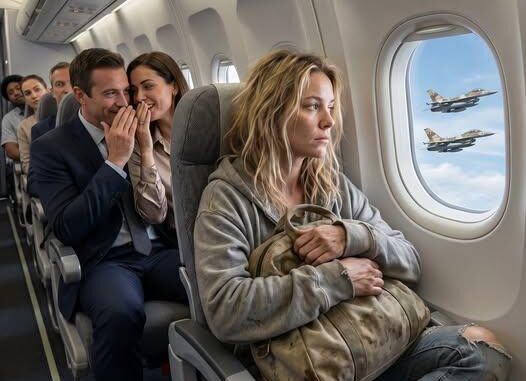
“Water would be fine,” Olivia said, her tone steady, neither warm nor cold.
Sarah nodded quickly, grateful for something simple she could do, and hurried toward the galley. Mark lingered for half a second longer, as if he wanted to say more, then thought better of it and stepped away.
Around them, the cabin slowly began to settle again—but not in the same way as before. The earlier noise had been filled with casual judgment and careless confidence. This quiet felt different. It was heavier, more aware. People weren’t just sitting anymore; they were thinking.
Kayla stared down at her phone, the screen now dark. For once, she didn’t rush to turn it back on. The moment had moved past content. There was no angle that didn’t feel wrong now. She tucked the phone into her bag and sat still, replaying her own words in her head with a kind of discomfort she wasn’t used to.
Sophie, the teenager, leaned back in her seat and pulled her hoodie sleeves over her hands. She kept glancing at Olivia, then looking away quickly, as if eye contact might confirm something she wasn’t ready to face yet. Her mother placed a hand gently over hers, a quiet reminder that some lessons don’t need to be spoken out loud.
Harold remained seated, his eyes still resting on Olivia, though now with something softer than shock—something like respect mixed with relief. He had seen enough years to recognize what the others were just beginning to understand: that moments like this didn’t come often, and when they did, they stayed with you.
Greg said nothing more.
For the first time since boarding, he seemed unsure of how to occupy the space around him. His posture had changed, the easy arrogance gone, replaced by something tighter, more restrained. He looked forward, hands folded, as if trying to make himself smaller without drawing attention to it.
The plane continued its descent.
Outside the window, the fighter jets held formation for a while longer before gradually peeling away, one after the other, their departure just as precise as their arrival. The sky returned to its usual vast emptiness, but the impression they left behind didn’t fade.
Inside, Olivia reached into her tote once more, not for the tag this time, but for the folded letter. She didn’t open it. She simply held it for a moment, her thumb resting along the crease, as if grounding herself in something quieter than everything that had just happened.
She looked out the window again.
Washington was beginning to take shape below—grids of streets, clusters of buildings, the slow, steady approach of something official waiting on the ground. But up here, in this in-between space, she allowed herself a breath.
Not a dramatic one.
Just enough.
When the wheels finally touched down, the cabin erupted into the usual sounds—seatbelts clicking, overhead bins opening, people shifting back into motion. But even that felt different now. No one rushed past 22C. No one jostled for position in the aisle near her row.
They waited.
Not because they were told to.
Because they chose to.
Olivia remained seated until the aisle cleared slightly. Sarah returned briefly, offering a small, genuine smile this time—one without performance or uncertainty. Olivia nodded in return, a quiet acknowledgment.
When she finally stood, she lifted her tote over her shoulder, adjusting the worn strap with practiced ease. The same hoodie. The same sneakers. Nothing about her appearance had changed.
Only the way people saw her.
As she stepped into the aisle, conversations softened. A few passengers met her eyes and offered small, sincere nods. Not admiration exactly. Not even apology in words.
Something simpler.
Recognition.
She moved forward without stopping, without seeking attention, without avoiding it either. Just walking, one step at a time, toward the open door and whatever waited beyond it.
At the front of the plane, Mark stood aside, giving her space without saying anything more. This time, he didn’t try to lead. He understood that wasn’t his place.
Olivia paused briefly at the exit.
Not long enough to make it a moment.
Just long enough to look back once—not at any single person, but at the cabin as a whole.
Then she stepped out.
And just like that, she was gone.
The space she left behind didn’t fill immediately.
People gathered their things more slowly than usual. Conversations started in hushed tones, then stopped again. Some passengers avoided eye contact altogether, while others seemed to be searching for it, unsure of what they would say if they found it.
Greg remained seated longer than most.
Eventually, Derek stood and reached for his bag, hesitating before speaking. “You coming?”
Greg nodded once, but didn’t move right away. When he finally did, it was without the same certainty he had boarded with.
As he stepped into the aisle, he glanced once toward seat 22C.
Empty now.
Just a window, a tray table, and the faint outline where someone had been sitting.
Nothing extraordinary.
And yet, everything about it felt different.
Because the lesson wasn’t about who Olivia Mercer turned out to be.
It was about who she had been all along—before anyone knew her name.
And more importantly, how easily that truth had been ignored.
By the time the last passengers exited the plane, the story had already begun to change—not in facts, but in understanding. It wasn’t just about fighter jets or recognition or a past that few could imagine.
It was about something much closer.
Something quieter.
The realization that respect should never depend on proof.
And that the measure of a person is not revealed in moments of recognition—but in the moments before it.
Leave a Reply