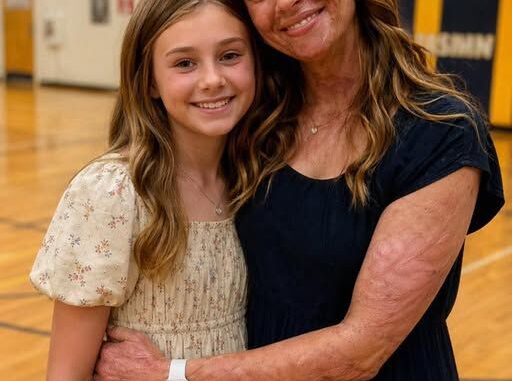
My Daughter Begged Me Not to Come to Her School Because of My Scarred Face – Then a Stranger Walked In and Revealed the Truth I Had Kept Hidden for 20 Years

Every morning started the same way for me.

Before I left for work or stepped out into the world, I would stand in front of the mirror and look at my reflection. It wasn’t just a routine—it was a reminder.

The left side of my face still carried the marks of a fire that happened more than twenty years ago. The scars stretched across my cheek, down my jawline, and faded into my neck in uneven lines. Makeup could soften their appearance, but it could never truly hide them.

Over the years, I learned how to live with people’s reactions. I understood the quick glances, the sudden pauses, and the uncomfortable silence that sometimes followed me into rooms. I also learned the difference between curiosity, sympathy, and cruelty.

Eventually, I told myself I was strong enough not to care.

But I was wrong about one thing.

I didn’t realize how deeply it would affect my daughter.


A Request I Never Expected

My daughter Clara was eleven years old—gentle, thoughtful, and sensitive in ways that made her both kind and vulnerable.

She used to trace the edges of my scars when she was younger and ask innocent questions like, “Does it hurt?” or “How did it happen?”

I always answered calmly, never letting her see how heavy the memory actually was.

But everything began to change one afternoon when I picked her up from school.

She was standing near the school gate with a group of children. I noticed her before she saw me. A boy from her class glanced at my car, leaned toward the others, and whispered something. A second later, laughter broke out.

Clara’s posture changed instantly. Her shoulders tightened, and she walked toward the car without looking up.

The silence in the passenger seat felt heavier than usual.

“What happened?” I asked gently.

“Nothing,” she said quickly.

But I could tell that wasn’t true.

After a long pause, her voice broke.

“Mom… can you please stop coming to my school?”

For a moment, I didn’t respond. I thought I had misunderstood.

But her eyes filled with tears, and I realized she meant it.

“I love you,” she whispered, “but they laugh when they see you. They laugh at me too.”

Those words stayed in the air long after she finished speaking.

When we got home, she finally told me everything. There was a school event coming up—something for families. Students were supposed to invite their mothers and speak about them in front of the class.

Clara had been excited at first.

But then the teasing started.

She told me about whispers in the classroom, about drawings passed between desks, about names she never wanted to hear associated with me.

“Monster mom,” she said quietly.

And worse—“monster’s child.”

I didn’t react immediately. Not because I didn’t feel it—but because I didn’t want her to see me break.

Instead, I asked her a question.

“Do you know how I got these scars?”

She nodded slowly. “From a fire.”

I took a breath.

“That fire happened when I was sixteen,” I said. “A building caught fire in the middle of the night. People were running out, but I heard children screaming upstairs.”

Clara looked at me carefully now.

“I went back in,” I continued, “because I couldn’t leave them.”

My voice lowered.

“I carried them out. But the fire… took part of my face before I made it out.”

Clara didn’t speak.

So I added softly, “I didn’t lose my face because something bad happened to me. I lost it because I refused to walk away.”


A Decision That Changed Everything

The next morning, I made a decision.

I would go to the school.

Not to argue.

Not to defend myself.

But so my daughter would never feel ashamed of the truth again.

Clara didn’t want me to go. She was scared it would make things worse.

But I told her something simple.

“I would rather face discomfort than let you carry shame for something you didn’t cause.”

That morning, I dressed carefully. I wore a navy dress I reserved for important days. I tied my hair back neatly and stood in front of the mirror a little longer than usual.

My mother watched me from the doorway.

“Are you sure about this?” she asked.

I nodded.

“If my daughter is being hurt because of me, I can’t stay silent.”

She sighed softly. “Then go and make sure they understand the truth.”


The School Event

When we arrived at the school, Clara held my hand tightly. I could feel her nervousness through her grip.

The auditorium was already filled with families. Rows of folding chairs were arranged facing a small stage.

Whispers followed us as we entered. I didn’t need to hear the words to understand their tone.

One by one, students were called up. They spoke about their mothers with pride—about meals cooked at home, bedtime stories, kindness, and love.

Clara sat beside me, frozen.

When her name was finally called, she didn’t move.

I stood first.

And held out my hand.

She hesitated for a moment, then took it.

As we walked toward the stage, something struck my shoulder. A crumpled piece of paper fell to the floor.

I picked it up.

Inside was a drawing of a face—distorted, exaggerated, marked with scars.

Clara flinched beside me.

A voice from the back of the room called out something cruel. Laughter followed.

My chest tightened, but I kept walking.


Speaking the Truth

On stage, I took the microphone.

My hands were steady, even if my heart wasn’t.

“I’m Clara’s mother,” I began.

The room quieted slightly.

“These scars are not something I am ashamed of. But I am ashamed that my daughter has been made to feel ashamed of them.”

A hush spread across the audience.

Then I told them about the fire.

About the children I saved.

About the choice I made when I was sixteen—to run into danger when others were running out.

I didn’t raise my voice. I didn’t need to.

The truth carried itself.

And then something unexpected happened.

The school doors opened.

A man walked in quickly, his expression urgent.

He stepped into the aisle, and something about him felt familiar.

He was Clara’s music teacher.

His name was Scott.

He stopped near the stage.

And then he spoke.

“She didn’t just save three children that night,” he said.

The room went still.

“She saved me too.”


The Truth Revealed

Scott continued, his voice shaking slightly.

“I was one of the children trapped in that building,” he said. “She went back in after the firefighters told her not to.”

I closed my eyes briefly.

I hadn’t expected this moment to resurface here.

He looked at me.

“You carried me out,” he said. “You saved my life.”

Silence filled the room.

No laughter. No whispers.

Just stillness.

Scott turned to the audience.

“She asked my family not to make it public,” he said. “She didn’t want me to grow up thinking my survival came at someone else’s cost.”

Clara turned toward me slowly.

For the first time that day, she didn’t look embarrassed.

She looked stunned.

I knelt in front of her.

“I didn’t tell you everything,” I said softly, “because I didn’t want my scars to define me in your eyes.”

Her lips trembled.

“I was ashamed,” she whispered.

I shook my head immediately.

“No. You were hurting. That’s different.”


After the Silence

The room eventually shifted.

The tension softened.

Apologies were whispered.

Some heads were lowered.

And slowly, applause began—uncertain at first, then growing stronger.

After the event, Clara refused to let go of my hand.

On the drive home, she stayed quiet for a long time.

Finally, she asked, “Why didn’t you tell me everything?”

I thought for a moment.

“Because I didn’t want you to see me as something broken,” I said. “I wanted you to see me as your mother first.”

She nodded slowly.

“I think I saw the wrong thing,” she said quietly.

“No,” I replied. “You saw what you were taught to see. Now you know more.”


A New Understanding

That evening, Clara stood behind me as I removed my earrings in front of the mirror.

She studied my reflection.

“Do you still hate your scars?” she asked.

I paused.

“No,” I said. “Some days I forget they’re even there. Some days I still feel them. But they remind me I survived something I didn’t think I would.”

I turned toward her.

“And now,” I added softly, “they remind me that you understand me again.”

Clara hugged me tightly.

And for the first time in a long time, I felt like we both saw the same truth.


Final Reflection

For years, I believed my scars were the hardest part of my life.

But I was wrong.

The hardest part was watching my child misunderstand them before she understood me.

And the most healing part was realizing that love didn’t disappear when the truth was finally seen—it grew stronger because of it.

Sometimes, what we try to hide isn’t what hurts us most.

It’s the fear that others will never understand it.

And sometimes, all it takes is the truth—spoken at the right moment—to change everything.

Be the first to comment

Leave a Reply

Your email address will not be published.


*