Coins are among the most familiar objects in everyday life. They pass through countless hands, settle into pockets, collect in jars, and appear in small, routine transactions. Because they are so common, it’s easy to overlook the details that define them.
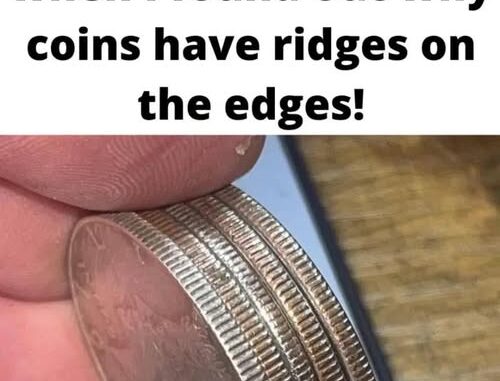
Yet one small feature stands out the moment you pay attention. Along the edge of many coins, there is a pattern of tiny grooves—precise, evenly spaced, and clearly intentional. Most people have felt them without thinking twice.
But those ridges are far from decorative. They are the result of a practical solution to a very real problem—one that once threatened the reliability of entire monetary systems.
To understand their purpose, it’s necessary to go back to a time when coins were fundamentally different from the ones we use today.
When Coins Were Made of Real Value
In earlier centuries, coins were not just symbolic representations of money. They were made from precious metals such as gold and silver, meaning their value was tied directly to their physical composition.
A silver coin wasn’t simply worth a certain amount because a government declared it so—it was worth that amount because of the silver it contained.
While this gave coins a tangible and reliable form of value, it also introduced a vulnerability. If someone could remove even a small portion of that metal, they could reduce the coin’s true worth without immediately changing its appearance.
This created an opportunity for a specific type of fraud that became surprisingly widespread.
The Practice of Coin Clipping
One of the most common financial crimes in early modern Europe was known as coin clipping.
The method was simple. Individuals would take coins and shave off small amounts of metal from their edges. Each individual shaving was tiny—barely noticeable—but over time, these fragments could be collected, melted down, and reused or sold.
The altered coins would then continue circulating as if nothing had changed. To most people, they still looked valid. They still functioned as currency.
But in reality, each clipped coin represented a loss of value.
At first glance, the impact might seem minor. But when repeated across thousands of coins, the effect became significant. The overall value of circulating currency began to decline, even though the number of coins remained the same.
This created a growing problem. Trust in money started to weaken. Merchants became cautious. Governments faced financial strain.
The issue wasn’t just theft—it was a gradual erosion of confidence in the system itself.
Why It Was Hard to Stop
Stopping coin clipping proved difficult for several reasons. The changes made to each coin were small, making them hard to detect. A slightly reduced edge might not stand out unless closely examined.
Authorities attempted to deter the practice through strict laws and severe punishments. But enforcement alone wasn’t enough. The crime continued because it was easy to carry out and difficult to prove.
As long as coins had smooth edges, the opportunity remained.
Eventually, it became clear that solving the problem required more than punishment. It required a change in design.
A Shift Toward Prevention
In the late 17th century, efforts to reform currency systems began to take shape. One of the key ideas was to make coins resistant to tampering by altering their physical structure.
Instead of leaving edges smooth, coins were produced with ridged patterns along their sides. These became known as reeded edges.
The concept was simple but highly effective.
With a consistent pattern in place, any attempt to shave off metal would disrupt the grooves. Even a small alteration would be noticeable. A clipped coin could no longer pass easily as normal.
This transformed the coin into something more than just a unit of currency—it became a built-in security device.
The brilliance of this solution was its simplicity. It didn’t rely on complex systems or constant monitoring. It worked by making tampering visible.
A Lasting Design Choice
Although modern coins are no longer made from precious metals in the same way, the ridged edges have remained a standard feature in many currencies.
There are several reasons why this design has endured.
One important factor is verification. Machines that handle coins—such as vending machines, ticket dispensers, and counting systems—often rely on physical characteristics to identify authentic currency. Edge patterns help ensure accuracy in these processes.
Another reason is accessibility. For individuals who are blind or visually impaired, the texture of a coin’s edge can help distinguish between different denominations. By feeling the ridges, users can identify coins without needing to see them.
What started as a security feature has become a practical tool that supports everyday use.
Why Some Coins Are Smooth
Not all coins have ridged edges. Lower-value coins are often smooth, and this choice is rooted in historical practicality.
Because these coins contain little intrinsic material value, there was never a strong incentive to clip them. Shaving small amounts of metal from such coins would not produce meaningful profit.
As a result, adding ridges was unnecessary.
This distinction created a subtle pattern within currency systems—higher-value coins tended to have ridges, while lower-value ones remained smooth.
Even today, this difference can still be observed in many countries.
An Everyday Feature with a Hidden Purpose
What makes coin ridges particularly interesting is how easily they go unnoticed. They are present in daily life, yet rarely considered.
Most people don’t question why coins feel the way they do. The grooves are simply part of the object.
And yet, they represent a thoughtful solution to a problem that once had serious economic consequences.
Before modern technology introduced digital security measures, this was an early example of embedding protection directly into a physical design.
It demonstrates that effective solutions don’t always require complexity. Sometimes, a simple adjustment can address a problem at its source.
A Broader Lesson in Design
The history of coin ridges reflects a larger principle about problem-solving.
When systems face repeated challenges, solutions often evolve from reactive measures to proactive design. Instead of responding to issues after they occur, designers aim to prevent them altogether.
In the case of coin clipping, punishment alone was not enough. The system needed to change so that the crime itself became easier to detect—or harder to carry out.
By modifying the structure of coins, that goal was achieved.
This approach continues to influence modern design across many fields. Whether in technology, manufacturing, or infrastructure, the idea remains the same: build solutions that address problems before they arise.
A Small Detail with a Big Impact
The ridges on a coin may seem like a minor feature, but they carry significant meaning. They are a reminder of how design can shape trust and stability.
They also show how small changes can have lasting effects. A simple pattern added to the edge of a coin helped protect entire economies from gradual loss.
Today, those grooves continue to serve practical purposes, even as the nature of money has evolved.
Taking a Closer Look
The next time you hold a coin, consider the detail along its edge. Run your finger across the ridges and think about why they are there.
They are not just a design choice. They are the result of a need to protect value, maintain trust, and improve the reliability of a system used by millions of people.
They represent a moment when a small idea solved a large problem.
And they continue to exist as a quiet example of how thoughtful design can endure over time.
Sometimes, the most effective innovations are the ones we barely notice—working quietly in the background, shaping our everyday experiences without demanding attention.
Coin ridges are exactly that: a subtle feature with a powerful history, still doing its job centuries after it was first introduced.
Leave a Reply