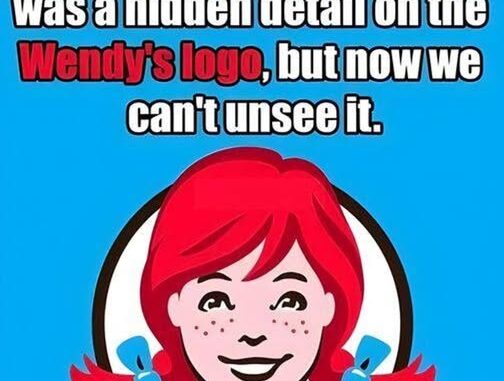
When people think about iconic fast-food branding, few images are as instantly recognizable as the smiling red-haired girl from Wendy’s. With her bright pigtails, friendly expression, and old-fashioned blue dress, the logo has long conveyed warmth and familiarity—something that feels more personal than the typical fast-food experience.
At first glance, the design appears simple and inviting. It doesn’t rely on flashy visuals or aggressive marketing cues. Instead, it leans into something softer—comfort, nostalgia, and a sense of home. For decades, that’s all most people saw.
But over time, a subtle detail hidden in plain sight began to capture attention—and once noticed, it completely changed how many people viewed the logo.
A Small Detail That Sparked Big Curiosity
The discovery didn’t come from a major announcement or redesign. Instead, it emerged quietly, as people began taking a closer look at the logo—specifically the ruffled collar beneath the character’s chin.
Some observers noticed that the folds and lines in the collar seemed to form letters. Not random shapes, but something recognizable: the word “MOM.”
At first, many dismissed it as coincidence. But once the idea spread, it became hard to ignore. The more people looked, the more convincing it seemed. The shapes aligned just enough to suggest intention, even if subtle.
Soon, what had once been an overlooked design element became the center of widespread curiosity.
Why the “MOM” Interpretation Felt So Powerful
Part of what made this discovery resonate so strongly was the emotional weight behind the word itself. “Mom” is more than just a label—it represents care, comfort, and trust. It evokes feelings of home, warmth, and being looked after.
For a fast-food brand, those associations are incredibly valuable.
Fast food is often linked to convenience and speed, not emotional connection. But the idea that Wendy’s logo might quietly include “MOM” suggested something deeper—that the brand was subtly positioning itself as comforting and familiar, almost like a home-cooked meal.
Whether intentional or not, people connected with that idea. It made the brand feel more human.
The Real Story Behind the Brand
The theory gained even more traction because of the company’s origins. Dave Thomas, the founder of Wendy’s, named the restaurant after his daughter, Melinda “Wendy” Thomas.
From the beginning, the brand emphasized a sense of family, quality, and personal care. Unlike competitors focused purely on speed or scale, Wendy’s built its identity around a more approachable and down-to-earth image.
Because of that, the idea of a hidden “MOM” message didn’t feel out of place. It seemed consistent with the brand’s story—even if it wasn’t officially confirmed.
The Role of the Internet in Amplifying the Idea
As soon as the “MOM” detail gained attention, social media took over. People began sharing images, zooming in on the logo, and tracing the collar lines to highlight the hidden word.
What started as a small observation quickly turned into a viral discussion.
Some users were convinced it was intentional—a clever piece of design meant to influence perception subconsciously. Others argued it was simply a coincidence, a case of people seeing patterns where none were intended.
Either way, the conversation spread rapidly, drawing in millions of people who suddenly saw the logo differently.
The Company’s Response—and Why It Didn’t End the Debate
Eventually, Wendy’s addressed the theory. According to the company, the “MOM” detail was not intentionally designed into the logo. The collar was simply meant to be a decorative element, not a hidden message.
Normally, that kind of clarification would settle things.
But in this case, it didn’t.
By the time the statement was released, people had already formed their own interpretations. The idea had taken on a life of its own, and for many, the emotional connection mattered more than the official explanation.
Why People Still Believe in the Meaning
Even after the company’s response, many people continue to embrace the “MOM” interpretation—not because they doubt the statement, but because the meaning feels real to them.
This highlights something important about branding and perception.
Once a design is released into the world, it no longer belongs entirely to its creators. People bring their own experiences, emotions, and perspectives to what they see. In doing so, they create meanings that may go beyond the original intent.
In this case, the logo became more than just a corporate symbol. It became something personal.
The Power of Emotional Branding
The story of the Wendy’s logo is a powerful example of how emotional connections can shape the way people interact with brands.
Companies spend years trying to build trust and familiarity. They carefully craft messages, visuals, and experiences to create positive associations. But sometimes, those connections happen organically.
A small, unintended detail can resonate more deeply than a planned campaign.
The “MOM” interpretation did exactly that. It gave people a reason to feel something when they looked at the logo—and that emotional response is incredibly valuable.
How Consumers Shape Meaning
Another key takeaway is the role of consumers in defining brand identity.
People are not passive observers. They actively interpret what they see, often adding layers of meaning that designers never intended. These shared interpretations can become part of the brand’s story, influencing how it is perceived over time.
In the case of Wendy’s, the audience helped create a new narrative—one that connected the brand to ideas of family and comfort in a deeper way.
Why This Still Matters Today
Years later, the logo itself hasn’t changed. The same smiling face and ruffled collar remain.
But the way people see it has evolved.
For some, it’s still just a familiar fast-food symbol. For others, it carries an added layer of meaning—one tied to warmth, care, and emotional connection.
And that shift in perception is significant.
It shows how even the smallest detail can spark curiosity, conversation, and a lasting impression.
Final Thoughts
The story of the Wendy’s logo isn’t really about whether the word “MOM” was placed there on purpose.
It’s about how people see meaning—even in the smallest details—and how those meanings can grow into something powerful.
In the end, the logo achieved something remarkable. It made people stop, look closer, and think differently about a brand they thought they already understood.
And sometimes, that’s all it takes.
Because meaning doesn’t always come from what’s created—it often comes from how it’s seen.
Leave a Reply