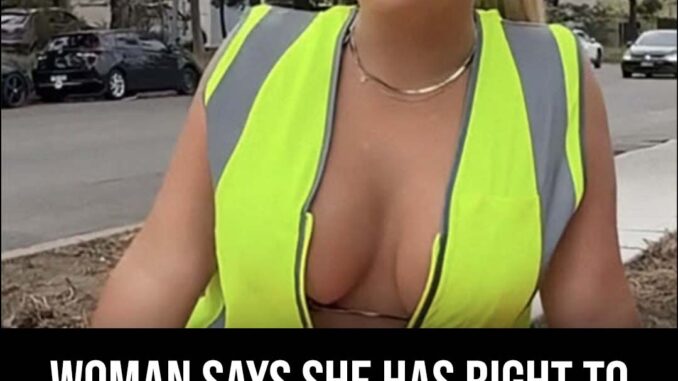
The sun feels merciless on a Sydney construction site where temperatures climb past 40°C, turning steel, concrete, and machinery into sources of relentless heat. Workers wipe sweat from their faces, shirts cling to skin, and exhaustion settles into every movement by midday. For years, one unspoken rule has existed almost unquestioned across many of these worksites: when the heat becomes unbearable, men sometimes strip their shirts off and keep working. Nobody stares twice. Nobody calls it distracting. It’s treated as practical, ordinary, even expected.
But the moment a female landscaper challenged that same freedom, the conversation exploded far beyond the job site itself.
Shianne Fox — widely known online as “The Bikini Tradie” — ignited a viral firestorm after criticizing what she described as a blatant double standard. According to her, women working under the same brutal conditions are expected to remain fully covered while shirtless men move freely around them without consequence. To Fox, the issue is painfully simple: if extreme heat justifies comfort and practicality for men, then women should be trusted with the same choice. She argues that bodies are natural, the Australian sun is dangerous, and equality should not stop at symbolic slogans when real physical conditions are involved.
Her videos spread rapidly across TikTok and social media, where millions watched the debate unfold in real time. Supporters praised her for exposing hypocrisy they felt people had ignored for years. Some argued that workplace equality means applying the same standards to everyone, not protecting outdated expectations about how women’s bodies should be viewed. Others pointed out that heat exhaustion, dehydration, and sun exposure are legitimate occupational hazards, not abstract political talking points.
For Fox, the argument goes beyond clothing alone. She believes challenging rigid workplace culture could help attract more women into trades industries that have historically struggled with gender imbalance. In her view, normalizing women’s physical presence in demanding outdoor jobs — without shame or excessive scrutiny — is part of breaking down barriers that still make many worksites feel unwelcoming.
But the backlash revealed something far more complicated beneath the surface.
Many female tradies strongly rejected Fox’s position, arguing that the issue cannot be separated from the reality women already face on male-dominated worksites. For them, the concern isn’t only about fairness in theory. It’s about survival within environments where respect often feels fragile and conditional. They argue they have spent years fighting to be taken seriously for their skills, competence, and professionalism rather than being reduced to appearance. In industries where women are already heavily outnumbered, many fear that pushing topless equality could unintentionally reinforce stereotypes they’ve worked desperately to escape.
That tension is what transformed the debate from a simple argument about clothing into something emotionally charged and deeply symbolic.
Some female workers said Fox’s approach risks feeding the exact attitudes that already make job sites uncomfortable for women — the staring, the comments, the constant pressure to prove they belong there for more than novelty. They worry that once attention shifts toward bodies, it becomes even harder to maintain authority and professional credibility in environments where they are already scrutinized more heavily than men.
Their question isn’t merely, “Should women be allowed to go topless too?”
Leave a Reply