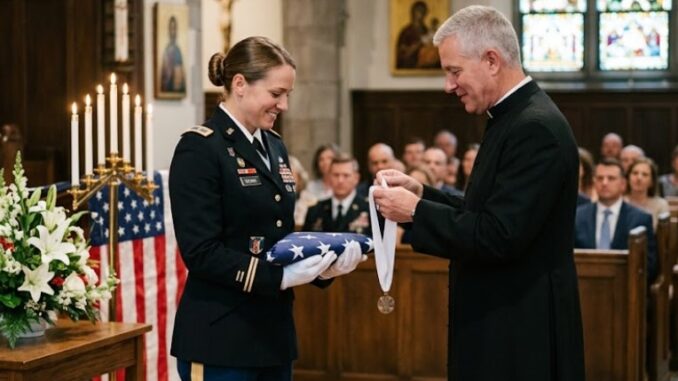
The heavy wooden doors of the church closed behind me, cutting off the low murmur of the mourners gathered inside. Outside, the afternoon sun beat down on the pavement where my stepfather Thomas stood waiting beside his car. He wore a carefully arranged smile, a practiced look of grief that unsettled me far more than open hostility ever could have. To anyone else, he was the devoted patriarch grieving a family loss. But something inside me had fundamentally shifted. The fragile illusion of our family dynamic had shattered, and the heavy sorrow of the day was no longer standing alone. A cold, sharp doubt had entered beside it, sparked by a name whispered to me in absolute confidence just moments before by an elderly family friend: Daniel Mercer.
Before I could voice the flood of questions rising in my throat, the old man had simply nodded once, a solemn gesture honoring a promise made long ago, and walked away into the shadows. That name hung in the air like a phantom. Instead of returning to the family home where Thomas could monitor my movements, I made a sudden decision. I turned away from his waiting car, ignited my own engine, and drove toward the desolate outskirts of town to a bleak facility called Fairview Storage. In my pocket rested a small, tarnished brass key that had belonged to my late mother, an item she had kept hidden from Thomas for decades.
The brass key turned smoothly in the rusted padlock, opening a narrow, climate-controlled unit covered in a thick layer of dust and years of heavy silence. There was no hidden chest of gold waiting inside, nor any dramatic evidence of a violent crime. Instead, the unit contained only a single gray plastic storage bin and a thick, weathered manila envelope. It had been left behind by someone who understood that truth sometimes survives quietly on paper, buried in the dark, long after the people involved are gone. I pulled the envelope from the bin, sat down on the cold concrete floor, and began to read through the contents.
The documents spread across my lap revealed a chilling reality. My biological father, Daniel Mercer, had not simply packed up and abandoned our family following a tragic boating accident, which was the convenient lie I had been fed since early childhood. The deeper truth was slower, colder, and far more calculated. My stepfather Thomas had spent years of his life systematically removing my biological father from every legal and personal record in existence. It was a bureaucratic execution.
Page after page exposed a trail of forged signatures, altered property deeds, and fraudulent financial transfers. Thomas had meticulously manipulated custody documents to create the legal appearance of total abandonment, ensuring my biological father would have no right to ever see me again. It became painfully clear that Thomas had not merely stepped in to fill a void within our household; he had attempted to completely erase Daniel Mercer from history. Some forms of cruelty are loud, chaotic, and reckless, but the cruelty Thomas enacted was patient, administrative, and clinical. It was built through years of quiet manipulation that eventually hardened into accepted family history.
As I sat in the dim light of the storage unit, processing the vast scale of the deception, my phone began to vibrate repeatedly against the concrete. The screen lit up with text messages from Thomas demanding that I come home immediately. The artificial warmth in his previous words had vanished. The urgency in his messages no longer sounded parental or protective. It sounded terrified. He knew the key was gone, and he knew his decades-long lie was on the verge of collapsing.
Buried at the very bottom of the manila envelope lay a small plastic bag. Inside was an old, faded photograph of my father in his military uniform. He stood upright, shoulders squared, carrying the exact same distinct posture that people had often told me I possessed naturally without ever understanding why. Beside the photograph were his military dog tags, the metal worn smooth around the edges from age. I held the cold steel in my palm for a long time, feeling the physical weight of a man I had been taught to forget, before placing the chain around my neck. What I felt in that moment was not a blinding hatred toward Thomas, though a deep anger certainly burned within me. It was something far steadier and more powerful: the quiet realization that a person’s true identity can be buried, distorted, or hidden, but it can never be fully destroyed. Truth has a unique way of surviving in fragments until someone is finally strong enough to face it.
The legal battle that followed lasted for months, dragging my family through a public reckoning. Fraud investigations moved with agonizing slowness, requiring meticulous paperwork, handwriting analysis, and cold evidence rather than raw emotion. Piece by piece, under the scrutiny of investigators, the official records were corrected and Thomas’s false claims were unraveled. My biological father’s name was finally restored to his properties, his military records, and most importantly, to my birth certificate. My true name was restored right alongside his.
My mother’s role in this dark story remained the most difficult piece to accept. Through the uncovered letters and journal entries hidden in the bin, I came to understand that fear can trap a person inside a cage of silence for a lifetime. Thomas had used his financial power and legal manipulation to convince her that she would lose everything, including me, if she ever spoke the truth. That understanding did not erase the profound pain her silence had caused me over the years, but it softened the temptation to reduce her memory entirely to weakness. Human beings often endure complicated loyalties poorly, especially when fear and financial dependence become inextricably intertwined.
When the legal dust finally settled and the final court orders were signed, I packed my belongings and left Savannah behind. I carried far less certainty about the traditional concept of family than I once had, but I also carried something far more honest. Not every inheritance comes in the form of money, real estate, or material wealth. Sometimes the most valuable thing passed down to you is a name, a buried truth, or the rare chance to stop living inside someone else’s distorted version of your life. Ultimately, true peace begins the exact moment you refuse to disappear.
Leave a Reply