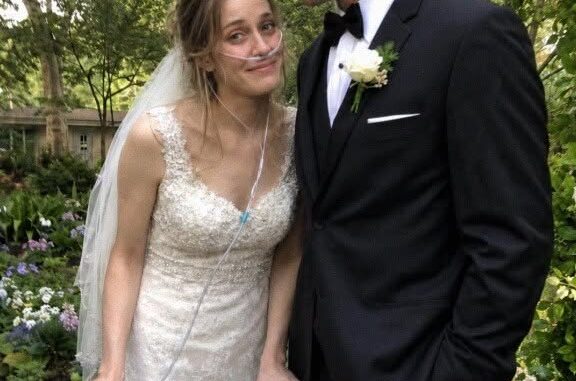
Everything changed the day Daniel said four simple words:
“I can’t do this.”
At first, I thought he meant the diagnosis. The doctors had just explained that my illness was advanced and terminal. The words still didn’t feel real, like they belonged to someone else’s life and not mine. I was sitting at our kitchen table, still wearing the soft sweatshirt he had left behind one night, my tea growing cold in front of me.
Daniel stood near the door with a packed bag. His eyes were red, and his hands kept tightening around the handle like he was trying to convince himself to leave.
For a moment, I genuinely believed he just needed space. That he would step outside, breathe, and come back.
But then he said it again, quieter this time.
“I can’t do this, Serah.”
And I understood.
He wasn’t talking about the illness.
He was talking about me.
The realization didn’t come as shock. It came as a slow collapse, like something inside the room had lost its structure.
“You said we would get through anything,” I said, my voice barely steady.
He looked exhausted. Not angry. Not cruel. Just overwhelmed in a way that made him seem like someone I barely recognized anymore.
“I know,” he said. “I meant it when I said it.”
But intentions didn’t matter anymore.
Because a moment later, he picked up his bag and walked out.
The door clicked shut behind him, and the apartment felt suddenly larger and emptier than it ever had before.
The Wedding That Was Already Paid For
The wedding was only twelve days away.
Everything had already been arranged. My parents had spent months preparing for it—booking the venue, choosing flowers, organizing food for over a hundred guests, and even arranging travel for relatives coming from other states.
My mother had rehearsed her toast more than once. My father had practiced walking me down the aisle like it was a role he needed to get right.
And now none of it made sense anymore.
For three days, I barely left my bed. Not because I was physically unable to, but because there was nothing outside of it that felt real enough to face.
On the fourth night, I opened my closet and looked at my wedding dress.
It was still there, perfectly preserved, untouched.
That was when a thought came to me—strange, uncomfortable, but impossible to ignore.
The wedding didn’t have to disappear.
It just needed a different groom.
I didn’t tell anyone immediately. I didn’t even fully admit it to myself at first. But by morning, I was searching online for something I never thought I would need: a performer for hire.
Someone who could stand in for a ceremony that no longer had a partner.
The Stranger Named Peter
That search led me to an agency that provided event performers. Some worked at corporate functions, others at private events, and a few were available for unusual personal requests.
I chose a profile that seemed simple. A man with calm eyes, a neutral expression, and a presence that didn’t feel intimidating.
His name was Peter.
I wrote him an email I was almost embarrassed to send. I explained that I had been planning my wedding, that my fiancé had left after my diagnosis, and that I wasn’t asking for anything romantic or deceptive.
Only for someone to stand beside me during a ceremony so my family wouldn’t lose the day completely.
I expected him to refuse.
Instead, he replied the next morning.
“I will only agree under one condition,” he wrote.
My heart tightened as I opened the message.
“I will not lie to your family. They will know exactly who I am and why I am there.”
That honesty changed everything. He wasn’t trying to pretend. He wasn’t trying to take advantage of the situation. He simply wanted everything to be clear and respectful.
I agreed.
Meeting Him in Person
When Peter arrived a few days later, he didn’t look like a performer. He looked calm, grounded, and slightly older than I expected.
My parents met him with cautious politeness. My mother asked careful questions. My father watched him closely, like he was trying to understand his intentions without words.
Peter answered everything directly. He didn’t exaggerate anything. He didn’t try to impress anyone.
When my father asked why he had agreed to something so unusual, Peter paused before answering.
“Because sometimes people need a moment that still matters,” he said. “Even when everything else is falling apart.”
That answer stayed with me longer than I expected.
What He Brought Into the Room
Over the next several days, Peter returned to help prepare for the ceremony. We went over details like music, seating, and timing. Nothing about it felt romantic at first. It felt practical, almost distant.
But slowly, something shifted.
He didn’t treat me like someone fragile or broken. He didn’t rush conversations or avoid difficult silence. He simply stayed present.
One afternoon, I admitted something I hadn’t said aloud before.
“I don’t think anyone will ever look at me the same way again,” I said.
Peter didn’t rush to correct me.
He just replied, “Then they were never the right people to begin with.”
It wasn’t a dramatic reassurance. It was simple. Honest. And it stayed with me.
The Day Everything Collided
On the morning of the wedding, I assumed Daniel might appear. Part of me expected an apology. Another part expected nothing at all.
But he did arrive.
He showed up just before the ceremony began, asking to speak to me. My father and Peter both stood between him and the entrance without needing instructions.
When I finally saw him, he looked desperate.
“I made a mistake,” he said.
But mistakes don’t erase choices.
And some choices leave consequences that cannot be undone.
Peter didn’t argue. He didn’t escalate anything. He simply stood quietly beside me, steady and composed, as if reminding me I wasn’t alone anymore.
For the first time that morning, I realized I wasn’t afraid.
Not of Daniel.
Not of the situation.
Not of the wedding changing shape.
I simply wanted it to continue.
And it did.
A Ceremony That Became Something Else
The ceremony itself was not traditional in the way I had once imagined, but it became something more meaningful than I expected.
Peter stood beside me, not as a replacement for what I lost, but as someone who understood the weight of the moment.
When it came time for vows, he spoke honestly—not as a performance, but as a reflection of everything that had happened in the days leading up to it.
“I didn’t expect to be here for anything beyond a simple arrangement,” he said. “But life rarely stays simple when people are involved.”
His voice was steady, but sincere.
“I’ve learned that showing up for someone, even briefly, can mean more than we realize.”
There was no script in that moment. No acting. Just presence.
After the Wedding
The rest of the day unfolded naturally. There was music, food, laughter, and photographs. My parents smiled more than they had in weeks. People danced. People talked. The heaviness that had followed me for days felt lighter, even if only temporarily.
Peter stayed close without overwhelming the space. He never acted like he belonged to the moment. He simply respected it.
When the evening ended, I expected him to leave quietly.
But he didn’t disappear.
He stayed in touch afterward, checking in, helping with small things, and eventually becoming someone I could talk to without hesitation.
Over time, what began as an unusual arrangement turned into something more grounded. Not dramatic. Not sudden. Just steady understanding growing where uncertainty had been.
What I Learned
I don’t tell this story as if everything turned out perfectly. It didn’t. Illness still existed. Loss still existed. And life didn’t suddenly become easy or fair.
But I learned something important.
Sometimes the person who leaves shows you what is missing.
And sometimes a stranger who enters quietly shows you what presence actually looks like.
Not every ending is clean. Not every beginning is planned.
But sometimes, in unexpected ways, life still gives you moments worth holding onto.
And that, in itself, can be enough.
Leave a Reply