The natural world is filled with journeys that often go unnoticed.
Every year, countless birds travel thousands of miles across continents, crossing mountains, rivers, deserts, and coastlines in search of food, breeding grounds, and favorable environmental conditions. While humans have observed these migrations for centuries, many aspects of these remarkable journeys remained a mystery until modern technology provided scientists with new tools for studying wildlife movement.
Among the most fascinating examples are large birds of prey, whose seasonal migrations can span enormous distances and involve complex navigation through changing landscapes. By tracking individual birds over extended periods, researchers have gained valuable insights into migration patterns, habitat use, environmental adaptation, and conservation needs.
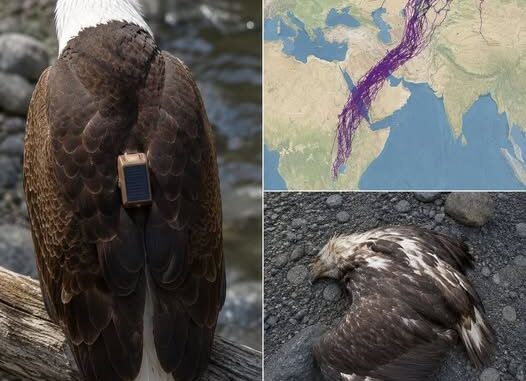
One particularly long-term research effort followed the movements of a single eagle over many years. What initially appeared to be a collection of scattered travel routes eventually revealed a fascinating story about survival, adaptation, and the remarkable capabilities of migratory birds.
The findings not only improved scientific understanding but also highlighted the importance of protecting habitats that support wildlife throughout their journeys.
The Mystery of Bird Migration
Migration has long been one of nature’s most intriguing phenomena.
For centuries, people wondered how birds could:
- Travel such great distances
- Return to the same locations repeatedly
- Navigate unfamiliar terrain
- Adapt to changing weather conditions
- Locate food and resting sites along the way
Before modern tracking technology, many answers remained speculative.
Researchers relied primarily on direct observation, banding programs, and occasional sightings to piece together migration routes.
While these methods provided valuable information, they often offered only fragments of a much larger story.
The Rise of Wildlife Tracking Technology
Advances in technology have transformed wildlife research.
Today, scientists can use tools such as:
- GPS transmitters
- Satellite tracking systems
- Geographic mapping software
- Environmental monitoring data
These technologies allow researchers to monitor animal movements with unprecedented accuracy.
Instead of relying solely on occasional observations, scientists can now follow migration patterns in near real time.
This capability has revolutionized the study of birds, mammals, marine species, and other wildlife.
Following a Single Eagle
Long-term tracking projects are especially valuable because they reveal patterns that short-term studies may miss.
By monitoring a single eagle across multiple years, researchers were able to observe:
- Seasonal migration routes
- Habitat preferences
- Responses to environmental changes
- Travel timing
- Resting locations
- Breeding and wintering behavior
At first glance, the accumulated data appeared complicated.
Thousands of individual location points created intricate maps stretching across vast geographic regions.
The routes seemed unpredictable.
However, closer analysis revealed a remarkable level of consistency and adaptation.
The Challenges of Long-Distance Migration
Migration is far from a simple journey.
Birds face numerous challenges during long-distance travel.
These include:
Weather Conditions
Wind patterns, storms, and temperature fluctuations can influence travel decisions.
Geographic Obstacles
Mountains, deserts, rivers, and oceans present unique challenges.
Food Availability
Migratory birds must locate sufficient food resources throughout their journeys.
Energy Conservation
Efficient travel is essential for survival.
Human Development
Urban expansion and habitat loss can alter traditional migration pathways.
Successfully navigating these factors requires a combination of instinct, experience, and environmental awareness.
Understanding Navigation
One of the most fascinating questions in migration research involves navigation.
How do birds find their way across thousands of miles?
Scientists continue studying this topic, and evidence suggests that birds may use multiple cues, including:
- Sun position
- Star patterns
- Geographic landmarks
- Magnetic fields
- Weather conditions
- Learned experience
Rather than relying on a single navigation method, birds appear to integrate various sources of information as they travel.
This flexibility helps them adapt to changing conditions.
Patterns Hidden Within the Data
When researchers first reviewed years of tracking information, the routes appeared complex and irregular.
However, detailed analysis revealed recurring patterns.
The eagle frequently:
- Returned to similar regions
- Used familiar migration corridors
- Selected specific resting areas
- Adjusted routes based on environmental conditions
These findings demonstrated that migration is neither random nor rigid.
Instead, it reflects a dynamic balance between consistency and adaptation.
Why Long-Term Studies Matter
Wildlife research often benefits from extended observation periods.
Short-term studies may capture only a small portion of an animal’s life cycle.
Long-term tracking provides opportunities to understand:
- Behavioral changes over time
- Environmental influences
- Population trends
- Habitat requirements
- Conservation priorities
The longer scientists observe a species, the more accurately they can identify important patterns and challenges.
Eagles as Indicators of Ecosystem Health
Birds of prey often serve as indicators of broader environmental conditions.
Because they occupy high positions within food chains, changes affecting ecosystems can sometimes become visible through changes in raptor populations.
Researchers monitor these species to assess:
- Habitat quality
- Food availability
- Environmental stability
- Conservation outcomes
Healthy eagle populations frequently reflect healthy ecosystems.
This makes migration studies particularly valuable for conservation planning.
The Importance of Habitat Connectivity
One major lesson from migration research is the importance of connected habitats.
Migratory birds depend on multiple locations throughout the year.
They require:
- Breeding grounds
- Stopover sites
- Feeding areas
- Winter habitats
Protecting only one location is often insufficient.
Conservation efforts are most effective when they consider the entire migration network.
The eagle’s journey highlighted how interconnected these habitats truly are.
How Technology Supports Conservation
Modern tracking technology provides practical benefits beyond scientific curiosity.
Data collected from wildlife tracking programs can help:
- Identify critical habitats
- Guide conservation initiatives
- Inform land management decisions
- Monitor environmental changes
- Support wildlife protection efforts
By understanding where animals travel and what resources they rely upon, conservation organizations can make more informed decisions.
Adapting to Environmental Change
The natural world is constantly changing.
Wildlife species must adapt to:
- Climate variations
- Habitat alterations
- Weather extremes
- Human activity
Migration research helps scientists understand how animals respond to these challenges.
Some species adjust travel timing.
Others modify routes or alter habitat use.
Studying these responses contributes to broader understanding of ecological resilience.
Lessons From a Lifetime of Travel
The eagle’s long journey offered insights extending far beyond one individual bird.
Researchers gained a deeper appreciation for:
- The complexity of migration
- The importance of habitat protection
- The adaptability of wildlife
- The value of long-term monitoring
These lessons apply to many migratory species around the world.
Each tracked animal contributes valuable information that enhances scientific understanding.
Public Interest in Wildlife Research
Stories involving animal migrations often capture public imagination.
People are fascinated by:
- Long-distance travel
- Navigation abilities
- Seasonal movements
- Survival strategies
- Connections between ecosystems
This interest helps generate support for conservation and environmental education initiatives.
When people understand the challenges wildlife faces, they are often more motivated to support protective efforts.
Conservation Challenges in the Modern Era
Despite advances in research, migratory species continue facing numerous challenges.
These may include:
- Habitat fragmentation
- Environmental degradation
- Climate variability
- Human disturbance
- Infrastructure development
Addressing these issues often requires cooperation among multiple regions and organizations.
Migration routes frequently cross national boundaries, making international collaboration especially important.
Why Individual Animals Matter in Research
Studying individual animals can provide surprisingly valuable information.
Each tracked bird offers a unique perspective on:
- Movement behavior
- Habitat use
- Environmental adaptation
- Survival strategies
Although researchers also study populations as a whole, individual stories often reveal details that broader analyses might overlook.
The eagle’s journey served as one such example.
Inspiring Future Research
Scientific discoveries often generate new questions.
As tracking technologies continue improving, researchers can investigate topics such as:
- Migration efficiency
- Climate adaptation
- Habitat selection
- Species interactions
- Conservation effectiveness
Future studies will likely provide even deeper insights into the lives of migratory birds.
The foundation created by earlier research remains essential to these efforts.
What Migration Teaches Us About Nature
Migration reminds us that ecosystems are interconnected.
The well-being of a bird in one location may depend on habitats thousands of miles away.
This interconnectedness highlights the importance of viewing conservation from a broad perspective.
Protecting wildlife often requires understanding entire ecological networks rather than isolated locations.
The eagle’s journey illustrated this principle beautifully.
The Wonder of the Natural World
Perhaps the most enduring lesson from the study is a simple one.
Nature remains remarkably complex.
Even after decades of research, scientists continue uncovering new insights about animal behavior and ecological systems.
Each discovery deepens our appreciation for the intricate relationships that shape the natural world.
The more we learn, the more we recognize how much remains to be understood.
Conclusion
What initially appeared to be a collection of scattered GPS points ultimately revealed a remarkable story of migration, adaptation, and survival. Over many years, researchers followed the movements of a single eagle and gained valuable insights into how migratory birds navigate vast distances, respond to environmental challenges, and depend on interconnected habitats throughout their journeys.
The study demonstrated the power of modern technology to enhance wildlife research while highlighting the importance of long-term observation and conservation planning. More importantly, it reminded us that migration is one of nature’s most extraordinary achievements—a complex process shaped by instinct, experience, and environmental awareness.
As scientists continue exploring the mysteries of wildlife movement, stories like this inspire greater appreciation for the natural world and the remarkable species that travel across it. The eagle’s journey serves as a powerful example of how observation, research, and curiosity can transform seemingly random data into meaningful knowledge that benefits both science and conservation.
Leave a Reply